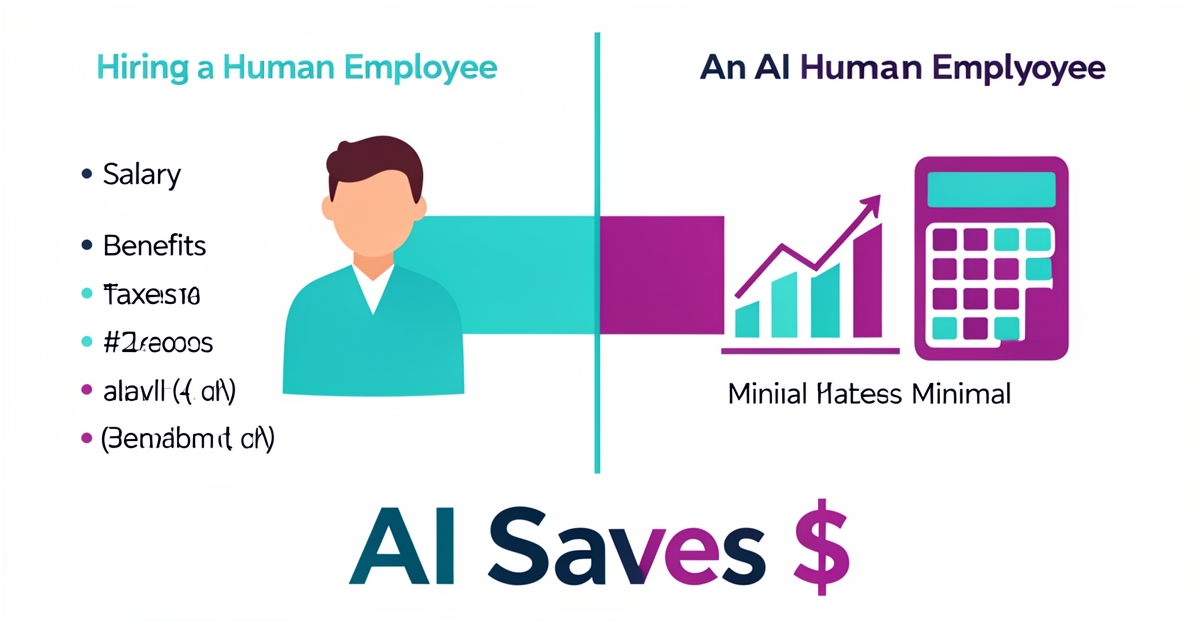
The True Cost of a Human Hire vs an AI Employee: Full Breakdown
Key Facts
- The true cost of a human hire is 1.25-1.4 times their base salary due to benefits, taxes, and turnover according to VenaSolutions.
- AI employees can handle 168 hours per week, compared to a human's 40 hours as noted by MedPhone AI.
- An AI receptionist costs $300–$3,600 per year, while a human receptionist can cost $61,820–$230,470 per year according to CloudTalk.
- AI adoption is projected to become economically viable across more sectors by 2030 as reported by Fortune.
- Replacing an employee can cost 50-200% of their salary, making turnover a significant expense according to Gallup.
- AI receptionists can handle an average of 100 calls per day, compared to 20-30 calls per day for human receptionists as noted by MedPhone AI.
- The cost of hiring a human employee includes an additional 25-35% for benefits and payroll taxes according to VenaSolutions
Hire a team member that works 24/7 — for less than a part-time wage.
AI receptionists, SDRs, dispatchers and 99+ roles. Trained on your business, fully managed.
Not sure where to start? Ask our AI planner
The Hidden Price Tag: Why Your $50K Hire Really Costs $70K
When a business budgets $50,000 for a new receptionist, sales rep, or coordinator, the number on the spreadsheet is rarely the number that shows up on the P&L. The true cost of a human employee runs 1.25–1.4 times base salary once everything is loaded in, according to payroll cost analysis from Vena. That $50K hire is really a $62,500–$70,000 hire before the first workday even begins.
The gap comes from costs most SMBs never itemize. Benefits alone account for roughly 33% of total compensation, and mandatory payroll taxes stack on top of that. Then there's the price of finding the person in the first place: SHRM research puts the average cost-per-hire at $4,700, covering job postings, screening time, and onboarding.
And hiring is only the entry fee. When that employee leaves, the replacement cost hits hard. Gallup's workforce research estimates turnover costs at 50–200% of the departing employee's salary, depending on the role's complexity. For a customer-facing position, a single resignation can wipe out a year of careful budgeting.
The fully loaded picture looks like this:
- Base salary: $35,000–$55,000+ for typical front-office roles
- Benefits and payroll taxes: an additional 25–35% of salary
- Recruiting and training: $3,000–$10,000 per hire
- Turnover exposure: 50–200% of salary every time someone walks out the door
Here's the structural problem: most small and medium-sized businesses budget for salary and stop there. They compare a human hire against an AI alternative using the raw wage figure, not the fully loaded cost. That framing makes human labor look far cheaper than it actually is. When you compare honestly, an AI receptionist runs 2–6% of the cost of a fully loaded human equivalent, per CloudTalk's cost analysis — while covering 168 hours a week instead of 40.
This is the math we walk through with clients at AIQ Labs before recommending anything. The point isn't that humans are always the wrong answer; it's that the comparison has to start from the real number, not the advertised one. Once the fully loaded cost is on the table, the decision about which roles to automate — and which to staff with people — becomes far clearer.
The AI Employee Math: 2–6% of a Fully Loaded Human Hire
The cost of hiring a human employee can be staggering, with the true cost ranging from 1.25 to 1.4 times the base salary due to benefits, taxes, and turnover. In contrast, AI employees, such as AI receptionists, can cost as little as $300 to $3,600 per year, which is 2-6% of the cost of a fully loaded human hire. According to industry research, this significant cost difference is due to the fact that AI employees can work 24/7 without breaks, handling an unlimited number of calls and tasks.
One of the key advantages of AI employees is their scalability and availability. While human employees are limited to working 40 hours a week, AI employees can work 168 hours a week, handling multiple tasks and calls simultaneously. This makes them ideal for high-volume tasks such as reception, scheduling, and customer service. As noted in a recent study, AI receptionists can handle an average of 100 calls per day, compared to 20-30 calls per day for human receptionists.
Some of the key benefits of using AI employees include:
- Cost savings: AI employees can cost up to 90% less than human employees
- Increased scalability: AI employees can handle an unlimited number of tasks and calls
- Improved efficiency: AI employees can work 24/7 without breaks, improving response times and customer satisfaction
As experts note, the cost of hiring a human employee is not just limited to their salary, but also includes benefits, taxes, and recruitment costs. In contrast, AI employees like those offered by AIQ Labs' AI Employee model can provide a cost-effective solution for businesses looking to automate high-volume tasks.
With the ability to work around the clock and handle multiple tasks simultaneously, AI employees are becoming an increasingly popular choice for businesses looking to improve efficiency and reduce costs. As industry leaders note, the cost of AI is expected to decrease significantly in the coming years, making it an even more attractive option for businesses.
Where AI Wins Today—and Where It Doesn't
The rise of AI employees has sparked intense debate about their cost-effectiveness compared to human hires. According to industry research, AI receptionists cost 2-6% of a fully loaded human hire, with annual savings of $58,220-$226,870. This significant cost advantage is driving businesses to adopt AI for high-volume, repetitive tasks.
A recent study found that 78% of businesses use AI for routine tasks, such as scheduling and FAQs, while humans handle complex interactions. This hybrid model is particularly effective in industries like healthcare and legal services, where human judgment and empathy are essential.
However, experts note that AI currently costs more than human workers in some sectors, with a projected tipping point for economic viability by 2030. As inference costs for large language models are expected to drop >90% by 2030, AI is likely to become more cost-effective.
Some key benefits of AI employees include:
- 24/7 availability
- unlimited scalability
- zero turnover risk
These advantages make AI an attractive option for businesses looking to reduce costs and improve efficiency. With the right implementation strategy, businesses can harness the power of AI to drive growth and competitiveness.
As AI technology continues to evolve, it's essential for businesses to stay informed about the latest developments and trends. By leveraging AI solutions, such as those offered by AIQ Labs, businesses can streamline operations and improve customer experiences. With a phased approach to AI adoption, businesses can test the waters and scale up their AI capabilities as needed.
How to Run the Comparison for Your Business
Numbers only matter if you run them on your own business. Here's a practical framework to compare a human hire against an AI employee using your real workflows, not industry averages.
Step 1: Calculate your fully loaded human cost. Start with base salary, then apply the standard multiplier. HR research shows the true cost of an employee runs 1.25–1.4x base salary once you add benefits (roughly 33% of compensation), payroll taxes, and recruitment. A $50,000 hire is really a $62,500–$70,000 commitment. Add turnover risk: Gallup estimates replacing an employee costs 50–200% of their salary, and SHRM puts the average cost per hire at $4,700.
Step 2: Identify high-volume, repetitive workflows. AI earns its keep where volume is high and judgment is low. CloudTalk's analysis found AI receptionists cost 2–6% of a fully loaded human hire, saving $58,220–$226,870 annually. Look for tasks that fit this pattern:
- Call answering, routing, and appointment scheduling
- Lead qualification and intake
- Invoice processing and follow-up
- FAQ and routine customer support
- Data entry and CRM updates
Be honest about what doesn't fit: complex complaints, relational work, and in-person tasks still need humans. Fortune reporting notes AI isn't universally cheaper yet—economic viability varies by role and is projected to improve as inference costs drop. A hybrid model is often the right answer.
Step 3: Test with a phased pilot. Don't bet the payroll on a spreadsheet. Deploy one AI employee in a single defined role, measure real performance against your fully loaded human cost, and scale only what works. AIQ Labs structures this deliberately: the Start Monthly model includes the build, training, integrations, monitoring, and improvements—with the ability to pause or adjust anytime, so a failed pilot doesn't become a sunk cost.
Before you commit to anything, run the two-minute Fit Check at aiqlabs.ai/apply, which leads to a free 30-minute strategy call. You'll get real numbers in writing for your specific role and workflow—no fake price anchors, and if there isn't a clear win, they'll say so. That's how the comparison should work: on your numbers, not someone else's averages.
The Bottom Line: Real Numbers, Not Vendor Promises
Strip out the vendor brochures, and the math is surprisingly consistent. A human hire costs 1.25–1.4x their base salary once benefits, taxes, and recruitment are included, according to workforce cost analysis. An equivalent AI employee runs a fraction of that—which is why AIQ Labs' own comparison lands at 75–85% less for equivalent roles.
But the honest version of this finding comes with a caveat: the savings depend entirely on role fit. The numbers are most dramatic in high-volume, repetitive roles like reception, scheduling, and lead intake. An AI receptionist comparison puts the annual cost at $300–$3,600 versus $61,820–$230,470 for a fully loaded human—roughly 2–6% of the cost. For roles requiring complex judgment, relationships, and in-person presence, the case gets murkier; Fortune reporting notes AI still costs more than human labor in some sectors, with a viability tipping point projected around 2030.
So the decision framework looks like this:
- High-volume, rules-based tasks (answering, routing, scheduling, intake): AI wins decisively, with annual savings of $58,220–$226,870 in receptionist-type roles.
- Hybrid roles: let AI handle the routine 24/7—168 hours a week versus a human's 40, per availability comparisons—while people handle complaints and complex conversations. 78% of businesses already operate this way.
- Turnover-heavy roles: factor in that replacing an employee costs 50–200% of their salary, per Gallup research. AI eliminates that line item entirely.
- Judgment-heavy roles: keep humans, and don't let a 75% savings headline override common sense.
Here's the part no spreadsheet captures: while you're weighing this decision, the missed calls are still coming in. Every unanswered ring after hours is a prospect dialing the next business on the list. The cost of "waiting to decide" isn't zero—it's measured in booked jobs you never see.
The low-risk way to verify the math for your own business is a phased pilot: one AI employee in one defined role, on a flat monthly plan you can pause anytime, so the numbers prove themselves against your real call volume instead of vendor promises. If the fit isn't there, a good partner will tell you that too—before you spend a dollar.
Still paying for 10+ subscriptions that don’t talk to each other?
We build custom AI systems you own outright. No vendor lock-in. Full control.
Not sure where to start? Ask our AI planner
Frequently Asked Questions
How much does a human employee really cost compared to their base salary?
How much cheaper is an AI employee compared to a human?
Are AI employees reliable for high-volume tasks?
What are the hidden costs of hiring a human employee?
Can AI replace human workers entirely?
Is AI adoption worth the initial investment?
Run Your Own Numbers Before Someone Else Runs Them on You
The math in this article comes down to one shift: stop comparing a $50,000 salary against an AI subscription and start comparing fully loaded costs. A human hire really runs 1.25–1.4x base salary once benefits, taxes, and recruitment are in, and turnover can add another 50–200% of salary every time someone leaves. Against that, an AI employee covering 168 hours a week in a high-volume role like reception or scheduling isn't a rounding error—it's a structural difference. But the honest caveat stands: role fit decides everything. Judgment-heavy, relational work still belongs to people. The next step is simple—pick one repetitive, high-volume workflow in your business, calculate what it truly costs you today, and test an AI alternative in that single role before scaling anything. At AIQ Labs, that's exactly how we start: one AI Employee on a flat monthly plan you can pause anytime, with real numbers in writing after a free strategy call—and if there isn't a clear win, we'll tell you. Meanwhile, the phones keep ringing. Start the two-minute Fit Check and find out whether the math works on your numbers, not industry averages.
Make AI your competitive advantage — not just another tool.
Strategy, implementation and ongoing optimization. One partner, end to end.
Not sure where to start? Ask our AI planner