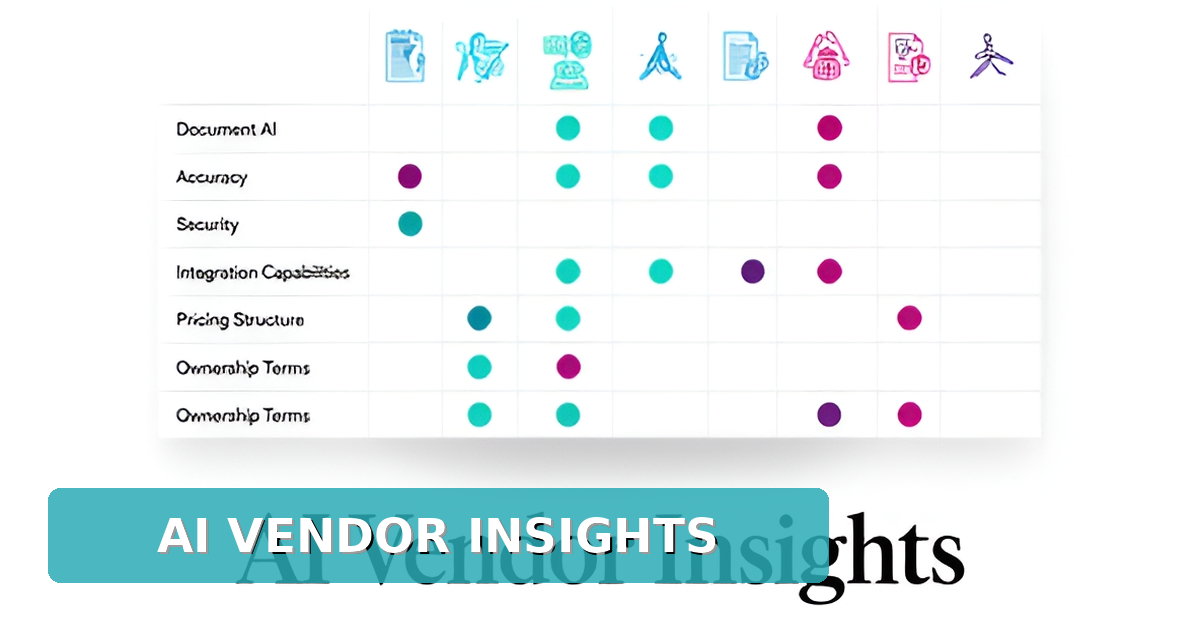
Vendor Capability Matrix for Document Processing Platforms
Key Facts
- IDP market forecasts diverge by 4x, from $7.18B by 2031 to $29.7B by 2033, leaving buyers guessing at direction, per Mordor Intelligence and Grand View Research.
- ABBYY led document AI with 16.20% market share in 2025, while the top five vendors held 42.29% combined, according to GMI's market analysis.
- GenAI-native vendors will progressively displace legacy OCR-centric platforms through 2027, with NLP growing at 22.95% CAGR, per Mordor Intelligence.
- Databricks claims 94.7% accuracy on ~9,000 complex documents, yet its announcement contains no ownership terms at all, per its own blog.
- Mistral itself cautions buyers to read every IDP accuracy figure, including its own, as a starting point for evaluation, not a verdict, per practitioner analysis.
- Self-hosting document AI only breaks even at roughly 50,000–100,000 pages monthly, and only with a dedicated ML engineer, per Digital Applied's build-vs-buy analysis.
- In an AIIM survey of 600 large organizations, data security ranked as the top IDP adoption concern and integration challenges second, per Doxis.
- Specialized healthcare document models reach 98% accuracy and cut deployment from months to weeks, outperforming generic platforms, per Mordor Intelligence.
- Cloud deployment dominates IDP at 63.3% share in 2025, while on-prem persists at ~25% for BFSI and government data sovereignty, per Grand View Research.
Hire a team member that works 24/7 — for less than a part-time wage.
AI receptionists, SDRs, dispatchers and 99+ roles. Trained on your business, fully managed.
Not sure where to start? Ask our AI planner
Why Choosing a Document AI Vendor Is Harder Than Ever
Buying document AI in 2026 means shopping in a market that can't even agree on its own size. Every major research firm pegs the intelligent document processing market above USD 3 billion in 2025, but their forecasts diverge wildly, from a conservative $7.18B by 2031 to a projected $29.7B by 2033. When analysts disagree by a factor of four, buyers are left guessing at the market's direction, let alone the right vendor.
The vendor field itself is crowded and confusing. Legacy OCR players like ABBYY (which held over 16% market share in 2025) sit alongside hyperscaler APIs from Microsoft, AWS, and Google, plus a wave of GenAI-native newcomers. That wave matters: analysts project GenAI-native vendors will progressively displace legacy OCR-centric platforms through 2027, and NLP is growing at a 22.95% CAGR as buyers shift from character recognition to semantic understanding. The technology baseline is moving under everyone's feet.
Then there's the accuracy problem. Nearly every performance number you'll see is vendor self-reported. Databricks claims 94.7% accuracy on complex documents. SER claims more than 99% on key document types. Even Mistral, a company with every incentive to promote its own benchmarks, cautions that its OCR figures should be read as "a starting point for your own evaluation, not a verdict." If the vendor publishing the benchmark tells you not to trust it, that's a signal.
So what should buyers actually evaluate? Beyond marketing numbers, the research points to a few criteria that genuinely separate vendors:
- Semantic capability, not just OCR. Vendors investing in multimodal, NLP-driven stacks are gaining what analysts call a decisive edge over character-recognition-only platforms.
- Vertical tuning. Domain-tuned models routinely outperform generic platforms, specialized healthcare models hit 98% accuracy and cut deployment from months to weeks.
- Security and integration. In an AIIM survey of 600 organizations, data security was the top adoption concern and integration challenges ranked second.
- Ownership terms. Almost no vendor publishes what happens to your code, models, and data, a gap that matters more as subscription costs compound.
That last point deserves emphasis. Research on build-vs-buy economics shows self-hosting only breaks even at roughly 50,000–100,000 pages per month with a dedicated ML engineer, leaving most SMBs stuck choosing between per-document API pricing and managed platform subscriptions. It's exactly why AIQ Labs built its document processing work around custom systems clients own outright rather than metered subscriptions. The rest of this matrix applies these criteria to the vendors actually competing for your document workloads.
The Five Criteria That Actually Predict Document AI Success
Most document AI evaluations fail before the first invoice is processed, not because the technology is weak, but because buyers score the wrong things. Accuracy demos are table stakes; what actually separates a durable deployment from a stalled pilot is a narrower set of criteria.
1. Vertical tuning. Generic platforms impress in demos and underperform on your documents. According to Mordor Intelligence, providers with vertically tuned models are winning buyers who want out-of-the-box accuracy, specialized healthcare models reach 98% accuracy and cut deployment from months to weeks. Domain-tuned accelerators routinely outperform generic platforms, and the vendors that cultivate deep vertical expertise can command premium pricing because CFOs can validate the ROI.
2. Security and compliance as gating conditions. In an AIIM survey of 600 large U.S. and European organizations, data security and privacy ranked as the top adoption concern, with integration challenges second. Treat security as pass/fail: encryption, access controls, data residency, and audit trails are prerequisites for high-value use cases, not checkbox features to compare after accuracy.
3. Integration depth. A document platform that extracts cleanly but can't write into your CRM, accounting, and communication systems just moves the manual work downstream. Ask vendors for proof of two-way integrations with the exact tools you run, and for evidence of what happens when a workflow fails mid-pipeline.
4. Deployment model. Cloud dominates, 63.3% share in 2025 per Grand View Research, and 74.10% per Mordor, but on-prem persists where BFSI and government require data sovereignty. The right answer depends on your regulatory posture, not vendor preference.
5. Total cost of ownership. Per-page sticker prices mislead. Normalized pricing analysis shows managed platforms like Nanonets at $1.20 per invoice versus $0.016 for an OCR API, but self-hosting only breaks even at roughly 50,000–100,000 pages per month, and only with a dedicated ML engineer. Model the full picture:
- Extraction cost per document, including failed and reprocessed pages
- Engineering time for integration, monitoring, and exception handling
- Human review overhead for the accuracy gap the demo didn't show
- Exit costs: who owns the models, code, and data if you leave
That last line is why ownership terms belong on your scorecard alongside accuracy. AIQ Labs builds custom document systems that clients own outright, code, agents, and data, which matters precisely because most managed platforms transfer none of those. Whatever vendor you choose, the decisive factor is rarely the model. It's execution discipline: vendors that make security, human review, and integration manageable within your control environment are the ones that convert pilot interest into production commitments.
Build vs. Buy: The Volume Math Most Vendors Won't Tell You
Ask a document processing vendor what their solution costs and you'll get a demo. Ask what it costs per thousand invoices at your volume and you'll get a pause. The pricing gap between sourcing paths is so wide that the wrong choice can cost a mid-sized business five figures a year, or save them the same.
There are three conventional paths. Managed IDP platforms like Rossum, Nanonets, and ABBYY handle everything but charge accordingly. Raw OCR APIs from Mistral, AWS, Google, and Azure trade convenience for integration work. Self-hosted open-weight models like PaddleOCR-VL and DeepSeek-OCR offer the lowest compute cost but demand engineering talent most SMBs don't have.
The normalized numbers are stark. Per a build-vs-buy analysis normalizing all pricing to a 4-page invoice, Mistral's OCR 4 API runs $0.016 per invoice (dropping to $0.008 in batch), while Nanonets charges $1.20, a 75x spread for overlapping functionality. Rossum's Starter tier runs $1,500/month flat, or $18,000/year, whether you process 500 invoices or 5,000.
The break-even math is where vendors get quiet. Self-hosting only wins at roughly 50,000–100,000 pages per month, and only if you employ a dedicated ML engineer to maintain the models. Cheap managed APIs push that threshold even higher: with a 0.25-FTE engineer, self-hosting doesn't pull ahead until around 50,000 invoices (roughly 200,000 pages) monthly. Compute alone might cost $0.0029 per invoice on an L40S GPU, but the ~$2,291/month part-time engineer erases that advantage fast.
Below break-even volume, most SMBs assume their only options are per-document pricing or an underused platform subscription. There's a fourth path that often goes unmentioned: a custom-built system owned outright. This is the model AIQ Labs works in, architecting document processing and AP automation systems where the client keeps the code, agents, and data, escaping per-invoice fees entirely rather than renting extraction forever.
- **Below ~10,000 invoices/month:** managed platforms or owned custom builds; APIs alone leave integration gaps
- **10,000–50,000 invoices/month:** API-based pipelines or an owned system built on them
- **50,000+ invoices/month with ML staff:** self-hosted open-weight models finally win on cost
One honest caveat: per-invoice costs for custom builds vary by document complexity and scope, so any comparison requires a scoped evaluation against your actual documents, not a list price. As practitioner analysis puts it, build vs. buy is a volume question, not a values question. Run your numbers first; the vendor's pricing page won't do it for you.
The Ownership Gap: What Vendor Matrices Leave Out
Scroll through any published comparison of document AI platforms and you'll find meticulous columns for extraction accuracy, pricing per page, and language support. What you won't find, in any major research source, is a column for who actually owns the code, the models, and the data once the contract is signed. That silence is the single biggest blind spot in vendor evaluation today.
The pattern is consistent across the research. Databricks publishes a detailed 94.7% accuracy benchmark across roughly 9,000 complex documents, yet its materials say nothing about ownership terms. Managed platforms like Nanonets ($1.20 per invoice) and Rossum ($1,500/month flat) are documented in normalized pricing analysis, but always on a per-run or subscription basis, with no ownership transfer mentioned anywhere.
This matters because the industry itself treats accuracy claims cautiously. Mistral's own guidance, echoed in practitioner analysis, tells buyers to read every IDP accuracy figure as "a starting point for your own evaluation, not a verdict." Meanwhile, GMI's market analysis projects GenAI-native vendors will displace legacy OCR-centric platforms through 2027, meaning architecture and ownership questions are becoming more decisive, not less.
What a complete ownership column would cover:
- Code and IP ownership, does the system belong to you, or does it live and die with the vendor's subscription?
- Data rights, who controls your documents, extractions, and training artifacts?
- Exit terms, what happens to your workflows if you cancel or the vendor is acquired?
- Architecture transparency, multi-agent and agentic designs, or a black-box pipeline?
One provider positioning itself squarely against this gap is AIQ Labs. Its "Own It Outright" model, full ownership of code, agents, and data upon completion, is a direct answer to the subscription-dependence that dominates the market. Its LangGraph multi-agent architecture aligns with the GenAI-native shift researchers describe, and its MCP-based integrations plus compliance-first design (audit trails, human-in-the-loop controls) map to the security and integration criteria analysts call gating conditions.
To be clear: these are self-reported company claims, not third-party verified data. No independent research source currently documents ownership terms for any vendor, including AIQ Labs. Treat this as market-context positioning, not a head-to-head scorecard, and demand the same ownership clarity from every vendor you evaluate.
How to Run Your Own Vendor Evaluation in 30 Days
A capability matrix is only as good as the evidence behind it, and every accuracy figure you'll encounter is vendor self-reported. Mistral itself cautions buyers to read every IDP accuracy number "as a starting point for your own evaluation, not a verdict" (Digital Applied). So run your own test, on your own documents, in 30 days.
Week 1–2: Test on your actual documents. Pull 200–500 representative samples, the messy ones, not the clean scans. Handwriting, legacy scans, and multi-column layouts remain hard for every model on the shelf, so include them deliberately. Score each vendor on extraction accuracy against your ground truth, not their marketing claims.
Week 2–3: Demand ownership and data terms in writing. Ask every vendor who owns the models, the extracted data, and the code. Most managed platforms are priced per-run with no ownership transfer mentioned, and Databricks' own accuracy announcement (94.7% on ~9,000 complex documents) contains no ownership terms at all. If it isn't in the contract, assume you don't own it.
Week 3: Apply gating criteria before scoring anything else. An AIIM survey of 600 large organizations found data security and privacy was the top adoption concern, with integration challenges second. Treat both as pass/fail:
- Security and compliance: encryption, access controls, data residency, audit trails
- Integration depth: two-way API connections to your CRM, accounting, and scheduling systems
- Human-in-the-loop controls and escalation paths for exceptions
- Vertical tuning for your document types, specialized models reach 98% accuracy and deploy in weeks, not months
Week 4: Model total cost at your real volume. Published pricing varies enormously: normalized per 4-page invoice, Mistral OCR 4 runs $0.016 while Nanonets runs $1.20 and hyperscaler APIs $0.040 each. Self-hosting only breaks even at roughly 50,000–100,000 pages per month, and only with a dedicated ML engineer. Run your actual monthly page count through each model before shortlisting anyone.
If you'd rather pressure-test the build path before committing, AIQ Labs offers a structured way to do exactly that. Start with the two-minute Fit Check at aiqlabs.ai/apply, then book a free 30-minute strategy call with an AI engineer to map your document bottlenecks and identify the highest-ROI automation. You'll get real numbers in writing, and an honest "no" if there isn't a clear win.
Still paying for 10+ subscriptions that don’t talk to each other?
We build custom AI systems you own outright. No vendor lock-in. Full control.
Not sure where to start? Ask our AI planner
Frequently Asked Questions
How much does document AI actually cost per invoice?
At what document volume does it make sense to self-host instead of buying?
Can I trust the accuracy numbers vendors publish?
What criteria matter most when comparing document AI vendors?
Do document processing vendors let me own the code, models, and data?
Is the document AI market moving away from traditional OCR vendors?
The Bottom Line: Own the Questions Before You Own the System
Choosing a document AI vendor in 2026 is less about finding the most impressive accuracy claim and more about asking the questions vendors hope you skip. Every benchmark you'll encounter is self-reported, even Mistral tells buyers to treat its own numbers as "a starting point for your own evaluation, not a verdict." The criteria that actually predict success are vertical tuning, security and integration as pass/fail gates, honest volume math on total cost of ownership, and the ownership question almost no vendor will answer in writing: who keeps the code, models, and data if you leave? For most SMBs below the 50,000–100,000 pages-per-month self-hosting break-even, the real choice isn't build versus buy, it's renting extraction forever versus owning a system outright. That's the gap AIQ Labs built its "Own It Outright" model to fill. Your next step is simple: run the 30-day evaluation on your own messy documents, and demand ownership terms in writing from every vendor on your shortlist. If you'd like to pressure-test the owned-build path first, start with the two-minute Fit Check at aiqlabs.ai/apply, then book a free 30-minute strategy call with an AI engineer. You'll get real numbers in writing, and an honest "no" if there isn't a clear win.
Make AI your competitive advantage — not just another tool.
Strategy, implementation and ongoing optimization. One partner, end to end.
Not sure where to start? Ask our AI planner