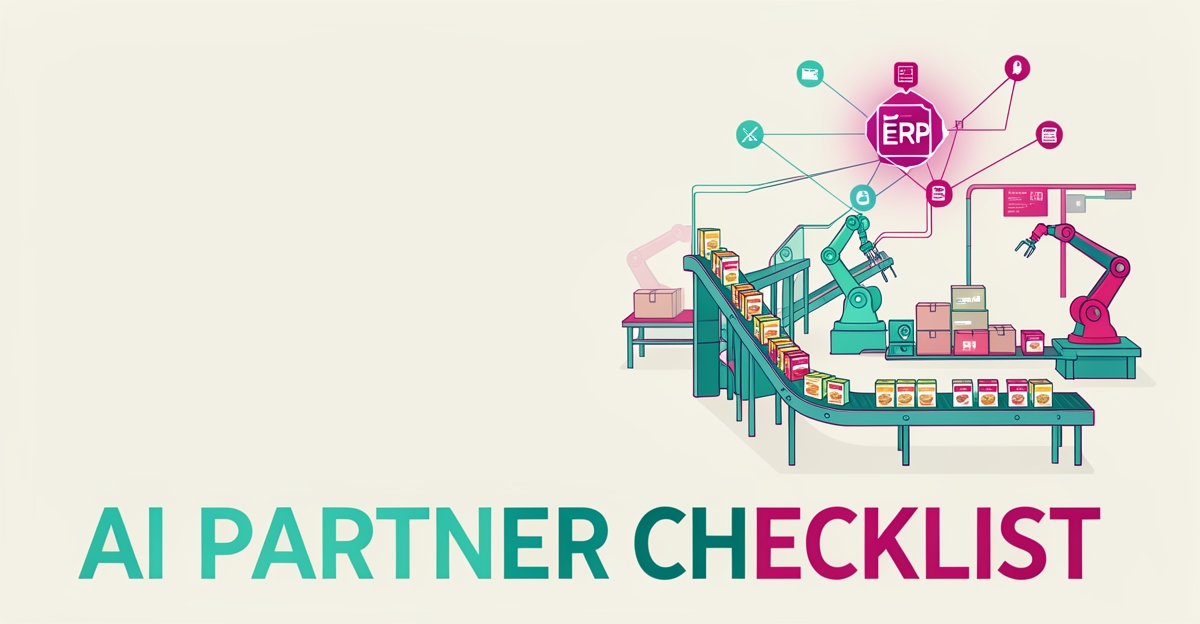
What to Look for in an AI Partner for Food Co-Packing Operations
Key Facts
- A substantial share of industrial companies, industry analyses commonly cite figures above a third, already integrate AI into their operations according to industry analysis
- A meaningful percentage of U.S. consumers reportedly use generative AI for product research and comparison per TechRadar reporting
- Agentic commerce has been projected to represent tens of billions of dollars in U.S. ecommerce by 2030 per market projections
- The global smart packaging market is widely projected to grow into the tens of billions of dollars by 2030 per Solulab market research
- AI adoption in regulated industries is outpacing governance, creating compliance risks per industry research
- AI operating systems can integrate with platforms like SAP Food & Beverage or Wonderware MES for real-time insights per food manufacturing comparisons
- Pilot projects help test AI performance and measure ROI before scaling operations per industrial AI integration practices
Hire a team member that works 24/7 — for less than a part-time wage.
AI receptionists, SDRs, dispatchers and 99+ roles. Trained on your business, fully managed.
Not sure where to start? Ask our AI planner
Why AI Adoption in Food Co-Packing Requires More Than Just Technology
The pressure to adopt AI in food co-packing is real. With consumer behavior shifting and operational efficiency becoming a key differentiator, businesses are moving quickly to bring AI into their operations. But the path to successful adoption is harder than the sales pitches suggest, especially in regulated environments where compliance and traceability are non-negotiable.
One of the most significant hurdles is the gap between rapid AI experimentation and the lack of governance infrastructure. According to industry research, many organizations are deploying AI tools without the necessary governance frameworks in place. That creates real risk in regulated industries where compliance is critical.
To navigate these challenges, food co-packing operations need more than technology. They need a strategic approach that covers governance, integration readiness, and operational alignment. That's where AIQ Labs comes in. Depending on where you're starting from, we offer three entry points: AI Employees for managed AI staff, Workflow Builds to rebuild the one workflow that costs you the most, and AI Operating Systems for a single connected operating layer you own outright.
Here are some key considerations for evaluating AI vendors in the food co-packing industry:
- Industry expertise and understanding of regulatory requirements
- Integration capability with existing systems and tools
- Operational fit and alignment with business goals
- Governance frameworks and compliance support
- Proven track record in regulated environments
According to industry analysis, a substantial share of industrial companies, commonly cited at over a third, already integrate AI into their operations. But successful deployment in food co-packing requires more than technology. It requires a partner who understands the unique challenges of this regulated environment.
At AIQ Labs, we take a lifecycle partnership approach. We don't deliver point solutions and disappear; we work with clients so AI produces sustainable business impact. With 200+ multi-agent systems deployed and four live SaaS products we run ourselves every day, we build in phases, prove value at each milestone, and hand you something you own. Payment models are straightforward: Start Monthly, Build in Milestones, or Own It Outright, no invented case-study numbers, no fake pricing games.
As the food co-packing industry continues to evolve, the need for a strategic AI partner keeps growing. With the right partner, businesses can navigate the complexities of AI adoption and unlock new levels of efficiency. If you're ready to explore how AI can transform your food co-packing operations, start with our two-minute Fit Check and then book a free 30-minute strategy call.
The Three Non-Negotiables: Industry Expertise, Integration Capability, and Operational Fit
Choosing an AI vendor without checking these three boxes is like hiring a co-packer without a food safety audit. The pitch may sound impressive, but the gaps only show up after you've signed, and in a regulated food environment, those gaps are expensive.
The first non-negotiable is deep food industry expertise. With a large share of industrial companies already integrating AI, vendors with general-purpose tools are everywhere. What's rarer is a partner who understands HACCP constraints, lot traceability, allergen changeovers, and the audit trails regulators expect. AI adoption in regulated industries is outpacing governance, and the real question, as industry analysts have framed it, is whether organizations are "building the operational foundation to deploy it responsibly." A vendor who can't speak to that foundation fluently will leave you carrying the compliance risk alone.
The second is integration capability. Your AI system must connect with the tools already running your floor, ERP, supply chain, and production systems. The best AI operating systems integrate directly with platforms like SAP Food & Beverage or Wonderware MES to automate routine decisions and surface critical insights in real time, as documented in food manufacturing comparisons of AI systems and manual processes. Ask every candidate vendor to demonstrate a live integration, not a slide about one. Integration complexity is consistently cited as a top implementation challenge, and a system that can't talk to your existing stack creates a second silo instead of removing one.
The third is operational fit, alignment with how your team actually works. The smartest model fails if line supervisors route around it. Before signing, evaluate:
- Whether the vendor starts with a pilot to test performance and measure ROI before scaling across larger operations
- How the system handles escalation paths and human-in-the-loop decisions on the floor
- Whether training and change management are built into the engagement, not sold separately
- The cost structure: significant upfront investment versus the ongoing labor costs of manual coordination
That last point matters more than most buyers realize. Manual processes carry higher ongoing labor costs and reactive quality issues, while AI-driven operations shift toward proactive optimization that reduces waste and downtime, side-by-side comparisons make the tradeoff explicit. The market context reinforces the urgency: the global smart packaging market is widely projected to grow into the tens of billions of dollars by 2030, per market research, so waiting for the "perfect" vendor is its own risk.
This is the lens we apply at AIQ Labs when advising co-packers: assess readiness, verify integration depth, and demand a clear pilot path before any commitment. A vendor who resists any of those three checks has answered your question for you. Our Workflow Builds are a good example: fixed price, phased delivery, focused on the single workflow that costs you the most.
How to Build a Governance-First AI Implementation Plan
Deploying AI in food co-packing without governance creates risk faster than value. Regulated food environments demand a plan that pairs technical rollout with clear accountability, workforce readiness, and auditability from day one.
Start with high-impact pilots that prove value and build confidence. Identify packaging operations where AI can deliver quick, measurable improvements, then run limited trials to test performance, measure ROI, and build trust before scaling. This staged approach mirrors how industrial companies are integrating AI, with a substantial share already embedding it into operations.
Data quality determines model reliability. Use quality data to improve model performance and output reliability, and establish a centralized governance function early. That function is essential for effective AI deployment: clear rules of engagement, defined escalation paths, and workforce readiness.
Integration must be deliberate, not bolted on. AI operating systems can integrate with existing tools such as SAP Food & Beverage or Wonderware MES to automate routine decisions and surface critical insights in real time. Begin with pilot projects to test performance and measure ROI, then connect AI tools with your ERP, supply chain, and production systems. For co-packers ready for a fully connected layer, our AI Operating Systems offering is built in phases and owned outright, you keep the system, not a subscription.
Governance-first implementation in co-packing typically follows:
- Pilot selection and success criteria defined by operations, quality, and compliance leaders
- Data readiness audit and lineage mapping for traceability and recall requirements
- System integration with ERP and MES with human-in-the-loop controls for critical decisions
- Workforce training, role definition, and escalation paths for exceptions
- Audit trails, logging, and compliance documentation for regulated food environments
Scale gradually while maintaining oversight. Expand AI across multiple packaging stages only after pilots demonstrate consistent, auditable outcomes. As industry research shows, the question for enterprise leaders isn't whether to deploy AI, it's whether they're building the operational foundation to deploy it responsibly.
Market pressure is accelerating adoption. A meaningful share of U.S. consumers reportedly use generative AI for product research and comparison, per TechRadar reporting, and agentic commerce has been projected to represent tens of billions of dollars in U.S. ecommerce spending by 2030. The smart packaging market's continued growth reinforces why co-packers need governance and integration capability from vendors, not just models.
Vendor selection in regulated food environments must weigh industry expertise, integration capability, and operational fit. AIQ Labs aligns governance, integration, and workforce readiness into a single accountable plan, and with transparent payment models (Start Monthly, Build in Milestones, Own It Outright), you always know what you're paying for. Details are on our pricing page.
Still paying for 10+ subscriptions that don’t talk to each other?
We build custom AI systems you own outright. No vendor lock-in. Full control.
Not sure where to start? Ask our AI planner
Frequently Asked Questions
Why is AI adoption in food co-packing more than just implementing technology?
What are the three non-negotiables when choosing an AI vendor for food co-packing operations?
How does AI integration work with existing systems in food co-packing facilities?
What role does governance play in AI implementation for regulated food environments?
Is it better to start with a pilot project before scaling AI across food co-packing operations?
What market trends are driving the urgency for AI adoption in food co-packing?
Turning AI Potential into Packing Line Performance
Successfully adopting AI in food co-packing isn't about chasing the latest technology, it's about building a responsible foundation that aligns with your operational reality, regulatory demands, and business goals. The real differentiators are deep industry expertise, seamless integration with systems like SAP or Wonderware MES, and true operational fit that includes pilot testing, workforce readiness, and governance from day one. Without these, even the most advanced AI becomes a liability rather than an advantage. The market is moving fast, and sustainable advantage goes to those who deploy AI with clarity and control. If you're ready to assess where AI can deliver measurable impact in your operations, without the guesswork, start with our two-minute Fit Check to identify your highest-opportunity areas, then book a free 30-minute strategy call to map a realistic path forward. No obligation, just clarity on what's possible for your business.
Make AI your competitive advantage — not just another tool.
Strategy, implementation and ongoing optimization. One partner, end to end.
Not sure where to start? Ask our AI planner