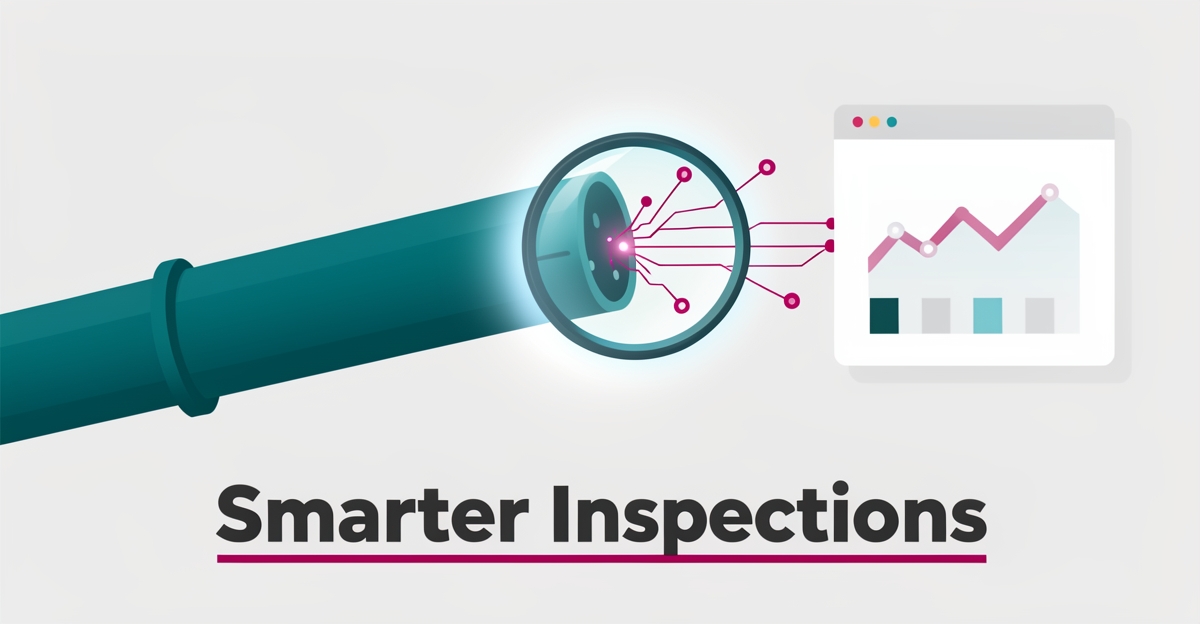
What to Look for in an AI Solution for Pipeline Inspection Data Management
Key Facts
- Most pipelines are buried, concealed in walls, or embedded in machinery, direct visual access is nearly impossible without borescopes and inspection cameras
- Early defect detection reduces emergency repair costs, minimizes downtime, and extends asset lifespan; late detection means leaks and unexpected failures
- Poor data quality carries a measurable cost across industries, inspection teams making decisions on incomplete footage face the same failure mode
- AI governance frameworks call for logging and retention of AI interactions, documented model details, and guardrails to meet compliance and litigation needs
- The pool of downloadable AI models includes ones vulnerable to attack, security testing and validation are non-negotiable for safety-critical use
- Generic AI tools built for CRM data and text workflows cannot process high-volume visual inspection data or integrate with mechanical inspection equipment
Hire a team member that works 24/7 — for less than a part-time wage.
AI receptionists, SDRs, dispatchers and 99+ roles. Trained on your business, fully managed.
Not sure where to start? Ask our AI planner
The Pipeline Inspection Data Problem
Every mile of pipe buried under a city street or threaded through a factory wall is a system most people never think about, until it fails. Pipelines form the hidden backbone of modern life: delivering clean water, removing wastewater, transporting industrial chemicals, and supporting countless commercial and residential systems. When that backbone goes unmonitored, the risks compound silently.
The core inspection challenge is access. Most pipelines are buried underground, concealed within walls, or embedded deep inside machinery, making direct visual access nearly impossible. Traditional methods, excavation, pipe cutting, or full system shutdowns, are costly, disruptive, and increasingly unsustainable. And even when modern borescopes and inspection cameras capture clear internal footage, the resulting data often sits unanalyzed.
That data problem is where costs escalate. Common defects like blockages, internal corrosion, cracks, sediment buildup, and loose joints are only actionable if someone catches them in time. Early detection reduces emergency repair costs, minimizes costly downtime, and extends asset lifespan, while late detection means leaks, unexpected failures, and disrupted operations.
The stakes of acting on poor information are enormous. Industry research on data quality has consistently estimated that bad data costs the U.S. economy trillions of dollars annually, with some analyses suggesting businesses can lose a significant share of revenue to poor data quality. Inspection teams drowning in unstructured footage and manual reports face the same failure mode: decisions made on incomplete or inaccurate information.
For operators evaluating AI solutions, the problem breaks down into recurring pain points:
- Manual review of hours of inspection video and imagery, slowing defect identification to a crawl
- Inspection records scattered across spreadsheets, paper forms, and disconnected systems with no single source of truth
- Inconsistent defect classification between technicians, undermining trend analysis and maintenance planning
- No audit-ready documentation trail, even as regulatory expectations around AI and infrastructure tighten
Different operators also face distinct pressures. Municipalities must maintain vast underground sewer networks, water utilities focus on potable water integrity, commercial buildings battle recurring drain clogs, and factories must ensure chemical pipelines meet strict safety standards. A generic data tool rarely accounts for any of this.
This is why AIQ Labs emphasizes evaluating AI solutions built for pipeline-specific needs rather than off-the-shelf platforms repurposed for the job. The right system must handle visual inspection data, integrate with existing borescope and endoscope equipment, and support the compliance and audit requirements that govern safety-critical infrastructure. If your inspection workflow is the bottleneck, a focused AI Workflow Build is often the fastest way to prove value.
Understanding the problem clearly is the first step toward choosing a solution that actually reduces risk instead of adding another layer of complexity.
Three Non-Negotiable Evaluation Criteria
Pipeline inspection AI fails fast when it is treated like a generic software add-on. The data is visual, the stakes are safety-critical, and the hardware in the field is mechanical. Three evaluation criteria separate production-ready solutions from risky pilots.
Regulatory compliance and governance must be built in, not bolted on. Organizations need logging and retention capabilities for AI interactions to meet compliance requirements and respond to potential litigation effectively, including capturing user prompts and responses for AI applications. Current AI governance guidance, such as Microsoft's framework for governing AI apps, calls for standardized documentation of model name, version, purpose, and evaluation metrics for quality, safety, and security risks. Privacy impact assessments should be extended to AI applications, and guardrails must detect and block harmful content while correcting ungrounded output to reduce wrongful decisions.
Security testing and validation is non-negotiable for models that influence maintenance decisions. With over a million AI models available for download, some are vulnerable to attack and others produce harmful or toxic responses. Effective evaluation requires:
- Security testing for prompt injection and toxicity
- Vulnerability scanning with tools like garak and red teaming
- Operational guardrails and LLM-guard testing for real-world use
Without these checks, defect detection can be silently compromised.
Hardware integration with borescopes, endoscopes and real-time analytics defines practical value. Traditional excavation is costly and disruptive, so modern cameras provide clear real-time internal views without digging. An AI solution must ingest live video from pipe inspection borescopes, handheld borescopes, or USB borescope cameras and return actionable analytics in the field. When data flows uninterrupted from inspection hardware to decision systems, teams consistently report meaningful efficiency gains from automation, though exact figures vary by operation, so ask vendors for evidence specific to inspection workloads, not borrowed from unrelated industries.
AIQ Labs helps businesses select and deploy AI solutions that are built for pipeline-specific needs, not generic off-the-shelf tools. A checklist-based approach to evaluating AI tools for managing inspection data emphasizes integration, regulatory compliance, and real-time analytics as the foundation for sustainable deployment.
From Checklist to Deployment
Selecting the right AI solution for pipeline inspection data management requires a structured approach that moves beyond generic checklists to address the specific demands of infrastructure monitoring. Unlike sales automation tools that focus on lead management and forecasting, pipeline inspection AI must handle visual data analysis, real-time defect detection, and integration with mechanical inspection equipment.
Start by identifying your specific pipeline type and accessibility constraints. Different industries have unique requirements, municipalities need to maintain vast underground sewer networks, water utilities focus on potable water integrity, and factories must ensure chemical pipelines meet strict safety standards. Most pipelines are buried underground, concealed within walls, or embedded deep inside machinery, making direct visual access nearly impossible.
Match your inspection tool to your specific use case. Pipe inspection borescopes work well for long-distance municipal networks with extended probe length and HD imaging, while handheld pipeline borescopes offer portability for field technician on-site checks. USB borescope cameras provide cost-effective solutions for everyday plumbing checks with smartphone connectivity. Consider integration requirements including WiFi transmission capabilities and compatibility with existing systems.
Build governance into your AI implementation from day one. Leading AI governance frameworks emphasize several critical components:
- Build and manage assessments using enterprise compliance management tooling
- Configure data lifecycle management to retain necessary content and delete unnecessary content for compliance reasons
- Implement AI content safety measures to block harmful content and detect ungrounded responses
- Document AI project details including model name, version, purpose, and evaluation metrics for quality, safety, and security risks
Security testing cannot be an afterthought. With over a million AI models available for download, some are vulnerable to attack and others produce harmful and toxic responses. Your evaluation should include testing for prompt injection, toxicity, and vulnerability scanning.
Ensure your solution provides true ownership and integration flexibility. AIQ Labs builds AI systems that clients own outright, avoiding the vendor lock-in common with off-the-shelf solutions. Whether you start with a single AI Workflow Build at a fixed price or grow into a full AI Operating System built in phases, the approach allows deep integration with your existing inspection equipment and workflows rather than forcing you to adapt to generic software limitations.
Finally, prioritize real-time defect detection capabilities. Regular pipeline inspection plays a vital role in preventing leaks, avoiding unexpected failures, and extending asset lifespan. Early detection helps organizations reduce emergency repair costs, minimize costly downtime, and ensure continuous operation, making real-time analytics a non-negotiable feature for any pipeline inspection AI solution.
Why Generic AI Tools Fail for Pipeline Inspection
Generic automation AI is built for conversations and clicks, not corrosion and cracks. That mismatch shows up the moment an off-the-shelf tool meets borescope video, SCADA telemetry, and safety-critical decisions.
Sales automation AI centers on lead management, forecasting, and deal tracking. Research in that sector consistently finds sales representatives spend only a minority of their week actually selling, with the rest consumed by administrative tasks, data entry, and follow-ups, and that teams using automation report improved pipeline management and forecasting. Those are real gains, but they come from automating text and CRM records, not visual inspection data.
Pipeline inspection AI must handle visual inspection, defect detection, and infrastructure monitoring. Pipelines form the hidden backbone of modern life, delivering clean water, removing wastewater, transporting industrial chemicals, and supporting countless commercial and residential systems. Data types are image and video streams from borescopes and endoscopes, sensor readings, and defect measurements, not CRM records and email logs.
Integration points diverge sharply. Sales tools connect to CRM systems, email platforms, and communication tools. Inspection solutions must integrate with borescopes, endoscopes, inspection cameras, and SCADA systems, often legacy mechanical equipment with limited connectivity. Real-time analysis is required on site, not batched reporting.
Regulatory focus is another break point. Sales automation emphasizes data privacy like GDPR and CCPA. Pipeline inspection AI faces safety regulations, environmental compliance, and infrastructure standards, with logging and retention requirements for AI interactions to meet compliance and respond to litigation. Current AI governance guidance highlights the need for assessments, documentation, privacy impact assessments, and guardrails for responsible AI.
Performance metrics reflect the gap. Sales AI is judged on conversion rates, forecast accuracy, and response times. Inspection AI is judged on defect detection accuracy, inspection speed, and maintenance scheduling, where false positives and false negatives carry safety and cost consequences.
Off-the-shelf tools fail because they cannot:
- Process high-volume visual inspection data from borescopes and endoscopes in real time
- Integrate with mechanical inspection equipment and SCADA for closed-loop action
- Meet safety and environmental compliance with audit trails and governance guardrails
- Deliver reliability for safety-critical infrastructure decisions
A checklist-based approach to evaluating AI tools for inspection data emphasizes integration, regulatory compliance, and real-time analytics. AIQ Labs helps businesses deploy AI solutions built for pipeline-specific needs, not generic off-the-shelf tools, through phased builds that address the data types, integration points, and performance metrics unique to physical asset monitoring.
Still paying for 10+ subscriptions that don’t talk to each other?
We build custom AI systems you own outright. No vendor lock-in. Full control.
Not sure where to start? Ask our AI planner
Frequently Asked Questions
Why can't I just use a generic automation AI tool for my pipeline inspection data?
What are the biggest risks of deploying an AI solution without built-in governance and compliance features?
How do I know if an AI model for pipeline inspection is secure and won't produce harmful or unreliable results?
What efficiency gains can we realistically expect from automating pipeline inspection data management with AI?
Our inspection equipment is a mix of old and new borescopes, will an AI solution actually integrate with what we have?
How does bad inspection data quality impact our bottom line compared to other industries?
The Infrastructure Is Waiting, Your Data Shouldn't
Pipeline inspection generates terabytes of critical visual data, but value only emerges when that data drives decisions before failures occur. The evaluation framework outlined here cuts through the noise: demand AI solutions that integrate natively with your existing borescopes and SCADA systems, embed regulatory compliance and security testing into their core architecture, and deliver the real-time defect detection that safety-critical infrastructure demands. Generic tools simply cannot bridge the gap between automation built for text and the physical realities of corrosion, cracks, and blockages. The cost of delay is measurable, poor data quality drains revenue while emergency repairs and compliance gaps compound daily. AIQ Labs builds AI systems that you own outright, engineered specifically for pipeline inspection workflows rather than adapted from generic platforms, and paid for in milestones so you're never locked into a subscription you don't control. If you're ready to move from unstructured footage to audit-ready intelligence, start with the two-minute Fit Check at aiqlabs.ai/apply, then book a free 30-minute strategy call at aiqlabs.ai/book. We'll map your highest-ROI automation opportunity, or tell you honestly if the fit isn't there.
Make AI your competitive advantage — not just another tool.
Strategy, implementation and ongoing optimization. One partner, end to end.
Not sure where to start? Ask our AI planner