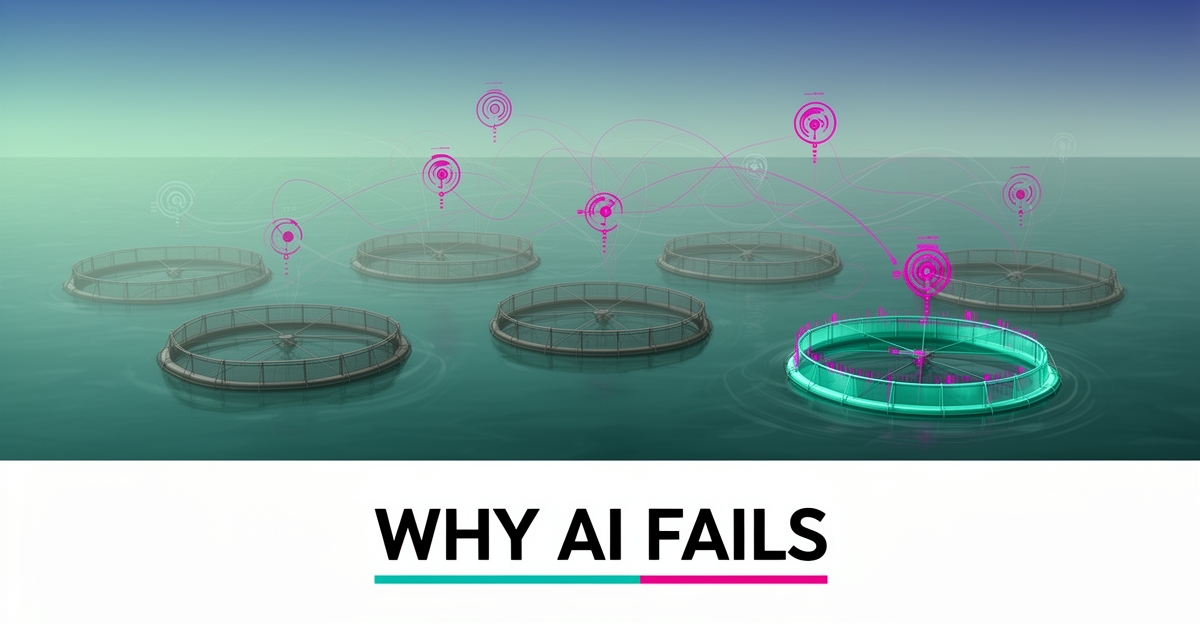
Why Most Aquaculture Farms Fail at AI Implementation
Hire a team member that works 24/7 — for less than a part-time wage.
AI receptionists, SDRs, dispatchers and 99+ roles. Trained on your business, fully managed.
Not sure where to start? Ask our AI planner
The 80% Failure Rate: Why Aquaculture AI Projects Collapse
More than 80% of AI projects fail—roughly twice the failure rate of traditional IT initiatives, according to RAND research on project anti-patterns. For aquaculture operations, this statistic hits particularly hard, given the industry's thin margins and the complexity of biological systems.
The disconnect between urgency and readiness explains much of this. While 97% of business leaders report increased urgency to deploy AI, only a small fraction say their organizations are fully ready to integrate these systems. Aquaculture farms often fall into this gap, rushing to adopt technology without the data infrastructure or strategic clarity to support it.
Misunderstanding the problem ranks as the leading cause of failure. Farms frequently deploy AI because competitors are doing it, not because they've identified a specific operational bottleneck—whether that's optimizing feed conversion ratios or predicting dissolved oxygen crashes. Without a laser focus on the actual problem, even sophisticated models produce expensive dashboards that gather dust.
Data scarcity compounds the issue. According to research on aquaculture AI, there is currently no generalized AI model capable of handling all essential aquaculture activities across diverse, heterogeneous ponds. Every operation generates unique time-series data influenced by local water chemistry, genetic stocks, and climate conditions—variables that off-the-shelf solutions simply cannot accommodate.
The infrastructure gap proves equally fatal. Many farms lack the continuous monitoring systems needed to train effective models, relying instead on manual record-keeping that introduces errors and gaps. As the Global Seafood Alliance notes, traditional notebook-and-spreadsheet approaches are time-consuming and prone to error, yet they remain the norm at operations attempting to leap directly into predictive analytics.
Common failure patterns include:
- Deploying generic software that ignores farm-specific variables like water chemistry and genetic stocks
- Skipping the foundational data collection infrastructure required for model training
- Expecting immediate ROI without the long-term commitment successful AI projects require
- Focusing on technology capabilities rather than specific operational problems
The financial stakes magnify these risks. With feed typically representing up to 70% of operational expenses, according to industry analysis, a failed AI implementation doesn't just waste IT budget—it burns capital that could have optimized the farm's largest cost center.
AIQ Labs approaches these implementations differently, building farm-specific data infrastructure and custom models rather than deploying one-size-fits-all tools. By starting with the operational problem and engineering the data pipeline to match, farms can avoid becoming another statistic in the failure rate.
The Off-the-Shelf Trap: Why Generic AI Models Fail Fish Farms
Generic AI solutions often fail in aquaculture because they ignore the unique biological and environmental variables that define each farm's success. Standardized models trained on broad datasets cannot adapt to the specific water chemistry, genetic stocks, or microclimate conditions that vary dramatically even between neighboring ponds. As industry experts note, every operation has distinct characteristics that influence growth patterns and health outcomes, making one-size-fits-all approaches ineffective from the start.
Early digital tools compounded this issue by relying on linear growth curves that assumed uniform development across all settings, overlooking critical factors like feed conversion ratios tied to local temperature fluctuations or disease susceptibility linked to specific water profiles. This rigidity led to inaccurate forecasts and poor decision-making, eroding trust in AI before its potential could be realized. Research confirms that no single generalized AI model currently exists capable of handling the heterogeneous nature of aquaculture operations across diverse geographical areas, where continuous time-series data reflects vastly different ecological realities.
The failure to account for farm-specific context represents a fundamental misalignment between technology and problem definition—a root cause cited in the majority of AI project failures across industries. When models are built without deep integration into local operational workflows or without sufficient high-quality data on variables like dissolved oxygen levels or pathogen presence, they optimize for incorrect metrics and deliver little practical value. Sustainable AI implementation in aquaculture requires moving beyond off-the-shelf tools toward adaptive systems that learn from each farm's unique data streams, continuously refining predictions based on real-time conditions rather than static assumptions.
To build AI that truly serves aquaculture's complexity, farms need partners who prioritize problem-first design over technology-first deployment—architecting systems that evolve with the pond, not against it. This means investing in customized data collection protocols and models trained on historical performance alongside current metrics to generate actionable, localized insights. Without this foundation, even the most advanced AI will struggle to deliver meaningful results in an industry where no two operations are truly alike.
Start with a free 30-minute strategy call to explore how AIQ Labs develops farm-specific AI systems that account for your unique water chemistry, genetic stocks, and local climate—avoiding the off-the-shelf trap that derails most aquaculture AI initiatives.
Data Poverty: The Silent Killer of Aquaculture AI
Many aquaculture farms rush into AI implementation without establishing the continuous, high-quality data streams that form the foundation for any successful system, a critical oversight that dooms projects from the start. As the RAND report emphasizes, data scarcity is a primary reason for failure, with the majority of AI projects failing overall due in part to insufficient or inadequate data for effective model training according to research on AI project failures. This challenge is amplified in aquaculture, where effective AI depends on capturing complex, interrelated variables that most farms simply aren't monitoring systematically before attempting deployment.
Successful aquaculture AI requires a foundation of continuous water quality monitoring, health management data, real-time growth tracking, and biomass estimation—data streams that are rarely collected with the consistency and granularity needed for robust model development as highlighted in aquaculture-specific AI research. Without this baseline, even sophisticated algorithms are trained on incomplete or noisy data, leading to inaccurate predictions and recommendations that erode trust and deliver little operational value. The shift from basic record-keeping to predictive analytics demands this level of detail, yet many farms attempt to leapfrog the data collection phase entirely.
- Continuous water quality parameters (dissolved oxygen, pH, temperature, ammonia)
- Health indicators and disease surveillance data
- Individual and population-level growth metrics
- Accurate biomass estimation and feeding response
- Environmental conditions and feed utilization efficiency
AIQ Labs addresses this foundational gap through AI Workflow Builds, helping farms establish the data infrastructure and collection protocols necessary before any model development begins. By prioritizing problem definition and data readiness over technology selection, farms can avoid the common pitfall of deploying AI solutions that lack the fuel to function effectively. Building this data foundation isn't just a technical prerequisite—it's the difference between AI that delivers marginal insights and systems that drive meaningful improvements in feed efficiency, survival rates, and overall farm profitability. Without it, AI implementation remains an expensive experiment rather than a strategic advantage.
Problem-First, Technology-Second: The Implementation Framework That Works
Most aquaculture AI projects fail not because of technology limitations, but because teams start with the solution instead of the problem. As RAND research confirms, successful implementations are laser-focused on the problem to be solved, not the technology used, a principle that directly counters the industry's tendency to chase generic AI tools without clear operational targets. Over 80% of AI projects fail due in part to this fundamental misalignment, often wasting resources on models that don't address real farm-level challenges like feed inefficiency or disease prediction.
The path forward requires a deliberate, problem-first framework grounded in aquaculture's unique economics. Feed optimization represents a critical leverage point, as feed can account for up to 70 percent of operational expenses, making it a high-value target for AI-driven precision. Before deploying any model, farms must first invest in robust data infrastructure—ensuring consistent, high-quality inputs from water quality sensors, growth tracking systems, and feeding logs—because manual record-keeping is more time-consuming and error-prone, undermining AI reliability from the start. Only with clean, contextualized data can adaptive models reflect farm-specific variables like water chemistry, genetic stocks, and microclimate conditions, avoiding the pitfalls of one-size-fits-all solutions.
Implementation must also embrace a long-term horizon, with RAND emphasizing that successful projects require a sustained commitment to allow for model refinement, team adaptation, and measurable ROI realization. This timeline supports iterative development—starting with a single workflow like feed dispensing automation—before scaling to broader operations. At AIQ Labs, we guide farms through this exact sequence: diagnose the highest-impact problem, strengthen data foundations, then build and deploy custom AI systems that evolve with the farm's unique rhythms, ensuring technology serves the problem, not the other way around. Start the 2-minute Fit Check to map your operation's biggest bottleneck and identify where AI can deliver real, sustainable value.
Building Farm-Specific AI: From Strategy to Sustainable Implementation
Most farms don't fail at AI because the models are weak. They fail because the system around the model was never built to sustain it.
Pilot purgatory starts with a shiny demo and ends with a spreadsheet no one updates. Research on AI project failures finds more than 80% of AI projects fail, with misunderstanding the problem and inadequate data infrastructure among the leading causes. Without governance, even promising pilots stall before scaling.
Data governance is the foundation, not an afterthought. Continuous water quality monitoring, health management, real-time growth monitoring, and biomass estimation all require accurate, continuous data collection. Recent aquaculture AI research emphasizes that no single generalized model can perform all essential activities across diverse, heterogeneous ponds using time-series data. Manual record-keeping with notebooks and basic spreadsheets remains more time-consuming and more prone to error, creating a data debt that models cannot fix.
Adaptive modeling separates sustainable systems from off-the-shelf disappointments. A critical failure point in early digital solutions was reliance on standardized linear growth curves that did not account for farm-specific variables. Industry analysis of AI adoption shows modern systems create customized projections by analyzing historical farm performance alongside current metrics. As consultant Tony Vaught notes, every operation has unique characteristics that affect development patterns, from water chemistry to specific genetic stocks to local climate conditions.
Feed management illustrates why farm-specific design matters. Feed can represent up to 70 percent of operational expenses in aquaculture, making accurate forecasting a direct profit lever. Generic tools miss the farm-level signals that drive real savings.
Building from strategy to sustainable implementation means:
- Establishing data governance and collection infrastructure before model training
- Designing adaptive models that learn from historical farm performance and current metrics
- Setting realistic expectations about AI capabilities and required timelines
- Planning for long-term ownership and continuous improvement, not a one-time pilot
Unrealistic expectations derail adoption. RAND research on AI failures warns that applying AI to problems inherently too complex for current technology leads to failure, and successful projects require a long-term commitment measured in months and years, not weeks.
This is where farm-specific AI differs from platform resale. AIQ Labs builds custom, owned AI systems tailored to specific farm operations rather than selling one-size-fits-all platforms—whether that's a single AI Workflow Build for the one workflow that costs the most, or a full AI Operating System that connects the whole operation in phases, owned outright. The result is a system the farm owns and can evolve, not a subscription that stalls at pilot.
Still paying for 10+ subscriptions that don’t talk to each other?
We build custom AI systems you own outright. No vendor lock-in. Full control.
Not sure where to start? Ask our AI planner
Frequently Asked Questions
Why do most aquaculture AI projects fail despite the technology being available?
Can I use off-the-shelf AI software for my fish farm, or do I need a custom solution?
What data do I actually need to collect before starting an AI project in aquaculture?
How long should I expect to wait before seeing ROI from an AI investment in my aquaculture operation?
Is feed optimization really a high-impact area for AI in aquaculture, or is it overhyped?
What's the first step I should take if I want to avoid becoming part of the 80% failure rate for aquaculture AI projects?
Why Your Aquaculture AI Project Should Start With the Pond, Not the Platform
Most aquaculture AI projects fail not because the technology is inadequate, but because they begin with off-the-shelf tools instead of the farm's unique biological and operational reality. As we've seen, generic models ignore critical variables like water chemistry, genetic stocks, and microclimate conditions, while poor data infrastructure turns even sophisticated algorithms into expensive guesswork. The path forward isn't about chasing the latest AI trend—it's about starting with a clear problem, whether that's optimizing feed conversion (which can represent up to 70% of operational costs) or predicting dissolved oxygen crashes, then building the data foundation and custom models to support it. AIQ Labs helps farms avoid the failure rate by guiding them through a problem-first, technology-second approach: diagnosing the highest-impact bottleneck, strengthening data collection protocols, and developing owned, adaptive AI systems that evolve with the pond. If you're ready to move beyond pilot purgatory and build AI that delivers real, sustainable value, start with a free two-minute Fit Check to map your operation's biggest bottleneck and identify where AI can drive measurable ROI.
Make AI your competitive advantage — not just another tool.
Strategy, implementation and ongoing optimization. One partner, end to end.
Not sure where to start? Ask our AI planner