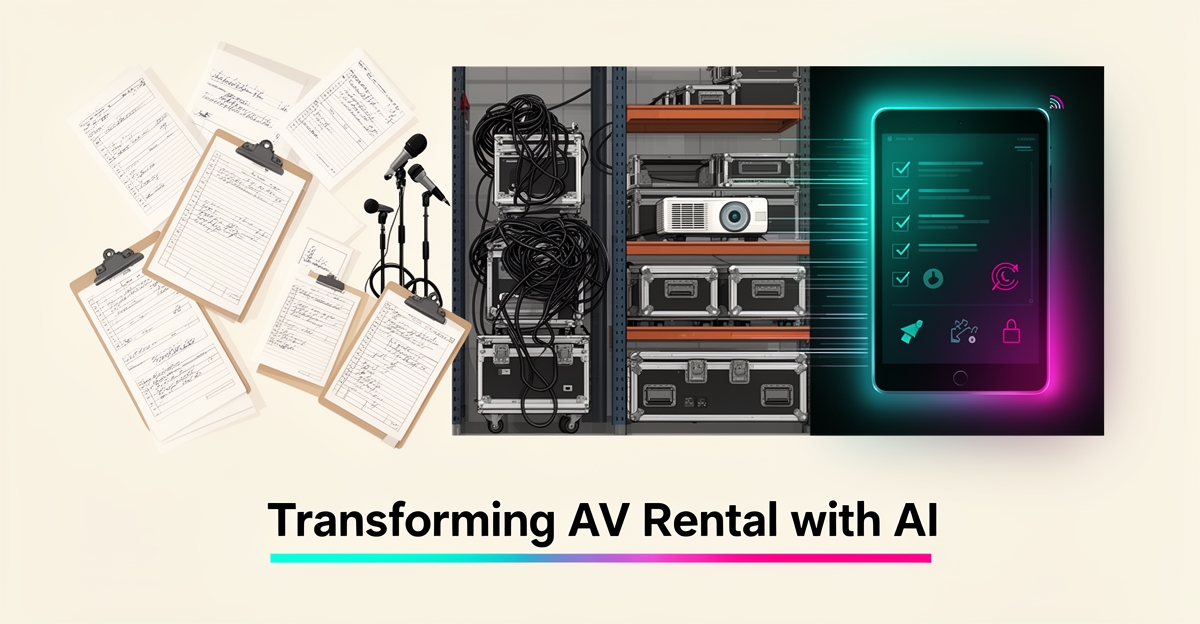
Why Most AV Rental Businesses Still Use Paper-Based Equipment Logs (And How to Fix It)
Key Facts
- The global AV industry is a multi-hundred-billion-dollar market according to industry research.
- A significant share of rented equipment is often not looked at between jobs per rental automation studies.
- Inventory inaccuracies can drain an estimated 4% of annual revenue from equipment management research.
- Proper equipment tracking can typically cut lost or damaged gear by 15-25% per AV tracking guidance.
- Automation typically reduces inventory counts and reconciliation time by around 30% according to equipment tracking research.
- Real-time availability checking can enable meaningfully faster quote turnaround per AV equipment tracking guidance.
- The industry has faced a well-documented shortage of skilled AV workers as covered in industry reporting.
Hire a team member that works 24/7 — for less than a part-time wage.
AI receptionists, SDRs, dispatchers and 99+ roles. Trained on your business, fully managed.
Not sure where to start? Ask our AI planner
The Hidden Cost of Paper-Based Equipment Logs in AV Rentals
The audio-visual industry is a multi-hundred-billion-dollar market, yet as of late 2026 a surprising number of rental businesses still track six-figure equipment inventories on clipboards and disconnected spreadsheets. Industry research has long documented a shortage of skilled AV workers, which makes every hour spent manually reconciling gear counts a direct hit to operational capacity.
Paper-based logs create a cascade of hidden costs that compound across every rental cycle. Data from rental automation studies suggests a significant share of rented equipment goes unchecked between jobs, while inventory inaccuracies can drain an estimated 4% of annual revenue. On a per-transaction basis, undocumented damage quietly erodes asset value across hundreds of rentals.
- Unchecked returns let damage and missing items slip into the next job
- Spreadsheet version conflicts create phantom availability for sales teams
- Manual counts consume far more labor hours than automated reconciliation
- No audit trail means disputes become he-said-she-said negotiations
These inefficiencies hit hardest when skilled technicians are already stretched thin. Tracking specialists note that companies using digital systems typically reduce shrinkage by 15-25% — which, for a business with $500,000 in equipment, can translate to tens of thousands of dollars in annual savings. The gap between paper processes and digital visibility isn't just administrative; it's the difference between a crew showing up prepared and a show-delaying scramble.
AIQ Labs works with AV rental operators to replace these fragile paper trails with AI-powered document processing that captures equipment condition, location, and chain of custody in real time — turning a reactive scramble into a searchable, auditable system of record. For teams that want to start with the single most expensive workflow, a phased AI Workflow Build is often the fastest entry point.
What Digital Tracking Fixes That Paper Can't
Paper logs hide problems until a client calls about missing gear. In an industry this size and this competitive, that delay costs real revenue.
Digital tracking replaces guesswork with real-time visibility across locations. Instead of chasing clipboards and spreadsheets, teams see exactly what is in, out, and where it is moving.
Real-time visibility typically cuts inventory reconciliation time by around 30%. Automation removes manual counts and spreadsheet updates, freeing staff for revenue work. Industry research on AV equipment tracking shows teams spend roughly 30% less time on inventory counts and reconciliation with digital systems.
That visibility directly protects assets. Paper trails leave a meaningful share of rented equipment unnoticed according to rental operations analysis, creating blind spots for loss and damage. Digital logs typically reduce lost or damaged gear by 15-25% through automated check-in/check-out and condition capture.
Faster decisions follow. With live availability, quote turnaround accelerates substantially. AV equipment tracking guidance notes that real-time availability checking enables significantly faster quote turnaround, helping win more bookings in a competitive market.
Shrinkage is the hidden tax on paper-based fleets. For a $500k equipment fleet, a 15% reduction in shrinkage can save $15,000-25,000 per year. Equipment tracking analysis quantifies that impact for mid-size rental operations.
Digital tracking fixes what paper cannot:
- Live location and status for every asset, eliminating end-of-day reconciliations
- Automated rental reports that reduce manual data entry and errors
- Instant availability for quoting and scheduling, cutting response time
- Condition history and damage attribution tied to each transaction
Paper logs also contribute to broader industry pain. The AV sector faces a shortage of skilled labor and high operating costs as documented in industry coverage, so manual tracking wastes the talent you do have.
AIQ Labs builds fully automated, compliant, and searchable digital logs that reduce manual work and ensure real-time visibility across all locations. The approach aligns with AI Document Processing & Management, turning handwritten or scanned logs into structured, queryable records without replacing existing workflows.
The result is fewer missed rentals, less revenue leakage, and a team that spends time serving clients instead of hunting for gear.
From Paper Logs to AI-Powered Digital Logs
Paper-based equipment logs create blind spots that ripple through AV rental operations. Manual data entry consumes valuable staff time, increases error rates, and delays access to critical equipment information. According to industry analysis, a significant share of rented equipment is often not properly tracked, leading to ineffective operations and unnecessary costs. These inefficiencies compound when managing inventory across multiple locations, where paper logs prevent real-time visibility and create reconciliation challenges that can consume hours each week.
Digital transformation addresses these pain points by converting static paper records into dynamic, searchable systems. AI-powered document processing eliminates manual entry by automatically extracting equipment details, usage history, and maintenance records from scanned logs, forms, and invoices. This automation reduces processing time while improving data accuracy — critical when research shows that proper equipment tracking can typically achieve a 15-25% reduction in lost or damaged gear. Real-time synchronization across locations ensures staff always see current equipment status, enabling faster quote turnarounds and minimizing double-booking risks.
AIQ Labs builds owned digital log systems that grow with your business through flexible payment models. Start Monthly deploys a foundational AI-powered logging system with ongoing support. Build in Milestones allows phased implementation — beginning with equipment check-in/check-out workflows before expanding to maintenance tracking and reporting. Own It Outright delivers a complete, customizable system where you retain full ownership of the code, data, and AI models. Each approach eliminates manual data entry, provides real-time multi-location visibility, and creates searchable logs that support compliance and operational efficiency — turning equipment tracking from a liability into a strategic advantage. For operations that want a connected layer across dispatch, quoting, and inventory rather than a single workflow, an AI Operating System ties it all together in phases you own outright.
A Practical Path to Digitize Equipment Tracking
Paper logs create blind spots that cost AV rental teams real money every week. With the global AV industry operating at a multi-hundred-billion-dollar scale according to industry research, the pressure to operate without manual errors is intensifying.
A practical path to digitize equipment tracking starts with clarity, not software. Map where paper fails first: check-out delays, missing condition notes, and untracked returns. Many teams discover a meaningful share of rented equipment is often not looked at, leading to ineffective operations and extra costs as noted in rental operations analysis. That visibility gap drives the estimated 4% of annual revenue that can be lost to inventory inaccuracies highlighted by equipment management research.
Define measurable goals before evaluating tools. Target reductions in lost or damaged gear, quote turnaround time, and manual reconciliation hours. AV equipment tracking research suggests a 15-25% reduction in lost/damaged gear is achievable through proper equipment tracking, along with faster quote turnaround through real-time availability checking. Use those benchmarks to score vendors.
Software selection must balance capability with operational reality. Review real-time inventory management, scheduling, and tracking, plus integration with existing booking, accounting, and dispatch systems. Cost, training, integration, and data security are recurring considerations when implementing digital equipment tracking software. Prioritize solutions that support multi-location visibility and audit trails.
Implementation succeeds when staff adoption is planned from day one. A structured rollout reduces resistance and protects data integrity.
- Identify business needs and goals with input from dispatch, warehouse, and sales teams
- Research digital equipment tracking software options against your workflow and integration requirements
- Choose a software that meets your needs and confirm data security and compliance controls
- Implement the software and train staff with role-based sessions and clear SOPs
- Monitor and evaluate performance using KPIs like inventory accuracy and time spent on reconciliation
Training and integration are where most digitization efforts stall. Provide hands-on practice with real rental scenarios, not just feature tours. Automation can reduce the time spent on inventory counts and reconciliation by roughly 30% according to tracking software findings, but only if teams trust the system.
AI workflow automation adds a layer of intelligence on top of digitized logs. AIQ Labs builds fully automated, compliant, and searchable digital logs that reduce manual work and ensure real-time visibility across all locations. With AI Employees supporting dispatch and inventory management, check-ins are auto-documented, exceptions are flagged instantly, and availability updates flow to quoting without re-keying.
Monitor performance continuously after go-live. Track quote speed, equipment utilization, shrinkage, and labor hours per rental. Use the data to refine processes and expand automation to adjacent workflows like maintenance scheduling and customer communications.
Still paying for 10+ subscriptions that don’t talk to each other?
We build custom AI systems you own outright. No vendor lock-in. Full control.
Not sure where to start? Ask our AI planner
Frequently Asked Questions
How much money are we actually losing by sticking with paper equipment logs?
Why does paper tracking cause us to miss damaged or missing gear until it's too late?
Can digital tracking actually speed up our quote turnaround times?
How much time can automation save our warehouse team on inventory counts?
Is digital tracking worth it if we're already short on skilled AV technicians?
What's the practical first step to ditch paper without disrupting current operations?
Turning Equipment Chaos into Competitive Advantage
The evidence is clear: paper-based equipment logs are silently draining AV rental businesses through lost revenue, wasted labor, and preventable errors — especially when skilled teams are already stretched thin. By replacing manual processes with AI-powered digital tracking, companies gain real-time visibility, typically cut reconciliation time by around 30%, reduce shrinkage by 15-25%, and accelerate quote turnaround. These aren't just operational upgrades; they directly protect margins and free staff to focus on what drives growth — serving clients and winning more bookings. The path forward starts with identifying where paper fails first, setting measurable goals, and choosing a solution that integrates with your existing workflows. If you're ready to move beyond guesswork and build a system that scales with your business, start with a free strategy session to see where AI can deliver the fastest impact for your operation. Book your free 30-minute strategy call — or start with the 2-minute Fit Check — to map your biggest bottleneck and explore a clear, no-obligation path forward.
Make AI your competitive advantage — not just another tool.
Strategy, implementation and ongoing optimization. One partner, end to end.
Not sure where to start? Ask our AI planner