Why Most Building Material Suppliers Still Use Manual Quoting (And How AI Fixes It)
Key Facts
- Manual data entry consumes 85% of quote comparison time, leaving only 15% for actual analysis according to industry research
- A five-supplier RFQ takes 3.25–6.5 hours manually but drops to 1.3–2.7 hours with AI extraction per workflow analysis
- AI-powered quoting saves $127–$255 in labor per RFQ at $85/hour fully loaded cost based on procurement labor calculations
- A 300-line-item bill with five suppliers creates 1,500+ manual entries where a 0.2% error rate causes three pricing errors per error impact analysis
- Manual quoting hits a scalability ceiling at 15 RFQs per month due to data entry consuming team capacity per procurement scalability findings
- AI extraction eliminates transcription errors by reading documents directly instead of requiring human retyping per error reduction methodology
- Teams using AI-assisted workflows can evaluate more suppliers without adding headcount by removing the extraction bottleneck per scalability advantage analysis
Hire a team member that works 24/7 — for less than a part-time wage.
AI receptionists, SDRs, dispatchers and 99+ roles. Trained on your business, fully managed.
Not sure where to start? Ask our AI planner
The Hidden Cost of Manual Data Entry in Material Quoting
Manual quoting feels like analysis work, but the numbers show it is mostly clerical. Suppliers open PDFs, retype unit prices into spreadsheets, and normalize mismatched formats before any real comparison can start.
According to industry research on vendor quote workflows, the comparison logic accounts for roughly 15% of total task time. The remaining 85% is data logistics — locating, transferring, and normalizing values from documents into a structure where comparison can begin. That is why teams stall.
For a five-supplier RFQ, manual work takes 3.25–6.5 hours. With AI extraction, the same cycle drops to 1.3–2.7 hours. At a fully loaded procurement labor cost of $85/hour, that is $127–$255 in labor saved per RFQ, with the decision step unchanged. The breakthrough is not faster comparison, it is removing the extraction barrier so comparison is where effort concentrates.
The hidden cost shows up as errors and capacity ceilings. A 300-line-item bill of quantities with five suppliers and seven comparison columns creates 1,500+ manual entries. A 0.2% error rate means three pricing errors — enough to flip the recommended supplier. Manual workflows also hide risk:
- Transcription errors from retyping values like $4.20 to $4.02
- Equivalency errors when “SSD-500-SATA” and “Solid State Drive, 500 Gigabytes” are assumed equal
- Scope omission errors when footnotes about freight or exclusions are missed on page three
These errors are structural, not typographical, and they compound as volume rises. Manual quoting is manageable at 2-3 RFQs per month. Procurement analysis identifies fifteen RFQs per month as the scalability ceiling, where data entry becomes the team’s capacity limit. Beyond that, the suppliers you never evaluate become the real cost.
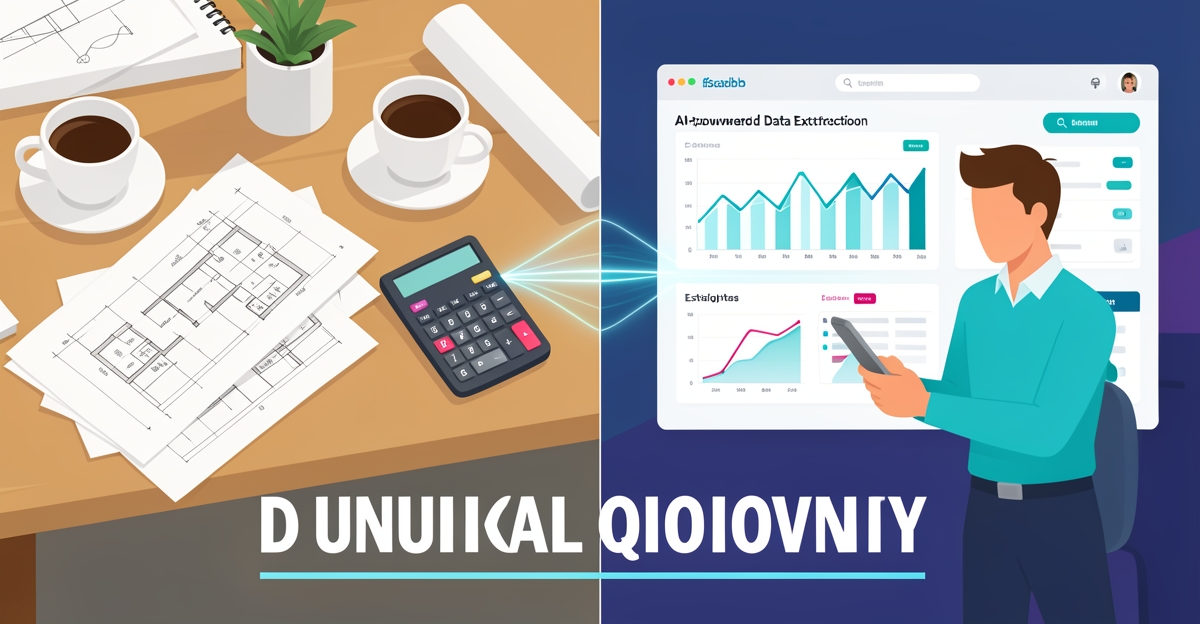
AI-powered quoting tools decouple extraction from judgment. AI reads unit prices, MOQs and terms from PDFs, scanned docs and emails regardless of layout, then populates a clean comparison table for human review. The supplier equivalency decision stays with the buyer, but it moves to a reviewable step after extraction.
That shift matters for building material suppliers handling project specs from CAD or project management tools. AIQ Labs builds custom AI systems that integrate with those tools and instantly generate accurate, customized material price sheets from specs, cutting turnaround from days to minutes while keeping ownership with the client.
How AI Extraction Removes the Bottleneck Without Replacing Judgment
The fear that AI will replace the estimator's expertise is the single biggest barrier to adoption in building material supply. In reality, modern extraction tools are designed to remove the administrative friction that buries that expertise, not the judgment itself. By decoupling data entry from decision-making, these systems allow procurement professionals to focus on the work that actually requires their experience.
The bottleneck is rarely the analysis. According to industry research on procurement workflows, 85% of the total task time in a quote comparison is consumed by "data logistics"—locating unit prices across differently formatted PDFs, retyping values into spreadsheets, and normalizing mismatched units. Only 15% involves actual comparison logic. When a five-supplier RFQ takes 3.25 to 6.5 hours manually, the majority of that time is spent on transcription, not evaluation.
AI extraction removes this barrier by reading documents directly and populating comparison tables automatically. The same research indicates that an AI-assisted workflow reduces the total time to 1.3–2.7 hours per RFQ, delivering a 60% reduction in cycle time. At a fully loaded labor cost of $85 per hour, that translates to $127–$255 in savings per quote—without altering the final decision-making step.
The technology works by semantically locating values like "Unit Price" or "MOQ" anywhere on a page, regardless of format. Instead of opening five PDFs and manually building a spreadsheet, the reviewer starts with a populated table. This shift eliminates transcription errors—where a simple typo like transposing $4.20 to $4.02 can flip a supplier recommendation—and reduces scope omission errors by ensuring the AI reads entire documents, including footnotes that often hide exclusions like freight charges.
However, AI extraction does not eliminate the need for human judgment on equivalencies. When one supplier lists "SSD-500-SATA" and another describes "Solid State Drive, 500 Gigabytes," the system cannot determine if they are truly comparable. Instead, the technology moves this critical decision to a separate, reviewable step where it can be documented and audited. As LinkedIn's guidance on AI implementation notes, these systems function as tools to augment human capability, not replace it.
AIQ Labs builds custom extraction systems that integrate directly with existing ERP and project management tools, handling the data logistics while preserving the estimator's role in scoping and equivalency decisions. The workflow typically breaks down as follows:
- Automated extraction: AI reads PDFs and emails to populate comparison tables instantly
- Normalization review: Human verifies unit conversions and formatting consistency
- Equivalency mapping: Estimator confirms product matches across supplier catalogs
- Scope validation: Professional reviews flagged footnotes and exclusions
- Final recommendation: Human applies scoring and selects the supplier
This division of labor addresses the scalability ceiling that manual processes impose. Teams handling 15 RFQs per month hit a capacity limit not because they lack procurement expertise, but because data entry consumes their available hours. By removing the extraction barrier, suppliers can evaluate more vendors without adding headcount.
The stakes extend beyond efficiency. According to a California Policy Lab report, AI is driving displacement rather than replacement in the labor market, particularly for roles heavy in routine data processing. For building material suppliers, adopting extraction technology is not just about faster quotes—it is about future-proofing the workforce by shifting human effort toward the judgment-based tasks that AI cannot perform.
Why AIQ Labs’ Custom Approach Delivers Sustainable Advantage Over Point Solutions
Generic quoting tools promise speed but deliver fragility—they treat every project as a standalone task, forcing suppliers to rebuild context from scratch with each RFQ. AIQ Labs takes a different approach: we build owned, integrated AI systems that connect directly to CAD platforms and project management tools, creating a persistent intelligence layer that learns from every quote, revision, and win. Unlike point solutions that require constant reconfiguration, our custom systems eliminate redundant data entry by automatically syncing material takeoffs, pricing rules, and project timelines across your tech stack. This isn’t just automation—it’s workflow ownership that compounds over time. Suppliers using our integrated approach see quote turnaround shrink from days to minutes, not because the AI works faster, but because the system removes the 85% of time typically lost to data logistics—locating, transferring, and normalizing values from disparate documents. With manual RFQs consuming 3.25–6.5 hours for a five-supplier comparison, AI-assisted workflows cut that to 1.3–2.7 hours, saving $127–$255 in labor per RFQ at fully loaded rates. More importantly, by reducing manual entry—which balloons to 1,500+ items for a 300-line construction bill—our systems virtually eliminate transcription errors that can flip supplier recommendations. The real advantage emerges in scalability: while manual processes hit a hard ceiling at 15 RFQs per month due to administrative burden, our owned systems let teams scale evaluation volume without adding headcount, turning quoting from a bottleneck into a strategic advantage. This is how AIQ Labs delivers sustainable edge—not through temporary fixes, but through embedded intelligence that grows more valuable with every project. To explore how a custom AI quoting system can transform your workflow, start with our free strategy call to map your biggest bottleneck and identify high-ROI automation opportunities.
Still paying for 10+ subscriptions that don’t talk to each other?
We build custom AI systems you own outright. No vendor lock-in. Full control.
Not sure where to start? Ask our AI planner
Frequently Asked Questions
How much time does AI actually save when comparing quotes from multiple building material suppliers?
What specific labor cost savings can I expect per RFQ when using AI for material quoting?
Will AI replace my judgment when determining if two products from different suppliers are equivalent?
How many manual data entries are typically involved in a large building material quote, and what error rate could flip the supplier recommendation?
What is the scalability limit for manual quoting in building material supply, and how does AI change that?
Does using AI for quoting increase the risk of job displacement for procurement teams in building material supply?
From Data Drudgery to Strategic Sourcing
The numbers are clear: manual quoting wastes 85% of a procurement team’s time on data logistics, not decision-making, creating a hard ceiling at just 15 RFQs per month and introducing costly errors that can flip supplier recommendations. AI extraction flips this equation—cutting quote cycle time from 3.25–6.5 hours to 1.3–2.7 hours per RFQ, saving $127–$255 in labor while preserving the estimator’s critical role in equivalency judgments and scope validation. For building material suppliers drowning in PDFs and spreadsheets, this isn’t about replacing expertise; it’s about freeing it to focus on what truly moves the needle: smarter sourcing, stronger supplier relationships, and scalable growth. The bottleneck isn’t your team’s skill—it’s the process. Ready to see where your quoting workflow is leaking time and value? Start with our free strategy call to map your biggest bottleneck and uncover high-ROI automation opportunities—no obligation, just clarity.
Make AI your competitive advantage — not just another tool.
Strategy, implementation and ongoing optimization. One partner, end to end.
Not sure where to start? Ask our AI planner