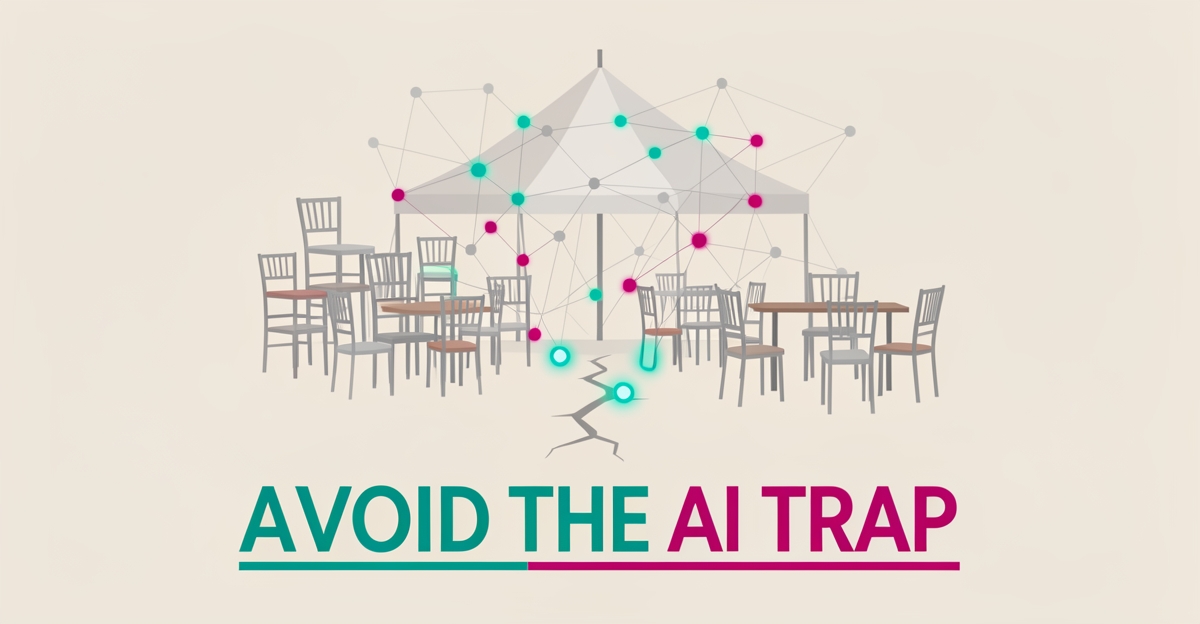
Why Most Event Rental Businesses Fail at AI Adoption, And How to Avoid It
Key Facts
- Poor data integration is consistently cited as a leading barrier to AI adoption in small businesses
- Many AI initiatives stall in "pilot purgatory", small experiments that never scale into operations
- AI Employees typically cost roughly 80% less than a human hire while working around the clock
- AIQ Labs has deployed 200+ multi-agent systems and runs 4 live SaaS products daily
- A readiness-first approach, assess data, staff, and workflows before spending, separates businesses that see ROI from those that write off their AI budget
Hire a team member that works 24/7 — for less than a part-time wage.
AI receptionists, SDRs, dispatchers and 99+ roles. Trained on your business, fully managed.
Not sure where to start? Ask our AI planner
The Three Fatal Mistakes Event Rental Businesses Make with AI
Small business AI adoption has grown sharply over the past few years, yet many event rental companies that jump on the bandwagon end up with shelfware instead of results. The technology isn't the problem. The groundwork, or the lack of it, is.
Event rental businesses operate on thin margins and seasonal demand spikes, which makes AI enormously attractive. AI can automate routine tasks like composing emails, building budgets, and creating seating plans, while also sorting feedback and generating structured reports from event data. But the same pattern shows up again and again in businesses that fail: three predictable mistakes that separate companies seeing ROI from those writing off an expensive regret.
Mistake #1: Poor data integration. Most rental companies run quotes in one system, inventory in another, and customer records in a third. When AI is layered on top of disconnected data, it produces inaccurate or incomplete outputs, a classic garbage-in, garbage-out scenario, and one of the most commonly cited barriers to AI adoption in small businesses. An AI-driven demand forecast built on messy inventory data won't deliver the carrying-cost savings that accurate forecasting can make possible.
Mistake #2: Skipping staff training. Untrained teams don't just use AI poorly, they abandon it entirely. Worse, lack of training breeds unrealistic expectations about what the tools can actually do, compounding the problem. This is why AIQ Labs builds role-specific training into every engagement rather than treating adoption as an afterthought.
Mistake #3: Unrealistic expectations. Owners who expect AI to "fix everything" in a month set their teams up for disappointment and frustration. When the first output isn't magic, the initiative gets shelved, and the budget with it.
The pattern across all three failures is the same: businesses buying tools before assessing readiness. A proactive assessment, evaluating your data infrastructure, current systems, and team capabilities before spending a dollar, is what determines whether AI becomes a competitive advantage or a line-item regret. That groundwork matches AI solutions to your actual business needs, not the ones a vendor promises.
The winners aren't the companies with the most advanced tools. They're the ones who did the unglamorous work first.
Why Your Data Infrastructure Is Sabotaging Your AI Before You Start
Most event rental owners don't ignore AI because they doubt the technology, they ignore it because their data lives in five different places and none of them talk to each other. Booking confirmations sit in one system, inventory counts rot in spreadsheets, customer emails scatter across threads, and payment records hide in processor dashboards. AI doesn't fix disconnected data; it amplifies the chaos.
Demand forecasting is the clearest example. AI-driven forecasting can meaningfully reduce inventory carrying costs, but that result only materializes when the forecasting model sees a complete, accurate history of every rental, return, damage claim, and seasonal spike. Feed it fragmented records and you get confident wrong answers instead of hesitant right ones.
- Booking platform: customer contacts, event dates, contract values
- Inventory spreadsheet: item counts, conditions, locations, maintenance logs
- Email threads: special requests, change orders, verbal approvals
- Payment processor: deposits, balances, refunds, disputes
- Paper files: signed waivers, damage photos, delivery notes
Before spending a dollar on AI tools, audit what you actually have. Open each system and ask: Can I trace a single rental from inquiry to final payment without switching tabs? Do item names match across every list? Are customer records deduplicated? Is historical data complete enough to train a model? The answers reveal whether you're ready for AI or need a data integration project first.
AIQ Labs starts every engagement with this exact assessment because clean, integrated data is the prerequisite for every AI win that follows. The businesses that skip this step don't fail at AI, they fail at preparation.
The AI Readiness Assessment Framework That Prevents Costly Failures
Most event rental businesses rush into AI adoption without first evaluating whether their operations are truly prepared for the transformation. This reactive approach leads to wasted investment, stalled pilots, and frustration when technology fails to deliver promised results. A proactive readiness assessment changes this outcome by identifying gaps before they become costly failures.
The AI Readiness Assessment Framework evaluates five critical areas that determine whether AI implementation will succeed or stall. First, it examines data maturity and integration capability, ensuring systems can share clean, structured information across platforms. Second, it assesses staff technical readiness and capacity for change, recognizing that even the best technology fails without skilled, willing users. Third, it establishes realistic goals based on actual business bottlenecks rather than industry hype. Fourth, it aligns budget allocation with expected ROI timelines to prevent premature abandonment. Finally, it pinpoints the highest-value automation targets where AI will generate measurable impact fastest.
This structured evaluation directly combats the "pilot purgatory" that traps a large share of businesses attempting AI adoption, small experiments that never graduate into operations. By grounding decisions in operational reality instead of aspiration, businesses avoid the cycle of expensive experimentation and build AI capabilities that deliver sustained advantage. AIQ Labs applies this framework across all three of its entry points, AI Employees, Workflow Builds, and AI Operating Systems, so every solution addresses genuine needs with predictable outcomes.
From Assessment to Implementation: Building Your AI Roadmap
An assessment is only as valuable as the roadmap that follows it. Once you know where your gaps are, in data integration, staff capability, or system readiness, the next step is turning those findings into a sequence of deliberate, phased moves rather than one risky overhaul.
Start by prioritizing the workflows where AI delivers the fastest, most measurable wins. For event rental businesses, three candidates consistently rise to the top. Booking management is often first: automating routine tasks like composing confirmation emails, building budgets, and creating seating plans frees staff for the high-touch work that actually makes events great. Customer communication comes next, since AI can handle inquiries, follow-ups, and scheduling around the clock. Inventory forecasting typically follows once your data foundation is solid, the carrying-cost savings are real, but that payoff depends on accurate, complete data first.
The sequencing matters because poor data integration remains the leading barrier to AI adoption in rental businesses. Deploying forecasting or automation on top of disconnected systems produces inaccurate outputs, which then fuels the unrealistic expectations that derail so many implementations. Fix the data path before scaling the intelligence on top of it.
When choosing between custom-built systems and managed AI employees, weigh control against speed:
- Managed AI Employees, receptionists, SDRs, dispatchers, booking agents, and 99+ other roles, go live quickly, handle real workflows end-to-end, and typically cost around 80% less than a human hire.
- A Workflow Build rebuilds the single workflow that costs you the most, at a fixed price and in phases, ideal when one bottleneck is bleeding margin.
- An AI Operating System connects everything into one operating layer, built in phases and owned outright, best once you've proven value and want no vendor lock-in.
Structure implementation in phases that deliver quick wins while building toward comprehensive automation. A single critical workflow fix can show results in weeks, not months, and each success builds the internal credibility needed for the next phase. AIQ Labs' payment models reflect this: Start Monthly to prove value, Build in Milestones as each phase lands, or Own It Outright when you want the system to be yours. No fake prices, no invented numbers, just a phased path with training customized to each role, precisely because lack of staff training and unrealistic expectations are the mistakes that make AI adoption expensive.
Finally, treat change management as an ongoing workstream, not a launch event. AI can also help here, organizing feedback, grouping survey responses, and generating structured reports that show your team what's working. Businesses that pair every deployment with role-specific training and clear performance metrics consistently avoid the disappointment that stalls so many AI initiatives before they scale.
Turning AI Potential into Profitable Reality
The difference between AI success and expensive shelfware isn't the sophistication of the technology, it's the rigor of the groundwork laid before implementation begins. Event rental businesses that audit their data infrastructure, invest in role-specific training, and set realistic milestones position themselves to capture real savings in carrying costs, labor, and response times. Start by tracing a single rental from inquiry to final payment across your current systems; if that journey requires switching between five disconnected tools, you've identified your first priority. AIQ Labs helps rental companies navigate this exact assessment-to-implementation pathway, with 200+ multi-agent systems deployed and 4 live SaaS products the company runs daily, the focus is on actual operational bottlenecks rather than vendor hype. Whether you're ready for a comprehensive readiness evaluation or want to test the waters with a single automated workflow, the key is starting with clarity about where you stand today. Take the two-minute Fit Check to map your biggest automation opportunity and determine if AI is the right next step for your business.
Make AI your competitive advantage — not just another tool.
Strategy, implementation and ongoing optimization. One partner, end to end.
Not sure where to start? Ask our AI planner