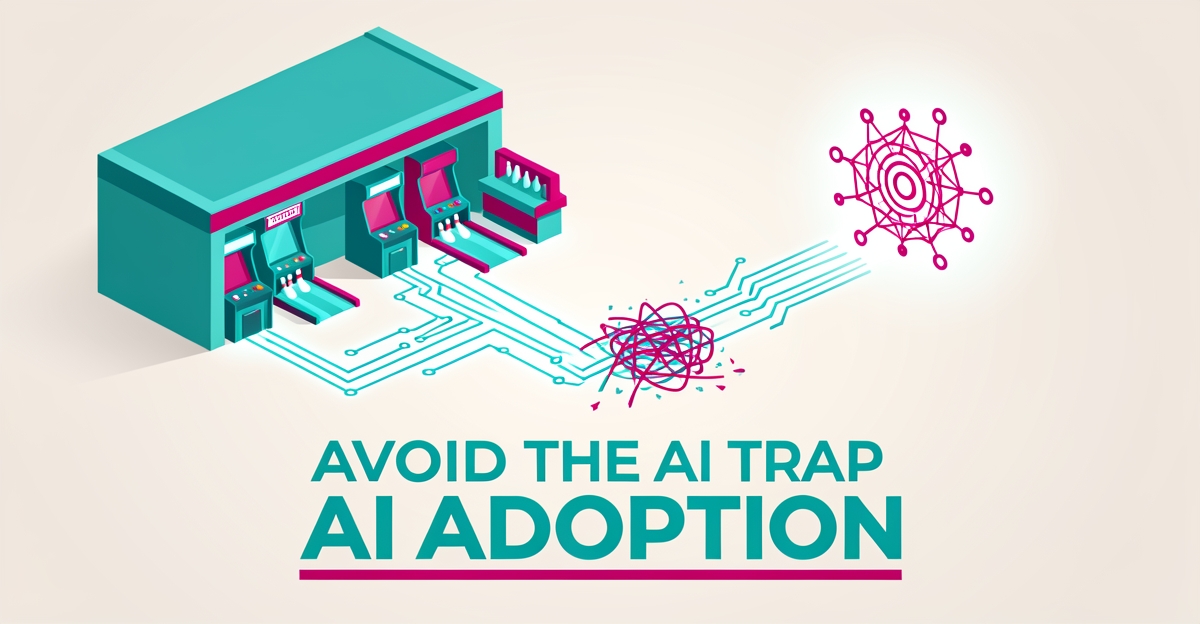
Why Most Family Entertainment Centers Fail at AI Adoption, And How to Avoid It
Key Facts
- AI projects typically fail on the people side, adoption, culture, and workflow fit, more often than on the technology itself
- Siloed systems (POS, booking, waivers, CRM) undermine AI's ability to deliver accurate, actionable insights
- Staff training fails when it focuses on theory instead of execution inside daily workflows
- Unrealistic expectations set teams up for disappointment when AI doesn't deliver instant change
- A readiness assessment evaluates data maturity, team readiness, and realistic goal-setting before deployment
- High-ROI automation opportunities for FECs typically include missed-call recovery and party booking automation
Hire a team member that works 24/7 — for less than a part-time wage.
AI receptionists, SDRs, dispatchers and 99+ roles. Trained on your business, fully managed.
Not sure where to start? Ask our AI planner
The Hidden Barriers to AI Success in Family Entertainment Centers
Many family entertainment centers struggle to move beyond AI experimentation because they overlook the human and systemic factors that determine real success. Technology alone rarely drives transformation; it's the alignment of data, people, and realistic goals that separates pilots from lasting impact. Industry analyses consistently point to the same pattern: AI initiatives tend to miss their objectives because of poor employee adoption and organizational misalignment, not because the tools don't work.
The first barrier is poor data integration, which undermines AI's ability to deliver accurate, actionable insights. When ticketing, concession, and attendance systems operate in silos, AI models lack the unified data needed to predict staffing needs, optimize game pricing, or personalize guest experiences. AI adoption requires more than tech training; it calls for cultural shifts, clear communication, and ongoing support to make data flow a natural part of operations. Without this foundation, even sophisticated AI tools generate outputs that erode trust.
The second pitfall is inadequate staff training that focuses on theory over execution. Many FECs invest in AI certifications only to see adoption remain flat because employees don't know how to apply the technology to their daily workflows. The problem usually isn't education, it's execution. Staff need role-specific guidance on how AI reduces their workload, such as automating shift scheduling or predicting peak concession demand, so they see tangible benefits in their routines.
Finally, unrealistic expectations set teams up for disappointment when AI doesn't deliver instant, sweeping changes. Throwing AI tools at teams without a clear problem to solve is like giving them a sports car without driving lessons. Success begins with framing AI as a solution to specific pain points, reducing wait times, cutting food waste, or increasing repeat visits, so every team member understands how it improves their work and the guest experience. AIQ Labs helps FECs navigate these barriers through a readiness-first approach that evaluates data maturity, team readiness, and realistic goal-setting before any technology is deployed.
A Proven Framework for Assessing AI Readiness in Entertainment Venues
Most family entertainment centers don't fail because AI is too complex, they fail because they start with tools instead of readiness. That gap shows up fast: adoption stalls when the people and systems around the technology aren't prepared for it.
A practical readiness framework starts with three questions: Can your systems share data cleanly, can your team act on insights, and can your workflows support automation without breaking daily operations? This is where many venues uncover hidden friction, POS, booking, waivers, CRM, and party scheduling often live in disconnected silos, making poor data integration the first red flag.
The second lens is team capability. The bulk of AI's impact comes from culture, managers, and systems, not the tools themselves. That's why certifications alone don't move adoption; execution does. In FECs, that means assessing whether front-desk staff, party hosts, and managers understand how AI supports bookings, guest communication, and staffing decisions.
A structured assessment should score readiness across five areas:
- Technology stack health and integration readiness
- Data quality, access, and governance
- Team skills and role-based adoption needs
- Workflow bottlenecks with measurable time or cost impact
- Ongoing support capacity for training and optimization
This approach prevents unrealistic expectations. The brief isn't "build something with AI"; it's "solve a real problem that's costing us time or money." In practice, that means prioritizing high-value use cases like missed-call recovery, party booking automation, and guest follow-up before attempting more complex forecasting or personalization.
AIQ Labs applies this kind of structured evaluation before recommending anything. Depending on where you land, that might mean AI Employees handling phones and bookings, a fixed-price Workflow Build that rebuilds your single costliest workflow in phases, or a longer-term AI Operating System that connects your operations in one layer you own outright. That upfront clarity helps FECs avoid the common pilot-to-scale trap and focus on high-ROI automation opportunities that fit their actual operations, with payment models (monthly, milestone-based, or outright ownership) that match the scope. See how pricing works for details.
From Assessment to Action: Building Sustainable AI Adoption in Family Entertainment
From assessment to action, successful AI adoption in family entertainment centers requires more than just technology, it demands a structured approach that centers people. Tools alone cannot drive success without workforce readiness. To build sustainable adoption, centers must first involve staff in planning discussions to foster investment and reduce resistance, creating emotional buy-in by addressing fears through transparent communication about how AI will support, not replace, their roles. Matching tools to skill levels ensures non-technical teams aren't overwhelmed, while focused training on high-impact, role-specific skills prevents wasted effort on generic certifications that don't translate to daily tasks. Establishing ongoing support systems, such as mentoring sessions, accessible helpdesks, and evolving resource libraries with troubleshooting guides, turns adoption into a continuous process rather than a one-time launch. Peer-led sessions showcasing real-world results and internal champions sharing workflows further reinforce confidence and practical understanding. By following these steps, family entertainment centers can move beyond pilot stagnation and embed AI into their operating model, turning innovation into lasting competitive advantage. To begin this journey, take the two-minute Fit Check and book a free 30-minute strategy call that maps your biggest bottleneck and identifies high-ROI automation opportunities tailored to your center's unique workflow.
Still paying for 10+ subscriptions that don’t talk to each other?
We build custom AI systems you own outright. No vendor lock-in. Full control.
Not sure where to start? Ask our AI planner
Frequently Asked Questions
Why do most family entertainment centers struggle to move beyond AI pilot projects?
How much of AI's impact comes from culture and management rather than the technology?
How can family entertainment centers ensure staff actually use AI tools in their daily work?
What's the biggest mistake FECs make when starting with AI?
What should a family entertainment center assess before investing in AI?
How does AIQ Labs help family entertainment centers avoid AI adoption failure?
Turning AI Potential into Real Results for Your Family Entertainment Center
The path to successful AI adoption in family entertainment centers isn't about chasing the latest technology, it's about building readiness. Poor data integration, inadequate training, and unrealistic expectations derail most efforts, and the impact of AI depends far more on culture, systems, and management than on the tools themselves. The good news? These barriers are predictable and preventable. By starting with a structured readiness assessment that evaluates your data flow, team capabilities, and workflow bottlenecks, you can avoid costly missteps and focus on high-ROI automation that fits your center's real operations. AIQ Labs helps FECs navigate this journey with proven frameworks, 200+ multi-agent systems deployed and four live SaaS products running daily, turning AI from a pilot into a sustainable competitive advantage. To see where your greatest opportunity lies, take the two-minute Fit Check and book a free 30-minute strategy call to map your biggest bottleneck and uncover tailored automation opportunities, no obligation, just clarity.
Make AI your competitive advantage — not just another tool.
Strategy, implementation and ongoing optimization. One partner, end to end.
Not sure where to start? Ask our AI planner