Why Most Flatbed Trucking Companies Fail to Automate Route Planning
Key Facts
- Static planning typically stretches rerouting time by 30-50% during disruptions per TechXler
- Major rerouting events can cost $10,000-$100,000+ in losses per TechXler
- Customer satisfaction often drops 20-40% during crisis periods with static systems per TechXler
- AI-driven route optimization can reduce miles driven by 8-15% per route per truck telematics guide
- Fleets using modern telematics report 30-40% efficiency improvements per truck telematics guide
- 95% of new Class 8 trucks ship with telematics per truck telematics guide
- AI route optimization can reduce logistics costs by up to 35% per TechXler
Hire a team member that works 24/7 — for less than a part-time wage.
AI receptionists, SDRs, dispatchers and 99+ roles. Trained on your business, fully managed.
Not sure where to start? Ask our AI planner
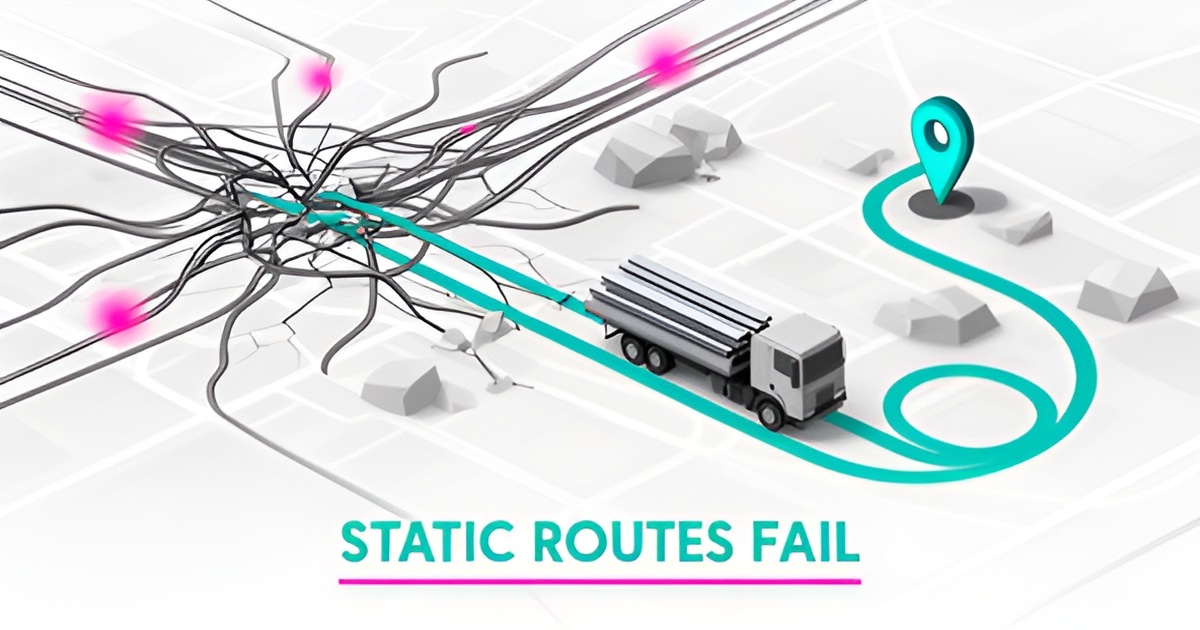
The Static Planning Trap: Why Rule-Based Tools Fail in Real-World Trucking
Flatbed fleets that claim to have “automated” routing often still run on static, rule-based logic that collapses the moment reality intervenes. The plans look clean on a screen, but they ignore the variables that actually move trucks.
Rule-based tools work from static schedules, zip codes and basic distance calculations. They cannot adapt to changing conditions or optimize multiple variables simultaneously. That rigidity shows up as 30-50% longer planning times during disruptions and losses of $10,000-$100,000+ per major rerouting event. Customer satisfaction drops 20-40% during crisis periods when the system cannot respond.
The core limitation is data input. According to industry research, rule-based tools rely on static schedules while AI route optimization uses real-time traffic and predictive data. Traditional routing systems rely on static rules and basic distance calculations and cannot adapt to changing conditions.
Without real-time feedback, plans assume perfect world averages. Drivers are given routes based on speed limits and zero traffic, assuming every customer is waiting at the curb. When a route is planned using perfect world averages instead of real-world data, the driver pays the price with stress and safety risks. The “rush” mentality that follows increases accidents and turnover in an industry already facing a chronic driver shortage.
Static planning also fails on truck-specific constraints. Flatbed operations require HGV road restrictions, bridge weight limits and clearance rules, axle load limitations, hazmat routing requirements and Hours of Service compliance. NextBillion.ai notes its platform delivers AI-powered truck route planning that respects HGV restrictions, bridge weight limits, hazmat rules, and real-time traffic. The platform processes 50+ hard and soft constraints including vehicle dimensions, load capacity, time windows, and HGV road restrictions.
The cost of that failure is measurable. Fleets using modern telematics report 30-40% efficiency improvements and a 12% reduction in fuel costs. AI-driven route optimization reduces miles driven 8-15% per route. Yet companies stuck on static tools leave those gains unrealized because the software cannot ingest live feeds or recalculate.
AIQ Labs builds production-ready systems with real-time data feeds and dynamic adjustments to avoid missed loads and delays. That approach mirrors what the research shows is missing: live traffic data from GPS devices and traffic APIs, predictive modeling that flags recurring congestion and dwell times, and immediate rerouting when construction, breakdowns or incidents occur. For fleets that want to start smaller, a single AI Workflow Build can rebuild the one routing workflow that costs the most, then expand from there.
Common failure patterns from rule-based systems include:
- Plans built on static schedules with no warehouse or dock door integration, creating bottlenecks before the engine starts
- Deadhead miles from ignoring driver starting locations, burning fuel without revenue
- No real-time rerouting, so delays compound and ETAs become unreliable
The result is operational inefficiency despite apparent automation efforts, higher costs, and driver frustration. Moving beyond static rules requires connected analytics, multi-variable optimization, and continuous feedback loops that update plans as conditions change.
Data Silos and the Integration Gap: How Poor System Connectivity Undermines Automation
Despite having access to advanced routing tools, many flatbed carriers still operate with disconnected systems that undermine automation from the start. When route planning software doesn’t share data with warehouse management, telematics, or transportation management systems, critical information stays trapped in silos. This disconnect creates blind spots that turn even the smartest algorithms into ineffective planners—scheduling trucks to arrive when docks aren’t ready or ignoring real-time traffic that could save hours. According to industry analysis, poor integration between routing software and warehouse schedules often results in dock congestion where trucks idle for hours despite being "on time" on paper, wasting fuel and driver availability https://nuvizz.apoxeo.in/blog/poor-route-planning-carrier-efficiency/.
These integration gaps don’t just cause delays—they actively generate waste. Fleets using disconnected systems frequently assign routes that ignore a driver’s current location or next assignment, leading to excessive deadhead miles that burn fuel without generating revenue. Research shows that every deadhead mile represents pure operational loss, consuming resources while contributing nothing to the bottom line https://nuvizz.apoxeo.in/blog/poor-route-planning-carrier-efficiency/. Meanwhile, dispatchers and drivers operate on outdated information, relying on sticky notes or memory instead of live data feeds, which turns communication into a reactive scramble rather than a coordinated workflow. This siloed communication gap is repeatedly cited as a core reason efficiency evaporates before a truck even leaves the yard https://nuvizz.apoxeo.in/blog/poor-route-planning-carrier-efficiency/.
AI-driven platforms solve this by acting as a central nervous system for logistics—pulling real-time data from telematics, warehouse dock schedules, traffic APIs, and TMS platforms into a unified view. When routing software syncs with live dock availability, it automatically staggers departures to match actual capacity, eliminating bottlenecks before they form. By integrating GPS location data with upcoming assignments, these systems minimize deadhead miles by optimizing not just for delivery stops, but for the full driver journey from current location to next pickup. AIQ Labs builds these connected workflows as part of its AI Workflow Builds, ensuring that route planning doesn’t run in isolation but flows seamlessly with inventory updates, load confirmation, and compliance tracking. For carriers ready to connect routing, dispatch, telematics, and compliance into one layer they own outright, an AI Operating System is built in phases and owned outright—no vendor lock-in. The result is a dynamic system where every data point—from trailer temperature to HOS clocks—feeds into smarter, adaptive routing decisions that reduce waste and improve on-time performance.
Building a Production-Ready System: Constraints, Real-Time Feedback, and Dynamic Adjustment
Production-ready route automation fails when it stops at a map and starts with constraints. Flatbed operations live or die on truck-specific rules that generic routing ignores, and without live feedback loops the plan decays the moment a driver leaves the yard.
The foundation is truck-specific constraints enforced at build time. Successful systems configure 50+ hard and soft constraints including vehicle dimensions, load capacity, time windows, and HGV road restrictions according to NextBillion.ai's truck routing service. That means HGV road restrictions, bridge clearance rules, hazmat routing requirements, time windows, and driver HOS compliance are modeled before a route is ever generated as described in the smart truck route documentation. When those rules are baked in, compliance-related delays tend to fall significantly per AI route optimization analysis.
Real-time data feeds turn a static plan into a living system. Using inputs from GPS devices, traffic APIs, and IoT-enabled sensors, AI systems access real-time updates on congestion, road closures, and accidents per RTS Labs research. Predictive modeling builds on that stream: AI examines historical delivery data to uncover patterns that often lead to delays, such as recurring traffic congestion near specific hubs or longer-than-average dwell times at certain locations as RTS Labs explains. The result, per industry analyses, is a 25-30% reduction in unexpected delays from predictive modeling according to TechXler and a 20% improvement in delivery time accuracy in the same analysis.
Dynamic adjustment closes the loop between plan and reality. When delays arise due to construction, breakdowns, or other incidents, the software recalculates routes immediately to preserve delivery speed and minimize detours per RTS Labs. Fleets that operate this way see traffic delay reduction of 35-45% per TechXler and 95% customer time window adherence with constraint optimization in the same report. AI-driven route optimization also reduces miles driven 8-15% per route per truck telematics industry guidance.
A production system is built as a closed loop, not a one-off export:
- Import stop lists and fleet data including truck height, weight, axle load, and cargo type via CSV, API or TMS
- Apply truck-specific constraints and road rules, then generate compliance-ready multi-stop routes with real-time traffic and departure-time modelling
- Dispatch to driver apps and monitor live with deviation and safety alerts
- Reconstruct trips post-run to compare planned vs actual, audit mileage, validate HOS compliance, and feed insights back into planning
Adoption is already high because the hardware is in place. 80% of fleet professionals now run GPS fleet tracking, up 11 percentage points year-over-year per the 2026 truck telematics guide, and 95% of new Class 8 trucks ship with telematics per the same guide. That telemetry becomes valuable only when it is integrated with warehouse schedules, dispatch, and driver apps.
At AIQ Labs, production-ready systems are engineered with engineering excellence over prototypes, with deep two-way API integrations that create seamless operational workflows. The approach mirrors how AIQ Labs builds custom AI workflow and integration services that eliminate manual data entry, ensuring route automation is owned, monitored, and continuously optimized rather than rented as a dashboard. With 200+ multi-agent systems deployed and four live SaaS products the company runs daily, the build process is proven in production—not on a slide deck.
Still paying for 10+ subscriptions that don’t talk to each other?
We build custom AI systems you own outright. No vendor lock-in. Full control.
Not sure where to start? Ask our AI planner
Frequently Asked Questions
Why do flatbed trucking companies say they have automated routing but still struggle with delays?
What makes flatbed route planning different from standard truck routing?
How much efficiency can I actually get from modern telematics and AI routing?
Are data silos really hurting my route planning?
What happens to drivers when routes are planned with perfect-world averages?
Can predictive modeling and real-time rerouting reduce unexpected delays?
From Static Plans to Self-Correcting Routes
Flatbed fleets don’t fail at automation because they lack software; they fail because static rules and siloed data can’t keep pace with real roads, real docks, and real constraints. When planning ignores live traffic, warehouse capacity, HOS limits, and truck-specific restrictions, every disruption compounds into delays, deadhead miles, and driver burnout—costing up to $10,000-$100,000+ per major rerouting event. The fix isn’t another dashboard—it’s a production-ready system that ingests real-time feeds, enforces 50+ constraints, and recalculates routes the moment conditions change. AIQ Labs builds these owned, closed-loop workflows: no vendor lock-in, no brittle prototypes, just systems that adapt as fast as your operation does. If you’re ready to move beyond static plans, start with the two-minute Fit Check at aiqlabs.ai/apply, then book a free 30-minute strategy call at aiqlabs.ai/book. We’ll map your highest-ROI automation win—or tell you if there isn’t one. Questions first? Reach us at [email protected].
Make AI your competitive advantage — not just another tool.
Strategy, implementation and ongoing optimization. One partner, end to end.
Not sure where to start? Ask our AI planner