Why Most Freight Brokerages Fail to Scale with AI — And How to Avoid It
Key Facts
- Industry research indicates most enterprise AI pilots fail to deliver measurable P&L impact across industries according to industry analysis
- Personnel and payroll costs reportedly consume the large majority of gross margin per load for mid-market brokerages based on operational data
- Logistics organizations typically utilize only a fraction of their available data for AI applications per supply chain analytics
- AI-enabled brokerages have been reported to achieve meaningfully higher margins than traditional competitors in performance benchmarks
- Brokerages using AI tools often handle several times more loads per employee than manual counterparts per productivity studies
- Positive ROI for AI in freight brokerage is typically achieved within the first few months of deployment per implementation case studies
- Supply chain AI initiatives commonly exceed budgets due to integration complexity per supply chain research
Hire a team member that works 24/7 — for less than a part-time wage.
AI receptionists, SDRs, dispatchers and 99+ roles. Trained on your business, fully managed.
Not sure where to start? Ask our AI planner
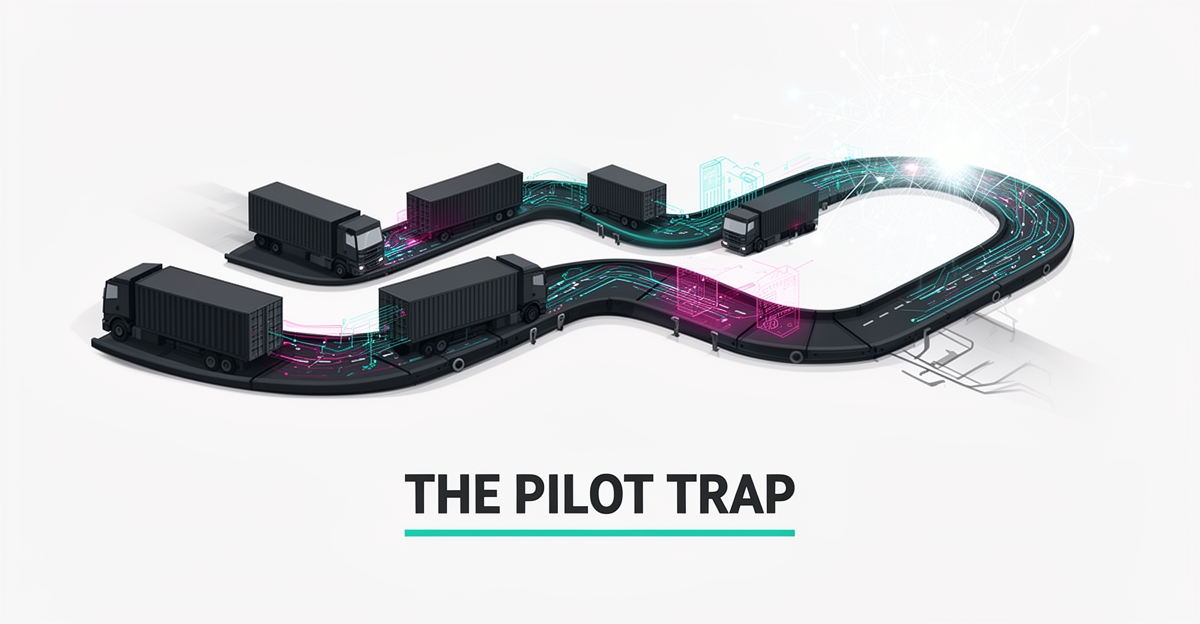
The Pilot Trap Is Leaking Margin, Not Just Time
The scaling gap is visible across the industry. While the largest brokerages process millions of shipments a year with fleets of specialized AI agents, the vast majority of brokerages remain stuck in pilots that never reach production.
That stall is expensive. Mid-market brokerages typically earn a few hundred dollars in gross margin per load, and personnel and payroll costs reportedly consume the large majority of that margin. When margin is that thin, every manual minute is a direct leak.
Pilots stall because they are built on clean data, while production runs on messy reality. Logistics organizations typically utilize only a fraction of their available data for AI applications, with the rest locked in legacy systems or suffering from quality issues. Without standardized pipelines and deep TMS integration, models that looked promising in a demo degrade the moment they hit emails, PDFs, carrier texts and load board pulls.
The time leak is where the margin goes. A typical freight broker spends most of their week on administrative tasks rather than relationship building. The compounding cost shows up in repeatable workflows:
- Inbound RFQ quoting can take 20–40 minutes manually versus minutes with AI
- Carrier vetting can take 30–60 minutes manually compared to seconds via API
- Load posting across platforms takes several minutes per load, repeated dozens of times daily
These are not one-off delays. They are structural drag that prevents teams from scaling without adding headcount — and a new hire carries a fully-loaded cost of thousands of dollars with a months-long ramp time. Managed AI employees exist precisely to absorb this kind of work at a fraction of a human hire's cost.
The pilot trap is reinforced by organizational gaps. Only a minority of supply chain organizations have a formal AI strategy, and most enterprise AI pilots fail to deliver measurable P&L impact across industries. Failure points are rarely technical; they are organizational and structural, stemming from a lack of formal strategy, poor data integration, and insufficient change management.
Closing the gap requires moving from project wins to operational infrastructure. That means establishing clear governance, creating standardized data pipelines, ensuring deep integration with existing TMS systems, and deploying specialized, role-based AI agents rather than generic tools. A deep-dive into common scaling failures in freight brokerage AI adoption — such as poor data integration and lack of role-based automation — shows why phased, operations-tailored implementation is critical to avoid the pilot trap.
Brokerages that rebuild the operational infrastructure around AI tools, not just the tools themselves, are the ones positioned to operate at a cost structure competitors cannot match.
Four Structural Failures That Kill AI at Scale
The gap between a promising AI pilot and a production-grade system isn't technical — it's structural. While industry leaders process millions of transactions with specialized agents, most brokerages remain stuck in the "pilot trap," where pilots fail to deliver measurable P&L impact because the infrastructure around the models collapses under real-world weight.
- Governance without ownership: No one owns the AI output when it's wrong or updates the model when tariffs shift, leaving a dangerous gap between IT and operations.
- Production-unready data: Logistics organizations typically utilize only a fraction of their available data, with the rest locked in emails, PDFs, carrier texts, and TMS exports that don't speak the same language.
- Integration debt: Supply chain research indicates a majority of AI initiatives exceed budgets due to unforeseen complexity connecting TMS, carrier portals, rating APIs, and EDI systems simultaneously.
- No operational visibility: Without real-time monitoring of what automation handles, misses, or degrades, scaling becomes guesswork rather than strategy.
A pilot runs on clean, curated data. Production runs on the messy reality of inbound RFQs, rate confirmations, and exception management that generic AI tools weren't built to parse. This is why AIQ Labs' workflow builds start by rebuilding the one workflow that costs the most — with standardized data pipelines, defined governance layers, and deep TMS integration — the operational infrastructure that lets specialized agents execute freight-specific workflows reliably at scale. The brokerages pulling ahead didn't just buy better models; they rebuilt the infrastructure around them.
Role-Based AI and Production Infrastructure
The era of the single, all-knowing "super AI" is over; the brokerages actually scaling in 2026 are deploying a modular bench of specialists instead. Rather than one generalist model trying to handle everything, leading firms assign tactical AI agents to specific, high-volume tasks—carrier check calls, POD retrieval, appointment confirmations, and track-and-trace updates. This shift toward purpose-built automation delivers faster adoption and better reliability than generic chat tools, according to recent industry analysis. Deployments of task-specific agents for these workflows have been reported to cut labor costs substantially and pay back within the first quarter.
However, deploying specialized agents without production-grade infrastructure creates expensive chaos. A pilot can run on clean, curated data, but production runs on messy reality—emails, PDFs, carrier texts, and TMS exports that don't speak the same language. Logistics organizations typically utilize only a fraction of their available data for AI applications, leaving the rest locked in legacy silos. To move from pilot to production, brokerages need four foundational layers:
- Governance layer: Clear ownership for AI outputs, update cycles, and fallback protocols when models drift.
- Standardized data pipelines: A single source of truth connecting email, TMS, carrier data, and compliance workflows.
- Deep TMS integration: Two-way API connections that let AI work within your existing stack, not around it.
- Real-time monitoring: Operational visibility into what automation is handling, what it's missing, and where humans are still filling gaps.
The ROI for getting this right is substantial. AI-enabled brokerages have been reported to achieve meaningfully higher margins than traditional competitors, while handling several times more loads per employee. With positive ROI typically achieved within the first few months, the payback period moves faster than most software implementations.
Yet supply chain research indicates a majority of AI initiatives exceed their budgets, almost entirely due to unforeseen integration complexity. This is where AIQ Labs' AI operating system approach proves critical—architecting the governance frameworks and data pipelines that prevent these overruns before they happen, built in phases and owned outright by the brokerage. By treating AI deployment as an infrastructure project rather than a software purchase, brokerages build systems that scale reliably across millions of transactions.
The brokerages pulling ahead aren't necessarily those with the biggest AI budgets. They're the ones that rebuilt their operational infrastructure to support specialized agents at scale. In an industry where personnel costs consume most of the gross margin, that infrastructure gap determines who captures the margin lift and who keeps leaking profit one manual email at a time.
A Phased Roadmap to Scale Without Disruption
Most brokerages stall after promising AI pilots because they treat implementation as a series of disconnected projects rather than a cohesive transformation. This fragmented approach ignores the systemic changes needed to scale automation across complex freight workflows. Without a phased roadmap tied to operational reality, even advanced tools fail to deliver sustainable ROI.
AIQ Labs structures adoption into three clear phases, using the TMS as the central hub and deploying role-based AI agents with human-in-the-loop safeguards. Phase 1 focuses on intelligent load matching and distribution—auditing manual workflows to identify time sinks, then automating load board posting across platforms and activating smart carrier matching using predictive analytics. This reduces the hours brokers typically spend on manual load matching to just minutes, directly addressing the bulk of time lost to administrative tasks.
Phase 2 introduces automated carrier qualification and communication, setting up continuous compliance monitoring for DOT ratings and insurance while deploying AI to handle routine inquiries and streamline onboarding. By replacing 30–60 minute manual vetting processes with API-driven checks in seconds, brokerages reclaim capacity for higher-value activities like shipper negotiations. Throughout both phases, AIQ Labs emphasizes change management—training teams to see AI as an augmentation tool, not a replacement—to drive operator buy-in and prevent workflow disruption.
Phase 3 achieves end-to-end shipment management by implementing AI for exception handling and track-and-trace automation, using voice agents for 24/7 carrier check calls and ETA confirmations. This closes the loop on shipment lifecycle management, turning reactive firefighting into proactive exception resolution. With human oversight retained for complex decisions, the system scales reliably—turning AI from a pilot experiment into a margin-preserving operational backbone.
Still paying for 10+ subscriptions that don’t talk to each other?
We build custom AI systems you own outright. No vendor lock-in. Full control.
Not sure where to start? Ask our AI planner
Frequently Asked Questions
Why do most AI pilots in freight brokerage fail to scale into production?
How much time do freight brokers waste on administrative tasks instead of building relationships?
What is the financial impact of manual processes like carrier vetting and load posting in freight brokerage?
How much higher can margins be for brokerages that successfully scale AI compared to traditional competitors?
What are the four foundational layers needed to move AI from pilot to production in freight brokerage?
How quickly can a freight brokerage expect to see ROI after implementing AI with proper infrastructure?
Stop Leaking Margin, Start Building Infrastructure
The freight brokerage industry's AI gap isn't about access to technology—it's about building the operational foundation that lets AI deliver real margin at scale. As we've seen, pilots fail not because models are weak, but because data stays siloed, governance is unclear, and integration complexity derails budgets. Meanwhile, every manual minute spent on quoting, vetting, or load posting is a direct drain on thin per-load margins where payroll already consumes most of the gross. The path forward isn't another demo—it's a phased, infrastructure-first approach that deploys role-based AI agents on standardized pipelines, deep TMS integration, and real-time monitoring. Brokerages that treat AI as an operational backbone, not a side project, are the ones capturing the margin lift and handling more loads per employee. If you're ready to stop patching pilots and start scaling with confidence, the first step is clarity. Start the Fit Check—a two-minute assessment that leads to a free 30-minute strategy call to map your biggest bottlenecks and see where AI can actually move the needle. Questions first? Reach us at [email protected].
Make AI your competitive advantage — not just another tool.
Strategy, implementation and ongoing optimization. One partner, end to end.
Not sure where to start? Ask our AI planner