# Why Most Handrail Repair Businesses Fail at AI Adoption
**Quick Answer:** Most handrail repair businesses fail at AI by deploying generic models that miss critical safety flaws, like hairline cracks in corroded joints. Success starts with domain-specific data and human oversight. AIQ Labs builds AI that understands your actual repair environment, one workflow at a time. Start with a free Fit Check.
## Key Facts
- Research on pattern-recognition systems has shown AI can score near-perfect accuracy on familiar inputs and fail completely on slight variations outside its training data
- Studies of AI pattern recognition consistently conclude that a human in the loop is essential for safety-critical classification
- Surveys of the global workforce suggest roughly eight in ten workers report lacking the time or energy to complete their work
- Industry analyses of predictive maintenance in infrastructure commonly report meaningful reductions in failures and maintenance costs when systems train on domain-specific data
- A single unnecessary field dispatch can easily cost a four-figure sum once truck time and labor are counted
## Table of Contents
- [The Data Trap: Why Generic AI Fails Handrail Repair Workflows](#the-data-trap-why-generic-ai-fails-handrail-repair-workflows)
- [Beyond Chatbots: Solving Real Problems in Handrail Maintenance](#beyond-chatbots-solving-real-problems-in-handrail-maintenance)
- [Phased AI Integration: From Pilot to Predictive Maintenance in Handrail Systems](#phased-ai-integration-from-pilot-to-predictive-maintenance-in-handrail-systems)
### The Data Trap: Why Generic AI Fails Handrail Repair Workflows
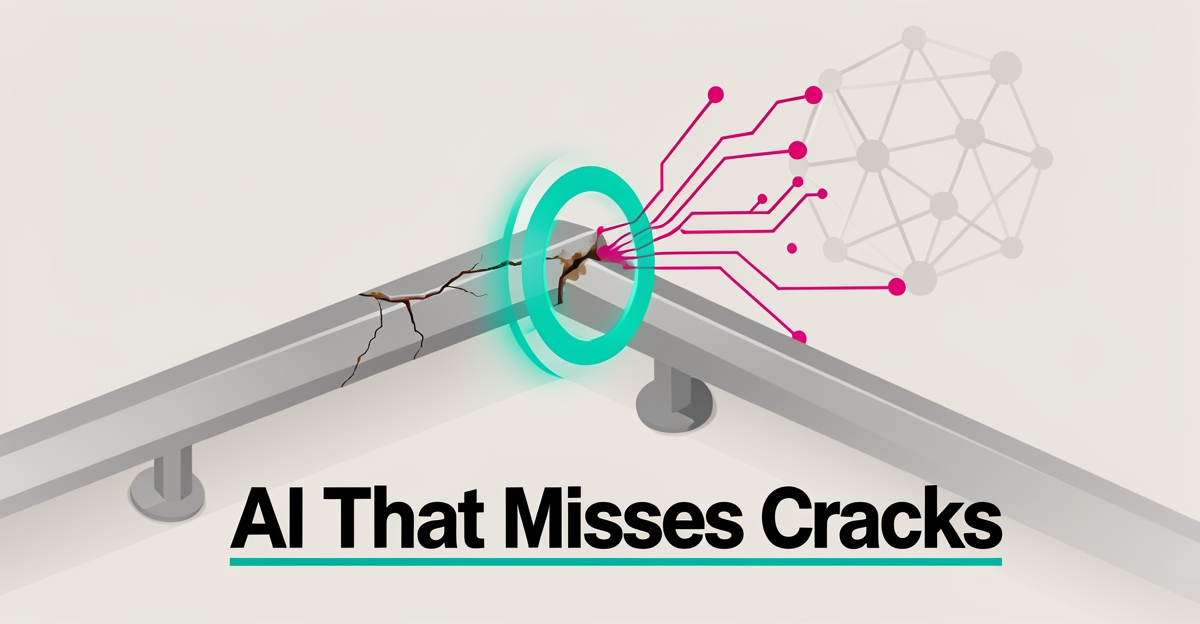
Your AI system confidently flags a corroded handrail joint as "structurally sound" while missing a hairline crack that could trigger catastrophic failure. This isn't hypothetical, it's the predictable outcome when generic AI meets messy, real-world infrastructure data.
The problem mirrors what researchers have repeatedly found when testing pattern-recognition AI in unfamiliar domains: systems that score near-perfect accuracy on familiar inputs can fail completely when encountering modified inputs outside their training data. Slight variations the system hasn't seen before can fool it every time.
**The same vulnerability plagues handrail inspection systems.** Train an AI on pristine warehouse photos of uniform steel railings, and it will struggle when confronting weathered aluminum, powder-coated finishes, or rust patterns that don't match its training set. The system doesn't know what it doesn't know, it just confidently misclassifies critical safety issues.
This data trap catches businesses off-guard because generic AI vendors rarely ask about your specific materials, environmental conditions, or failure modes. They deploy one-size-fits-all models trained on internet images, not the salt-air corrosion patterns of coastal properties or the stress fractures common in high-traffic commercial stairwells.
The consequences extend beyond missed defects. Poor data quality creates cascading failures throughout your workflow:
- False positives that waste technician time on unnecessary site visits
- Missed corrosion that leads to liability exposure and emergency repairs
- Inaccurate repair estimates that erode profit margins and client trust
- Compliance documentation that fails regulatory scrutiny
Industry analyses of predictive maintenance in infrastructure consistently report substantial reductions in failures and extended asset lifespans, but only when systems train on domain-specific data. Generic models can't distinguish between surface discoloration and structural compromise because they've never been taught the difference.
**The solution isn't abandoning AI, it's demanding better data hygiene.** As researchers studying AI pattern recognition have put it: AI can see a pattern and completely misclassify it. There needs to be a human in the loop.
This means building systems that augment inspector expertise rather than replace it. Your data strategy should capture the nuances of your specific repair environment, the metal alloys you encounter, local climate effects, building code variations, and failure patterns unique to your service area.
AIQ Labs approaches this through AI Workflow Builds: we start by auditing the one workflow that costs you the most, often inspection reporting or dispatch, before deploying any automation. We identify gaps in your data, establish validation protocols, and design human-in-the-loop workflows that catch AI errors before they reach the field. This isn't about buying software, it's about engineering systems that understand the difference between cosmetic wear and structural danger, delivered in fix
AI Employees
Hire a team member that works 24/7 — for less than a part-time wage.
AI receptionists, SDRs, dispatchers and 99+ roles. Trained on your business, fully managed.
See If You’re a Fit — AI Employees from $700/mo
Not sure where to start? Ask our AI planner
ed-price milestones.
The businesses that succeed with AI don't start with the technology. They start with honest evaluation of their data assets and clear-eyed recognition that generic solutions fail when safety hangs in the balance.
### Beyond Chatbots: Solving Real Problems in Handrail Maintenance
Handrail repair businesses often chase AI solutions that promise broad transformation but deliver little practical value. The most common mistake? Starting with generic tools like chatbots instead of targeting specific, high-utilization problems. This misalignment leads to wasted investment, frustrated teams, and AI that adds complexity rather than relief.
The wearable AI market offers a cautionary tale: devices positioned as complete replacements for existing tools tended to fail because they asked "what can AI do?" rather than "what problem needs solving?" The lesson generalizes. Surveys suggest roughly eight in ten workers report lacking sufficient time or energy to complete their work, and a majority of workplace conversations happen as ad hoc calls outside scheduled time. AI that doesn't reduce this cognitive overload only makes things worse.
In contrast, predictive maintenance in infrastructure delivers measurable results by solving bounded, high-utilization tasks. By continuously monitoring assets and detecting issues before failure, this approach is widely reported to reduce failures and maintenance costs meaningfully. These systems work because they focus on a narrow job, predicting wear and tear, and execute it consistently within existing workflows.
For handrail repair businesses, the path forward isn't chasing AI for its own sake. It's identifying where technicians lose time, such as repeated emergency calls due to undetected corrosion or scheduling inefficiencies, and applying AI to solve those specific problems. Success requires human oversight, quality data, and phased implementation. Researchers studying AI pattern recognition have warned plainly that there needs to be a human in the loop to prevent misclassification when systems encounter unexpected data.
Sometimes the fastest relief isn't a custom build at all. AI Employees, managed AI receptionists, SDRs, and dispatchers, can take call intake, scheduling, and follow-up off your team's plate at a fraction of the cost of a human hire, while your field operations stay untouched. AIQ Labs helps businesses define these high-impact problems first, ensuring AI serves as a practical tool, not another source of complexity.
### Phased AI Integration: From Pilot to Predictive Maintenance in Handrail Systems
Most handrail repair businesses stall at the pilot stage because they try to automate everything at once instead of proving value in a bounded workflow first.
A realistic rollout starts with a narrow, high-utilization task that plugs into existing tools and scales only after human oversight is proven. That approach mirrors how AIQ Labs structures every engagement: fixed-price milestones, clear governance, and no open-ended consulting loops.
Phase one is a bounded pilot focused on inspection reporting. Crews capture photos and notes in the field, and an AI agent structures the report, flags wear patterns, and routes it to the dispatcher. This reduces the ad hoc context-switching that leaves most workers reporting they lack the time or energy to do their work.
Phase two integrates the pilot with your CRM, scheduling, and work-order systems. Integration prevents data silos and the cognitive overload that sank early over-ambitious AI products. The market asks for relief, not more technology, and successful tools answer where people lose time and clarity.
Phase three adds human-in-the-loop controls for critical decisions. Pattern-recognition failures are real: systems that score near-perfect accuracy on known inputs can be fooled consistently with modified inputs. For handrail systems, a technician reviews AI-flagged risk scores before a truck rolls, avoiding false dispatches that can easily cost four figures per site visit once labor and travel are counted.
Scaling to predictive maintenance is where ROI compounds. Operators shifting from calendar-based checks to condition-informed monitoring commonly report lower maintenance costs, less downtime, and longer asset life, provided the underlying inspection data is clean and labeled.
A phased path that respects existing workflows looks like this:
- Pilot bounded reporting with human review to prove data quality and adoption
- Integrate with existing tools for seamless data flow and a single source of truth
- Add human-in-the-loop escalation and guardrails to manage edge cases and compliance
- Expand to predictive maintenance models once clean, la
AI Development
Still paying for 10+ subscriptions that don’t talk to each other?
We build custom AI systems you own outright. No vendor lock-in. Full control.
See If You’re a Fit — AI Employees from $700/mo
Not sure where to start? Ask our AI planner
beled inspection data is established
For businesses ready to go further, an AI Operating System connects these phases into one operating layer, built in stages, owned outright, and paid for milestone by milestone. See pricing for how Start Monthly, Build in Milestones, and Own It Outright work in practice.
This staged model avoids the common pitfall of over-reliance on generic chatbots and poor data quality. It builds capability, reduces cognitive load, and creates the foundation for **predictive maintenance that cuts downtime and extends asset life** without overwhelming crews.
## Frequently Asked Questions
**Why does generic AI fail at handrail inspection when it claims high accuracy on training data?**
Generic AI systems can perform near-perfectly on familiar patterns but fail badly when faced with data outside their training set, weathered materials, unfamiliar corrosion patterns, because they misclassify what they don't recognize as safe. This creates dangerous blind spots in safety-critical inspections.
**How can handrail repair businesses avoid wasting money on AI that doesn't solve real problems?**
Start by identifying specific, high-utilization pain points, like repeated emergency calls from undetected corrosion, rather than adopting AI for its own sake. The market isn't asking for more technology; it's asking for relief from cognitive overload and inefficiency.
**What is the biggest risk of deploying AI without human oversight in infrastructure inspection?**
The biggest risk is that AI can confidently misclassify critical defects, like mistaking structural damage for surface wear, when encountering unexpected data. Research on pattern recognition has shown such systems can be fooled consistently by inputs outside their training distribution. Human-in-the-loop controls are essential to catch these errors before they reach the field.
**What results can handrail repair businesses expect from AI-powered predictive maintenance when implemented correctly?**
When trained on domain-specific data, predictive maintenance is widely reported to reduce infrastructure failures, extend asset lifespans, and cut maintenance costs meaningfully. Exact figures vary by operation, which is why AIQ Labs doesn't quote generic numbers, we scope your workflow first and measure against your own baseline.
**Why do most AI pilots in handrail repair businesses fail to scale beyond the initial test phase?**
Most pilots fail because businesses try to automate too much at once instead of starting with a bounded, high-utilization task, like AI-assisted inspection reporting, that proves value and integrates smoothly into existing workflows before expanding.
**How does AIQ Labs help handrail repair businesses avoid common AI adoption pitfalls?**
AIQ Labs starts with a Workflow Build: we audit data quality around your costliest workflow, identify gaps, and design human-in-the-loop processes that prevent AI errors from reaching the field. AI augments inspector expertise rather than replacing it, and you pay in milestones, not open-ended retainers.
## The Path Forward: Building AI That Works as Hard as You Do
The businesses that thrive with AI aren't the ones chasing the shiniest tools, they're the ones solving real problems with clean data, human oversight, and phased rollouts that respect how work actually gets done. Whether it's preventing a four-figure false dispatch or catching corrosion before it becomes a liability, the difference between AI that delivers and AI that disappoints comes down to strategy, not software. AIQ Labs helps handrail repair businesses move beyond generic chatbots and pilot purgatory by starting with what matters: auditing your data quality, identifying high-impact workflows, and building systems that augment your team's expertise rather than replace it. With 200+ multi-agent systems deployed, we know what works and what doesn't. If you're ready to move past the hype, start with a two-minute Fit Check to map your biggest bottleneck and see if there's a clear win worth pursuing. No pressure, no sales pitch, just an honest assessment of where AI can deliver real ROI for your operation.
AI Transformation Partner
Make AI your competitive advantage — not just another tool.
Strategy, implementation and ongoing optimization. One partner, end to end.
See If You’re a Fit — AI Employees from $700/mo
Not sure where to start? Ask our AI planner