Why Most Lawn Care Businesses Fail at AI Adoption (And How to Avoid It)
Key Facts
- 47% of AI value is lost when implementations lack a strong operational foundation according to TechRadar analysis.
- 93% of major enterprises are actively exploring agentic AI initiatives per industry research.
- 66% of CEOs report measurable business benefits from generative AI initiatives based on recent surveys.
- Jobber serves 350,000+ active users with a 4.5-star aggregate rating as of late 2026.
- The greatest AI value emerges when AI adaptability combines with ERP operational discipline per TechRadar analysis.
- Organizations with strong foundations are more likely to sustain AI initiatives long-term according to enterprise research.
- AI does not eliminate operational complexity, it exposes underlying weaknesses as PwC's Jennifer Colapietro observes.
Hire a team member that works 24/7 — for less than a part-time wage.
AI receptionists, SDRs, dispatchers and 99+ roles. Trained on your business, fully managed.
Not sure where to start? Ask our AI planner
The Operational Foundation Gap Exposing AI Failures
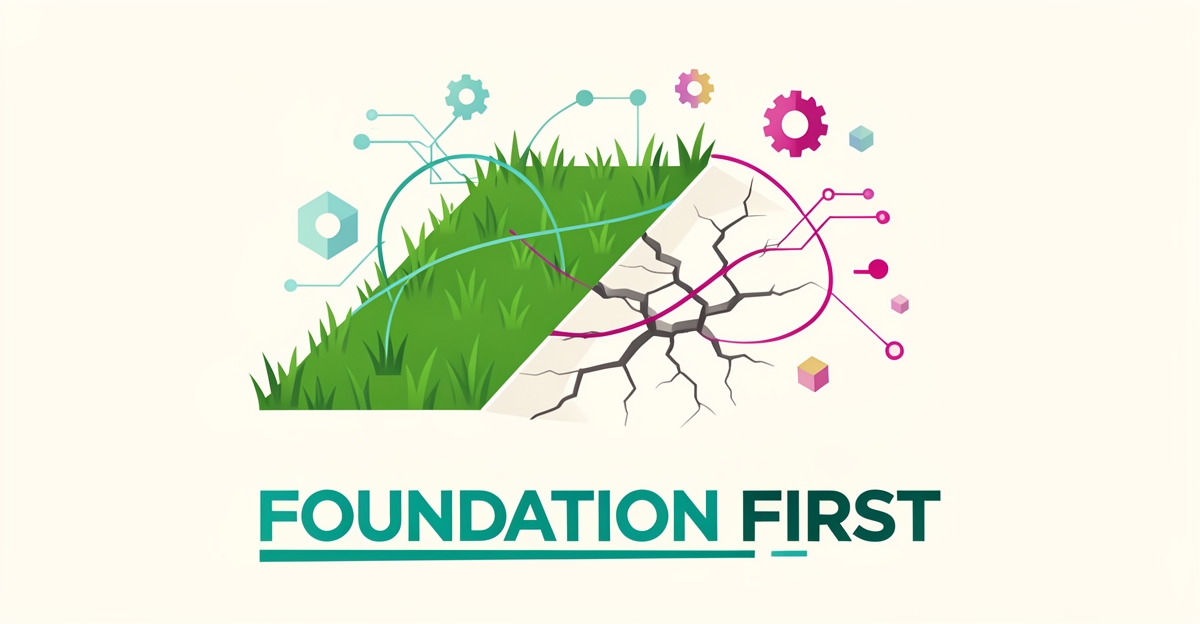
Many lawn care businesses rush into AI adoption without first addressing the operational cracks beneath the surface, setting themselves up for failure. Research shows that 47% of AI value is lost when implementations lack a strong operational foundation, turning promising initiatives into costly experiments. As Jennifer Colapietro of PwC US observes, "AI does not eliminate operational complexity, it exposes it," revealing weaknesses in data, processes, and governance that were previously masked by manual workarounds.
In field service operations like lawn care, these gaps often manifest as data silos where customer information, job schedules, and equipment logs live in disconnected systems, spreadsheets, paper forms, or standalone apps, making it impossible for AI to access the unified, real-time data it needs to function accurately. Process inconsistency further undermines AI reliability; when technicians follow different routines for the same task, such as varying mowing patterns or chemical application logging, AI models trained on one workflow fail when faced with another, leading to errors in scheduling, routing, or service recommendations. Without clear governance, there’s no framework to define who oversees AI decisions, how data quality is maintained, or how compliance with environmental regulations is tracked, especially critical given the lack of native chemical application logging in platforms like Jobber.
These foundational weaknesses don’t just hinder AI, they amplify operational friction, erode technician trust, and stall adoption before scaling can begin. AIQ Labs helps lawn care businesses diagnose and close these gaps through structured readiness assessments that evaluate data infrastructure, process standardization, and governance readiness before any AI is built. By strengthening the operational core first, cleaning data, documenting workflows, and establishing clear ownership, businesses create the conditions where AI can reliably automate dispatching, optimize routes, and enhance customer communication without exposing hidden fragility. The result isn’t just fewer failed pilots, but a sustainable path to scaling AI as a true force multiplier across field service operations.
Common Pitfalls Stalling Lawn Care AI Projects
Many lawn care businesses jump into AI projects only to see them stall before delivering real value. A common starting point is fragmented data and poor integration with tools like Jobber, which holds a 4.5-star rating across platforms with over 350,000 active users but lacks native chemical application logging, creating compliance gaps. Without centralized, accurate data on service history, chemical usage, and customer preferences, AI systems cannot generate reliable insights or automate critical workflows effectively.
Inconsistent routing and scheduling processes further undermine AI potential, as algorithms depend on predictable, repeatable inputs to optimize routes or predict labor needs. When field teams use ad-hoc methods or multiple disconnected apps for dispatching, AI recommendations are ignored or overridden, eroding trust in the technology. This lack of process standardization means even well-designed AI tools fail to scale beyond isolated pilots, especially when businesses prioritize buying AI-first tools without aligning them to existing ERP or operational systems.
Research shows that 93% of major enterprises are exploring agentic AI initiatives, yet 47% of potential value is lost when AI is implemented without a strong operational foundation. The greatest returns come when AI works alongside ERP systems that provide process discipline, data governance, and execution control, turning AI from a experimental tool into a sustainable driver of efficiency. For lawn care businesses, this means assessing readiness, cleaning data, standardizing workflows, and integrating AI thoughtfully rather than chasing isolated use cases. AIQ Labs helps organizations navigate this foundation-first approach through strategic AI transformation consulting, ensuring AI adoption builds on solid ground.
Foundation-First AI Strategy for Field Service
Lawn care owners are buying AI tools before they can trust their own data, and the results show up in missed routes, duplicate entries, and stalled projects. A foundation-first approach flips that sequence by stabilizing operations first, then layering intelligence on top.
AI does not eliminate operational complexity, it exposes it. PwC research highlighted by TechRadar warns that AI often reveals underlying weaknesses in an organization’s operational framework. For field service, that means inconsistent scheduling, fragmented customer records, and tribal knowledge that never reaches the system.
The cost of skipping the foundation is measurable. Industry analysis finds 47% of value is lost when AI is implemented without a strong operational foundation. Yet the appetite remains high, with 93% of major enterprises actively exploring agentic AI initiatives and 66% of CEOs reporting measurable business benefits from generative AI initiatives.
A foundation-first strategy starts with operational readiness assessment. That means mapping recurring workflows like route planning and chemical application logging, identifying where data lives, and standardizing how work is captured. Field service coverage shows platforms such as Jobber hold a 4.5-star aggregate rating with 350,000+ active users, underscoring how central ERP-style systems are to daily execution.
Data quality and integration come next. Clean, connected data is the fuel for reliable automation. Businesses should prioritize:
- Consolidating customer, property, and service history into a single source of truth
- Standardizing process steps for scheduling, dispatch, and invoicing
- Establishing governance for data entry, updates, and access controls
- Auditing integrations between field apps, accounting, and CRM tools
Modern ERP is evolving from a system of record to a system of execution. When AI and ERP work together, AI gains operational discipline, scalability, and governance while ERP gains adaptability. TechRadar analysis notes the greatest value is created when AI and ERP work together, combining adaptability with operational discipline.
That pairing enables sustainable value. Organizations that build AI on top of operational foundations are more likely to sustain their initiatives long-term, using intelligence to accelerate performance and improve decision-making rather than creating new complexity. For lawn care, this looks like AI-assisted route optimization, voice-enabled job updates, and automated quote generation that trust the underlying data.
A strategic assessment and phased rollout reduces risk. AIQ Labs works with field service teams through AI readiness assessments that evaluate technology stack, data infrastructure, and team capabilities before any build begins. The goal is not faster AI, it is reliable AI that compounds over time. Managed AI staff can handle repetitive tasks while your team focuses on high-value work.
Phased AI Rollout That Works for Lawn Care Teams
The difference between AI that delivers ROI and AI that becomes expensive shelf-ware comes down to sequence. Most lawn care companies jump straight to tool selection, chatbots, routing algorithms, predictive models, without first asking whether their operations can support them. Research shows that 47% of AI value is lost when implementation skips the operational foundation, and organizations that build on solid ground are far more likely to sustain their initiatives long-term.
Enterprise analysis confirms that AI doesn't eliminate complexity, it exposes it. For field service teams juggling recurring mowing routes, chemical compliance logging, and high-volume customer communication, those cracks show up fast. A phased rollout treats AI like any other operational upgrade: assess, pilot, integrate, govern, then scale.
- Assess readiness across data quality, process documentation, and team capacity before buying a single tool
- Pilot in focused workflows like dispatch coordination and customer communication where failure risk is low and feedback loops are tight
- Integrate with existing CRM and ERP systems so AI agents write to the same system of record your team already trusts
- Establish governance frameworks for compliance, data privacy, and human-in-the-loop escalation paths
- Scale with managed AI employees that operate within defined roles, dispatcher, intake specialist, scheduler, rather than generic automation
Field service research highlights that technician morale suffers when systems fail mid-season, making reliability non-negotiable. Industry platforms like Jobber now serve 350,000+ users with 4.5-star ratings, proving the operational backbone exists, AI just needs to plug into it properly. The greatest value emerges when AI adaptability meets ERP discipline, creating a governed environment where automation scales without chaos.
AIQ Labs structures this progression through an AI Readiness Assessment that maps your current maturity stage, whether you're exploring, piloting, or ready to scale, then builds a phased roadmap tied to measurable milestones. The goal isn't faster adoption. It's adoption that survives first contact with peak season. Rebuild your most expensive workflow with our fixed-price, phased approach.
Still paying for 10+ subscriptions that don’t talk to each other?
We build custom AI systems you own outright. No vendor lock-in. Full control.
Not sure where to start? Ask our AI planner
Frequently Asked Questions
Why do lawn care AI projects fail even when we buy the right tools?
Do we need to fix our operations before trying AI?
What’s the biggest data problem for lawn care AI?
Is AI adoption actually happening in our industry?
Will AI hurt technician morale if systems fail mid-season?
What’s a safe first step for AI in lawn care?
Build the Foundation First, Then Let AI Do the Heavy Lifting
AI won’t fix broken operations in lawn care, it will expose them. The businesses that fail rush into tools while data lives in silos, processes vary by technician, and governance around chemical logging and compliance is missing. That gap is costly; research shows 47% of AI value is lost without a strong operational foundation. Success starts with a foundation-first approach: assess readiness, consolidate customer and service data into a single source of truth, standardize scheduling and dispatch workflows, and define clear ownership for AI decisions. Then pilot in low-risk areas like dispatch coordination and customer communication, integrate with the ERP systems teams already trust, and scale with governance in place. AIQ Labs helps field service teams move through this progression with an AI Readiness Assessment and phased roadmap tied to measurable milestones. Start the Fit Check at aiqlabs.ai/apply for a free 30-minute strategy call to map your biggest bottleneck and identify high-ROI automation opportunities, no pitch, just clarity.
Make AI your competitive advantage — not just another tool.
Strategy, implementation and ongoing optimization. One partner, end to end.
Not sure where to start? Ask our AI planner