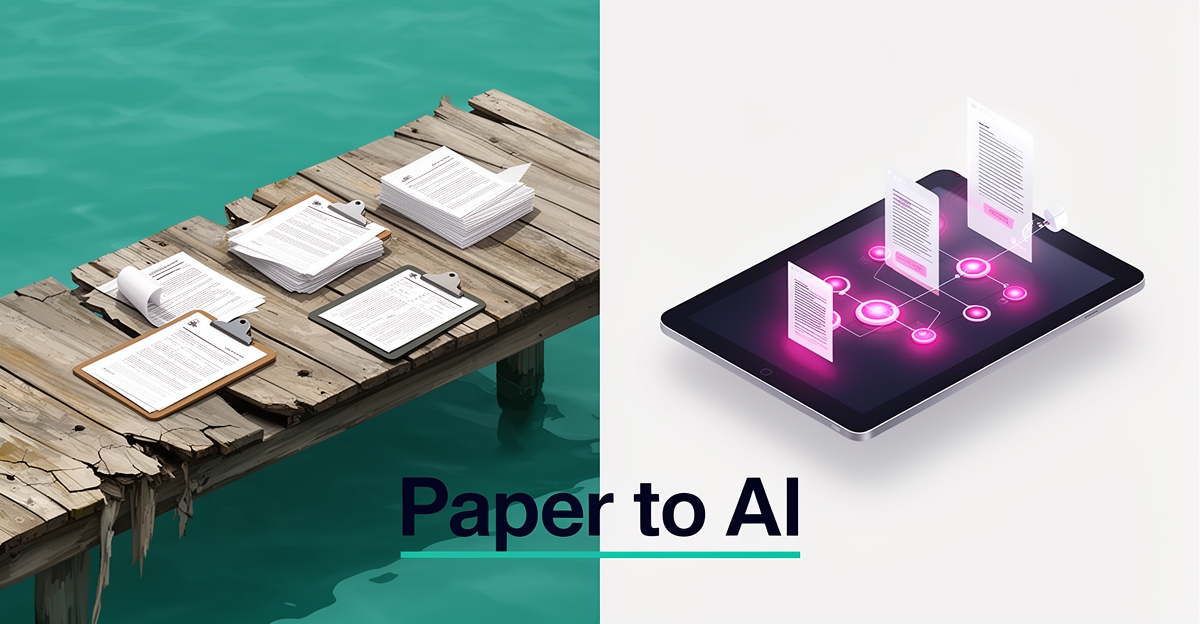
Why Most Marine Contractors Still Rely on Paper-Based Submittals (And How AI Fixes It)
Key Facts
- Industry reports as of late 2026 suggest AI-assisted plan review can catch substantially more code violations than manual review alone
- Construction workforce analyses continue to project a significant skilled-labor shortfall through 2030
- Marine contractors often stick with paper submittals due to lack of awareness, limited technical expertise, and constrained resources
- Slow digitalization in construction is commonly tied to concerns about data security, privacy and intellectual property
- AI can automate document collection, validation and digital routing, reducing errors and improving efficiency
- AI in construction is increasingly used to improve project planning, boost safety and support sustainability goals
- Paper-based submittals lead to delays, errors and compliance issues that compound into costly rework and reputational damage
Hire a team member that works 24/7 — for less than a part-time wage.
AI receptionists, SDRs, dispatchers and 99+ roles. Trained on your business, fully managed.
Not sure where to start? Ask our AI planner
The Hidden Cost of Paper Submittals in Marine Construction
On a marine construction site, a single missing signature on a submittal package can idle a crew for days. Yet many contractors still route critical approvals through printed binders, wet signatures, and couriered paperwork, a process that quietly drains margins long before anyone notices.
The costs are easy to underestimate because they hide inside the schedule. Paper-based submittals lead to delays, errors, and compliance issues that compound into costly rework and reputational damage. When a transmittal sits in a review pile or a spec revision gets missed, the correction happens on the water, where fixing mistakes is far more expensive than catching them during document review.
The scale of the problem becomes clearer when you look at what modern review tools can catch. Industry reporting as of late 2026 suggests AI-assisted plan review can identify substantially more code violations than human reviewers working alone, a gap that illustrates how much slips through manual document checks. Every violation that survives a human-only review cycle is a potential change order, a potential rework cycle, or a potential compliance finding down the line.
So why hasn't the marine sector moved on? The barriers are well documented:
- Lack of awareness about what digital submittal tools can do
- Limited in-house technical expertise to evaluate and deploy them
- Resource constraints that make "the way we've always done it" feel safer
- Ongoing concerns about data security, privacy, and intellectual property
Those concerns are real, but they come at a price. The industry's slow adoption of digitalization is partly driven by worries over data security and intellectual property, yet the alternative is a paper trail that offers no searchability, no audit history, and no way to prove compliance beyond a filing cabinet.
There's also a labor dimension that makes manual document handling riskier every year. Construction workforce analyses continue to project a significant skilled-labor shortfall through 2030. When experienced project engineers are scarce, spending their hours chasing signatures and re-keying submittal data is a cost the industry can no longer afford.
The fix is well within reach. AI systems can automate document collection, validation, and digital routing, reducing errors and improving efficiency, the approach AIQ Labs applies when rebuilding complex submittal workflows with accuracy and full audit trail tracking. For marine contractors, the question is no longer whether paper submittals cost money. It's how much longer they can afford to keep paying it.
Why Marine Contractors Haven't Digitized (Yet)
Despite growing interest in digital tools, many marine contractors continue to rely on paper-based submittals due to systemic barriers that go beyond simple resistance to change. A lack of awareness about available technologies, limited technical expertise within teams, and constrained financial and human resources often prevent firms from initiating digital transformation. These challenges are compounded by concerns over data security and the protection of sensitive project information, which remain top of mind for contractors handling high-value, regulated marine infrastructure projects. The construction sector's slow adoption of digitalization is frequently tied to fears around privacy, intellectual property, and the perceived complexity of integrating new systems into existing workflows.
- Marine contractors still rely on paper-based submittals due to lack of awareness, technical expertise, and resources.
- The construction industry is slow to adopt digitalization due to concerns about data security, privacy, and intellectual property.
- AI-assisted plan review catches issues manual review misses, highlighting the efficiency gains of digital alternatives.
For marine contractors operating in remote coastal environments or managing complex regulatory approvals, the perceived risks of digitization, such as data breaches or system incompatibility, often outweigh the anticipated benefits. Without clear guidance or trusted partners to navigate these concerns, many firms default to familiar paper processes, even as inefficiencies mount. AIQ Labs addresses these barriers by starting with an honest assessment of readiness and designing secure, compliant systems built for real-world marine construction workflows. By focusing on practical implementation rather than theoretical promise, the goal is to turn digitalization from a perceived risk into a reliable operational advantage.
How AI Automates Submittal Workflows from Collection to Audit Trail
For marine contractors still managing submittals with paper, the shift to AI-powered automation offers a clear path to eliminating manual bottlenecks. AI systems can now handle the entire submittal lifecycle, from initial document collection to final audit trail, catching issues that manual review routinely misses. This level of precision is critical in marine construction, where even minor documentation oversights can trigger costly rework, safety violations, or project delays. By replacing manual handling with intelligent automation, contractors gain not only speed but also the reliability needed to meet stringent regulatory and client requirements.
AI-driven document collection begins with smart ingestion tools that automatically capture submittals from email, portals, or field uploads, then classify and route them to the correct workflow without human intervention. Once collected, AI validation engines cross-check documents against project specs, codes, and compliance standards, flagging discrepancies in real time, something paper-based systems simply cannot do at scale. Every submittal version, approval, and revision is logged, eliminating the guesswork and lost paperwork that plague paper-based processes and keeping the whole trail audit-ready.
Digital routing powered by AI ensures documents move seamlessly between stakeholders, designers, engineers, regulators, and field teams, based on predefined rules and real-time project status. Unlike static email chains or physical handoffs, AI routing adapts to workflow changes, sends intelligent reminders, and escalates overdue items automatically. This end-to-end automation doesn't just save time; it creates a single source of truth where all stakeholders access the same verified document version. AIQ Labs builds these production-ready systems using multi-agent architectures, the same approach behind the 200+ multi-agent systems it has deployed and the four live SaaS products it runs daily, so marine contractors don't just digitize submittals, they transform them into a compliant, auditable, self-improving process. The result is fewer delays, fewer manual errors, and a clear audit trail that satisfies both internal quality controls and external regulatory demands, all without adding headcount or complexity. To see how this applies to your specific submittal workflow, book a free 30-minute strategy call to map your biggest automation opportunity.
From Paper to AI: A Practical Implementation Path for Marine Contractors
You don't need a company-wide digital transformation to escape paper-based submittals, you need a deliberate, phased path that starts with one workflow and proves itself before it scales. With the construction sector facing a projected skilled-labor shortfall through 2030, the contractors who automate document handling first will absorb the labor squeeze best.
The starting point is an honest assessment of your current submittal workflow. Map every step: how documents arrive, who reviews them, where they sit waiting, and how approvals get routed back. Most marine contractors discover that delays, errors, and compliance issues trace back to a handful of manual handoffs, not a fundamental process problem.
Once you've identified the bottlenecks, pilot AI on a single high-friction workflow. AI systems can automate document collection, validation, and digital routing, which means your pilot should focus on exactly those three functions for one project or one submittal category. The goal is measurable proof, not perfection.
A practical pilot checklist looks like this:
- Digitize inbound submittal documents and let AI extract and validate the key data automatically
- Route approvals digitally with a complete audit trail for every decision
- Track baseline metrics, cycle time, error rate, rework, against your paper process
- Keep a human in the loop for final sign-off during the first 30 to 60 days
The results from adjacent applications are compelling. AI-assisted plan review catches issues that human reviewers routinely miss, a signal of what rigorous automated validation can do for submittal quality control. And beyond efficiency, AI helps improve project planning, boost safety, and make projects more sustainable, benefits that compound as usage grows.
Scaling is where many contractors stall, which is why the engagement structure matters as much as the technology. AIQ Labs offers three entry points built for risk-averse adopters. Start Monthly with an AI Employee, a managed AI staff member handling document collection, validation, and routing at roughly 80% less cost than a human hire, with the build, training, integrations, monitoring, and improvements included, and the flexibility to pause or adjust anytime.
For contractors ready to rebuild the one submittal workflow that costs them the most, Build in Milestones through AI Workflow Builds splits the system into fixed-price phases. You approve and pay for each phase as it ships, and you can stop anytime while keeping everything built to date. And for firms that want one connected operating layer across the whole submittal department, AI Operating Systems is built in phases and owned outright, no vendor lock-in, no licensing hostage-taking.
The path from paper to AI isn't a leap. It's a sequence: assess one workflow, pilot with clear metrics, then scale with ownership. Contractors who follow it convert a chronic source of delays and compliance risk into a durable competitive advantage.
Still paying for 10+ subscriptions that don’t talk to each other?
We build custom AI systems you own outright. No vendor lock-in. Full control.
Not sure where to start? Ask our AI planner
Frequently Asked Questions
Why do most marine contractors still use paper-based submittals?
What are the real costs of sticking with paper submittals in marine construction?
How exactly does AI automate the submittal process for marine contractors?
Is AI-powered document review actually more accurate than human review?
Can AI submittal automation help with the construction labor shortage?
Do we need a full digital transformation to start using AI for submittals?
The Tide Is Turning on Paper Submittals
The marine construction industry stands at a crossroads. On one side lies the familiar comfort of paper-based submittals, binders, wet signatures, and couriered documents that drain margins through delays and compliance risks. On the other lies AI-powered automation that captures documents, validates them against specs, and routes approvals with complete audit trails. With AI-assisted review catching what manual review misses, and a projected skilled-labor shortfall through 2030, the case for change is clear. The path forward doesn't require a company-wide overhaul, it starts with one workflow, one pilot, one measurable win. AIQ Labs builds these production-ready systems with flexible engagement models: start monthly with an AI Employee, rebuild one workflow in milestones, or build a full AI Operating System you own outright. Ready to stop paying the hidden tax of paper submittals? Take the 2-minute Fit Check and discover your highest-impact automation opportunity in a free 30-minute strategy call.
Make AI your competitive advantage — not just another tool.
Strategy, implementation and ongoing optimization. One partner, end to end.
Not sure where to start? Ask our AI planner