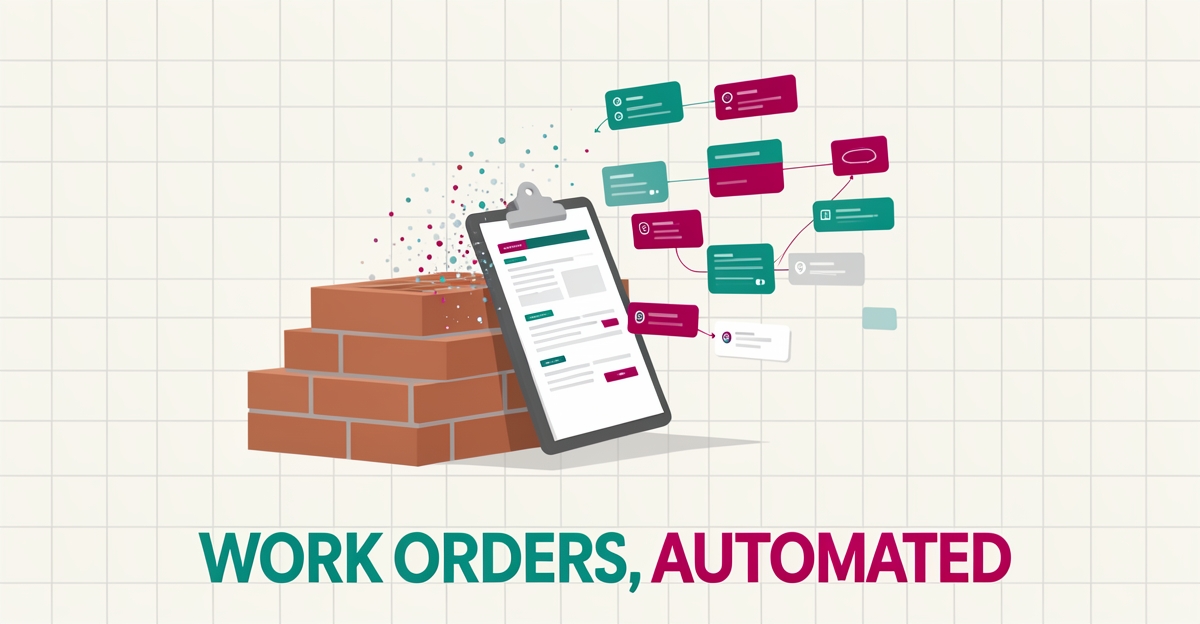
Why Most Masonry Contractors Still Use Manual Work Orders, And How AI Can Fix That
Key Facts
- Weather routinely claims a large share of potential working days in seasonal regions like the upper Midwest
- A standard pallet of bricks typically weighs around 2,000 pounds; 8-inch CMU pallets often reach 2,500 pounds
- Masonry typically requires a minimum 7-day curing time before loads bear weight
- Bricks generally need 10-15 minutes of soaking before laying; mortar ratios of 1:4 or 1:6 and ~10 mm joint thickness are standard practice
- Manual work orders break down under exactly these variables: weight, weather, chemistry, and time
Hire a team member that works 24/7 — for less than a part-time wage.
AI receptionists, SDRs, dispatchers and 99+ roles. Trained on your business, fully managed.
Not sure where to start? Ask our AI planner
The Manual Work Order Trap in Masonry
For masonry contractors, the workday often begins with a stack of paper and a prayer for clear skies. Despite the industry's physical sophistication, the back office remains stubbornly analog, tethered to manual work orders that crumble under the weight of real-world variables.
The trap is set by the trade's inherent complexity. Unlike controlled manufacturing environments, masonry operates at the mercy of atmospheric conditions. In seasonal regions like the upper Midwest, weather conditions can claim a substantial share of potential working days each year. When rain delays a pour or freezing temperatures halt mortar curing, paper-based schedules become obsolete instantly, yet updating them requires phone tag and physical erasure rather than instant digital recalibration.
Material logistics compound the chaos. A standard pallet of bricks typically weighs around 2,000 pounds, while 8-inch CMU pallets often tip the scales at 2,500 pounds. Manual takeoffs must account for these massive material movements alongside precise chemical requirements, mortar ratios of 1:4 or 1:6, joint thicknesses of roughly 10 mm, and the minimum 7-day curing time typically required before loads can bear weight. When these specifications live on carbon copies or Excel sheets, version control vanishes.
The workflow breakdown typically follows a predictable pattern:
- Foremen text photos of handwritten change orders that never reach the office
- Crews arrive on-site only to find material deliveries delayed by miscommunicated schedules
- Project managers discover too late that brick soaking times (10-15 minutes) weren't factored into morning labor allocations
- Invoices stall because completed work tickets sit in truck glove compartments for weeks
This administrative friction explains why thousands of contractors have migrated to specialized platforms, yet many more remain trapped in paper workflows. The result is a cascade of invisible costs: estimators recalculating material loads from scratch, coordinators playing phone tag to verify crew locations, and owners unable to distinguish between weather delays and productivity losses.
AIQ Labs observes this pattern across the trades, businesses possess deep craft expertise but lack the digital infrastructure to match. When a 2,500-pound pallet arrives at the wrong site because a faxed work order was illegible, or when a crew stands idle because no one updated the schedule after a morning rain delay, the problem isn't worker competence. It's that manual systems cannot process the variables that define masonry work: weight, weather, chemistry, and time.
How AI Automates Work Order Creation, Assignment, and Tracking
Weather-related delays already cost masonry contractors significant time, and manual work order systems compound those losses by requiring crews to wait for paper-based approvals or re-enter data when schedules shift unexpectedly. This inefficiency is especially costly given the physical demands of masonry, where standard pallets of bricks weigh roughly 2,000 pounds and 8-inch CMU blocks often reach 2,500 pounds, making accurate material planning critical to avoid delays or overstocking.
AI automation transforms work order management by generating detailed, data-driven orders instantly from project inputs like design files or site photos. These systems pull material specifications, labor requirements, and equipment needs directly from integrated tools, eliminating manual takeoffs and reducing errors in estimating. For example, AI can apply the correct mortar mixing ratios (1:4 or 1:6) and joint thickness (~10 mm) based on project plans, ensuring crews receive accurate instructions without guesswork. Once created, the work order is automatically assigned to the most qualified crew using skill-tracking logic that considers certifications, availability, and proximity to the job site, optimizing dispatch in ways manual scheduling cannot match.
Progress tracking becomes seamless as AI monitors job completion through mobile check-ins and image recognition, comparing actual work against the original work order specifications in real time. This enables immediate adjustments if curing times fall short of the 7-day minimum or if material usage deviates from estimates, preventing rework before it escalates. By connecting these automated steps, creation, assignment, and tracking, AI closes the loop between planning and execution, turning what was once a fragmented, error-prone process into a continuous workflow. For masonry contractors seeking to reduce administrative burden and improve field efficiency, this level of automation represents a practical step toward modernizing operations without replacing the skilled craftsmanship at the heart of their trade. To see how this applies to your specific work order challenges, start with a free strategy call to identify high-ROI opportunities tailored to your business.
From Paper to Production: Implementation for Masonry Teams
Masonry teams looking to move beyond paper-based work orders can start with a focused, phased approach that minimizes disruption while building confidence in the new system. The transition begins with mapping current workflows, identifying where delays occur in job creation, crew assignment, or material tracking, so AI automation targets the right pain points. This discovery phase ensures the solution fits real-world constraints like weather-dependent scheduling, which routinely disrupts outdoor work in seasonal regions.
Implementation follows a structured rollout: first digitizing existing work order templates into a centralized system, then layering in AI for intelligent dispatch based on crew location, skill sets, and material availability. Training is role-specific and hands-on, using actual job scenarios so foremen and crews see immediate value in reduced phone tag and fewer missed details. Data security is addressed through encrypted tool integrations and access controls, with AIQ Labs managing compliance verification during deployment. To ease change resistance, teams can begin with a single workflow fix, like automating work order creation from client requests, through an AI Workflow Build under the Build in Milestones model, validating results before scaling. This approach keeps investment aligned with measurable gains, such as faster response times and fewer errors in material takeoffs, where standard pallets of bricks weigh roughly 2,000 pounds and CMU blocks often 2,500 pounds. Progress is tracked through weekly check-ins, allowing adjustments without derailing the timeline, and teams retain full ownership of configured workflows as they advance. The process naturally extends to ongoing optimization, where AI learns from completed jobs to refine scheduling and resource allocation over time. For masonry contractors ready to begin, the first step is a free strategy call to map their specific bottlenecks and ROI potential. Complete the two-minute Fit Check, then schedule your free 30-minute strategy call to explore how AI workflow automation can transform your work order management, no obligation, just clarity on your AI opportunity.
The Blueprint Is Already in Your Hands
Masonry has always been a trade of precision, where a 10 mm joint and a 1:4 mortar ratio separate lasting structures from costly failures. Yet for too long, that precision has ended at the job site, while the office runs on guesswork and carbon copies. When weather eats into working days and a single misplaced pallet means 2,500 pounds of schedule disruption, manual work orders aren't just inefficient, they're a structural weakness in your business model. The shift to AI-powered workflow automation isn't about replacing the craft; it's about finally giving your back office the same engineering rigor your crews bring to the wall. AIQ Labs has deployed 200+ multi-agent systems and runs four live SaaS products daily, building custom systems for contractors who are ready to own their technology rather than rent it. If you're tired of watching profits erode through scheduling chaos and illegible change orders, start with a two-minute Fit Check at https://aiqlabs.ai/apply, then book a free 30-minute strategy call at https://aiqlabs.ai/book to map your specific bottlenecks. We'll help you identify the highest-ROI automation opportunities, no obligation, just a clear blueprint for building a stronger operation.
Make AI your competitive advantage — not just another tool.
Strategy, implementation and ongoing optimization. One partner, end to end.
Not sure where to start? Ask our AI planner