Why Most Mattress Disposal Businesses Fail at AI Implementation (And How to Avoid It)
Key Facts
- Industry forecasts project strong double-digit growth in robotic mattress recycling through the 2030s, with automated sorting and dismantling driving the expansion
- Major mattress retailers and manufacturers are already applying AI to supply chain and product decisions, raising the bar for the whole industry
- Smart mattress and sleep-tracking products have become a significant revenue driver for leading mattress brands, showing AI's proven commercial value in the sector
- Most AI initiatives across industries stall at the pilot phase due to poor planning and weak integration with real workflows
- AIQ Labs has deployed 200+ multi-agent systems and runs 4 live SaaS products daily, proof of production-grade AI, not slideware
Hire a team member that works 24/7 — for less than a part-time wage.
AI receptionists, SDRs, dispatchers and 99+ roles. Trained on your business, fully managed.
Not sure where to start? Ask our AI planner
The AI Gap in Mattress Disposal and Recycling
The mattress industry is racing toward automation while disposal and recycling operators watch from the sidelines. AI is already reshaping how mattresses are made, sold, and serviced, leaving a widening gap for businesses that handle end-of-life products.
AI is transforming core operations across the industry. Smart beds and sleep-tracking products have become a major revenue driver for leading brands, and manufacturers increasingly use AI to analyze customer data and inform product design. Retailers are applying AI to demand forecasting and supply chain decisions as well. The direction is clear: the companies that make and sell mattresses are investing in AI, and the ones that collect, dismantle, and recycle them mostly are not.
Recycling is moving toward automation too. Industry forecasts as of late 2026 project strong growth in robotic mattress recycling over the next decade, with AI-powered sorting systems and robotic dismantling technologies improving the efficiency of mattress recycling at scale. Early adopters in materials recovery are already proving the model.
Disposal businesses lag behind because the use cases look different from retail. Common gaps include:
- No data infrastructure to feed sorting and routing decisions
- Generic tools chosen without compliance or workflow fit
- Underestimated need for high-quality data and transparent AI decision-making
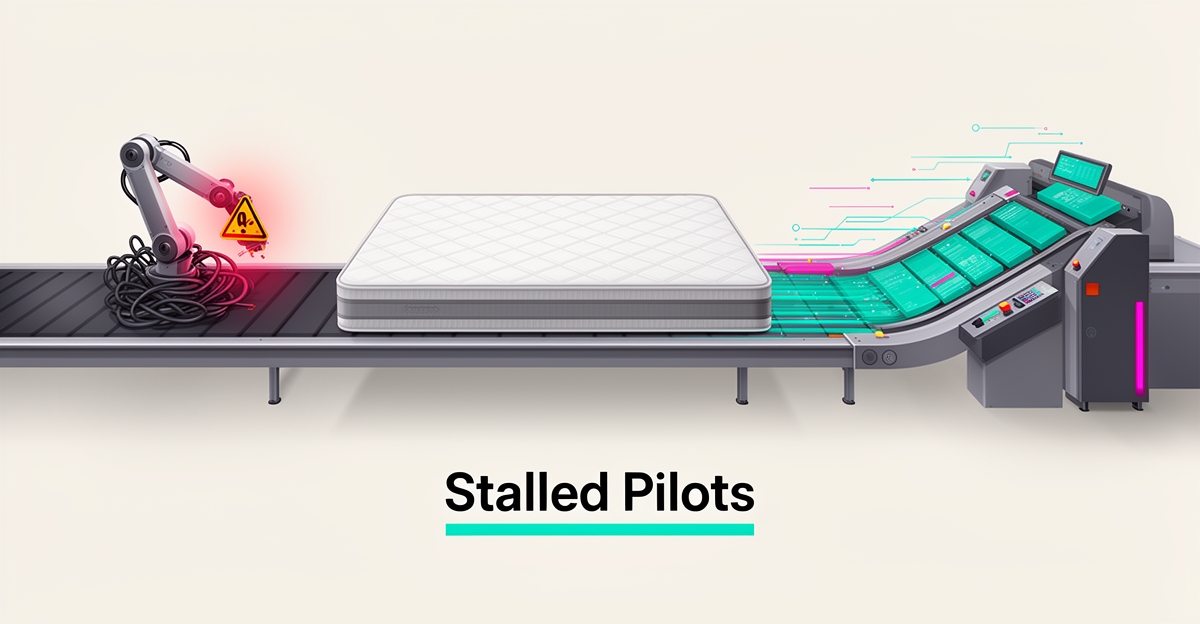
The result is pilot projects that stall before scaling. Many operators experiment with AI tools but fail to connect them to real workflows like intake, classification, logistics, and resale recovery. Without an implementation roadmap tailored to service operations, AI becomes a cost instead of a capability.
This is where strategic guidance matters. AIQ Labs works with service businesses to design AI implementations that prioritize practical, compliant solutions over hype, whether that's [AI Employees](/ai-employees) handling intake and dispatch, a targeted [Workflow Build](/workflow-builds) for your costliest process, or a full [AI Operating System](/ai-operating-systems) connecting the whole operation. The focus is on building systems that fit existing processes, data realities, and regulatory requirements from day one.
The gap is visible and growing. While manufacturers and retailers capture value from personalized sleep experiences and automated supply chains, disposal and recycling operators risk being left with manual processes in an increasingly automated industry.
Three Fatal Pitfalls Killing AI Projects
Many mattress disposal businesses stumble when implementing AI, not because the technology fails, but because they overlook foundational requirements. Ignoring compliance and transparency is a critical misstep, AI systems that process waste handling data must meet strict regulatory standards for traceability and accountability, yet many projects launch without audit-ready documentation or explainable decision-making. This erodes trust with both regulators and customers, especially when AI-driven sorting or routing decisions lack visibility into how materials are classified or diverted from landfills.
Underestimating data quality needs is another fatal flaw. AI systems in recycling operations depend on clean, consistent inputs, such as sensor readings from mattress components or historical disposal logs, but many businesses feed fragmented or noisy data into models, expecting accurate outcomes. AI applications across industries routinely underperform when training data lacks standardization, leading to poor sorting accuracy and unreliable forecasts. Without investing in data cleansing, labeling, and integration workflows upfront, even advanced models produce garbage-in, garbage-out results that undermine operational confidence.
Choosing generic off-the-shelf tools instead of purpose-built systems compounds these issues. Mattress disposal workflows involve unique variables, material composition tracking, hazardous component identification, and jurisdictional recycling regulations, that generic AI platforms aren't designed to handle. Businesses that force-fit these tools often face costly customizations, integration breakdowns, and compliance gaps. A smarter approach is [AI Workflow Builds](/workflow-builds): rebuilding the one workflow that costs you the most, at a fixed price, in phases, so the system is embedded in your regulated waste workflows from the start, and you own it outright rather than renting it. This avoids the trap of adapting rigid software to fluid, high-stakes operations where precision and accountability are non-negotiable.
What Successful AI Looks Like in Waste Operations
Forward-thinking waste operations are applying proven AI patterns from the broader mattress and logistics sectors to solve core disposal challenges. AI-powered sorting and robotic dismantling technologies, the same systems driving growth in automated mattress recycling, can be adapted for intake classification and material separation in disposal facilities, accurately identifying mattress components for recovery.
Sensor-driven monitoring, the pattern behind smart-bed sleep tracking, translates directly to sensor-enabled route optimization for collection fleets. Continuous monitoring creates adaptive systems: GPS and fill-level sensors feed AI models that dynamically adjust routes based on real-time demand and traffic patterns, reducing fuel costs and missed pickups.
Data-driven forecasting, the pattern retailers use for supply chain decisions, informs compliance tracking and predictive maintenance in disposal operations. By analyzing intake volumes, material composition, and regulatory requirements, AI systems can forecast processing needs, automate documentation for environmental compliance, and flag potential issues before they escalate, turning reactive waste management into a proactive, audit-ready process. For businesses navigating these transformations, AIQ Labs provides the strategic guidance needed to implement such systems with compliance and scalability built in from the start.
A Practical Roadmap to AI That Works From Day One
Many mattress disposal businesses rush into AI without a clear path, leading to stalled pilots and wasted investment. AIQ Labs turns lessons from failed implementations into a practical, step-by-step roadmap designed for real-world impact from day one.
We start with a readiness assessment that evaluates your data infrastructure, team capabilities, and compliance requirements, critical steps often overlooked when businesses underestimate the need for high-quality data in AI systems. This phase identifies high-value automation targets, such as intake classification, dispatch, or compliance documentation, while modeling ROI and risks specific to mattress disposal operations.
Next, we build the right solution for the problem. For many operators, that starts with [AI Employees](/ai-employees), managed AI staff like receptionists, SDRs, and dispatchers that slot into existing roles at a fraction of the cost of a human hire, billed monthly with no long-term lock-in. For deeper process problems, a fixed-price [Workflow Build](/workflow-builds) rebuilds the one workflow that costs you the most, delivered in phases. And for operators ready to connect everything, an [AI Operating System](/ai-operating-systems) provides one connected operating layer, built in phases and owned outright. Whatever the entry point, you keep ownership of what gets built, no lock-in.
Integration connects AI across core systems, from scheduling and dispatch to payment processing, with validation layers and guardrails to maintain reliability. We then establish governance frameworks for transparency, explainability, and regulatory alignment, addressing a key reason many AI projects fail in regulated or customer-facing contexts. Finally, we drive adoption through role-based training, change management, and continuous optimization, ensuring your team trusts and uses the systems we deploy. This structured path moves businesses beyond pilots into scalable, sustainable AI transformation. Industry research consistently shows that most AI initiatives stall at the pilot phase due to poor planning and integration, our roadmap is built to prevent that. To begin, [start the two-minute Fit Check](/apply) and book a free 30-minute strategy call that maps your biggest bottleneck and identifies high-ROI automation opportunities, no obligation, just clarity.
Still paying for 10+ subscriptions that don’t talk to each other?
We build custom AI systems you own outright. No vendor lock-in. Full control.
Not sure where to start? Ask our AI planner
Frequently Asked Questions
Why do most mattress disposal businesses fail when implementing AI?
What are the three fatal pitfalls killing AI projects in mattress disposal?
How can AI improve mattress recycling operations?
What does a practical AI implementation roadmap for disposal businesses look like?
Is AI in mattress disposal only about automation, or does it help with compliance too?
How do I know if my mattress disposal business is ready for AI implementation?
The Gap Is Growing, And It's Still Your Move
The mattress industry's AI story is being written right now, and disposal and recycling operators have a choice about which role they play. As we've seen, most failed implementations aren't caused by bad technology, they're caused by ignoring compliance, underestimating data quality, and forcing generic tools into workflows they were never designed to handle. Meanwhile, the opportunity is real: automated mattress recycling is projected to grow strongly through the 2030s, and operators who build AI into intake, sorting, routing, and compliance tracking today will own the efficiency advantage tomorrow. The difference between a stalled pilot and a scalable capability comes down to a tailored roadmap, one that fits your existing processes, data realities, and regulatory requirements from day one. That's exactly how AIQ Labs approaches AI transformation for service businesses: practical, compliant, and built for ownership rather than lock-in, with payment models that meet you where you are, start monthly, build in milestones, or own it outright. If you're ready to find out where AI delivers the fastest, highest-ROI win in your operation, [start the Fit Check](/apply) and book a free strategy call, no obligation, just clarity on your next move.
Make AI your competitive advantage — not just another tool.
Strategy, implementation and ongoing optimization. One partner, end to end.
Not sure where to start? Ask our AI planner