# Why Most Meat Processing Plants Fail at AI Adoption, And How to Avoid It
**Quick Answer:** Most meat processing AI pilots fail because of missing expertise, poor integration with existing systems, and treating AI as a prototype rather than infrastructure. Unplanned equipment failures are consistently among the largest drivers of downtime in food processing, and predictive maintenance can prevent a meaningful share of them. The fix is building AI that lives inside your workflows, not in a dashboard nobody watches. Start with a free Fit Check to map your highest-ROI opportunity.
## Key Facts
- A large share of meat processing downtime is typically attributed to unexpected equipment failures rather than scheduled maintenance.
- Industry monitoring data suggests most motor failures exhibit detectable vibration anomalies well before breakdown, often weeks in advance.
- Lack of relevant expertise is consistently cited by enterprises (including in Eurostat's AI adoption surveys) as the single biggest barrier to adopting AI.
- Legal uncertainty and data protection concerns are also among the top-cited barriers to AI adoption across manufacturing sectors.
- Plants that deploy predictive monitoring typically report preventing a substantial portion of unplanned failures, with payback commonly estimated in the 12–18 month range.
- The core lesson: AI has to stop being a tool and start looking like infrastructure, embedded in maintenance, production, and safety systems.
## Table of Contents
1. [The Hidden Cost of Reactive Maintenance in Meat Processing](#the-hidden-cost-of-reactive-maintenance-in-meat-processing)
2. [Why AI Pilots Fail: Expertise, Integration, and the Prototype Trap](#why-ai-pilots-fail-expertise-integration-and-the-prototype-trap)
3. [From Alert to Action: Implementing Production-Grade Predictive Maintenance](#from-alert-to-action-implementing-production-grade-predictive-maintenance)
## The Hidden Cost of Reactive Maintenance in Meat Processing
The true cost of equipment failure in meat processing goes far beyond the immediate repair bill. With production lines commonly running 16–20 hours per day in moisture-rich environments, even a brief stoppage can cascade into spoiled product, missed delivery windows, and food safety risks. When a critical motor, conveyor, or grinder fails unexpectedly, the entire line often halts to prevent cross-contamination or product degradation.
Industry research consistently points to unexpected equipment failures as a major share of unplanned downtime in meat processing, a figure that underscores how reactive maintenance strategies are simply not built for this environment. Calendar-based inspections miss the subtle degradation that occurs between checks, allowing small issues like bearing wear or misalignment to evolve into breakdowns during peak production runs. This gap between maintenance intervals is where predictive intelligence becomes essential, not as a futuristic add-on, but as a necessary evolution of plant infrastructure.
AIQ Labs approaches this challenge through AI Workflow Builds: rebuilding the one workflow that costs you the most, whether that's maintenance triage, downtime response, or compliance logging, at a fixed price and in phases, so sensor data, anomaly detection, and automated work orders function inside your existing operational flows rather than beside them.
## Why AI Pilots Fail: Expertise, Integration, and the Prototype Trap
AI pilots in meat processing often fail not because the technology doesn't work, but because organizations treat it as a temporary experiment rather than a foundational shift. The most significant barrier is the lack of relevant expertise, Eurostat's enterprise AI surveys have repeatedly identified it as the top reason enterprises that considered AI did not adopt it. Without internal data science or AI engineering capability, plants struggle to move beyond basic automation and fail to interpret or act on AI-generated insights. This gap is especially pronounced in smaller facilities that lack the budget to hire specialized talent.
Leg
AI Employees
Hire a team member that works 24/7 — for less than a part-time wage.
AI receptionists, SDRs, dispatchers and 99+ roles. Trained on your business, fully managed.
See If You’re a Fit — AI Employees from $700/mo
Not sure where to start? Ask our AI planner
al and data privacy concerns further stall progress. Eurostat's surveys also show unclear legal consequences and data protection worries ranking among the leading barriers. In an industry governed by strict food safety regulations, uncertainty around compliance, particularly when handling sensitive operational data, leads to hesitation or overly cautious implementations that limit AI's potential. These concerns are not theoretical; they directly shape decisions about data collection, storage, and integration with existing systems like CMMS or ERP platforms.
Perhaps the most insidious pitfall is the prototype trap: AI deployed in isolated, controlled environments without integration into core workflows. A model that predicts motor failure in a lab may fail on a wet, vibrating production line running 16–20 hours daily. AI has to stop being a tool and start looking like **infrastructure**, embedded in maintenance, production, and safety systems rather than operating in silos. Large food operators have already moved this direction, connecting kitchen equipment, labor decisions, and real-time data into unified operating platforms. For meat processors, the equivalent means AI should not just flag a failing conveyor but trigger an automatic work order, adjust line speed to prevent spoilage, and log compliance data, all without manual intervention. Until AI is treated as essential infrastructure, pilots will remain stuck in pilot mode.
## From Alert to Action: Implementing Production-Grade Predictive Maintenance
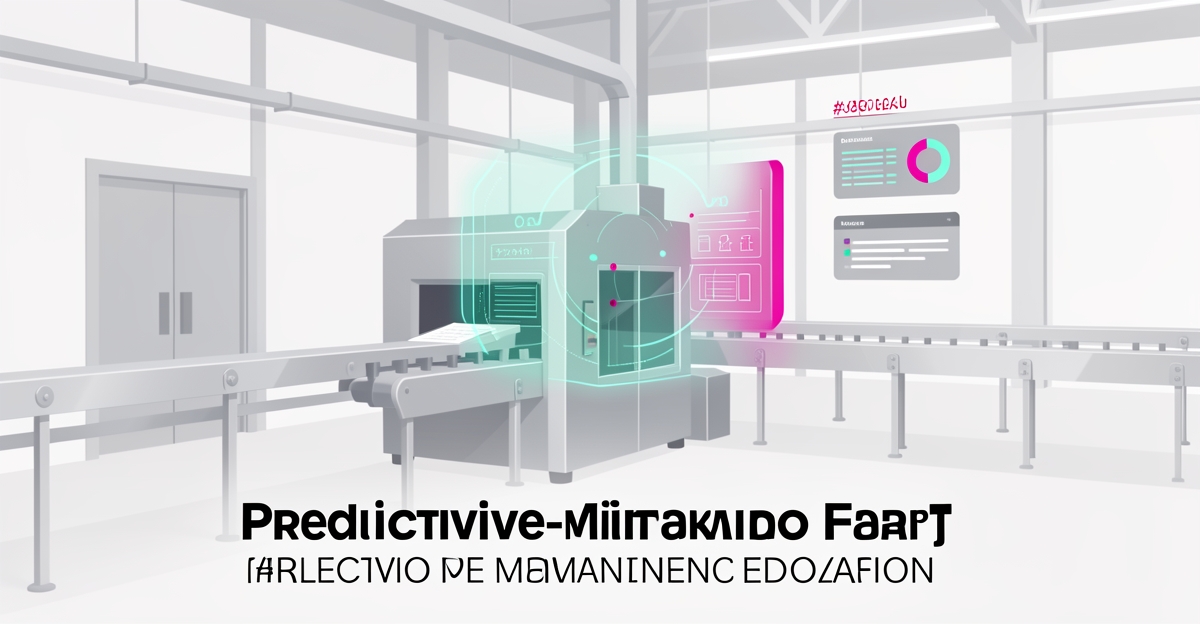
The path from AI alert to real-world action isn't about flashing dashboards or lab prototypes, it's about closing the loop between prediction and prevention. Most plants stumble here, treating AI as a monitoring tool rather than an operational trigger. The proven four-step path, sensor data collection, AI pattern analysis, predictive alerts, and automated work orders, turns insight into action, but only when built for the plant's relentless pace and punishing conditions.
**Start with robust sensor data collection.** Wireless vibration, temperature, and power sensors must be installed on critical assets like grinders, conveyors, and refrigeration compressors, designed to withstand daily sanitation cycles and continuous 16–20 hour operation. Industry monitoring data suggests most motor failures show detectable vibration anomalies weeks before breakdown, but only if sensors capture high-fidelity data in harsh, moisture-rich environments without signal dropouts or corrosion-related failures.
**Next, AI pattern analysis transforms raw data into failure forecasts.** Machine learning models trained on equipment-specific baselines identify subtle deviations, like increasing harmonics in a motor's power draw or abnormal thermal gradients in a bearing housing, that precede catastrophic failure. Unlike generic anomaly detection, production-grade systems contextualize alerts within operational rhythms, distinguishing between normal startup transients and true degradation. This specificity is why plants using predictive monitoring typically prevent a substantial share of unplanned equipment failures, as reported across industry case studies.
**When anomalies cross validated thresholds, the system issues predictive alerts** with recommended actions and estimated time to failure, critical for planning interventions during scheduled sanitation or changeover periods. Facilities that act on these alerts report recovered throughput, avoided overtime, and protected product integrity. These aren't theoretical gains; they represent the difference between a planned 30-minute bearing swap and a mid-shift line stop with product at risk.
**Finally, automated work orders close the loop.** Alerts trigger tickets in the plant's CMMS, complete with asset ID, failure mode, priority, and suggested parts, eliminating manual triage and ensuring maintenance teams act during planned downtime. This integration is where many AI projects fail: without seamless data flow into existing workflows, alerts sit unread in isolated dashboards. AIQ Labs builds this connection from the ground up, whether as a single AI Workflow Build or as part of a full
AI Development
Still paying for 10+ subscriptions that don’t talk to each other?
We build custom AI systems you own outright. No vendor lock-in. Full control.
See If You’re a Fit — AI Employees from $700/mo
Not sure where to start? Ask our AI planner
ber-deep underline-offset-4 transition-colors" href="https://ai-operating-systems">AI Operating System that connects your plant's data into one operating layer you own outright. The result is a self-reinforcing cycle: fewer surprises mean more stable production, and stable production funds further optimization, delivering the 12–18 month payback range commonly reported across food plants that treat AI as infrastructure, not experimentation.
## Frequently Asked Questions
**Why do so many AI pilots fail in meat processing plants?**
Most pilots fail because they're treated as isolated experiments rather than integrated infrastructure, and lack of relevant expertise is consistently cited as the top adoption barrier in enterprise surveys. Without integration into CMMS and production workflows, alerts sit in dashboards instead of triggering automated work orders during planned downtime.
**What's the actual ROI timeline for predictive maintenance AI in food plants?**
Industry reporting commonly points to a 12–18 month payback period, with plants preventing a substantial share of unplanned equipment failures. Exact numbers vary by facility, which is why AIQ Labs scopes each build around your specific costliest workflow rather than promising generic returns.
**Can AI sensors really survive daily sanitation and 20-hour production runs?**
Yes, production-grade wireless vibration, temperature, and power sensors are designed specifically for moisture-rich, high-vibration environments and continuous 16–20 hour operation. The key is high-fidelity data capture without signal dropouts or corrosion, which is a hardware selection question, not an afterthought.
**We don't have data scientists on staff, can we still implement this?**
The expertise gap is the #1 barrier in survey after survey. The solution isn't hiring internally but partnering with a provider who delivers fully managed, production-ready systems, like AIQ Labs' AI Employees and workflow builds, that integrate with your existing maintenance workflows and require no in-house AI engineering.
**How does predictive maintenance AI handle food safety compliance and data privacy?**
Legal uncertainty and data privacy concerns rank among the top adoption barriers, but production-grade systems are built compliance-first: automated work orders log all interventions for audit trails, sensor data stays in controlled environments, and integration with existing CMMS/ERP ensures regulatory alignment without creating new data risks.
**What's the difference between a monitoring tool and production-grade predictive maintenance?**
A monitoring tool shows dashboards; production-grade systems close the loop through four steps: ruggedized sensor collection, equipment-specific AI pattern analysis, predictive alerts with time-to-failure estimates, and automated CMMS work orders with parts and priority, turning insight into preventive action during scheduled sanitation windows instead of reactive firefighting.
## Turning AI Insight into Plant-Floor Action
The path to AI success in meat processing isn't about chasing prototypes or waiting for perfect conditions, it's about building systems that work in the reality of 16–20 hour production cycles, where a single motor failure can halt an entire line. The real value emerges when AI moves beyond alerts to trigger automated work orders, integrate with CMMS platforms, and prevent failures before they spoil product or risk compliance. Plants that treat AI as infrastructure, not experimentation, are the ones that see durable downtime reductions and payback inside two years. If you're ready to move from reactive maintenance to predictive resilience, start with a clear view of your biggest operational bottleneck. Take the 2-minute Fit Check, then book a free 30-minute strategy call to map your high-ROI opportunities and see whether an AI build is the right next step for your facility.
AI Transformation Partner
Make AI your competitive advantage — not just another tool.
Strategy, implementation and ongoing optimization. One partner, end to end.
See If You’re a Fit — AI Employees from $700/mo
Not sure where to start? Ask our AI planner