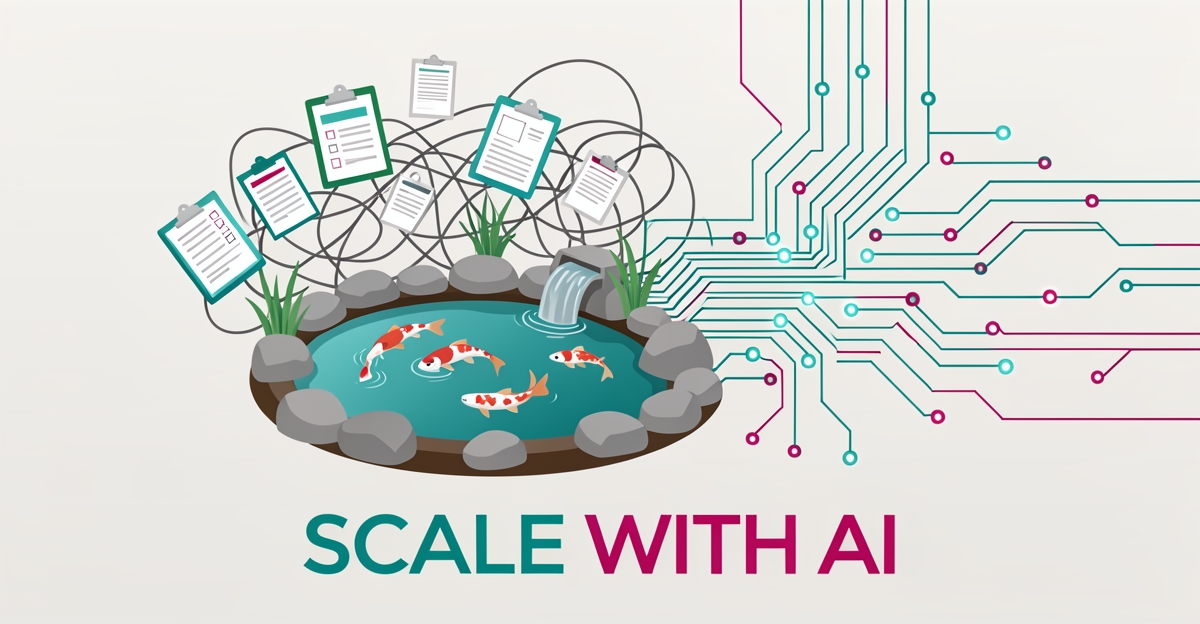
Why Most Pond Installers Fail to Scale, And How AI Can Fix It
Key Facts
- Admin work in the trades commonly consumes 20+ hours per week of owner and lead-installer time
- Most AI agent projects fail from poor data readiness and over-engineering, not from weak technology
- Organizations that succeed with AI typically invest heavily in data foundations before deploying agents
- AIQ Labs has deployed 200+ multi-agent systems and operates 4 live SaaS products daily
- AI Employees start at roughly 80% less cost than a comparable human hire
Hire a team member that works 24/7 — for less than a part-time wage.
AI receptionists, SDRs, dispatchers and 99+ roles. Trained on your business, fully managed.
Not sure where to start? Ask our AI planner
The Scaling Trap: Why Pond Installers Hit a Ceiling
Many pond installation businesses start strong, driven by skilled craftsmanship and local demand, but quickly hit a growth ceiling not because of market limits, but due to operational friction. Technicians who excel at designing and building water features spend disproportionate time on administrative tasks that don't leverage their expertise, scheduling jobs, tracking permits, managing client follow-ups, and juggling disparate software tools. This administrative overload creates a bottleneck where skilled labor is underutilized, directly capping how many projects a business can handle regardless of market opportunity.
Across the trades, ambition to adopt AI has grown faster than operational readiness. The core issue isn't lack of technical skill in the field; it's the absence of systems that free technicians from low-value work so they can focus on installation, design, and client relationship-building. Without addressing this imbalance, scaling efforts stall as owners and lead installers become overwhelmed by coordination tasks that grow with each new project.
This trap manifests in three interconnected bottlenecks: chronic staffing shortages despite available work, inefficient scheduling that creates idle time and overtime costs, and poor client retention stemming from inconsistent communication. When administrative work consumes 20+ hours weekly, as is common in similar trades, businesses cannot reinvest that time into growth activities like marketing, training, or process improvement. The result is a self-limiting cycle where increased demand leads to burnout, not expansion. Breaking this cycle requires rethinking how work flows through the business, not just hiring more people or working longer hours.
AI-Driven Solutions: From Permit Chaos to Predictable Growth
The builder who excels at installation but drowns in paperwork isn't a pond industry problem, it's a construction and trades pattern. The people who are incredible at the actual work are typically drowning in admin that has nothing to do with building. Targeted AI fixes that pattern:
- Automated permit tracking with real-time alerts for status changes and required actions
- AI-powered job site photo logs that organize by project and tag progress notes via image recognition
- Automated subcontractor communication for schedules, change orders, and payment updates
- Dynamic scheduling optimization using historical data and real-time factors like weather and crew availability
In reported implementations across construction and trades, businesses that deployed AI for permit tracking and proactive client communication have cut hours of weekly admin work and eliminated missed permit deadlines within the first few months. Results vary, but the pattern is consistent: the admin burden that caps growth is the most automatable part of the business.
The architecture decision matters critically. Most AI agent failures come from over-engineering, teams build elaborate multi-agent systems for problems a well-designed single agent could handle. For pond installers, this means starting with specific workflows: a single agent for permit tracking, another for scheduling optimization, a third for client communication, rather than one complex system attempting everything. That's exactly how AIQ Labs approaches Workflow Builds: rebuild the one workflow that costs you the most, at a fixed price, in phases.
For ongoing roles, answering calls, qualifying leads, dispatching crews, following up on estimates, managed AI Employees cover 99+ roles at roughly 80% less cost than a human hire. And when you want everything connected into one system you own outright, AI Operating Systems build that operating layer in phases.
Data readiness determines whether any of this works. Organizations that succeed with AI typically invest the majority of their effort in data readiness, structuring, cleaning, and connecting information, before deploying agents. Pond installers typically have data scattered across scheduling tools, CRM platforms, financial records, and project documentation. Without integration, AI initiatives fail regardless of technology sophistication. AIQ Labs helps businesses navigate this through structured assessment that starts with workflow analysis, builds data foundations first, and deploys targeted AI for permit tracking, dispatch, and client communication.
The Data-First Path to Sustainable AI Scaling
The difference between AI pilots that scale and those that collapse often comes down to one unglamorous factor: the quality of the data feeding the system. For pond installers, where project specs, permit records, and client histories typically live in disconnected spreadsheets and email threads, this reality determines whether an AI investment delivers returns or becomes another abandoned experiment.
The stakes are higher than most realize. Industry analyses consistently show that a large share of AI projects are abandoned due to lack of AI-ready data. Organizations succeeding with AI allocate the bulk of their effort to data readiness, not to flashy algorithms, but to the foundational work of structuring, cleaning, and connecting information.
This allocation feels counterintuitive. When you're eager to automate scheduling or streamline permit tracking, spending most of your effort on data preparation seems like bureaucratic delay. Yet consider what happens when you skip this step: your AI scheduling tool can't access historical project timelines, your customer communication system pulls from outdated contact records, and your permit tracking misses critical municipal requirements because the underlying data lacks proper categorization.
Building the data foundation requires treating information architecture as a strategic asset, not an IT afterthought. For pond installation businesses, this means establishing a single source of truth that integrates scheduling software, customer relationship management tools, financial records, and project documentation into a coherent system.
The preparation process involves several critical components:
- Standardizing naming conventions across all systems so "excavation," "digging," and "earthwork" don't appear as separate, unconnected categories
- Mapping relationships between projects, permits, clients, and seasonal factors
- Establishing data validation protocols to catch errors before they corrupt AI outputs
- Creating unified taxonomies for project types, materials, and regulatory requirements
Once data readiness is established, governance frameworks become essential. Robust governance isn't about restricting innovation, it's about creating clear rules for monitoring, security, and compliance so AI tools operate transparently and protect sensitive client information. This includes implementing role-based access controls, maintaining audit trails for automated decisions, and establishing protocols for when human oversight must override algorithmic recommendations.
Agile methodologies complement this structured approach. Rather than attempting a comprehensive AI overhaul, successful implementations break projects into manageable phases. You might start with a single agent handling permit status monitoring, validate its accuracy against manual tracking for 30 days, then expand to automated client notifications before tackling complex scheduling optimization.
At AIQ Labs, our implementation roadmaps prioritize this data-first methodology. We help pond installers audit their current information architecture, identify gaps that would undermine AI performance, and build integrated systems that scale without accumulating technical debt. With 200+ multi-agent systems deployed and 4 live SaaS products we run daily ourselves, the goal isn't just deploying AI, it's creating an operational backbone where AI enhances decision-making rather than complicating it.
When data readiness receives proper investment, AI transforms from a risky experiment into a predictable growth engine. Your scheduling optimization actually reflects crew availability and weather patterns. Your client communication draws from complete project histories. Your permit tracking anticipates requirements rather than reacting to oversights. That's the difference between the projects that get abandoned and the ones that scale.
Still paying for 10+ subscriptions that don’t talk to each other?
We build custom AI systems you own outright. No vendor lock-in. Full control.
Not sure where to start? Ask our AI planner
Frequently Asked Questions
Why do pond installation businesses hit a growth ceiling even when demand is strong?
How much admin time can AI actually save for installers?
Is AI adoption really that urgent for small trades businesses?
What's the biggest reason AI projects fail in construction and trades?
How much of our AI budget should go to data prep instead of the tech?
Will AI replace my installers or just the paperwork?
From Bottleneck to Breakthrough: Turning Admin Overload into Growth Momentum
The path to scaling a pond installation business isn't about working harder, it's about freeing skilled technicians from administrative drag so they can focus on what they do best: designing and building exceptional water features. The real growth ceiling isn't market demand but operational friction: permit tracking, scheduling chaos, and inconsistent client communication. AI offers a practical way out, starting with targeted solutions like automated permit monitoring or dynamic scheduling that save hours each week while improving accuracy and client satisfaction. But success hinges on one often-overlooked foundation: data readiness. Investing the majority of your effort in structuring, cleaning, and connecting your information isn't bureaucratic delay, it's what separates fleeting pilots from sustainable scaling. When your scheduling reflects real crew availability, your client communication draws from complete project histories, and your permit tracking anticipates requirements, AI stops being an experiment and becomes a predictable growth engine. The first step isn't a massive overhaul, it's identifying your highest-friction workflow and taking a focused, data-first approach. Ready to see where your biggest bottleneck lies and what a targeted AI fix could unlock? Start with the 2-minute Fit Check, then book a free 30-minute strategy call. Questions first? Email [email protected].
Make AI your competitive advantage — not just another tool.
Strategy, implementation and ongoing optimization. One partner, end to end.
Not sure where to start? Ask our AI planner