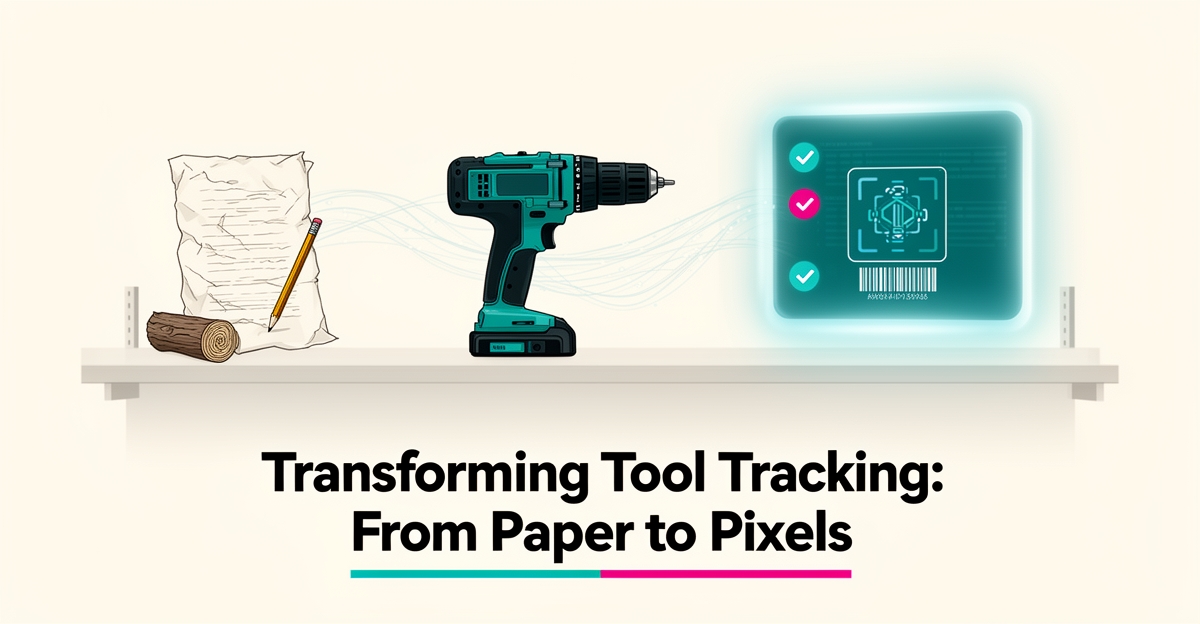
# Why Most Power Tool Rentals Still Rely on Paper Logs — And How AI Fixes It
**Quick Answer:** Paper logs quietly cost power tool rental businesses revenue through transcription errors, lost tools, and disputed damage. AI automates the full check-in-to-return lifecycle, creating accountability while the rental market keeps growing.
## Key Facts
- The power tool hire market is projected to grow from roughly $11.4 billion in 2025 to about $15.5 billion by 2033, per market analysis.
- The electric tool rentals segment is expected to approach $4.8 billion by 2034, per market research.
- Industry analyses suggest enterprises adopting AI in equipment rental see meaningfully higher year-over-year growth in customer-facing outcomes than paper-based competitors.
- AI document processing can typically reduce manual data entry by up to 95%, creating a searchable digital record of every rental.
- Remote monitoring for industrial assets has been forecast to grow at a strong double-digit CAGR through the decade, signaling broader industrial momentum toward connected operations.
## Table of Contents
1. [The Hidden Cost of Paper Logs in Power Tool Rentals](#the-hidden-cost-of-paper-logs-in-power-tool-rentals)
2. [How AI Automates the Full Rental Lifecycle](#how-ai-automates-the-full-rental-lifecycle)
3. [From Manual to AI: Implementation Roadmap for Rental Businesses](#from-manual-to-ai-implementation-roadmap-for-rental-businesses)
## The Hidden Cost of Paper Logs in Power Tool Rentals
The power tool rental industry is growing, with market research projecting expansion from roughly $11.4 billion in 2025 to about $15.5 billion by 2033. Yet many rental businesses still track expensive equipment using clipboards and carbon copies.
This disconnect between market growth and operational methods creates a costly paradox. While the electric tool rentals segment alone pushes toward $4.8 billion by 2034, paper-based tracking continues to drain profitability through inefficiency and human error.
**Paper logs create invisible revenue leaks** that compound daily. When a $2,000 concrete saw goes out with a hastily scribbled signature, or returns with damage noted in illegible handwriting, the true cost extends far beyond the missing paperwork. Disputes arise, accountability vanishes, and maintenance schedules slip through the cracks.
The manual check-in/check-out process introduces multiple failure points:
- Transcription errors when transferring paper records to digital systems
- Lost or damaged forms that erase rental history
- Time-consuming manual searches for tool availability
- Missed maintenance windows due to poor tracking
- Dispute resolution without photographic evidence or clear documentation
Industry analyses of AI adoption in equipment rental consistently point to a performance gap: businesses that automate customer-facing and operational workflows tend to grow faster than those that don't. That gap widens each day paper-based operations delay modernization.
**The hidden costs extend beyond immediate errors.** Staff spend hours deciphering handwriting, hunting for missing forms, and manually updating inventory spreadsheets. These administrative burdens prevent teams from focusing on customer service and business development — the activities that actually drive revenue.
AI-powered document process
AI Employees
Hire a team member that works 24/7 — for less than a part-time wage.
AI receptionists, SDRs, dispatchers and 99+ roles. Trained on your business, fully managed.
See If You’re a Fit — AI Employees from $700/mo
Not sure where to start? Ask our AI planner
ing eliminates these bottlenecks by digitizing, classifying, and automating rental records from check-in to return confirmation. Modern systems capture tool condition photos, automatically log serial numbers, and trigger maintenance alerts based on usage patterns. AIQ Labs builds these production-ready systems — [workflow builds](/workflow-builds) that eliminate manual data entry while creating complete audit trails.
The shift toward automation isn't optional anymore. As AI adoption spreads across industrial sectors, rental businesses clinging to paper logs face a mounting competitive disadvantage. **Every day of delay means more lost tools, disputed charges, and customers choosing competitors** with streamlined, transparent processes.
## How AI Automates the Full Rental Lifecycle
Paper logs still govern many power tool check-ins because the rental lifecycle is fragmented across counters, clipboards, and spreadsheets. That friction creates lost revenue, disputes over condition, and reactive maintenance that eats margins.
AI collapses the lifecycle into a single, digitized flow. Computer vision reads handwritten logs, rental tags, and condition photos at check-in and return, extracting tool ID, customer details, timestamps, and damage notes without manual entry. Document processing classifies invoices, waivers, and inspection forms, building a searchable record for every asset.
Condition verification accelerates because vision models compare return photos to check-in baselines and flag scratches, missing accessories, or misuse in seconds. That automation reduces inspection time and improves accountability across staff shifts. Predictive maintenance becomes possible when usage hours, return condition, and repair history are structured and analyzed continuously.
The power tool hire market is projected to reach roughly $15.5 billion by 2033, per market analysis, and AI adoption across industrial operations continues to accelerate — a combination that puts manual-tracking businesses at a structural disadvantage.
A full rental lifecycle automation typically covers:
- Automated intake and classification of paper logs, rental agreements, and inspection sheets via AI document processing
- Computer vision condition verification at check-in and return, with photo comparison and damage flagging
- Predictive maintenance triggers based on usage patterns, condition trends, and repair history
- Automated return confirmation, billing reconciliation, and customer notifications
Digitizing the lifecycle also improves customer experience. Staff spend less time hunting logs and more time serving renters, while customers receive instant confirmations and transparent condition reports. The result is faster throughput, fewer disputes, and higher utilization of the fleet.
When the entire rental record is structured, teams can query it, audit it, and improve it. That is the operational foundation AIQ Labs delivers — systems [built in phases and owned outright](/ai-operating-systems), not rented subscription tools.
## From Manual to AI: Implementation Roadmap for Rental Businesses
Power tool rental businesses still relying on paper logs face mounting pressure to modernize as the market expands through 2033. Transitioning from manual tracking to AI-powered workflows begins with a focused assessment of current pain points — delayed returns, misplaced tools, disputed damage — that directly impact revenue and customer trust. AIQ Labs' [Start Monthly](/pricing) model offers an accessible entry point, letting businesses pilot AI document processing for rental check-ins and returns without upfront infrastructure costs, integrating with existing tools like scheduling software or accounting platforms.
Implementation proceeds in phases to minimize disruption and build team confidence. First, AI automates data extraction from paper logs using intelligent document processing, typically reducing manual entry by up to 95% while creating a searchable digital record. Next, the system integrates with rental ma
AI Development
Still paying for 10+ subscriptions that don’t talk to each other?
We build custom AI systems you own outright. No vendor lock-in. Full control.
See If You’re a Fit — AI Employees from $700/mo
Not sure where to start? Ask our AI planner
nagement software to trigger automated notifications for overdue tools or maintenance needs, aligning with predictive maintenance practices that cut inspection time and downtime. Throughout, AIQ Labs provides ongoing monitoring and iterative improvements, ensuring the solution adapts to real-world usage — varied tool conditions, seasonal demand spikes — without requiring internal AI expertise.
Change management is critical for staff adoption, particularly for teams accustomed to tactile, paper-based processes. Training focuses on how AI augments — not replaces — their role, emphasizing time saved on administrative tasks for higher-value customer interactions. Businesses using the Build in Milestones approach can validate each phase — digitizing check-in workflows before scaling to returns processing — before committing further investment. This structured progression supports steady ROI tracking and positions rental companies to extend automation into inventory forecasting and customer self-service as they advance. Starting with the [two-minute Fit Check](/apply) helps identify the highest-impact workflow to automate first, ensuring resources target measurable improvements in efficiency and accountability.
## Frequently Asked Questions
**Why do most power tool rental businesses still use paper logs despite market growth?**
Despite the power tool hire market heading toward roughly $15.5 billion by 2033, many businesses rely on paper logs due to entrenched workflows and the perceived complexity of digital transformation — creating revenue leaks through transcription errors, lost forms, and missed maintenance windows.
**How does AI improve the power tool rental lifecycle from check-in to return?**
AI automates the full lifecycle by using computer vision to read handwritten logs and condition photos, extracting tool IDs and damage notes without manual entry, while enabling predictive maintenance and reducing inspection time through photo comparison and usage pattern analysis.
**What specific inefficiencies do paper logs create in tool rental operations?**
Transcription errors when digitizing records, lost or damaged forms that erase rental history, time-consuming manual searches for tool availability, missed maintenance windows, and dispute resolution without photographic evidence or clear documentation.
**Is there data showing AI adoption leads to better business outcomes in equipment rental?**
Industry analyses consistently indicate that enterprises adopting AI in equipment rental see stronger year-over-year growth in customer-facing outcomes than paper-based operations, highlighting a significant performance gap.
**What are the risks of delaying AI adoption for power tool rental businesses?**
Every day of delay means more lost tools, disputed charges, and customers choosing competitors with streamlined, transparent processes — a competitive disadvantage that compounds as AI adoption spreads across the sector.
**How can a rental business start implementing AI without disrupting current operations?**
Begin with AIQ Labs' Start Monthly model to pilot AI document processing for check-ins and returns, integrating with existing scheduling or accounting tools, then scale through the phased Build in Milestones approach to minimize disruption and build team confidence.
## Your Fleet Is Growing. Your Paperwork Shouldn't Be.
The power tool rental market is heading toward roughly $15.5 billion by 2033, yet many operators are still losing revenue to clipboards, illegible notes, and manual searches for tool availability. Paper logs create invisible leaks — disputed damage, missed maintenance windows, and hours of admin time that pull staff away from customers. AI closes those gaps by digitizing check-in and return records, verifying condition with computer vision, and triggering predictive maintenance from structured usage data. The result is faster throughput, fewer disputes, and a searchable audit trail you can actually use. If you want to see where paper is costing you most, start with the [two-minute Fit Check](/apply) — it leads to a free 30-minute strategy call where we map your highest-impact workflow and show you a realistic path to production-ready automation you own outright, with no obligation.
AI Transformation Partner
Make AI your competitive advantage — not just another tool.
Strategy, implementation and ongoing optimization. One partner, end to end.
See If You’re a Fit — AI Employees from $700/mo
Not sure where to start? Ask our AI planner