Why Most Seafood Processors Fail at AI Adoption (And How to Avoid It)
Key Facts
- Incompatible ERP data schemas are the most frequently cited bottleneck in stalled seafood-processing AI adoptions, per recent industry reporting on 2025 adoption slowdowns
- Most failed implementations lack real-time API support for cold-chain monitoring devices, forcing processors to rely on manual logs and delayed batch uploads
- Industry surveys suggest only a small minority of organizations, often reported around 13%, have governance in place to manage agentic AI per tech industry reporting
- Modular, phased integration is widely associated with shorter deployment timelines and significantly less post-deployment debugging than big-bang rollouts
- Mismatched validation protocols between HACCP lines and IoT packaging units create conflicting safety signals that erode trust in AI outputs
- AI projects fail when solving generic problems instead of targeted workflow bottlenecks per recent industry analysis
- Inconsistent safety data recording is a recurring barrier to operational teams trusting AI recommendations
Hire a team member that works 24/7 — for less than a part-time wage.
AI receptionists, SDRs, dispatchers and 99+ roles. Trained on your business, fully managed.
Not sure where to start? Ask our AI planner
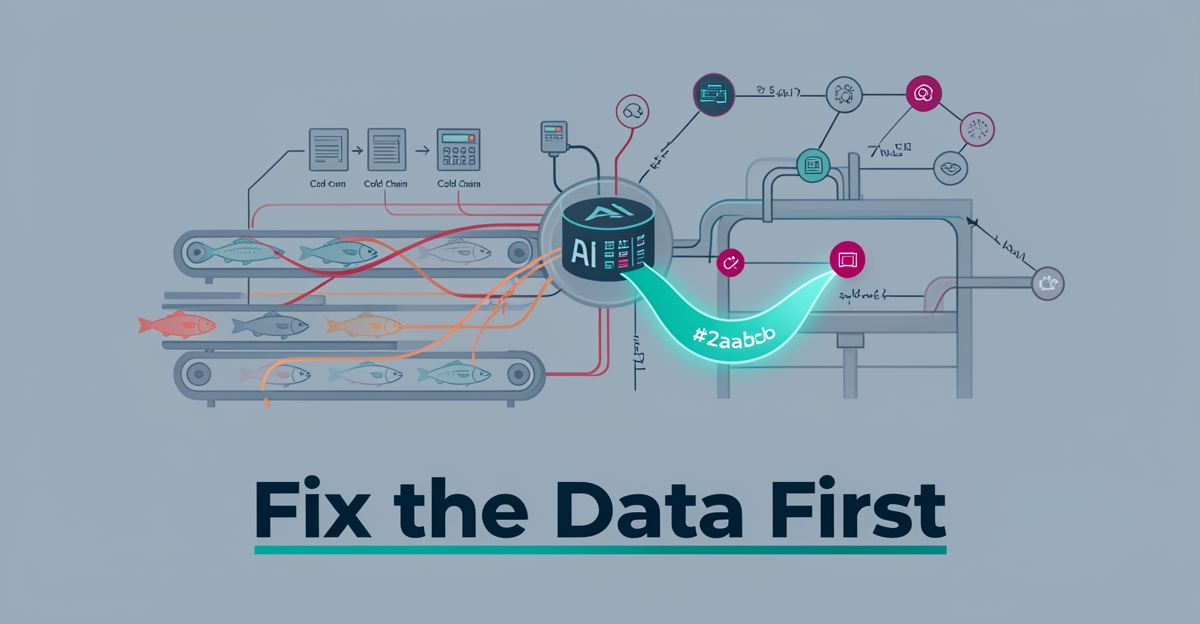
The Data Quality Trap: Why Your ERP and Cold-Chain Systems Are Sabotaging AI Before It Starts
The data quality trap is where most seafood processors' AI ambitions quietly die, not from lack of vision, but from foundations too fractured to support them. Before any algorithm can learn, before any model can predict, the data feeding it must be clean, connected, and timely. Yet in seafood processing, the very systems meant to enable intelligence often become its greatest obstacle.
Legacy ERP platforms, built for batch accounting rather than real-time insight, frequently operate with incompatible data schemas that prevent seamless information flow. Recent industry reporting on 2025 technology adoption in the sector points to integration complexity, not cost, as the dominant reason AI adoptions stall, with incompatible ERP schemas the most commonly cited bottleneck. These mismatches aren't just technical inconveniences, they create silent data silos where critical variables like catch volume, processing yield, and inventory turnover cannot be correlated across systems, rendering predictive analytics meaningless.
Compounding this issue is the widespread lack of real-time API support for cold-chain monitoring devices, a gap cited in most failed implementations. Without continuous, automated data streams from temperature sensors, GPS trackers, and humidity loggers along the supply chain, AI loses its ability to detect spoilage risks, optimize transit routes, or ensure regulatory compliance in real time. Instead, processors rely on manual logs or delayed batch uploads, introducing latency and error that undermine any attempt at proactive decision-making.
Further complicating integration, many processors report mismatched validation protocols between HACCP-certified processing lines and IoT-enabled packaging units, creating inconsistencies in how safety and quality data are recorded and interpreted. When one system logs a critical control point as "pass" based on visual inspection while another flags it via spectral analysis, AI models receive conflicting signals, eroding trust in their outputs and discouraging operational teams from acting on recommendations.
These aren't isolated IT headaches, they're systemic failures of data readiness. AI doesn't fail because the technology is too advanced; it fails because the data infrastructure isn't prepared to sustain it. Processors often underestimate the effort required to harmonize schemas, enable real-time APIs, and align validation standards across disparate systems. They assume AI can "work around" dirty or disconnected data, when in truth, garbage in still means garbage out, especially in an industry where precision impacts both safety and sustainability.
Addressing this trap requires more than buying new software. It demands a deliberate data modernization strategy: mapping ERP schemas for compatibility, retrofitting legacy equipment with API-enabled gateways, and establishing unified data governance frameworks that span from boat to plate. Only when the data foundation is solid can AI begin to deliver the predictive power, operational resilience, and traceability that seafood processing truly needs.
The Governance Gap: How Lack of Change Management Turns AI Pilots Into Expensive Failures
As seafood processors race to adopt AI, many launch pilots that never scale, consuming resources without delivering lasting value. The root cause isn't flawed technology but a critical oversight in organizational readiness. Agentic AI adoption is accelerating rapidly, yet governance frameworks lag dangerously behind. Industry surveys suggest only a small minority of organizations, often reported around 13%, have the right governance in place to manage agentic AI per tech industry reporting, creating significant risk for enterprises operating in regulated environments like seafood processing.
In HACCP-certified facilities, where food safety protocols are non-negotiable, deploying AI without proper change management amplifies operational and compliance risks. Processors often overlook the need for validation protocols that align AI-driven decisions with existing food safety standards. Without human-in-the-loop controls for critical quality checkpoints, automated systems may bypass essential verification steps, potentially compromising product integrity. This disconnect between AI capabilities and regulatory requirements turns well-intentioned pilots into liability traps.
Successful AI integration demands more than technical deployment, it requires a structured approach to organizational change. AIQ Labs helps seafood processors establish governance frameworks that embed accountability, traceability, and cross-functional alignment from the outset, whether through managed AI staff or targeted workflow builds. By prioritizing change management alongside technology adoption, processors can avoid the costly cycle of pilot failure and build AI capabilities that enhance, not undermine, their commitment to safety, quality, and regulatory compliance. Start the two-minute Fit Check to assess your readiness for governed, scalable AI adoption.
Misaligned Goals: When AI Projects Solve the Wrong Problems (Or Solve Them in the Wrong Order)
Many seafood processors jump into AI adoption chasing broad trends like efficiency, sustainability, and transparency without pinpointing where these technologies will actually move the needle. This misalignment often leads to stalled pilots, wasted budgets, and teams that grow skeptical of AI's value. When initiatives aren't tied to specific operational bottlenecks, like reducing invoice processing delays or improving cold-chain data flow, projects fail to deliver measurable ROI, and momentum fades quickly.
A recent industry analysis confirms that seafood processing faces mounting pressure to improve efficiency, sustainability, and transparency, yet many AI efforts miss the mark by solving generic problems instead of targeted workflows. For example, deploying AI for broad sustainability reporting while ignoring real-time data gaps in cold-chain monitoring yields little operational benefit. Similarly, automating quality checks without first fixing incompatible ERP data schemas creates fragile systems that break under real-world conditions.
To avoid this trap, processors should start by mapping their most painful, repeatable workflows and asking: Where do delays consistently occur? Where do errors cost the most? Where is data trapped in silos? High-impact targets often include invoice and accounts payable automation, inventory forecasting based on seasonal demand, or real-time tracking of HACCP-compliant processing lines. These are areas where AI can deliver immediate, provable value, cutting processing time, reducing stockouts, or eliminating manual data entry, before scaling to more complex use cases.
- Map end-to-end workflows to identify manual handoffs and data silos
- Quantify the cost of delays, errors, or inefficiencies in each process
- Prioritize AI projects that solve one bottleneck with clear, measurable ROI
- Validate data readiness, especially API access and schema compatibility, before building
- Start small, prove value, then expand based on results, not trends
By grounding AI initiatives in operational reality, not industry hype, seafood processors can build confidence, secure stakeholder buy-in, and create a foundation for sustainable transformation. AIQ Labs' AI Workflow Builds are designed around exactly this discipline: rebuild the one workflow that costs you the most, at a fixed price, in phases, so every project aligns with real business goals from day one.
The Structured Path Forward: How Modular Integration and Milestone Builds Prevent AI Failure
Many seafood processors struggle with AI adoption because they treat integration as a technical checkbox rather than an operational transformation. Without a structured path, even advanced systems fail to align with cold-chain realities, HACCP workflows, or legacy ERP constraints.
A proven approach begins with assessing your current technology landscape to uncover integration gaps. Industry reporting consistently points to incompatible ERP data schemas and missing real-time API support for cold-chain monitoring devices as the two dominant bottlenecks. These aren't isolated issues, they compound when AI systems are forced into environments not designed for interoperability.
Modular integration offers a practical solution: connect AI incrementally to critical systems, like inventory tracking or quality control, without overhauling entire infrastructures. By isolating components, teams can validate performance in one workflow before scaling, minimizing disruption and risk. Phased builds are widely associated with shorter deployment timelines and far less post-deployment debugging than big-bang rollouts.
AIQ Labs operationalizes this framework across three entry points: AI Employees (managed AI staff for roles like receptionists, SDRs and dispatchers at roughly 80% less cost than a human hire), AI Workflow Builds (rebuild the one workflow that costs the most, fixed price, delivered in phases), and AI Operating Systems (one connected operating layer, built in phases and owned outright). Payment models are straightforward, start monthly, build in milestones, or own it outright, so you're never locked into a bloated multi-year engagement before seeing results. Each step ensures AI systems enhance, not disrupt, the daily realities of seafood processing, from dock to distribution.
Still paying for 10+ subscriptions that don’t talk to each other?
We build custom AI systems you own outright. No vendor lock-in. Full control.
Not sure where to start? Ask our AI planner
Frequently Asked Questions
Why do seafood processors keep failing at AI even when they invest in the technology?
Is my ERP and cold-chain data actually good enough for AI?
Do we need better governance before piloting agentic AI?
Are we picking the wrong AI projects to start with?
Can we integrate AI without replacing our whole system?
How do mismatched validation protocols hurt AI in seafood processing?
Don't Let Your AI Investment Become Another Expensive Lesson
The path to AI success in seafood processing isn't about avoiding technology, it's about respecting the complexity of your operational reality. With incompatible ERP schemas and missing cold-chain APIs stalling most adoptions, and governance frameworks lagging far behind agentic AI deployment, the margin for error is slim. Yet the processors who succeed aren't necessarily the ones with the biggest budgets; they're the ones who start with clean data foundations, align AI initiatives with specific bottlenecks like invoice processing or cold-chain monitoring, and treat change management as seriously as they treat HACCP compliance. AIQ Labs exists precisely for this moment, with 200+ multi-agent systems deployed and four live SaaS products we run daily, we help you assess readiness, prioritize high-ROI workflows, and implement modular integrations that respect your operational constraints. Ready to move beyond pilot purgatory? Start the two-minute Fit Check to identify your clearest path to AI that actually works.
Make AI your competitive advantage — not just another tool.
Strategy, implementation and ongoing optimization. One partner, end to end.
Not sure where to start? Ask our AI planner