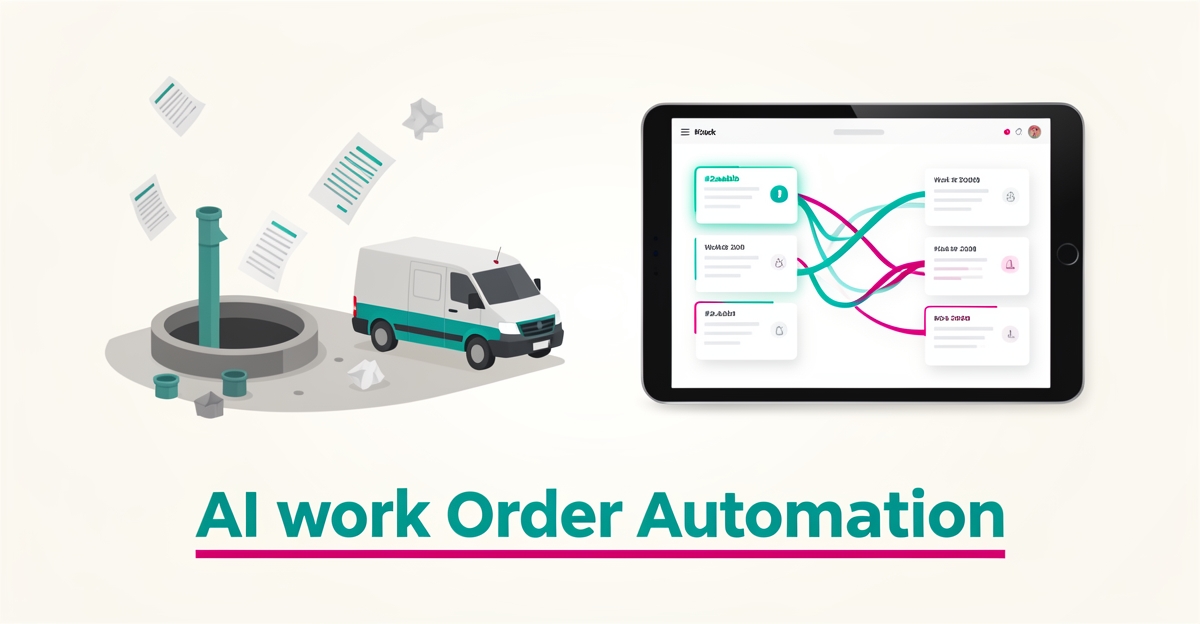
Why Most Sewer Repair Shops Still Rely on Paper Work Orders (And How to Fix It with AI)
Key Facts
- Vendors of AI-powered work order management have reported downtime reductions of up to 50% for field service operations according to industry analysis
- ServiceNow has been credited with roughly a 40% reduction in manual dispatch within six months in work order analysis
- UpKeep users have reported first-time fix rate improvements around 20% per benchmark data
- Fiix customers have reported maintenance cost per asset reductions near 15% in documented cases
- AI can automate intake, dispatch, and tracking while keeping technicians in the field as detailed in workflow analysis
- Poor data quality and lack of explainability are common pitfalls in AI work order adoption highlighted in industry studies
- Starting with a pilot on one asset class builds confidence in AI work order automation per industry guidance
Hire a team member that works 24/7 — for less than a part-time wage.
AI receptionists, SDRs, dispatchers and 99+ roles. Trained on your business, fully managed.
Not sure where to start? Ask our AI planner
The Hidden Cost of Paper Work Orders in Sewer Repair
Paper work orders feel familiar in sewer repair, but familiarity masks a growing operational drag. Crews still write tickets by hand, radio dispatchers copy details, and offices file carbon copies that disappear.
That manual loop creates delays at every handoff. Customers wait longer for intake confirmation while crews drive to sites without complete history. Industry analysis suggests paper-based work order management in sewer repair businesses is still prevalent as of late 2026, despite the risks of delays, lost records, and miscommunication.
Lost records are more than an annoyance. A missing work order means a repeat visit, wasted truck roll, and a customer who loses trust. Miscommunication between office and field compounds the problem, with wrong materials, wrong addresses, and reactive dispatch instead of planned routes. The result is reactive dispatch that keeps teams busy but not productive.
The cost shows up in downtime and rework. Analysis of AI tools for work order management reports downtime reductions of up to 50% with AI-powered work order management. Manual dispatch itself shrinks fast with automation, with ServiceNow credited in the same analysis with a roughly 40% reduction in manual dispatch within six months.
First-time fix rates improve when technicians arrive prepared. Benchmark data on CMMS platforms reports a roughly 20% improvement in first-time fix rate for UpKeep users, and a roughly 15% reduction in maintenance cost per asset for Fiix customers.
Paper systems also hide patterns that could prevent failures. Without digital history, predictive signals are invisible and prioritization defaults to who called loudest. AI can automate order intake, dispatch, and tracking, improving efficiency and productivity of sewer repair businesses.
The risks paper creates in daily operations include:
- Delayed intake and dispatch from handwritten tickets and phone relays
- Lost records and incomplete work histories that force repeat visits
- Miscommunication between office and field leading to wrong parts and routes
- Reactive scheduling instead of intelligent prioritization and routing
Fixing the workflow does not require replacing crews, it requires replacing the handoffs. AI Workflow Builds rebuild the one workflow that costs you the most, intake, dispatch, and tracking included, at a fixed price and in phases, so you keep technicians in the field. AIQ Labs builds systems you own outright rather than rent, tailored to field service operations.
When work orders become digital and connected, dispatch becomes proactive and measurable. That shift turns a paper habit into a competitive advantage.
How AI Automates Intake, Dispatch, and Tracking
Paper work orders still dominate sewer repair because the job is fast, dirty, and mobile. The cost is delays, lost records, and miscommunication that erode margins and customer trust.
AI replaces the clipboard with automated intake, intelligent dispatch, and real-time tracking that runs while crews are on the road. Industry analysis suggests AI-powered work order management can cut downtime by up to 50% by closing the gap between request and response.
Automated intake captures calls, texts, and portal submissions and converts them into structured work orders without manual entry. Natural language processing reads customer notes and technician updates, triages urgency, and auto-prioritizes requests. This eliminates transcription errors and frees office staff from data entry. An AI receptionist or dispatcher can answer every call and log every job at a fraction of the cost of a human hire.
Intelligent dispatch moves beyond first-available routing. AI matches job type, location, skill set, and parts availability to the right technician, then optimizes the day’s route. Work order analysis credits ServiceNow with a roughly 40% reduction in manual dispatch within six months, freeing dispatchers for exceptions instead of admin.
Real-time tracking gives customers visibility and managers control. Status updates, ETAs, and completion photos flow automatically to the customer and back office. The system logs parts used, time on site, and root-cause notes for future learning.
Key AI capabilities that drive these gains include:
- Predictive maintenance that flags likely failures before a backup occurs
- Automated triage and intelligent scheduling that balances workload and travel time
- Root-cause suggestions drawn from historical work histories and technician notes
- Inventory optimization that ensures the right parts are on the truck
The impact shows up in measurable KPIs. UpKeep users have reported first-time fix rate improvements around 20%, and Fiix customers have reported maintenance cost per asset reductions near 15%. Comparative tool analysis attributes these gains to better data, faster routing, and fewer repeat visits.
For sewer repair businesses, this means fewer callbacks, clearer billing, and crews spending more time fixing and less time chasing paperwork. AI acts as an assistant that needs training and governance, not a black box. When teams trust recommendations they can understand, adoption sticks and results compound.
AIQ Labs builds fully owned, production-ready workflow systems tailored to field service operations, replacing paper-based work order management with automated intake, dispatch, and tracking that businesses control outright.
What to Look for in AI Work Order Systems
Choosing the right AI work order system requires more than just evaluating features, it demands alignment with operational realities like data readiness, integration depth, and technician trust. For sewer repair shops, where field conditions are unpredictable and response times critical, the system must handle messy, real-world inputs while scaling with growth. Leading platforms vary significantly in how they address these needs, making a structured evaluation essential.
ServiceNow excels in large enterprises with complex workflows, offering strong NLP capabilities and automated routing credited with reducing manual dispatch by roughly 40% within six months according to industry analysis. Its strength lies in enterprise-grade integration and workflow orchestration, though its complexity and cost may overwhelm smaller field service teams. UpKeep, by contrast, targets mid-market operations with a mobile-first CMMS that delivers predictive alerts and has been associated with first-time fix rate improvements around 20% based on field data, making it a fit for teams prioritizing technician usability and quick adoption.
IBM Maximo is built for heavy industry, offering deep asset analytics and IoT integration that support predictive maintenance in infrastructure-heavy environments like municipal sewer systems. Fiix focuses on scalability for growing teams, providing robust analytics and integrations that have been associated with maintenance cost per asset reductions near 15% in documented cases, particularly where work order volume is increasing but IT resources remain limited.
When evaluating any tool, sewer repair businesses should assess five core criteria: data readiness (ensuring historical work orders are clean and timestamped), integration capability with existing dispatch or GPS systems, explainability of AI recommendations so technicians trust automated suggestions, scalability to handle seasonal demand spikes, and vendor support for ongoing training and troubleshooting. Platforms that fail on explainability or require extensive data cleansing upfront often see low field adoption, regardless of technical sophistication.
AIQ Labs helps field service providers navigate these choices by assessing operational maturity and recommending a path that fits, whether configuring an existing platform or building a custom workflow tailored to sewer-specific dispatch logic. The goal isn’t just automation, but sustainable improvement in response accuracy, record integrity, and team confidence, turning AI from a pilot experiment into a reliable part of daily operations.
A Practical Path to AI Work Order Automation
Paper-based work order management creates avoidable delays, lost records, and miscommunication in sewer repair operations, but a practical path to AI automation exists. Starting small with a focused pilot allows businesses to test value without disrupting core workflows, as industry guidance recommends beginning with one asset class or site to build confidence and refine processes. Cleaning work history data is essential, AI systems depend on accurate timestamps and complete repair histories to generate reliable predictions and scheduling suggestions, directly addressing a key barrier to effective AI deployment in field service.
Engaging technicians early in the process ensures buy-in and surfaces practical insights that improve system usability, since change initiatives fail without frontline involvement. Using explainable AI models helps teams trust automated recommendations by showing how decisions are made, which is critical for adoption in high-stakes environments like sewer repair where safety and precision matter. Finally, measuring the right KPIs, such as mean time to repair, first-time fix rate, and backlog age, provides clear evidence of impact, with vendors reporting reductions in manual dispatch and stronger first-time fix rates over the first six months. AIQ Labs supports this journey with production-ready workflow systems built for field service, enabling sewer repair businesses to own their automation end-to-end while scaling from pilot to full deployment. Industry analysis confirms that treating AI as a trainable assistant yields steady, measurable gains when implemented with these principles. Recent studies also highlight that poor data quality and lack of explainability are common pitfalls, addressing them upfront prevents wasted effort and builds lasting operational resilience.
Still paying for 10+ subscriptions that don’t talk to each other?
We build custom AI systems you own outright. No vendor lock-in. Full control.
Not sure where to start? Ask our AI planner
Frequently Asked Questions
Why are sewer repair shops still using paper work orders?
What results can AI work order management actually deliver?
How does AI handle intake, dispatch, and tracking for field crews?
Which AI work order platform is right for my sewer repair business?
How do we roll out AI work order automation without disrupting operations?
Do we have to replace our existing systems or rent another subscription?
From Paper Habits to Proactive Dispatch
Paper work orders feel familiar, but the handoffs they create are costing sewer repair shops time, repeat visits, and customer trust. Handwritten tickets, phone relays, and lost carbon copies drive reactive dispatch, wrong parts, and incomplete histories that force crews to chase paperwork instead of fixing pipes. AI changes that loop by automating intake, intelligent dispatch, and real-time tracking so technicians arrive prepared and customers stay informed. The shift shows up in measurable gains like reduced downtime and higher first-time fix rates when work orders become digital and connected. A practical path starts small: pilot one site, clean your work histories, bring technicians in early, and choose explainable systems teams can trust. When you replace paper handoffs with owned automation, you turn a daily habit into a competitive advantage. Start the 2-minute Fit Check at aiqlabs.ai/apply, then book a free 30-minute strategy call at aiqlabs.ai/book to map your biggest bottleneck and identify high-ROI automation opportunities.
Make AI your competitive advantage — not just another tool.
Strategy, implementation and ongoing optimization. One partner, end to end.
Not sure where to start? Ask our AI planner