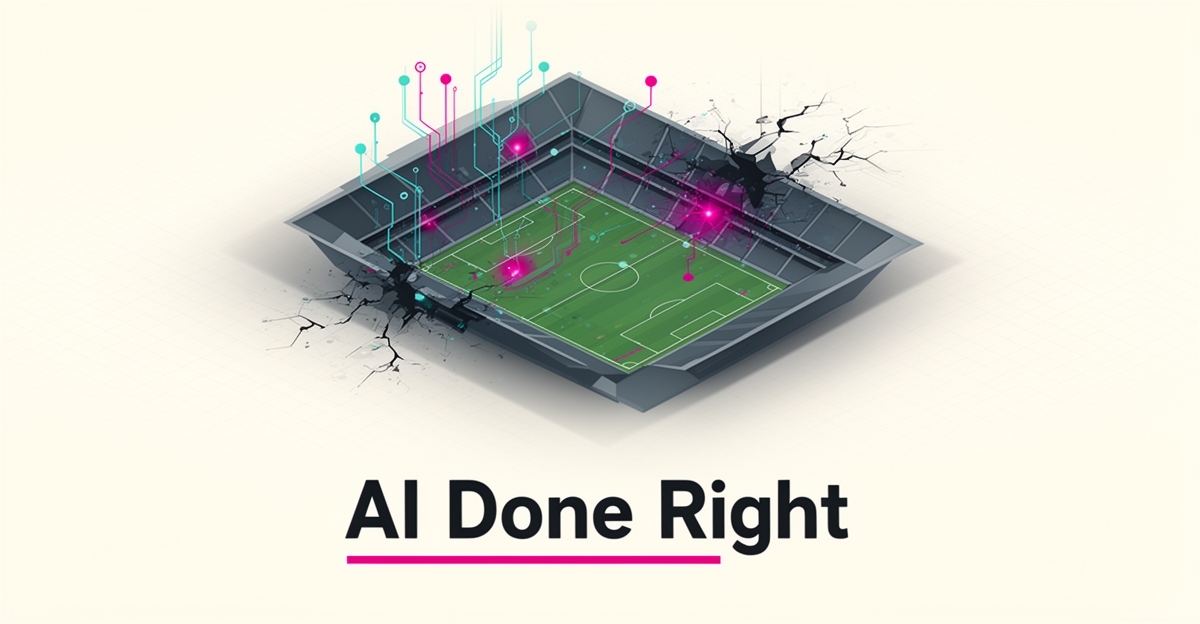
Why Most Sports Leagues Fail at AI Implementation (And How to Avoid It)
Key Facts
- Human-AI teams tend to be significantly more productive than human-only teams, per widely cited collaboration research summarized on LinkedIn
- Human-AI teams complete work measurably faster than human-only teams in the same research
- Collaboration research also reports higher positive emotions and more communication in human-AI teams
- HYPE Sports Innovation identified 12 notable AI missteps in sports per their analysis
- Poor data quality, lack of staff training, and over-reliance on chatbots are the three most common pitfalls in sports AI failures per HYPE Sports Innovation
Hire a team member that works 24/7 — for less than a part-time wage.
AI receptionists, SDRs, dispatchers and 99+ roles. Trained on your business, fully managed.
Not sure where to start? Ask our AI planner
The Hidden Cost of AI Overconfidence in Sports
Sports leagues love to announce AI first and figure it out later. That rush to the headlines is exactly how credibility gets lost on the field and off it.
An analysis by HYPE Sports Innovation highlights 12 notable AI missteps in the sports world, from the Sports Illustrated AI author backlash to Premier League offside technology delays. The pattern is not bad technology, it is bad foundations.
Organizations deploy models without clean data, without trained staff, and without clear human oversight. The result is damaged trust with fans, public reversals, and investment wasted on systems that never scale. Transparency and rigorous testing are repeatedly cited as missing safeguards.
The common thread across failures is overconfidence. Leagues assume AI will work because the vendor promised it will, and they skip the readiness work that makes deployment safe.
Poor data quality, lack of staff training, and over-reliance on chatbots are the three pitfalls most often called out in sports AI failures. The analysis emphasizes the importance of human oversight and transparency in AI implementation.
- Poor data quality undermines predictive power and creates biased outcomes
- Lack of staff training leaves teams unable to use or challenge AI outputs
- Over-reliance on chatbots replaces judgment with generic responses
- Missing backup plans expose leagues to high-stakes technology failures
Leagues that treat AI as a teammate rather than a replacement see different results. Widely cited research on human-AI collaboration, summarized by LinkedIn, reports substantially greater productivity and more positive team sentiment when humans and AI work together. The benefit comes from augmentation, not automation alone.
This is why an AI readiness assessment matters before any public launch. AIQ Labs starts every engagement by checking whether your data, processes, and team are actually ready—whether that's a single workflow rebuild or a full AI operating system. The contrarian look at common pitfalls is not about avoiding AI, it is about avoiding over-reliance on chatbots and hype-driven timelines.
Foundations first protects credibility. When leagues prioritize transparency, domain-specific training data, and human-in-the-loop controls, AI enhances refereeing, talent scouting, and fan engagement instead of eroding it.
Why Poor Data Quality Kills Sports AI Projects
Every AI model is only as good as the data it learns from, and in sports, that foundation is crumbling more often than most leagues realize. A comprehensive analysis of AI failures in sports by HYPE Sports Innovation identifies 12 notable cases where poor data quality directly contributed to implementation disasters, from biased player evaluations to unreliable officiating systems.
The core problem is deceptively simple: sports organizations collect massive amounts of data but rarely audit its quality before feeding it into AI systems. Incomplete injury histories, inconsistent performance metrics across different venues, and historical data that reflects outdated playing styles all create flawed training datasets that produce unreliable predictions.
Consider how this plays out in practice. An AI system trained primarily on data from one demographic of athletes will systematically undervalue players who don't match that profile. Officiating algorithms trained on limited game situations will make calls that seem statistically sound but miss crucial context. The research emphasizes that without accurate, diverse datasets, AI's predictive power diminishes significantly.
The stakes extend beyond wins and losses. When AI systems make recommendations about player recruitment, contract valuations, or injury risk assessments based on biased data, they perpetuate and amplify existing inequalities. Regular audits become essential to identify and eliminate these algorithmic biases before they influence critical decisions.
What makes sports data particularly challenging is its domain-specific nature. Generic AI models trained on broad datasets miss the nuanced patterns that define athletic performance. Key factors that demand specialized training data include:
- Sport-specific movement patterns and biomechanics that vary dramatically across disciplines
- Context-dependent performance metrics that change based on opponent strength, weather, and game situations
- Historical shifts in playing styles and rules that make older data potentially misleading
- The interaction between individual performance and team dynamics that simple statistics can't capture
This is where AI readiness assessments prove invaluable. Before deploying any AI system, organizations need to evaluate whether their data infrastructure can actually support reliable predictions. AIQ Labs builds every engagement on this check—starting with the one workflow that costs you the most, rebuilt at a fixed price through AI Workflow Builds, so data quality issues surface before they become public failures.
The lesson is clear: investing in sophisticated AI algorithms while neglecting data quality is like building a championship team on a broken foundation. Sports organizations that prioritize rigorous testing and human oversight alongside data quality create AI systems that actually deliver on their promise rather than becoming expensive failures.
The Chatbot Trap: When AI Replaces Instead of Enhances
The allure of AI chatbots as a quick fix for fan engagement and operational efficiency has led many sports leagues down a dangerous path—replacing human expertise with automation instead of enhancing it. This over-reliance strips critical decisions of nuanced judgment, turning AI into a blunt instrument where a scalpel is needed. When leagues deploy chatbots to handle complex inquiries like injury updates, ticketing disputes, or rule interpretations without human oversight, they risk eroding trust and accuracy. Collaboration research consistently finds that AI-only approaches fall short of human-AI teams, which are more likely to produce top-tier solutions, work faster, and communicate more—per research summarized by LinkedIn. AI's true value lies in augmentation, not replacement.
Sports organizations that treat chatbots as standalone solutions often overlook the irreplaceable role of human expertise in contextual understanding and empathy. For instance, a chatbot might efficiently route a fan's query about seat upgrades but fail to recognize the frustration behind a season ticket holder's complaint about obstructed views—a subtlety a human agent would catch and address with personalized follow-up. This gap becomes critical in high-stakes scenarios like officiating support or player health assessments, where AI's precision must be balanced with human situational judgment.
To avoid the chatbot trap, leagues must design AI systems that elevate—not eliminate—human roles. This means implementing clear handoff protocols where AI gathers initial information but escalates complex cases to trained staff, ensuring AI handles repetitive tasks while humans focus on judgment-intensive work. AIQ Labs takes this approach with AI Employees—managed AI staff that handle repetitive work like reception, scheduling, and dispatch at a fraction of the cost of a human hire, with humans kept firmly in the loop. By fostering collaboration over substitution, sports leagues can harness AI's scalability without sacrificing the human insight that defines the fan experience and competitive integrity.
Start the Fit Check — a free, 2-minute assessment at aiqlabs.ai/apply to map your AI opportunities and avoid costly implementation pitfalls.
Building AI Readiness: The Sports League Assessment Framework
Building AI readiness requires sports leagues to move beyond enthusiasm and into structured evaluation. Before deploying any AI system, organizations must assess their foundational capabilities across data infrastructure, team skills, and leadership alignment. This proactive approach prevents the costly cycle of pilot failures that plague many sports technology initiatives. A comprehensive readiness framework transforms AI from a speculative experiment into a strategic asset grounded in operational reality.
The research outlines six critical steps for responsible AI implementation that directly inform readiness assessment. First, prioritizing transparency means clearly documenting how AI informs decisions in areas like player scouting or fan engagement to build stakeholder trust. Second, investing in controlled testing involves piloting tools in low-risk environments—such as training scenarios or historical data analysis—before live deployment. Third, fostering human-AI collaboration requires designing systems where AI augments roles like refereeing or talent identification rather than replacing expert judgment. Fourth, training on domain-specific data ensures models understand sport-specific nuances, from biomechanics to league regulations. Fifth, conducting regular bias audits protects against skewed outcomes in recruitment or performance evaluation. Finally, establishing backup plans prepares leagues for technology failures during high-stakes moments like playoffs or drafts.
These steps connect to broader readiness pillars: data quality determines whether AI can learn meaningful patterns; team capabilities dictate whether staff can interpret and act on AI insights; and organizational buy-in ensures sustained adoption beyond initial excitement. Leagues skipping this evaluation often encounter the pitfalls highlighted in industry analyses—poor data integrity, undertrained staff, and over-reliance on chatbots that lack contextual understanding. By contrast, organizations that assess readiness using this framework create the conditions where AI delivers measurable improvements in speed, quality, and collaboration.
For sports leaders seeking to avoid common implementation traps, the path forward begins with honest self-assessment. AIQ Labs supports this process through a free 2-minute Fit Check followed by a 30-minute strategy call—examining your technology stack, data governance, and team readiness before anything gets built. This disciplined approach turns AI potential into predictable performance, ensuring investments yield lasting value in competitive environments.
From Pilot to Production: Making AI Work in High-Stakes Sports Environments
Most sports leagues get stuck at the pilot stage when implementing AI, unable to transition from controlled experiments to reliable production systems in live environments. The stakes are exceptionally high—failures are immediate, public, and can undermine the integrity of the sport itself. An analysis examining AI missteps in sports reveals that poor data quality, insufficient staff training, and over-reliance on chatbots without proper oversight are among the most common pitfalls leading to public failures according to HYPE Sports Innovation. These issues are magnified in real-time scenarios where split-second decisions impact game outcomes, fan trust, and competitive fairness.
Scaling AI across departments requires more than technical deployment—it demands a governance framework that ensures consistency, accountability, and human oversight. Successful integration means treating AI not as a replacement for expertise but as a force multiplier that enhances collaboration and decision-making. Collaboration research shows human-AI teams outperform human-only teams on both productivity and speed, demonstrating the value of balanced augmentation when implemented with care per LinkedIn's research summary. However, these gains only materialize when AI systems are trained on domain-specific data, regularly audited for bias, and paired with clear protocols for human intervention.
To move beyond pilots, sports organizations must establish cross-functional AI governance boards that include technologists, operations staff, athletes, and integrity officers. These bodies should oversee model validation, define escalation paths for AI uncertainty, and mandate transparency in how AI informs decisions—whether in officiating, player evaluation, or fan engagement. Pilot programs should include predefined success metrics tied to operational impact, not just technical accuracy, and must incorporate stress testing under live-condition simulations. Only through structured readiness assessments, phased scaling, and embedded oversight can AI transition from a risky experiment to a trusted component of sports operations. AIQ Labs builds in exactly this way—phased milestone-based delivery with human oversight at every stage, so you own the system outright when it's done.
Still paying for 10+ subscriptions that don’t talk to each other?
We build custom AI systems you own outright. No vendor lock-in. Full control.
Not sure where to start? Ask our AI planner
Frequently Asked Questions
Why do so many sports leagues fail when they try to use AI?
Is poor data quality really a dealbreaker for sports AI?
Can't we just use AI chatbots to handle fans and save money?
What makes AI work in high-stakes sports environments?
Does AI actually make teams more productive or just faster?
Where should we start before launching AI in our league?
Why Smart Leagues Win with AI: It Starts with Readiness
The path to AI success in sports isn't about chasing the latest hype—it's about building on solid ground. As we've seen, failures stem not from the technology itself, but from overlooked foundations: messy data, undertrained teams, and chatbots thrown into complex roles without guardrails. Leagues that treat AI as a collaborator, not a replacement, unlock real gains—when systems are designed with transparency, domain-specific training, and clear oversight. The good news? These pitfalls are avoidable with a proactive approach. Before your next AI initiative, assess where you stand. AIQ Labs helps sports organizations cut through the noise with a free 2-minute Fit Check and a 30-minute strategy call—so your AI enhances performance, credibility, and fan trust instead of undermining it. Take the first step: start the Fit Check to map your AI opportunities and avoid costly missteps.
Make AI your competitive advantage — not just another tool.
Strategy, implementation and ongoing optimization. One partner, end to end.
Not sure where to start? Ask our AI planner