Why Most Underground Utility Contractors Still Rely on Paper-Based Reporting
Key Facts
- A majority of utilities prioritize digital asset monitoring, yet most acknowledge they aren't using existing data effectively, according to recent industry research
- The American Society of Civil Engineers gave U.S. wastewater systems a D+ grade in its 2025 Infrastructure Report Card, citing a funding gap approaching $700 billion by 2033
- Most utility executives believe AI's full potential requires a foundation of trust, per Accenture's Tech Vision research on the utilities industry
- A large share of industry executives agree AI agents will reinvent how digital systems are built, according to Accenture Tech Vision 2025
- Paper-based reporting causes delays when field notes are misplaced, damaged, or never transcribed, leading to data loss that compromises project tracking and compliance
- Crews spend valuable hours on administrative tasks instead of field work due to paper-based reporting inefficiencies
- AI-driven modernization enables real-time data analysis, automated reporting, and predictive maintenance to reduce downtime and improve efficiency
Hire a team member that works 24/7 — for less than a part-time wage.
AI receptionists, SDRs, dispatchers and 99+ roles. Trained on your business, fully managed.
Not sure where to start? Ask our AI planner
The Hidden Cost of Paper: Why Legacy Reporting Inefficiencies in Underground Utilities
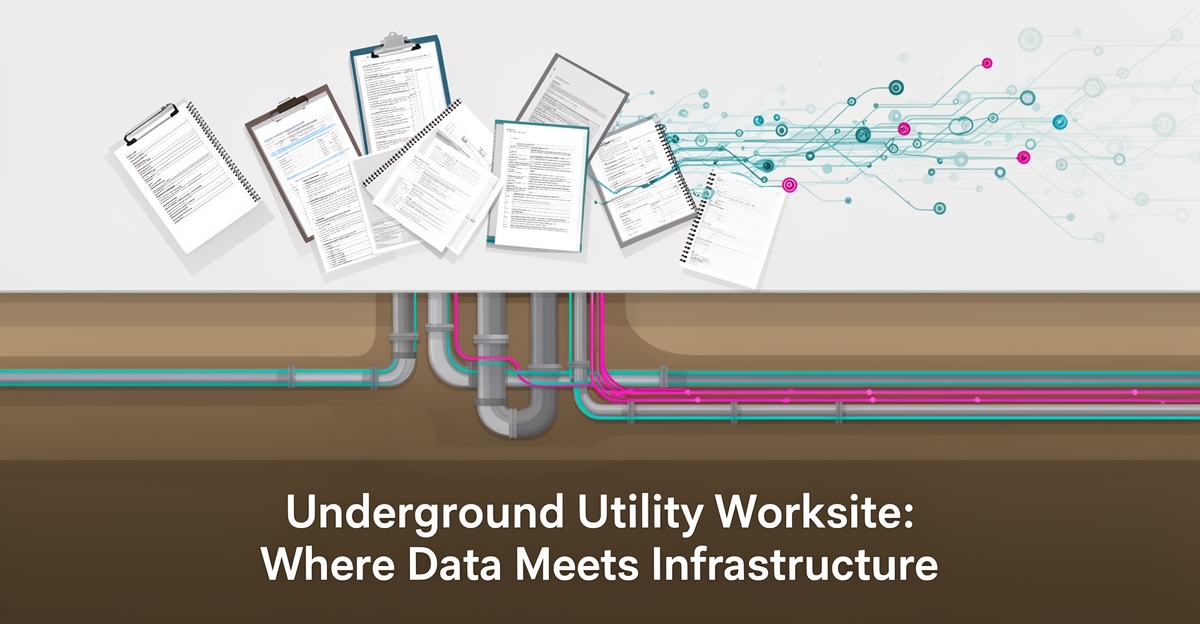
Despite its familiarity and low upfront cost, paper-based reporting in underground utilities creates significant operational drag. Contractors often face delays when field notes are misplaced, damaged, or never transcribed into central systems, leading to data loss that compromises project tracking and compliance. This inefficiency is compounded by the industry's own admission that even when data is collected, it is not being used effectively, industry research consistently finds that while a majority of utilities prioritize digital asset monitoring, most acknowledge they aren't leveraging existing data to inform decisions. As a result, critical insights about pipe conditions, maintenance needs, or safety risks remain trapped in filing cabinets or scattered notebooks, inaccessible when they're needed most.
The consequences extend beyond lost information. Paper-based workflows slow decision-making by requiring manual aggregation and interpretation, which can take days or weeks, time that aging infrastructure cannot afford. The American Society of Civil Engineers' 2025 Infrastructure Report Card underscores this urgency, assigning U.S. wastewater systems a D+ grade and highlighting a funding gap approaching $700 billion by 2033. In this context, delays caused by outdated reporting aren't just inconvenient; they exacerbate systemic vulnerabilities, increasing the risk of failures, service disruptions, and costly emergency repairs. Utilities operating without timely, accurate data are essentially managing critical infrastructure in the dark.
These legacy inefficiencies also reduce overall productivity, as crews spend valuable hours on administrative tasks instead of field work. Supervisors must chase down paper reports, clerks spend time re-entering data, and engineers wait for incomplete or illegible notes before approving next steps. This cycle of manual handling introduces errors, creates bottlenecks, and diverts focus from proactive maintenance and innovation. While paper may seem cost-effective, its hidden toll, measured in lost time, avoidable risks, and missed opportunities for optimization, far outweighs its simplicity. Modernizing these workflows isn't just about adopting new technology; it's about reclaiming the value of data that's already being collected but never fully utilized. AIQ Labs helps underground utility contractors transition from paper-dependent processes to intelligent, integrated systems that turn field insights into immediate action, without disrupting the workflows teams already trust.
Why Digital Adoption Stalls: Trust, Data Quality, and Regulatory Gaps
Despite the clear advantages of digital transformation, many underground utility contractors remain hesitant to move beyond paper-based reporting. Accenture's Tech Vision research on the utilities industry found that a large majority of utility executives believe AI's full potential can only be realized when it is built on a foundation of trust, yet legacy workflows and inconsistent data practices undermine that confidence. Without reliable, standardized inputs, AI systems risk producing flawed outputs, reinforcing skepticism rather than alleviating it.
This trust gap is compounded by poor data readiness across the industry. While most utilities prioritize digital asset monitoring, many admit they aren't using existing data effectively, according to industry reports. Paper-based field notes, handwritten logs, and scanned PDFs create fragmented datasets that are difficult to clean, integrate, or feed into AI models. As a result, even when contractors invest in digital tools, the underlying data quality often prevents meaningful automation or insight generation.
Regulatory uncertainty further stalls adoption. As of late 2026, there is still no universal framework governing how AI-generated insights should be validated, documented, or acted upon in underground utility work. Contractors worry about liability if AI recommendations lead to costly errors or compliance failures, especially in regulated environments where audit trails and human oversight are non-negotiable. Until clear guidelines emerge, many will default to familiar, albeit inefficient, paper processes they know how to defend.
From Paper to AI: A Practical Modernization Path for Utility Contractors
The path from paper-based reporting to AI-driven operations doesn't require a complete overhaul overnight. The most successful utility contractors are those who approach modernization as a phased journey, building capability and confidence with each step.
The first critical phase involves assessing your data readiness. Before implementing any AI system, contractors must evaluate the quality of their design files, GIS records, as-built documentation, field reports, and inspection data. Industry research consistently shows that while most utilities prioritize digital asset monitoring, many aren't using existing data effectively. This gap represents both a challenge and an opportunity for contractors willing to invest in data quality.
Starting with focused use cases delivers faster wins than attempting enterprise-wide transformation. Progress analytics, QA/QC verification, and schedule forecasting represent practical entry points where AI can demonstrate immediate value. Accenture's Tech Vision 2025 found that a large share of industry executives believe AI agents will reinvent how digital systems are built, but success requires strategic focus rather than scattered implementation.
Establishing governance early prevents costly missteps later. Contractors must define how AI-generated recommendations will be reviewed, who is responsible for acting on them, and how conflicts between model outputs and field conditions will be resolved. This governance framework becomes the foundation for scaling AI across operations.
Key implementation phases include:
- Data readiness assessment: Audit existing documentation quality and identify gaps in digital records
- Focused pilot programs: Start with a specific project, region, or construction program before expanding
- Governance framework: Establish review protocols and decision-making authority for AI recommendations
- Integration planning: Connect new AI systems with existing GIS and CMMS platforms
- Team training: Prepare field crews and office staff for new digital workflows
Vendors like SewerAI illustrate this phased methodology in action. In recent industry coverage, the company's leadership emphasizes superhuman speed and accuracy in defect detection, a modern user experience, and seamless GIS and CMMS integrations. This targeted application of AI to specific pain points, rather than broad, unfocused digitization, has driven strong utility adoption.
The regulatory and operational complexity of underground infrastructure demands careful planning. With the American Society of Civil Engineers assigning U.S. wastewater systems a D+ grade and identifying a funding gap approaching $700 billion by 2033, efficiency gains from AI modernization aren't optional, they're essential for staying competitive.
AIQ Labs helps contractors navigate this transition through structured implementation that respects both operational realities and budget constraints. Depending on where you are in the journey, that might mean deploying [AI Employees](/ai-employees) to handle reporting, dispatch, and follow-up tasks that currently eat crew hours, or a focused [AI Workflow Build](/workflow-builds) that rebuilds the single workflow costing you the most. The key lies in proving value incrementally, building internal expertise, and scaling only after establishing trust in AI-driven insights.
Still paying for 10+ subscriptions that don’t talk to each other?
We build custom AI systems you own outright. No vendor lock-in. Full control.
Not sure where to start? Ask our AI planner
Frequently Asked Questions
Why do underground utility contractors still use paper-based reporting despite its inefficiencies?
What are the main risks of relying on paper-based reporting in underground utility work?
How can utility contractors start adopting AI without overhauling their entire system?
What role does trust play in the slow adoption of AI in underground utilities?
Is AI-driven modernization worth the investment for small and mid-sized utility contractors?
What specific AI use cases deliver the fastest returns for utility contractors?
Turning Paper Trails into Predictive Paths
The shift from paper-based reporting isn't just about digitizing notes, it's about unlocking the value already buried in field data to make faster, safer decisions on aging infrastructure. As highlighted by ASCE's D+ grade for U.S. wastewater systems and the looming funding gap, delays caused by manual workflows aren't just inefficient; they increase risk when systems can least afford it. Contractors who begin with a data readiness assessment and targeted AI use cases, like progress analytics or QA/QC verification, can build trust incrementally while proving ROI. AIQ Labs supports this journey through structured implementation, helping teams move from reactive fixes to proactive insight without disrupting trusted workflows. To explore how your utility operation can start this transition with minimal risk, begin with the two-minute [Fit Check](/apply) to identify your highest-impact automation opportunity.
Make AI your competitive advantage — not just another tool.
Strategy, implementation and ongoing optimization. One partner, end to end.
Not sure where to start? Ask our AI planner