AI Agents Are Now a Sales Channel. Is Your Business Ready to Take Their Orders?
DoorDash's CEO says outside AI agents are becoming a sales channel, and Anthropic just raised $107.3 billion in its IPO. Here's why both stories matter for small and mid-sized businesses building AI capacity now.
November 22, 2026
TL;DR
DoorDash's CEO now treats outside AI agents as a customer-acquisition channel, and Anthropic's record $107.3 billion IPO signals durable AI infrastructure, which together suggest small and mid-sized businesses need transaction-capable AI of their own, not chat widgets.
Key Points
1DoorDash CEO Tony Xu said external AI agents are becoming a genuine customer-acquisition channel, provided they can complete full transactions end to end.
2DoorDash's AI spending jumped roughly 20-fold this year, then plateaued as models got more efficient and the company moved to fine-tuned open-weight models trained in-house.
3Anthropic's IPO raised a record $107.3 billion at $83 per share, valuing the company near $1.5 trillion and validating the model layer that applied-AI builders depend on.
4Falling per-unit AI costs are what make SMB-scale deployment viable, since agents that complete workflows now cost far less than equivalent human hires.
5Businesses that can't serve an AI-mediated customer will lose those orders to competitors that can, which favors building owned, action-capable AI systems over passive chatbot subscriptions.
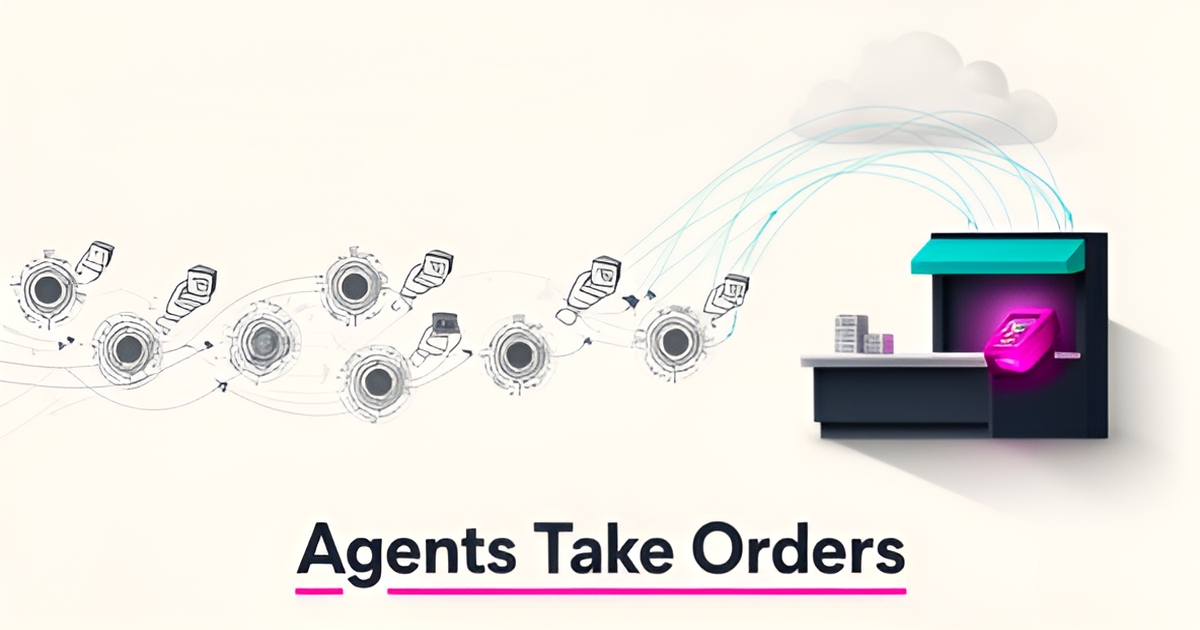
This week, two signals came out of the AI market that matter far beyond the big-cap tickers. DoorDash's CEO told an investor conference that AI agents from other companies are becoming a sales channel for his business, the same way search results and app stores became channels before them. And Anthropic, the maker of the Claude model family, pulled off the largest IPO on record, raising $107.3 billion at a valuation near $1.5 trillion. If you run a small or mid-sized business, both stories point to the same practical question: can your business take an order, book a job, or close a booking when the customer on the other end is an AI agent, or a customer served by one?
DoorDash Is Planning for a World Where Agents Are the Customers
Tony Xu's remarks at the November 21 investor conference, as reported by MarketBeat, laid out how a major consumer platform thinks about agentic commerce. DoorDash's own shopping agent, Ask DoorDash, can assemble a full grocery basket in under two minutes or surface restaurant recommendations. But the more interesting comment was about other people's agents. Xu said he treats external AI agents as a new customer-acquisition channel, with one condition: they have to be able to complete the whole transaction, including delivery details, substitutions, and returns.
That's a meaningful bar. An agent that can only browse your website doesn't generate revenue. An agent that can call your business, answer qualification questions, get a quote, and book the work does. This is exactly the distinction between a chat widget and what firms like AIQ Labs in Halifax build: AI Employees with defined roles that answer phones at all hours, qualify leads, schedule appointments, handle intake, and dispatch jobs, connected to the CRM, calendar, and payment tools that make the transaction real. Xu's framing suggests that within a few years, a meaningful share of inbound business will arrive through AI intermediaries, and businesses that can't serve that traffic will simply miss it.
The Efficiency Dividend: Why This Is Now Affordable for SMBs
DoorDash's AI spending tells a story that should encourage any business owner watching costs. Xu said the company's AI spend increased roughly 20-fold this year, then plateaued. The reason wasn't retrenchment. Leading models became more efficient, and DoorDash shifted toward fine-tuned open-weight models trained in-house, so each unit of AI capability got cheaper even as usage grew. He signaled spending will rise again as AI takes on more complex, intelligence-intensive work.
That plateau is the part SMBs should notice. The same efficiency curve that lets DoorDash pause its spending is what makes AI staffing viable for a 10-person plumbing company or a two-lawyer firm. If the cost per call, per lead qualification, or per booking keeps falling, then a managed AI receptionist or dispatcher that costs less than a part-time hire stops being a stretch and becomes an obvious trade. AIQ Labs prices its AI Employees on flat monthly plans, with the claim that they run 75 to 85 percent below the fully loaded cost of a human in an equivalent role, and the market's cost trajectory keeps moving in that direction.
Anthropic's Record IPO and the Model Layer Beneath the Ecosystem
The other dominant story of the week was Anthropic. According to ZeroHedge's premarket commentary on November 21, Anthropic PBC (ticker ANT) raised $107.3 billion in an upsized IPO and private placement, pricing at $83 per share against a marketed range of $70 to $78, with gray-market indications pointing to a 20 to 26 percent pop at the open. Nasdaq futures rose about 2 percent on the news, and the wider AI trade revived, with Alphabet up 4.2 percent and Amazon up 2.5 percent premarket.
For applied-AI builders, the significance is straightforward. Anthropic's Claude models are the primary reasoning engine behind many production agent systems, including the multi-agent architectures AIQ Labs deploys for clients. A model provider with a $1.5 trillion valuation and $107 billion of fresh capital isn't going away, and its roadmap is funded for years. That stability matters when a business is deciding whether to build core workflows on top of these models. The one caveat worth watching is pricing power: a model layer this concentrated can raise API costs, which is one more argument for owning your system outright rather than renting it from a subscription vendor whose prices you don't control.
Unit Economics Before Hype
There's a credibility lesson in DoorDash's approach that smaller firms should copy. The company has invested in autonomous delivery since 2018, yet its small autonomous vehicle, the DoorDash Dot, still handles only about 10 percent of delivery volume in Phoenix, and Xu is explicit that national scaling waits for proven unit economics. Drone delivery is being tested with international partners, but nothing scales until the numbers work.
That discipline mirrors how practical AI delivery should happen at any company size. AIQ Labs' own model is built around it: a free strategy call first, then a single workflow fixed at a set price, phased builds you can stop at any milestone while keeping what's been delivered, and full ownership of the code and data at the end. No fake price anchors, no grand promises. If there isn't a clear win, they'll say so. When a $1.5 trillion model company and a delivery platform both tie AI investment to measurable outcomes, the era of AI for AI's sake is over, and vendors that can't show the math won't last.
What SMBs Should Do This Quarter
The macro backdrop adds urgency. The ZeroHedge report noted hawkish FOMC minutes with roughly 27 basis points of December Fed hikes priced in, and a 10-year yield around 5.09 percent. Tighter money pressures SMB budgets, which argues against large, speculative AI projects and in favor of low-commitment entry points: one AI employee on a monthly plan you can pause, or one broken workflow rebuilt at a fixed price.
The practical starting sequence looks like this. First, identify the workflow that bleeds the most money, usually lead follow-up, missed calls, intake, or scheduling. Second, fix that one thing with a defined, measurable outcome. Third, once the first win is proven, expand toward a connected operating layer where the same AI handles intake, communication, scheduling, and reporting. That's the path from a single AI receptionist to a business that's genuinely agent-ready, able to serve the AI-mediated customers DoorDash is already planning for.
Conclusion
This week's market news isn't really about DoorDash or Anthropic. It's about a structural shift: AI agents that complete transactions are becoming standard infrastructure, the model layer underneath them is funded for the long haul, and the cost of deploying all of it keeps falling. Large platforms are rebuilding their operations around that reality. For SMBs, the move is smaller but the logic is identical, and the businesses that start now, with one workflow and one measurable win, will be the ones taking the orders that others miss.
Found this helpful?
Share it with your network or explore more AI insights.