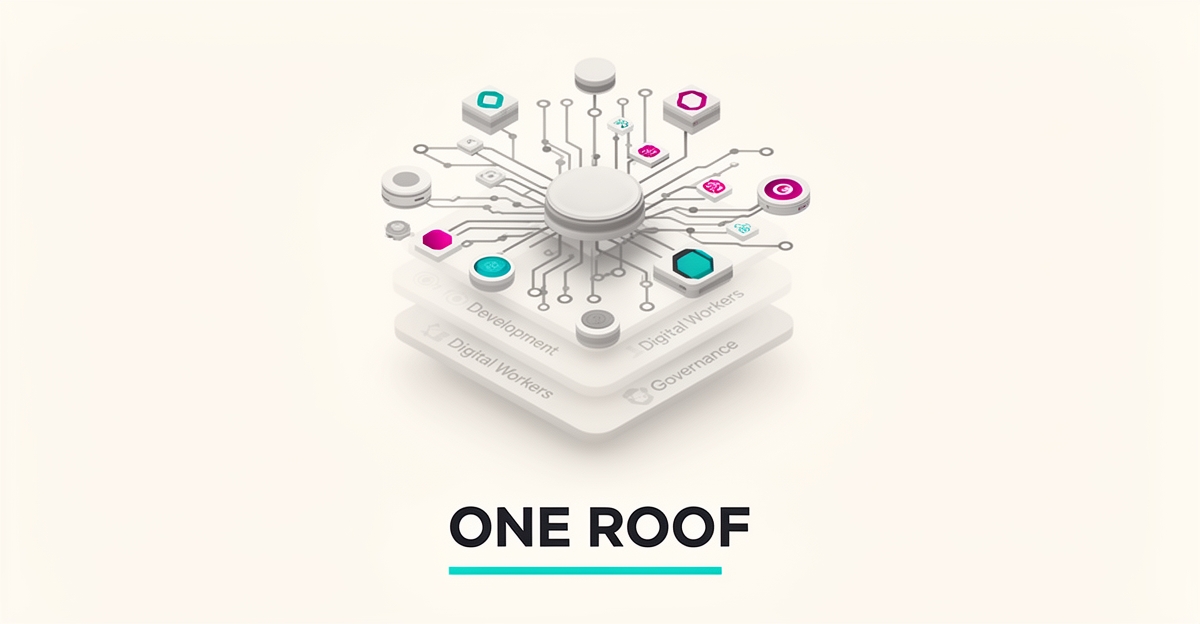
AIQ Labs Unveils Full-Stack AI Transformation Model for SMBs: Custom Development, Managed Digital Workers, and Strategic Governance Under One Roof
AIQ Labs introduces a full-stack AI transformation partnership for SMBs, unifying custom development, managed AI employees, and strategic consulting. With four live SaaS products running 70+ production agents, the firm proves its multi-agent architectures and regulated voice AI at scale before client deployment.
September 9, 2026
TL;DR
Halifax-based AIQ Labs launches a three-pillar AI transformation model combining custom development, managed AI employees, and strategic consulting to help SMBs replace fragmented SaaS stacks with owned, integrated AI systems.
Key Points
1AIQ Labs operates four live SaaS products with 70+ production agents, proving multi-agent architectures and regulated voice AI at scale before client deployment.
2The firm's 'AI Employee' model delivers role-specific digital workers (99 roles across 11 categories) at 75-85% cost reduction versus human FTEs with 24/7/365 availability.
3Custom development services transfer full IP ownership to clients, eliminating vendor lock-in and replacing subscription sprawl with unified, owned digital assets.
4AI Transformation Partner (AITP) framework addresses the 'Pilot Trap' through six structured pillars: assessment, development, integration, governance, adoption, and scaling.
5Technical foundation leverages LangGraph orchestration, Claude 4.5/Gemini 3 Pro model routing, and Model Context Protocol for real-world action execution across CRM, payments, and telephony.
Small and medium-sized businesses have long been caught in an AI adoption squeeze: enterprise-grade transformation requires seven-figure budgets and specialized engineering teams, while off-the-shelf tools deliver fragmented point solutions that don't integrate, don't scale, and leave data trapped in vendor ecosystems. Halifax-based AIQ Labs is positioning itself squarely in this 'missing middle' with a comprehensive three-pillar model that combines custom AI development, managed AI employees, and strategic transformation consulting under a single accountable partnership.
Proof Through Production: The Portfolio That Validates the Promise
AIQ Labs distinguishes itself by operating four revenue-generating SaaS platforms that serve as living proof of its engineering capabilities. These aren't prototypes or demos—they're production systems processing thousands of data points daily across 70+ specialized agents. The portfolio includes a personalized newsletter platform using conversational onboarding and multi-agent research for 1:1 content personalization at scale; an intelligent chatbot platform built on LangGraph with dual RAG and knowledge graph retrieval plus native e-commerce integrations; a large-scale marketing suite orchestrating 70+ agents for real-time trend research, content generation, and multi-platform distribution with automated fact-checking; and a compliant AI collections platform deploying voice agents for regulated debt collection across phone, SMS, and email with full audit trails and payment negotiation capabilities. This 'dogfooding' approach means every architecture, framework, and technique recommended to clients has been battle-tested in the firm's own commercial products.
Pillar One: Custom Development That Transfers Ownership
The development pillar addresses what AIQ Labs terms 'subscription chaos'—the average SMB's reliance on dozens of disconnected SaaS tools that create data silos and integration nightmares. The firm's 21 core services span operational excellence (AP/AR automation, inventory forecasting, financial dashboards, knowledge base generation), sales and marketing transformation (lead scoring, outreach intelligence, sales call automation, hyper-personalized content, SEO systems), customer experience (support chatbots, voice agents, call centers, receptionists), digital presence (AI-powered websites, generative engine optimization), and HR/recruiting. Three engagement tiers provide entry points: AI Workflow Fix starting at $2,000 for a single critical process; Department Automation at $5,000-$15,000 for cross-functional overhauls; and Complete Business AI Systems at $15,000-$50,000+ for enterprise-level multi-department ecosystems. Critically, all custom code, intellectual property, and architecture transfer to the client—no vendor lock-in, no platform dependencies, complete control over future development.
Pillar Two: AI Employees as Managed Digital Labor
Moving beyond chatbot widgets, AIQ Labs delivers 'AI Employees'—production-grade agents with defined roles, tool access, and 24/7/365 availability. The catalog spans 99 roles across 11 categories: sales and lead generation (14 roles including SDRs, appointment setters, closers), reception and administration (11 roles), customer service (10 roles), medical and healthcare (10 roles including patient coordinators and insurance verifiers), legal (7 roles including intake agents and paralegals), real estate (7 roles), trades and field services (9 roles including dispatchers and estimators), finance and accounting (8 roles including collections and AP/AR clerks), marketing (8 roles), HR and recruiting (7 roles), and operations and logistics (8 roles). The economics are compelling: AI Receptionists at $599/month after setup; specialized roles at $1,000-$1,500/month with $2,000-$3,000 setup fees. Compared to human FTEs at $4,000-$7,000/month fully loaded with 40-hour availability, AI Employees deliver 75-85% cost reduction with 4.2x availability uplift (168 vs. 40 hours weekly). The done-for-you model handles job description analysis, building, training, integration, deployment, and ongoing management including performance monitoring and continuous retraining.
Pillar Three: Transformation Partnership That Solves the Pilot Trap
Research indicates most organizations stall at Stage 2 of the AI maturity curve—running limited pilots that never scale. AIQ Labs' AI Transformation Partner (AITP) model addresses this through six structured pillars: Assessment & Strategy (readiness evaluation, ROI modeling, roadmap design); AI Agent & System Development (custom multi-agent systems on LangGraph/ReAct); Enterprise Integration (CRM, financial, operations, communication, and industry-specific platforms via MCP); Governance & Compliance (trust/ethics frameworks, data privacy, regulatory alignment, audit trails, human-in-the-loop controls); Adoption & Change Management (role-based training, stakeholder communication, feedback loops, success metrics); and Innovation & Scaling (new use case identification, cross-departmental expansion, emerging technology integration). Engagement types range from 2-3 day Discovery Workshops to 4-6 week Strategic Planning engagements, ongoing Implementation Advisory retainers, and periodic Optimization Reviews. This lifecycle approach ensures AI becomes embedded in the operating model rather than remaining a disconnected experiment.
Technical Architecture Built for Autonomous Action
The technical foundation reveals why AIQ Labs can deliver where others struggle. LangGraph provides stateful, cyclic multi-agent orchestration capable of complex long-running workflows—essential for collections negotiation, dispatch logic, and multi-step sales processes that linear chains cannot handle. Model routing uses Claude 4.5 as the primary reasoning engine for nuanced communication, Gemini 3 Pro for specialized tasks, and task-specific models for voice synthesis, speech recognition, and document processing, avoiding single-provider lock-in. The Model Context Protocol (MCP) enables agents to take real actions: booking appointments, processing payments, updating CRMs, transferring calls—not just generating text responses. The voice stack achieves human-parity neural TTS with real-time ASR robust to noise and accents, plus conversational management for interruptions, holds, transfers, and mid-call workflow execution. Safety layers include validation gates, hard guardrails, configurable human-in-the-loop escalation, graceful fallbacks, and complete audit trails—enabling deployment in regulated contexts like healthcare, legal, and financial services.
Market Positioning: The Anti-SaaS Alternative for the Agentic Era
As the market shifts from 'copilot' assistants to 'autopilot' autonomous agents, AIQ Labs occupies a distinct competitive position. Unlike management consultancies that deliver strategy without implementation, AIQ builds and operates the systems. Unlike SaaS vendors that rent per-seat licenses with limited customization, AIQ transfers ownership and enables deep workflow integration. Unlike dev shops that lack productized domain expertise, AIQ brings 99 pre-defined roles, 21 service templates, and a live production portfolio. Unlike staffing agencies and BPOs, AIQ delivers 75-85% cost savings with zero churn and instant scalability. The Halifax base provides operational cost advantages versus Toronto or U.S. hubs while maintaining Atlantic Time zone coverage bridging Europe and North America. Client engagements span architecture firms (70+ employee practice management automation), workers' compensation (voice audit platforms), healthcare construction (project management with IP transfer), education (admissions/collections/course building), electrical trades (dispatch automation plus 10,000+ programmatic SEO pages), legal (CRM-integrated intake), safety communications (brand voice RAG pipelines), and counseling services (intake/scheduling automation).
Conclusion
AIQ Labs represents a maturation of the AI services market: moving beyond tool installation toward genuine business transformation where AI systems are owned, integrated, governed, and continuously optimized as core operational infrastructure. For SMBs facing persistent labor shortages, software fatigue, and competitive pressure from AI-native rivals, the three-pillar model offers a structured path from experimentation to embedding—backed by a partner that has already proven the technology in its own commercial products. As generative engine optimization replaces traditional SEO, voice AI matures for regulated deployment, and agentic workflows become the new standard for business automation, firms that can deliver the full stack—strategy, engineering, managed labor, and governance—will define the next era of SMB competitiveness.