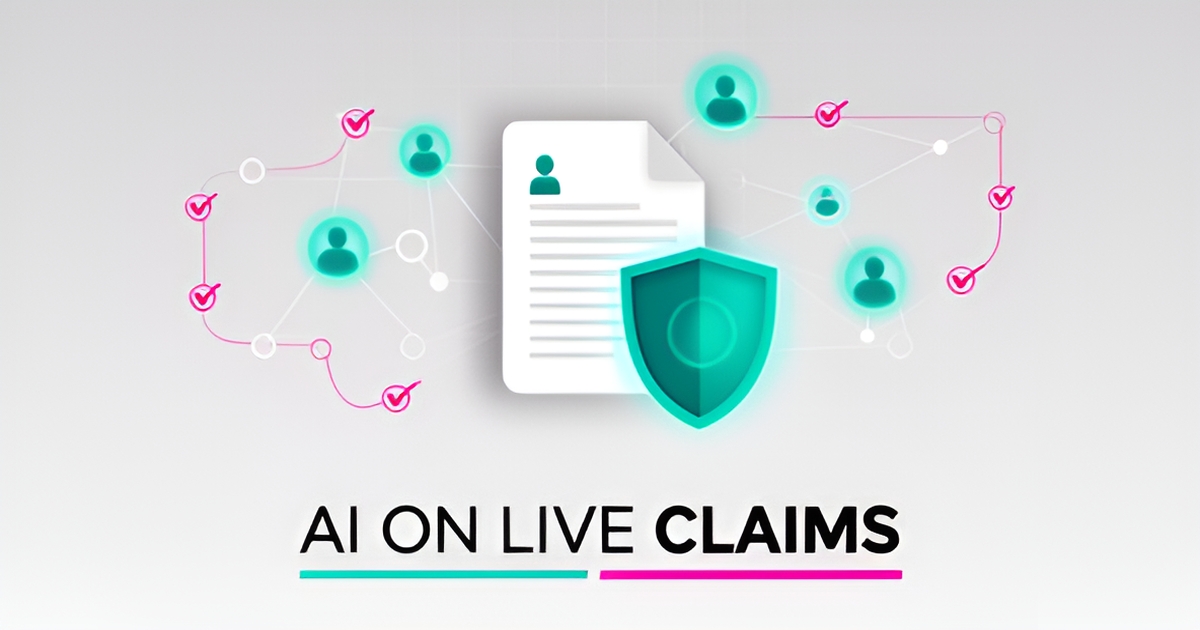
Guidewire Puts AI Agents on Live Insurance Claims. What That Means for Your Business.
The biggest name in insurance core software just put AI agents on live claims, with permissions and audit trails built in. The standard it sets applies to your business too.
October 28, 2026
TL;DR
Guidewire's October 27 announcement embedding governed AI agents into its core insurance platform confirms what AI-focused builders have argued for years: agents only work when they sit inside real workflows with permissions, audit trails, and the ability to act, and the same standard now applies to small and mid-sized businesses choosing their own automation partners.
Key Points
1Guidewire announced agentic AI running inside PolicyCenter, ClaimCenter, and UnderwritingCenter, where agents can act on live claims and policies rather than just answer questions.
2The company emphasized governance throughout: defined agent permissions, security controls, and audit trails maintained through ongoing updates.
3Several flagship capabilities, including parts of the agentic underwriting and claims suite, are still in Early Access, so buyers should treat some claims as roadmap rather than shipping product.
4Celent analyst Karlyn Carnahan's framing matters most: insurers are past experimentation, and the hard part is deploying agents inside production systems with proper controls.
5The same principles now set expectations for SMB software: if a vendor's AI can't touch your calendar, CRM, or phone system and log what it did, it's a demo, not an employee.
On October 27, at its Connections conference in Las Vegas, Guidewire announced a platform-level push into what it calls agentic insurance. For anyone outside the property and casualty world, Guidewire may not be a household name, but it matters: the company builds the core systems that insurers use to write policies, price risk, and settle claims, and more than 3,000 insurers and partners from 36 countries showed up to hear about it.
The headline is that Guidewire is embedding AI agents directly into those core systems. Agents will work inside PolicyCenter, ClaimCenter, and UnderwritingCenter, with access to the insurer's existing data and workflows. They can summarize submissions, flag risks on files, and in the case of a product called Concierge, run autonomous voice and chat conversations that capture loss details and hand decision-ready claims to ClaimCenter.
If you run a small or mid-sized business, this announcement is worth your attention anyway. Not because you'll be buying Guidewire, but because it settles an argument about how AI should be deployed, and that argument applies to your intake line, your scheduling, and your follow-up just as much as it applies to a national insurer.
The Core Argument: Agents Belong Where the Work Happens
Guidewire CEO Mike Rosenbaum's framing, as reported in the announcement, is that insurance is a business of decisions made in context, so agents need to operate where core operations run. That sounds obvious, but it cuts against how most AI has been sold over the past three years: chat widgets bolted onto websites, standalone copilots that require you to copy and paste between tabs, tools that can talk but can't do.
The difference between an agent that talks and an agent that acts is the difference between a receptionist who answers questions and one who actually books the appointment. Guidewire's UnderwritingCenter agent, for example, converts raw submissions into risk profiles and can quote directly into PolicyCenter. The agent doesn't hand you a summary and wish you luck. It completes the transaction inside the system of record.
Chief Product Development Officer Diego Devalle made the technical case: because agents run on the same platform as the core applications, they inherit the core's scalability and observability, which is what makes it safe to use them on live claims and live policies. That last phrase is the tell. Live claims. Not sandbox demos, not pilot folders. Real customer files moving through a production system.
Governance Is the Story, Not the Footnote
Read the announcement closely and you'll notice how much of it is about restraint. Agents operate within defined permissions. Security controls and audit trails are maintained through ongoing platform updates. Executive quotes repeatedly pair autonomy with human judgment. Definity CTO Tatjana Lalkovic, quoted in the release, praised Guidewire's Developer Assistants for speeding implementation while keeping human judgment central.
This is what maturity looks like in a regulated industry. Celent analyst Karlyn Carnahan put it plainly: insurers are past experimentation, and the challenge now is deploying agents within production systems with proper controls. In other words, the question has shifted from "can AI do this?" to "can we trust it to do this, and can we prove what it did?"
Any business buying AI automation in 2026 should be asking the same questions of any vendor, regardless of industry. What can the agent do without approval? What does it do when it hits something outside its authority? Is there a log I can review? If the answers are vague, you're not buying an employee. You're buying a liability with a friendly voice.
A Caveat Worth Flagging: Some of This Is Roadmap
One thing the press coverage tends to gloss over: several of the announced capabilities are designated Early Access or exist only on the roadmap. That's normal for a product conference, and Guidewire marks them accordingly, but buyers should read the announcement as partly forward-looking. The direction is real and the platform bet is credible. The shipping status of individual features varies.
There's a lesson in that too. When you evaluate an AI vendor, ask what's live today, in production, at a customer you can reference. Roadmaps are promises. Deployments are evidence.
Voice AI Has Crossed the Line Into Production
The Concierge product deserves specific attention because voice is where skepticism has lingered longest. Autonomous voice and chat agents that capture loss details from policyholders and deliver structured claims into ClaimCenter is not a parlor trick. It's sensitive, high-stakes customer interaction, and Guidewire is putting it in front of adjusters as a working tool.
This mirrors what's already happening further down the market. Voice agents now handle appointment booking for dental offices, after-hours intake for law firms, and dispatch coordination for trades. My own company runs a compliant voice-driven collections platform, and I can tell you from direct experience that natural-sounding agents handling real, sometimes uncomfortable customer conversations are viable in production today. What Guidewire's announcement adds is top-of-market validation. When the biggest name in insurance core software treats autonomous voice intake as standard product rather than innovation theater, the debate about whether voice AI is "ready" is over.
What This Means for Small and Mid-Sized Businesses
Here's the practical takeaway. Large insurers will spend months and significant budgets migrating to platforms like Guidewire's to get agents embedded in their operations. You don't have that timeline, and you don't need it. The principles transfer directly, and the mechanics are simpler at your scale.
First, agents need access to act. An AI receptionist that can't write to your calendar, or an intake agent that can't update your CRM, is a transcript generator. Insist on real integrations with the tools you already use: your scheduling software, your phone system, your payment processor.
Second, demand the governance stack by default. Validation layers before actions execute, guardrails customized per role, human escalation when a situation exceeds the agent's authority, and complete audit logging. Guidewire is building exactly this for insurers with thousands of employees. There's no reason a ten-person HVAC company should accept less.
Third, think about ownership. Guidewire's entire business model is a durable platform the insurer runs its company on. The counterpoint for smaller businesses is subscription sprawl: a dozen rented tools, each with its own login, none of them talking to each other, every one of them a monthly bill. An owned system, built for your workflows, is the same strategic bet Guidewire's customers are making, just priced for your size. It's also why we structure engagements so clients can own the code, the agents, and the data outright.
The gap this creates is competitive. While enterprise insurers deploy agents on live claims this quarter, plenty of small businesses still let after-hours calls go to voicemail and re-key data between systems by hand. The technology to close that gap is no longer experimental. It's a purchasing decision.
Conclusion
Guidewire's announcement is significant less for what it ships this month than for the standard it sets. Agents that act inside real systems, governed by permissions and audit trails, working alongside humans on live work: that's the shape of serious AI deployment in 2026, and it's now the benchmark across the market. If you're evaluating AI for your own business, hold every vendor to it. Ask what the agent can actually do, what it can't do without a human, and where the log lives. The businesses that ask those questions now will be the ones their competitors are chasing later.
Found this helpful?
Share it with your network or explore more AI insights.