The Handoff Is the Product: Why SMBs Can't Afford to Lose Context in AI Customer Service
When AI hands off to a human, losing conversation context forces customers to repeat themselves -- a problem 44% of consumers experience, and one AIQ Labs addresses through structured escalation and owned AI employees.
November 1, 2026
TL;DR
When AI hands off to a human, losing conversation context forces customers to repeat themselves -- a problem 44% of consumers experience, and one AIQ Labs addresses through structured escalation and owned AI employees.
Key Points
1Glance Networks' guide confirms that 44% of consumers almost always repeat themselves when switching service channels, and 76% feel frustrated by the experience.
2The 'AI-to-human handoff gap' is a known failure mode for AI employees and custom AI systems, particularly for SMBs lacking enterprise-grade escalation design.
3AIQ Labs' technical foundation includes human-in-the-loop controls, validation layers, and configurable escalation rules designed to preserve context across the transition.
4Measuring deflection rather than resolution is a vanity metric; first-contact resolution and handoff seamlessness are the outcome-based criteria that actually reflect customer experience.
5SMBs can access enterprise-grade handoff capabilities through AIQ's managed AI employee model, which structures escalation from day one without requiring internal AI expertise.
On October 30, 2026, Glance Networks released a free guide titled The Human Edge in AI Customer Service. The headline finding is direct: 44% of consumers almost always must repeat themselves when switching channels, and 76% feel frustrated by the experience. The guide frames this as the 'AI-to-human handoff gap' -- the weak point in customer journeys where context is lost and the conversation restarts from zero. For the businesses deploying AI employees and custom AI systems, this isn't theoretical. It's the most common failure mode in production.
The Handoff Gap
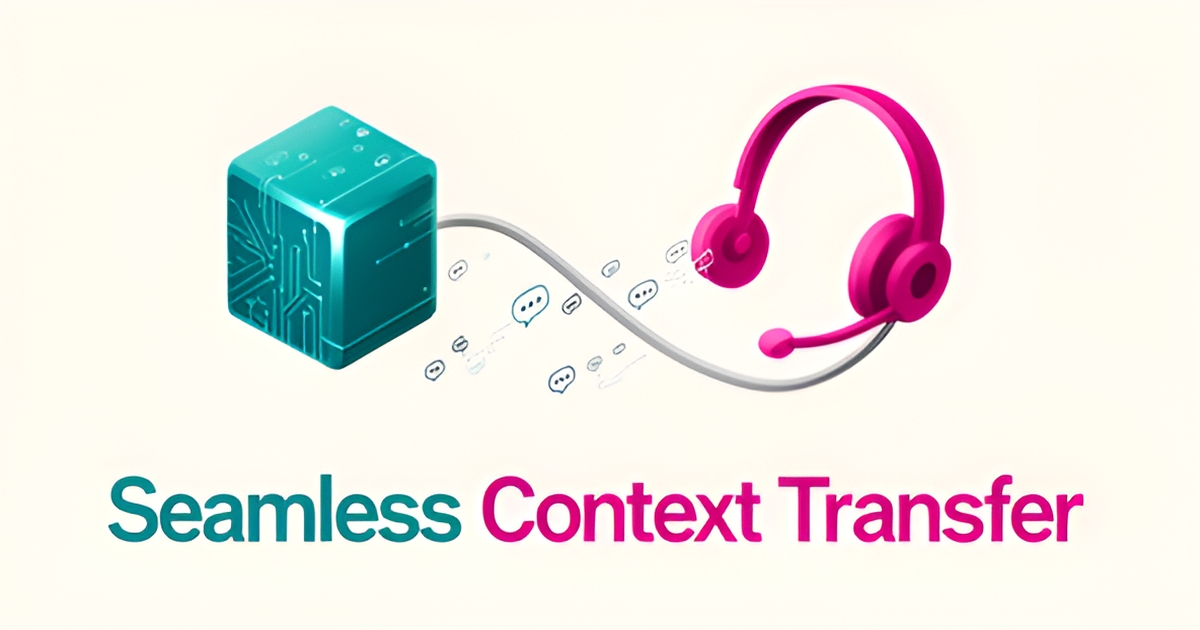
Every business that deploys AI for customer service faces the same structural question: what happens when the AI can't resolve the request? Glance's guide positions the handoff as the differentiator. The guide's three core themes -- AI elevates rather than replaces humans, the broken handoff problem, and measuring resolution rather than deflection -- map cleanly onto what AIQ Labs has built into its architecture. When an AI Receptionist or SDR encounters a situation outside its authority, the system is designed to escalate with full conversation context intact. That means the human agent picking up the call doesn't hear silence or a repetition of the customer's name and issue. They inherit the thread.
Why SMBs Feel This More Acutely
Glance's guide targets enterprise CX leaders. The company sells cobrowse and screen-share tools for high-touch moments, and the guide functions as demand-gen content for those products. But the statistics it cites -- 44% repeat themselves, 76% are frustrated -- are not exclusive to large organizations. SMBs face the same dynamic, often with fewer resources to design a sophisticated escalation workflow. A small team cannot dedicate a full-time engineer to build and maintain the context-transfer logic that an enterprise might custom-code. That gap is exactly what AIQ Labs' managed AI employee model fills. The company structures handoff rules as part of the initial build, so the client doesn't need in-house AI expertise to get it right.
From Deflection to Resolution
One of the guide's most practical recommendations is a shift in metrics. Glance frames the old model as 'measure deflection' -- how many contacts AI avoids -- and positions 'measure resolution' as the outcome-based alternative. First-contact resolution, customer effort, and the seamlessness of the AI-to-human transition are the metrics that actually reflect whether the customer's problem was solved. AIQ Labs' own positioning echoes this. The company's published results include 95% first-call resolution rates and zero missed calls for AI Receptionist roles. Those numbers are meaningful because they track whether the customer's issue was resolved, not whether the AI deflected the call onto a human.
Human-in-the-Loop as a Design Choice, Not a Concession
The Glance guide emphasizes that AI should elevate human agents, not replace them. High-stakes interactions -- mortgage applications, small business loans, Medicare enrollment -- still require human experts, and the real question is whether the handoff preserves context. AIQ Labs' technical foundation explicitly includes human-in-the-loop controls, validation layers before execution, and configurable escalation when situations exceed AI authority. These are not afterthoughts added after a bot fails; they are built into the multi-agent architecture from the first line of code. The result is that when a handoff occurs, it feels like a continuation, not a restart.
What This Means for SMBs Building Their AI Workforce
The market is moving toward hybrid AI-plus-human models rather than pure automation. Glance's guide confirms demand for this structure; AIQ Labs' positioning reinforces it. Businesses that deploy AI employees without a structured handoff design will see the 44% repeat-rate statistic reflected in their own customer feedback. Those that build with escalation rules, context preservation, and outcome-based metrics will differentiate themselves. For SMBs, the managed model is the practical path to enterprise-grade handoffs. AIQ Labs delivers the escalation architecture as part of the initial deployment, so the business can focus on its core operations rather than designing AI workflows from scratch.
Conclusion
The handoff is where AI customer service succeeds or fails. Glance's data makes clear that 44% of consumers are almost always forced to repeat themselves, and 76% feel frustrated by the experience. The good news is that this is a solvable problem. AIQ Labs' approach -- building escalation and context-preservation into every AI employee from the start -- gives SMBs the same structural advantages that enterprise CX teams are only now beginning to design. The businesses that treat the handoff as the product, not an afterthought, will be the ones customers stay with.
Found this helpful?
Share it with your network or explore more AI insights.