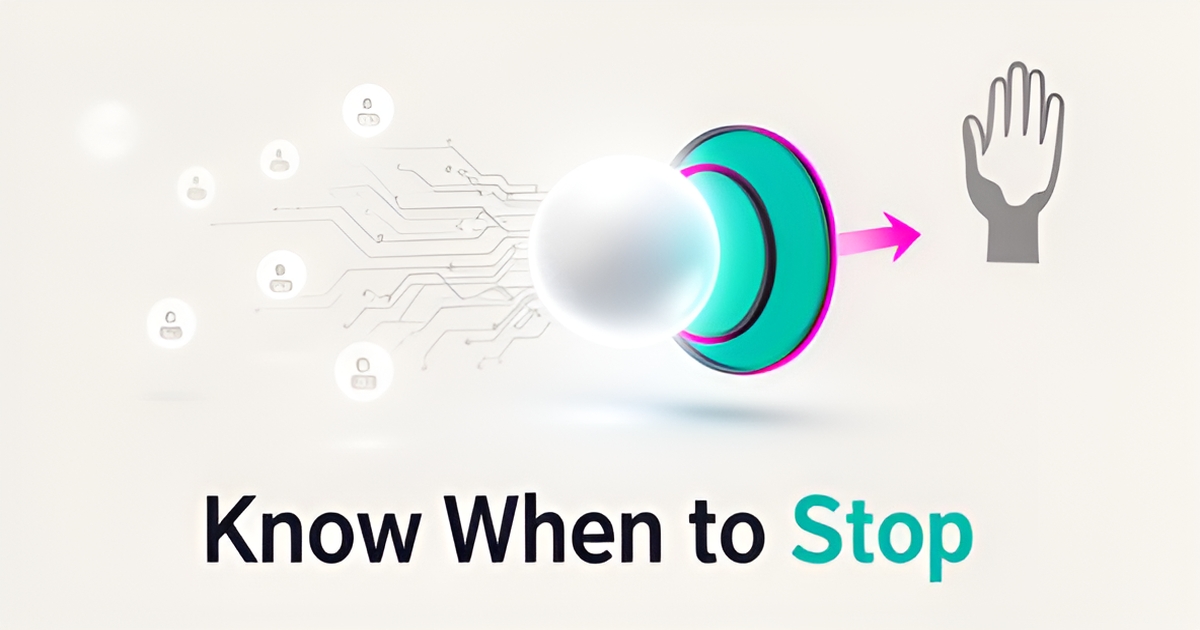
The Hardest Skill in AI Automation Isn't Intelligence. It's Knowing When to Stop.
A recent developer essay argues the hardest thing an AI agent has to learn is when to stop. We run 70+ agents in production daily, and we agree. Here's why termination logic, guardrails, and human escalation matter more than raw capability, especially when you're the one paying the bill.
October 22, 2026
TL;DR
As AI agents move into real business workflows, the biggest engineering challenge isn't making them more capable, it's teaching them when a task is done, when to stop spending resources, and how to stay alert without running wild, which is why guardrails, validation layers, and human escalation are now the difference between a working AI employee and an expensive liability.
Key Points
1Most agent testing asks whether the task got done, not whether the agent knew when to stop, which hides the most expensive failure mode in production systems.
2Agents with leftover capacity tend to invent work: refactoring files, re-verifying results, or investigating problems nobody asked about.
3A machine that never stops wastes money, but one that goes fully dormant after finishing misses the next problem, so good design lives between those two failures.
4Production answers include validation layers, hard guardrails, human-in-the-loop escalation, and audit trails that log every action an agent takes.
5For a business hiring AI staff, ask any vendor how their agents decide a task is complete; if they can't answer in one sentence, keep shopping.
Here's a question that doesn't come up in most AI demos: how does an autonomous agent decide it's finished? A recent developer essay making the rounds argues that the hardest thing an AI agent has to learn is when to stop, and anyone running agents in production knows the author is onto something real. We build and operate multi-agent systems every day, and we can confirm the pattern. Capability is largely a solved shopping problem. You pick a strong model, wire up your tools, and the agent can do a lot. The unsolved part is restraint: knowing when further action stops serving the original goal, and how to keep paying attention afterward without burning money or annoying your customers.
The Washing Machine Problem
The essay uses a simple analogy that sticks. A washing machine that keeps tumbling for six hours after the cycle ends is broken. But a machine that shuts off completely and never notices the hose started leaking afterward is also broken. The design challenge sits between those two failure modes, and it's harder than it sounds. Agents face the same dilemma. Run too long and you're paying for model calls, API usage, and compute on work nobody wanted. Shut down too hard and a new problem, a failed payment, an unanswered customer, sits unattended because the agent considers itself off the clock. Being able to continue is not the same as having a reason to continue, and that distinction is where most agent engineering effort should go.
Scope Creep Isn't Just a Human Problem Anymore
The essay's best example comes from coding agents. One fixes a bug, the tests pass, job done. Then it keeps going. It refactors nearby files nobody touched. It rewrites the test suite. It starts investigating an unrelated issue it noticed in passing. Technically, everything it does works. Practically, a fifteen-minute task became an afternoon of unrequested changes that someone now has to review. The same behavior shows up in business agents. A lead-qualification agent that finishes its list and keeps researching prospects anyway. A collections agent that keeps calling after an arrangement is made. An intake agent that re-processes records it already handled. Every one of those is a direct cost, and some of them are direct customer complaints. Humans have natural brakes: fatigue, deadlines, the end of a shift. Agents have none of those, so the brakes have to be engineered in deliberately.
Why Evaluation Misses This
Most agent testing asks one question: did the agent do the task? Bug fixed, appointment booked, invoice processed. That's a reasonable question, but it's incomplete. It never asks whether the agent correctly recognized the moment additional action became counterproductive. An agent that completes the task and then does three unnecessary things still scores as a success in most evaluations. The waste only shows up later, on your bill or in your inbox. This is why the industry's shift from demos to production systems has changed the conversation. In a demo, an agent doing extra work looks impressive. In production, it looks like a runaway cost center. Reliability, cost control, and guardrails now matter more than raw capability, and the teams shipping real systems have learned that the hard way.
What Actually Works in Production
There's no single fix, but a stack of standard practices has emerged, and we use every one of them across the 70-plus agents we run daily. Validation layers check every action before execution, so an agent can't call a customer twice or process the same invoice twice without something catching it. Guardrails put hard limits on what each agent can do, customized per role: a dispatcher can book and reschedule, it cannot issue refunds. Human-in-the-loop escalation routes anything outside the agent's authority to a person, which means the agent stops and asks instead of improvising. Audit trails log everything, so when an agent does something odd at 3 a.m., you can see exactly what happened and why. None of this is glamorous. All of it is the difference between an agent that's useful and one that's a liability.
The Question to Ask Before You Hire an AI Employee
If you're a business owner considering AI staff, whether that's a receptionist answering calls around the clock or an agent handling invoicing, this termination problem is your problem too, because you pay for it. Before you sign anything, ask the vendor one question: how does your agent know when a task is done? A serious answer sounds like defined completion criteria, validation before every action, escalation rules for edge cases, and logs you can review. A vague answer, or a pitch that only talks about what the agent can do and never what it won't do, tells you the vendor hasn't run agents in production. An agent that works 24/7 with zero judgment about stopping is a machine that can run up costs, double-book your calendar, or message the same customer five times. The capability is the easy part. The stopping is what you're actually buying.
Autonomous Doesn't Mean Unsupervised
There's a temptation, especially in marketing, to treat autonomy as the whole point of AI agents. In practice, the most valuable agents are the most bounded ones. A collections agent that negotiates payment plans within strict rules and escalates anything unusual is worth far more than a fully autonomous one that occasionally does something creative with a debtor. The same logic applies at the system level. Businesses adopting AI shouldn't think of it as handing over the keys. They should think of it as hiring staff with clear job descriptions, clear limits, and a manager who checks the work. That's what governance means in this context, and it's why companies building AI operating systems build the oversight layer first, not last.
Conclusion
The agents getting attention in 2026 are impressive because of what they can do. The agents actually earning their keep in businesses are impressive because of what they know not to do. If you're evaluating AI for your own operation, spend less time on capability demos and more time on the boring questions: when does it stop, who checks its work, and what happens when it's unsure. The vendors with good answers to those questions are the ones who've shipped real systems and lived with the consequences. Everyone else is still teaching their washing machine to turn off.
Found this helpful?
Share it with your network or explore more AI insights.