When Your AI Can Spend Money: The Mandate Boundary Every Business Needs to Draw
Payment networks solved agent-to-agent payments. The unsolved problem is accountability. Here's how SMBs should draw the line between what AI can do alone and what needs a human signature.
November 7, 2026
TL;DR
Payment networks have solved the plumbing for AI agents that buy and sell on their own, so the real question for 2027 is where you draw the line between what your AI can do alone and what still needs a human signature.
Key Points
1Mastercard, Visa, and Google all shipped agent-payment infrastructure between April 2025 and April 2026, giving AI agents verified identities and consent rails.
2OpenAI pulled its in-chat Instant Checkout feature in March 2026 after roughly six months, reportedly because users didn't trust AI with the final purchase step.
3Gartner predicts over 40% of agentic AI projects will be scrapped by end of 2027, largely due to cost, unclear ROI, and missing risk controls.
4The Mandate Boundary, the line between decisions an AI may execute alone and those needing human counter-signature, is now the core governance question for AI roadmaps.
5SMBs should start with bounded, single-workflow agents with audit trails and human escalation rather than full autonomous commerce.
Sometime in the past eighteen months, the hard part of AI changed. The question used to be whether software could understand your business well enough to be useful. That's largely settled. The question now is whether software can be trusted to act on its own, with money attached, and what happens when a transaction goes sideways and someone has to answer for it. If you run a small or mid-sized business and you've been watching the agentic AI wave from the sidelines, this is the shift that actually matters for your 2027 planning.
The Rails Are Built. Trust Isn't.
The infrastructure for machines paying machines quietly shipped while most businesses were still debating chatbots. Between April 2025 and April 2026, three of the institutions whose entire business is verifying who may move money built consent rails for non-human counterparties. Mastercard's Agent Pay binds a card token to a specific agent, merchant, and consent policy. Visa's Trusted Agent Protocol verifies agent identity and carries signed issuer consent. Google's AP2 splits a purchase into three cryptographically signed contracts: an Intent Mandate, a Cart Mandate, and a Payment Mandate.
Read that last one again. The payment networks, which move trillions of dollars and do not gamble on speculative tech, decided that autonomous software buyers are a real enough counterparty to build protocol-level support for. When Visa starts verifying the identity of a piece of software the way it verifies a cardholder, the agent-to-agent economy has left the whiteboard.
But rails are plumbing. The unsolved problem sits above them: when an agent acting on your behalf buys the wrong thing, negotiates a bad rate, or pays the wrong vendor, who is accountable? The protocol layer answers how the money moves. It doesn't answer who answers for it.
OpenAI's Retreat Is the Cautionary Tale Every SMB Should Study
The most instructive data point of the past year is a failure. In September 2025, OpenAI launched Instant Checkout, letting users buy products inside a chat window on the Agentic Commerce Protocol, built with Stripe. In March 2026, roughly six months later, it retired the feature. Reports at the time attributed the retreat to weak adoption, with only a dozen or so live merchants, and to conversion data that reportedly showed in-chat checkout performing about three times worse for Walmart than simply clicking through to Walmart's own site.
The lesson isn't that agentic commerce is doomed. It's that users drew their own Mandate Boundary, and they drew it tighter than the product designers expected. People were happy to let AI help them discover a product. They wanted to complete the purchase somewhere they already trusted the receipt. Autonomy ran ahead of trust habits, and trust habits won.
For a small business, that's actually encouraging news. It means you don't need to leap to fully autonomous commerce to get value. The pattern that works is bounded autonomy: give an agent a defined role, a defined set of actions, and a human escalation path, then widen the boundary as evidence accumulates.
The Mandate Boundary Is Now a Product Decision, Not a Policy Document
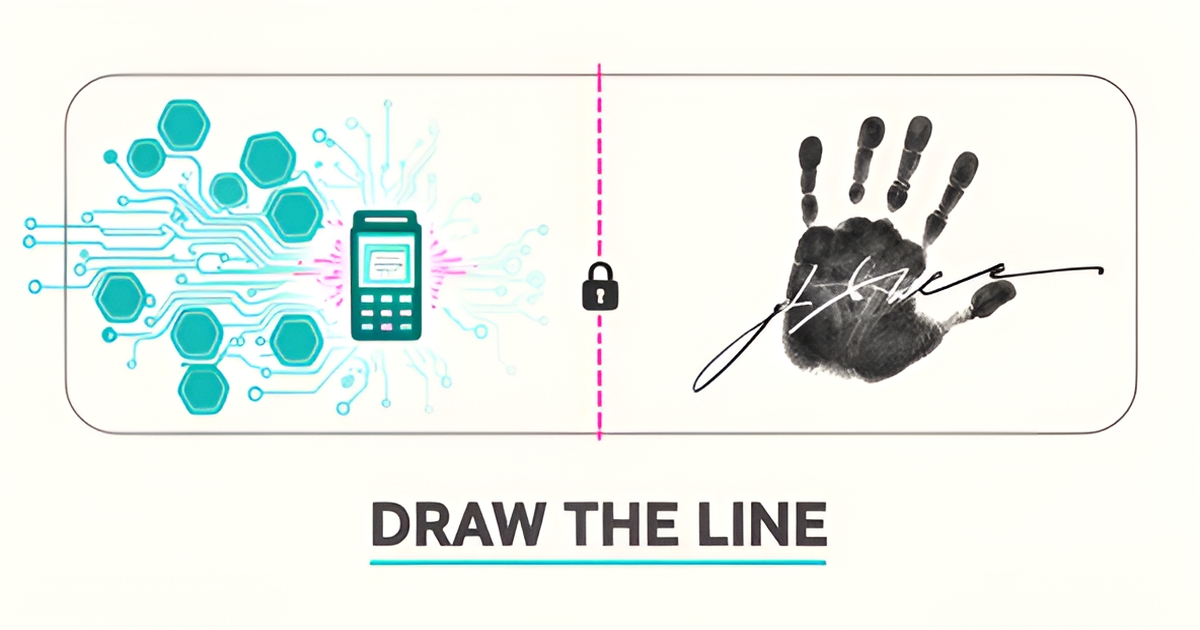
The core governance concept in this emerging economy is what practitioners are calling the Mandate Boundary: the line between decisions an AI system may execute unaccompanied and those that still require a human counter-signature. Every AI roadmap for 2027 versus 2030 is, underneath the feature list, a bet about where that line sits and how fast you're willing to move it.
This is where most vendors get vague and where you should get specific. When you evaluate any AI system that touches customers or money, ask three questions. First: which decisions does this system make without asking anyone? Second: when it hits the edge of its authority, what happens, and does a human see it? Third: if a customer disputes an action six months from now, can you produce a complete log of what the system did and why?
Those aren't compliance checkboxes. They're the difference between an AI deployment that scales and one that becomes the incident report. And they're exactly the architecture that firms doing this seriously already ship. Halifax-based AIQ Labs, for instance, builds validation layers that check every action before execution, hard guardrails limiting what each agent role can do, configurable human-in-the-loop escalation, and full audit trails. In the vocabulary of the agent-to-agent economy, that stack is a commercialized Mandate Boundary. It's also the reason their compliant voice collections platform, an AI that negotiates payment arrangements over the phone in a regulated financial context, can exist at all. Money-touching agents survive in regulated industries only when every action is logged and every limit is enforced in code.
Gartner's 40% Forecast and the Coming Shakeout
Here's the number that should discipline your planning: Gartner predicts that by the end of 2027, over 40% of agentic AI projects will be scrapped, driven by cost, unclear value, and missing risk controls. The firm also estimates that of the thousands of vendors calling themselves agentic, only around 130 have real capability.
That's a market correction, and corrections are useful. They clear out the marketing residue. The word 'agentic' has been stretched to cover everything from a chatbot with a scheduler to a genuinely autonomous procurement system, and the label tells you almost nothing anymore. The useful question when you're buying is where decision authority sits in the system, how far the organization has moved it, and how quickly it can be pulled back.
The shakeout also raises the bar for vendors' claims. When a provider tells you its AI receptionist costs 80% less than a human hire, or that its agents handle 99 roles, the follow-up matters: show me the deployment data, show me the escalation logs, show me what happens when the agent doesn't know. Vendors who can't produce evidence won't survive the Gartner window. Buyers who don't demand it will absorb the failure cost themselves.
What SMBs Should Actually Do Before 2027
If you're an SMB owner reading this, the practical path is narrower than the hype suggests, and that's fine. Start with one bounded workflow, the one that costs you the most in manual hours: lead follow-up, intake, scheduling, dispatch, invoicing. Deploy a single agent with a defined role and clear limits. Measure it. Keep the audit trail. Widen the boundary only when the evidence says you should.
Second, get your systems interoperable. Agent Pay and AP2-style protocols mean that within a couple of years, your CRM, your invoicing, and your scheduling tools will need to speak consent and mandate, not just data. The businesses that integrated cleanly will plug in; the ones running on disconnected subscriptions will pay someone to rip it all out first.
Third, treat governance as an investment, not overhead. The companies currently stuck at the pilot stage of AI maturity are almost always stuck there because nobody drew the boundary: no one decided which decisions the AI owns, so no one trusts it with any of them. A two-day governance conversation is cheaper than a scrapped project.
Conclusion
The frontier of AI has moved from comprehension to accountability. The payment networks have done their part; the protocols exist; agents will soon be able to buy, negotiate, and pay across the wire. What separates the businesses that benefit from the businesses that get burned is a single, deliberately drawn line: what your AI may do alone, and what it must bring to you first. Draw that line in 2026, in code, with logs behind it. By 2027, when the shakeout hits and the agent-to-agent economy arrives at your industry's door, you won't be guessing where it sits. You'll have a year of evidence telling you exactly how far to move it.
Found this helpful?
Share it with your network or explore more AI insights.