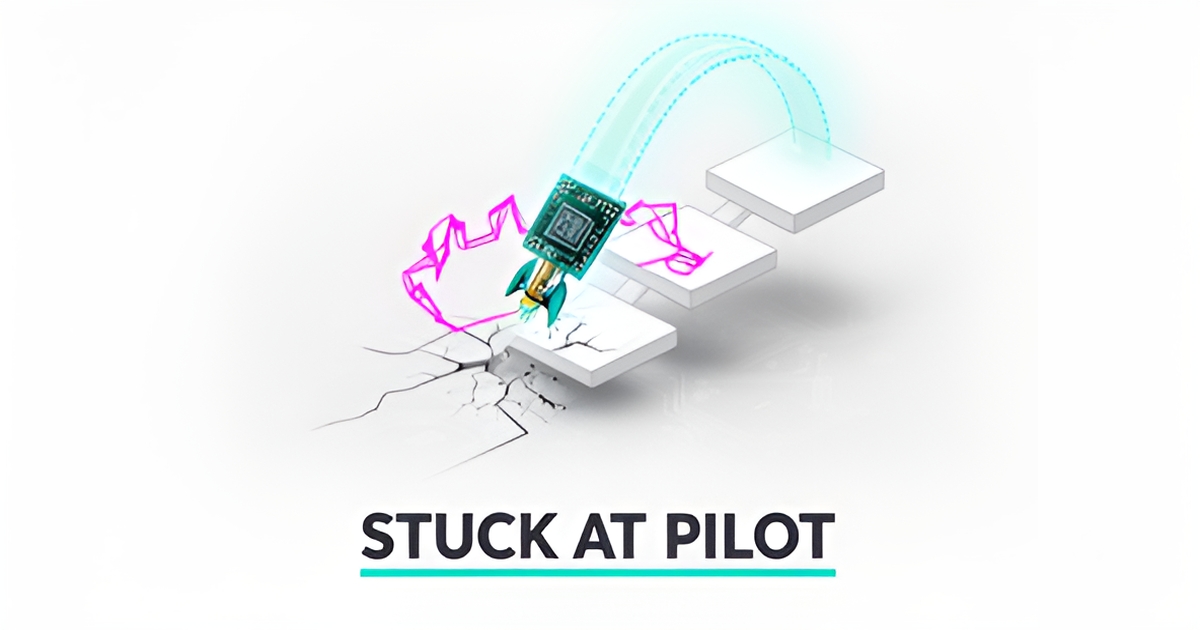
Why Most Small Businesses Get Stuck at the AI Pilot Stage, and How to Break Through
Pilots are where most SMB AI efforts go to die. A look at the maturity curve, the vendor gap that causes the stall, and the ownership-first model Halifax-based AIQ Labs is betting on.
November 11, 2026
TL;DR
Most small and mid-sized businesses experiment with AI but stall before it changes how they operate; a structured path from pilot to production, with ownership and accountability built in, is what separates the businesses that benefit from the ones that just dabble.
Key Points
1Most SMBs stall at the second stage of AI maturity: pilots that never scale into daily operations
2Point-solution vendors and strategy-only consultants leave a gap between recommendation and working system
3Companies like Halifax-based AIQ Labs argue the fix is lifecycle partnership: one partner handles strategy, build, and ongoing management
4Ownership of the code and data matters; renting AI tools forever compounds subscription costs without building an asset
5Cost math favors managed AI staff in defined roles, with company-reported savings of 75 to 85 percent versus equivalent human hires
If you run a small or mid-sized business, you have probably already tried AI somewhere. Maybe a chatbot on the website that handles the easy questions and punts the rest. Maybe an AI writing tool the marketing person swears by. Maybe a pilot project that showed promise and then quietly died when nobody owned it.
You are not alone, and you are not the problem. The way most AI vendors sell to businesses like yours practically guarantees that stall. You buy a tool, it does one narrow thing, and the deeper workflows (intake, scheduling, follow-up, collections) stay manual. Meanwhile the consultant you hired for the AI strategy handed you a beautiful roadmap and left the building.
There is a growing category of company trying to close that gap, and one of the more interesting examples is AIQ Labs, based in Halifax, Nova Scotia. The company reports deploying more than 200 multi-agent systems and running four of its own revenue-generating SaaS products, which matters for reasons we will get to. But the more useful story here is the pattern behind why businesses stall at pilots, and what actually moves them past it.
The five stages, and where everyone gets stuck
Think of AI adoption as a curve with five stages: exploration, pilots, scaling, optimization, and transformation. Exploration is cheap and fun. You sign up for tools, run a proof of concept, maybe impress the team in a demo.
The trouble starts at stage two. Pilots are where most organizations plateau. A pilot proves something can work in controlled conditions. Scaling it means connecting it to your CRM, your calendar, your phone system, your invoicing. It means someone is accountable when it misfires at 7 a.m. on a Tuesday. It means governance: what is the AI allowed to do, what does it escalate to a human, and who checks the logs?
None of that is glamorous, and none of it comes bundled with a chatbot subscription. That is the structural reason pilots die. It is rarely the technology. It is the missing connective tissue between a demo and a dependable part of operations.
The vendor gap: point solutions and drive-by consultants
Two archetypes dominate the SMB AI market, and both leave the same hole.
The first is the point-solution vendor. They sell you a tool that does one job. It works, in the narrow sense. But your business runs on a dozen interconnected processes, so you end up with a stack of subscriptions that do not talk to each other. Industry people have started calling this subscription chaos, and the name fits: more tools, more logins, more manual copy-paste between systems, and a monthly bill that grows faster than the value.
The second is the strategy-only consultant. They assess your readiness, model the ROI, and hand you a roadmap. Genuinely useful work, but then implementation falls on a team that is already stretched thin. The roadmap goes in a drawer.
What fills that gap is a third model: a partner who does the strategy, then builds the system, then stays on to manage and improve it. AIQ Labs structures itself exactly this way, with three entry points: managed AI staff they call AI Employees, single-workflow rebuilds, and full company-wide AI operating systems. Whether or not you hire them, the structure is worth studying, because it maps directly onto the failure modes above.
The 'AI employee' idea, taken seriously
The term AI employee gets thrown around loosely. Strip away the marketing and the useful version is specific: an AI agent with a defined job description, deployed on real channels (a phone number, an email address, live chat), connected to your actual tools, and monitored by someone whose job it is to make it better over time.
AIQ Labs maintains a catalog of 99 such roles across 11 categories, from receptionist and dispatcher to legal intake specialist and patient coordinator. The entry-level pitch is an AI receptionist on a flat monthly plan that costs less than a part-time hire, answering calls around the clock. The company claims total savings of 75 to 85 percent versus equivalent human roles, though that figure is self-reported and worth treating accordingly. What is harder to argue with is the availability math: a human covers 40 hours a week; an AI agent covers all of them, including the after-hours call that would otherwise go to a competitor.
The credibility question for any of this is whether the vendor actually runs what it sells. This is where the dogfooding angle earns its keep. AIQ Labs operates its own four SaaS products, including a collections platform that runs conversational voice AI in the regulated debt collection space, and it reports running more than 70 production agents daily across those platforms. Regulated voice AI is a genuinely high bar: compliance tracking, audit trails, and human escalation are mandatory, not optional. A vendor that clears that bar for itself has at least demonstrated the muscle.
Own it, do not rent it
Here is the argument that may matter most for your five-year budget. When you subscribe to AI tools, you are renting capability forever. When you commission a custom system, you can own the code, the agents, and the data outright.
AIQ Labs builds on custom code and multi-agent frameworks like LangGraph rather than no-code assembly, and it transfers full IP ownership to clients on outright builds. The company offers three payment structures to match different risk appetites: a monthly plan that mirrors a hiring cost, a milestone build where you pay per phase and keep everything shipped so far if you stop, and a one-price ownership model.
The milestone structure deserves a note. It is a sensible de-risking mechanism for SMBs burned by big-bang software projects. You approve each phase as it ships, and if the engagement sours, you walk away with working assets, not a sunk cost. That aligns incentives in a way flat annual contracts rarely do.
What to actually do on Monday
If you are stuck at the pilot stage, the way out is narrower than it feels. Start with one workflow, the one that costs you the most in lost hours or missed revenue. For service businesses that is usually lead follow-up, intake, or scheduling. For anyone invoicing manually, accounts payable is a common quick win; the company reports 80 percent reductions in processing time on such builds, again as a self-reported figure.
Then apply three tests to whoever you engage. First, will they integrate with the systems you already run, or do they want to replace everything? Second, who is accountable after go-live, and what does ongoing management include? Third, who owns the system when it is done?
If a vendor cannot answer all three crisply, you are about to buy another pilot.
Conclusion
The businesses pulling ahead with AI in 2026 are not the ones with the most tools. They are the ones that treated AI like an operational project with an owner, a scope, and a feedback loop, and picked partners willing to be accountable for outcomes rather than licenses. Whether that partner is AIQ Labs or someone else, the checklist is the same: one workflow at a time, real integration with the systems you already run, ongoing management after launch, and ownership of what gets built. The pilot stage is only a plateau if you let it be one.
Found this helpful?
Share it with your network or explore more AI insights.