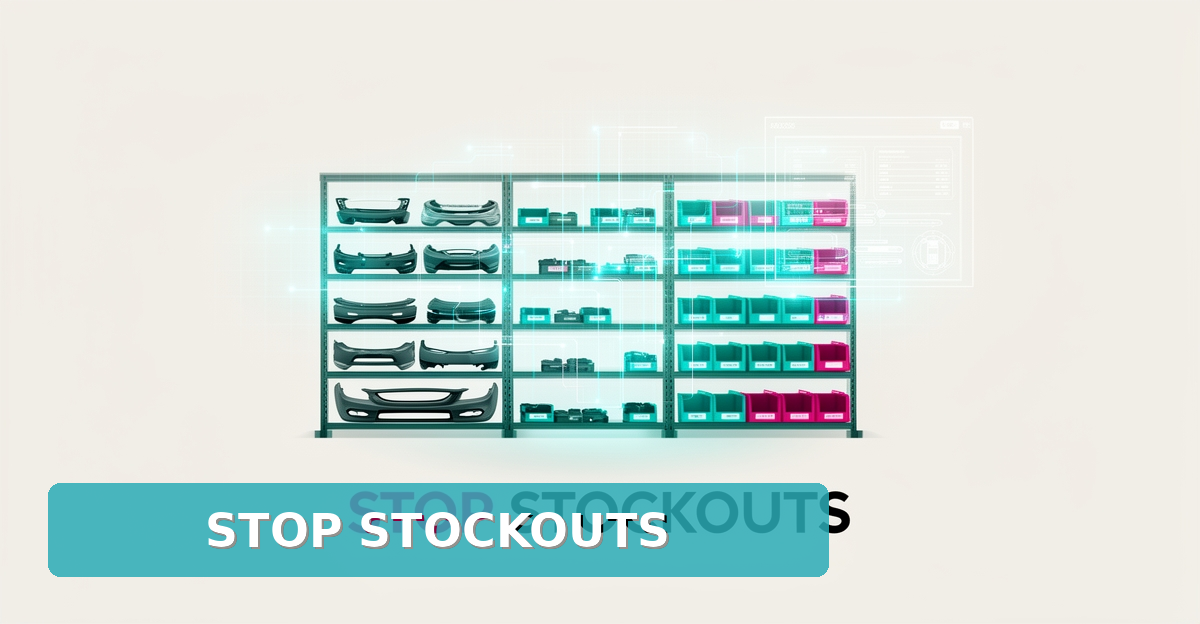
5 Signs Your Collision Repair Center Needs AI for Inventory and Parts Management
Key Facts
- AI-driven systems can respond to leads and reorder signals in minutes, versus the 30–60 minutes manual processes often take
- Structured production board scheduling is widely associated with shorter repair cycle times
- Predictive demand forecasting typically reduces both stockouts and excess inventory when tied to real-time data
- Lead time volatility in 2025 showed how risky manual reordering can be for parts-dependent operations
- Margin recovery in manufacturing has been tied primarily to reducing excess stock—not more sales
- AI inventory systems sync with shop databases to reduce waste and improve part availability
Hire a team member that works 24/7 — for less than a part-time wage.
AI receptionists, SDRs, dispatchers and 99+ roles. Trained on your business, fully managed.
Not sure where to start? Ask our AI planner
The Hidden Cost of Parts Stockouts and Repair Delays
A single missing fender liner can idle a $50,000 repair job, frustrate a customer, and throw off your entire production schedule for the week. In the collision repair industry, parts stockouts are not minor inconveniences—they are profit leaks that compound daily.
The root cause is often reactive inventory management. Shops relying on manual checks or basic spreadsheets cannot anticipate demand, leaving them vulnerable to sudden shortages. This uncertainty forces technicians to halt work, estimators to revise timelines, and managers to scramble for expensive rush orders. According to industry research, stockouts directly lead to low customer satisfaction and delayed repairs, while overstocking restricts cash flow and thins profit margins. The financial toll extends beyond the part itself to include rental car extensions, storage fees for immobilized vehicles, and the opportunity cost of bay downtime.
The impact ripples through your entire operation. Each vehicle moves through a complex sequence of body work, paint prep, paint booth, reassembly, and detail. When a bottleneck occurs at any stage due to a missing component, it delays every subsequent job in the queue. Research from Deelo highlights how critical smooth production workflow is to profitability—shops that schedule and track work on a structured production board tend to see shorter cycle times. Without predictive visibility, shops cannot synchronize parts arrival with production schedules, leading to idle labor and missed delivery promises.
Lead time volatility exacerbates the problem. As of late 2026, supply chain data continues to show that lead times can swing sharply quarter to quarter—manufacturing data from 2025, for example, captured periods where lead times nearly doubled in a single quarter. For collision centers dependent on OEM parts with long lead times or aftermarket parts with variable quality, this volatility makes manual reordering a gamble. Emergency orders carry premium shipping costs, while delayed parts extend cycle times and damage your reputation with insurers and customers alike.
Reactive inventory management creates several specific operational risks:
- Emergency procurement costs that erode job margins
- Extended rental car periods increasing insurance friction
- Technician downtime and reduced shop throughput
- Customer dissatisfaction and negative reviews
AI-driven inventory systems address these challenges by analyzing historical repair data, seasonal trends, and supplier lead times to predict demand before stockouts occur. Unlike manual processes that respond to crises, AI automates restocking triggers and integrates with your shop database to ensure parts arrive just as technicians need them. AIQ Labs builds these custom systems—often as a targeted AI Workflow Build—to sync directly with existing workflows, turning inventory from a reactive headache into a strategic advantage.
Why Overstocking Is Silently Draining Your Cash Flow
That shelf full of "just in case" parts feels safe until you read the cash-flow statement.
Overstocking ties up working capital in slow-moving inventory while manual reorder cycles keep guessing at demand. Without real-time visibility, shops buy for the last surge instead of the next one, and capital sits on the shelf earning nothing.
Manual processes make it difficult to know when to replenish inventory, which leads to either emergency costly orders or missed sales opportunities. Inventory management guides note that overstocking restricts cash flow and thins profit margins, while stockouts lead to low customer satisfaction and delayed repairs.
The financial impact shows up when lead times normalize. Manufacturing data from 2025 showed gross margins improving primarily as businesses reduced excess stock—not because sales jumped. Recent manufacturing data suggests margin recovery is directly tied to excess stock reduction.
In collision repair, demand fluctuates with weather, seasonality, and insurance cycles. Manual reorder points cannot balance that volatility, so shops overbuy after a busy quarter and run out during the next.
A collision repair inventory analysis highlights the core risk: without a robust system, businesses run the risk of both overstocking and overselling.
Overstocking quietly drains cash in several ways:
- Capital locked in parts that age, obsolesce, or require storage and handling
- Reduced cash available for urgent OEM orders when lead times spike
- Thinner profit margins from carrying costs and write-downs on excess stock
- Inefficient reorder cycles that create emergency buys and premium freight
AI inventory and supply chain systems address this by predicting demand and automating restocking. AIQ Labs builds custom inventory AI systems that sync with shop databases to reduce waste and improve part availability, using historical repair data, seasonality, and supplier lead times instead of gut feel.
Predictive demand forecasting uses time series analysis, regression models, and machine learning to anticipate needs based on historical data, seasonal fluctuations, and repair trends, rather than reacting to stockouts. Parts demand forecasting research shows this shifts ordering from reactive to proactive.
When reorder decisions are automated and tied to real-time visibility, shops hold less excess inventory and free cash for the parts that actually move.
How AI Predicts Demand and Automates Restocking
Collision repair disruption often begins with a single missing part, triggering delays that ripple through the entire shop. When technicians wait for components, repair timelines stretch, customer satisfaction drops, and cash flow tightens. AI-driven inventory systems prevent these disruptions by forecasting demand with precision and automating restocking before shortages occur.
These systems analyze historical parts usage, seasonal repair patterns, and external factors like weather or economic shifts to predict future needs. Using techniques such as time series analysis and machine learning, they identify subtle trends that manual reviews miss, enabling proactive ordering. According to industry research, predictive modeling can meaningfully reduce stockouts while cutting excess inventory—improving both service reliability and financial efficiency at the same time.
Automated reorder triggers activate when stock levels dip below dynamically calculated thresholds, generating purchase orders without manual intervention. This eliminates guesswork and reduces the risk of emergency, premium-priced orders. Real-time visibility into stock across multiple locations ensures technicians always know what's available and where, minimizing time spent searching or waiting. As noted in supply chain insights, such systems are essential for maintaining operational continuity amid volatile lead times—like the swings seen across manufacturing through 2025 and into 2026.
AIQ Labs builds custom inventory AI systems that integrate directly with shop management platforms, syncing repair histories, supplier data, and real-time sales to continuously refine forecasts. By aligning procurement with actual demand patterns, shops reduce waste, free up working capital, and keep bays moving. The result is a smarter, more resilient parts workflow that supports faster repairs and stronger margins—without requiring shops to overhaul their existing processes.
Integrating AI Inventory Systems Without Disrupting Your Existing Workflow
Collision repair centers can't afford a hard stop because a part is missing or sitting on a shelf too long. The right AI inventory system adds visibility without forcing your team to learn a new workflow from scratch.
Seamless integration starts with your shop management system. AI platforms are designed to integrate with existing dealership and shop management systems like CDK Global and Reynolds and Reynolds to pull inventory data, customer information, and service history for automated workflows that respond to real-time events. That connection preserves the tools your estimators and technicians already use while adding predictive intelligence underneath.
Data quality is the foundation that determines success. High-quality data is the foundation of reliable forecasts, so continuous processes must be established to monitor and improve data quality before models go live. Cleaning historical parts usage, repair frequency, seasonal trends, and supplier lead times ensures the system learns real patterns instead of noise. Without this step, even advanced forecasting models will misfire.
Once the data pipeline is clean, the system delivers real-time visibility and automated control. Modern inventory management achieves total inventory visibility, including exact stock levels, locations across multiple warehouses or on specific vehicles, and the status of incoming orders. Inventory software can be configured to send reorder point alerts and even generate automatic purchase order suggestions when stock falls below a defined threshold, eliminating manual stock checks.
Integration complexity is real, but manageable with a phased approach. A full AI Operating System requires deeper integration with existing platforms to access real-time data and trigger automated actions. Teams that plan for this upfront avoid disruption during go-live—which is why AIQ Labs builds in phases rather than all at once.
Practical implementation follows a clear sequence:
- Map current data sources and define the single source of truth for parts, repairs, and suppliers
- Connect the AI layer to your shop management system via API for two-way sync
- Validate forecasts against recent history and tune reorder points for OEM, aftermarket, and used parts
- Enable automated reorder alerts and real-time dashboards for estimators and parts managers
The payoff shows up in throughput and cash flow. Automated systems respond to reorder signals and customer requests in minutes rather than the 30–60 minutes manual processes often take, and structured production scheduling keeps cycle times down. That speed reduces the stockouts that delay repairs and the overstocking that restricts cash flow and thins profit margins.
AIQ Labs builds custom inventory AI systems that sync with shop databases to reduce waste and improve part availability, focusing on the integration and data foundations that make adoption stick. When the system is built around your existing workflow, your team gets predictive demand and automated restocking without changing the way they work.
Taking the Next Step: From Assessment to AI-Powered Inventory Control
After identifying the signs that your collision repair center needs AI for inventory and parts management, the next step is to begin with a clear, low-risk path forward. AIQ Labs starts every engagement with a free 30-minute strategy call to assess your current systems, pinpoint high-ROI automation opportunities, and map out a phased implementation plan—no obligation, just clarity on where AI can deliver measurable impact. This initial conversation helps determine whether a targeted workflow fix, a managed AI Employee for parts coordination, or a full connected system build aligns with your goals and readiness.
From there, the discovery workshop dives deeper into your operations, analyzing parts procurement delays, stockout frequency, and reorder inefficiencies to design a custom AI inventory system that syncs with your shop's databases and predicts demand using historical data, seasonal trends, and repair patterns. This phase ensures the solution is built on clean, validated data—critical because forecasting accuracy depends on eliminating inconsistencies in parts usage and supplier lead times. The AI model then continuously monitors real-time inventory levels and triggers automated reorder alerts when stock falls below defined thresholds, reducing the risk of both stockouts and overstocking.
Implementation follows a flexible, milestone-based approach aligned with AIQ Labs' three payment models: Start Monthly for gradual adoption, Build in Milestones for phase-by-phase validation, or Own It Outright for full ownership of a custom-built system. Each phase includes development, integration with your existing tools, testing, and user training—ensuring the AI system becomes a seamless part of your workflow rather than a disruptive add-on. With ongoing monitoring and optimization included, the solution scales with your business, turning inventory management from a reactive chore into a proactive, owned competitive advantage. To begin, start with the two-minute Fit Check at https://aiqlabs.ai/apply, then schedule your free 30-minute strategy call at https://aiqlabs.ai/book.
Still paying for 10+ subscriptions that don’t talk to each other?
We build custom AI systems you own outright. No vendor lock-in. Full control.
Not sure where to start? Ask our AI planner
Frequently Asked Questions
How much can AI reduce stockouts and excess inventory in collision repair centers?
Will implementing an AI inventory system require my team to learn a completely new workflow?
How does AI improve response times compared to manual processes?
What happens if my inventory data isn't clean—will the AI still work accurately?
Can AI help with both overstocking and stockouts, or does it only solve one problem?
How long does it typically take to implement a custom AI inventory system with AIQ Labs?
Stop Letting Missing Parts Run Your Shop
The signs are hard to miss once you know what to look for: stockouts idling expensive repair jobs, cash locked in slow-moving parts, and reorder cycles built on guesswork. As we've seen, reactive inventory management ripples through every bay, every rental car extension, and every frustrated customer—while lead time volatility makes manual reordering riskier than ever. AI-driven inventory systems flip that dynamic, using your repair history, seasonal trends, and supplier data to predict demand and automate restocking before shortages happen. The payoff is measurable: shorter cycle times, fewer stockouts, and working capital freed up for the parts that actually move. The best part is you don't need to change how your team works—AIQ Labs builds custom inventory AI systems that integrate directly with your existing shop management platform. Start small and low-risk: take the two-minute Fit Check at https://aiqlabs.ai/apply, then book your free 30-minute strategy call at https://aiqlabs.ai/book. If there's a clear win for your shop, we'll show you where it is—and if there isn't, we'll tell you that too.
Make AI your competitive advantage — not just another tool.
Strategy, implementation and ongoing optimization. One partner, end to end.
Not sure where to start? Ask our AI planner