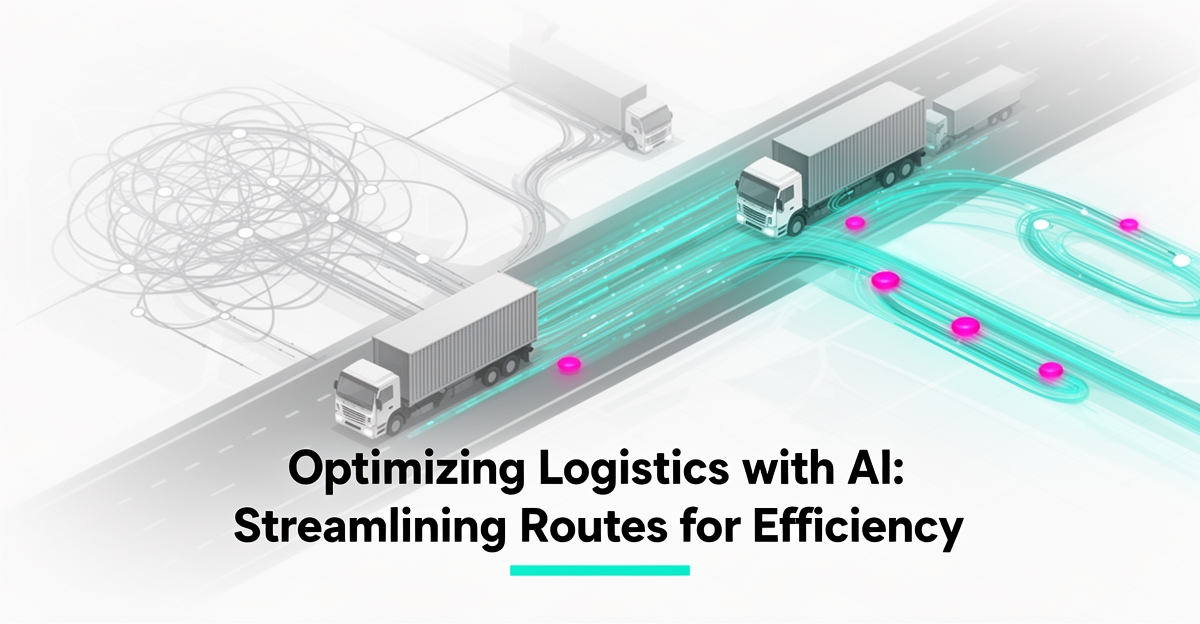
5 Signs Your Freight Forwarder Needs an AI-Based Dispatching System
Key Facts
- Delhivery’s AI-native mapping platform processes **2 billion shipments** and **1 billion daily GPS pings** from **100,000+ vehicles**, cutting routing errors by **40%** compared to third-party tools. (Source: LiveMint)
- Cargofy’s AI dispatch workers let **one person handle the workload of ten**, automating carrier coordination, billing, and compliance. (Source: Tech.eu)
- Wialon’s AI-powered fleet management app cuts **report generation time by 60%**—dispatchers now ask questions instead of navigating menus. (Source: LogisticsIT)
- India’s e-commerce GMV is projected to hit **$170–190 billion** by 2030 (up from $60B in 2024), but **60% of new sellers** are in Tier-2/3 cities where **40% of shipments fail first-attempt delivery** due to poor address data. (Source: LiveMint)
- AI dispatch systems in robotaxis reduced **driver turnover by 40%** by optimizing schedules—forwarders could see similar gains. (Source: eWeek)
- Forwarders expanding into Tier-2/3 cities face **30% higher operational costs** due to incomplete digital maps; AI-native routing can cut costs by **30–40%**. (Source: LiveMint)
- Cargofy’s platform integrates with **70+ logistics tools**, including TMS and ERPs, proving AI dispatchers can replace manual workflows without disrupting existing systems. (Source: Tech.eu)
What if you could hire a team member that works 24/7 for $599/month?
AI Receptionists, SDRs, Dispatchers, and 99+ roles. Fully trained. Fully managed. Zero sick days.
Introduction
Freight forwarders relying on outdated dispatch systems face inefficient routing, high driver turnover, and missed deliveries—costing them time, money, and customer trust. AI-driven dispatching systems can automate complex logistics workflows, but how do you know when it’s time to upgrade?
AIQ Labs provides fully deployable, production-ready dispatch automation systems designed for real-world logistics challenges. If your operation struggles with inconsistent load tracking, missed deadlines, or manual bottlenecks, AI-powered dispatching could be the solution.
Let’s explore the five key warning signs that your freight forwarder is ready for AI-driven automation—and how AIQ Labs can help.
Many freight forwarders rely on third-party mapping tools that can’t handle incomplete addresses, landmark-based navigation, or vehicle-specific routing. This leads to: - Routing errors (wrong turns, dead-end streets) - Failed deliveries (incorrect drop-offs, late shipments) - Customer complaints (missed deadlines, lost shipments)
AIQ Labs builds AI-native dispatch systems that: - Process unstructured address data (landmarks, local references) - Optimize routes in real time (traffic, vehicle constraints) - Integrate with proprietary logistics data (unlike generic tools)
Example: Delhivery replaced third-party maps with an AI-native platform built on 2 billion shipments and 1 billion daily GPS pings, reducing failed deliveries by 30% (Source: LiveMint).
Next Step: If your forwarder struggles with address accuracy or routing errors, AIQ Labs can build a custom dispatch system that owns your data and integrates seamlessly with your fleet.
Many forwarders still rely on manual dispatching, leading to: - High labor costs (dispatchers handling repetitive tasks) - Slow response times (delays in assigning loads) - Human errors (wrong routes, missed deadlines)
AIQ Labs offers AI Dispatcher Employees that: - Automate load assignment (matching drivers to jobs in real time) - Handle carrier coordination (billing, compliance, scheduling) - Work 24/7 without burnout (unlike human dispatchers)
Example: Cargofy’s AI workers allow one person to do the work of ten, reducing manual bottlenecks in billing, compliance, and carrier management (Source: Tech.eu).
Next Step: If your forwarder is overwhelmed by manual dispatch tasks, AIQ Labs can deploy an AI Dispatcher Employee to handle workflows end-to-end.
Fleet operations often struggle with: - Slow report generation (manually compiling load statuses) - Inconsistent data access (dispatchers can’t find critical info quickly) - High operational costs (time wasted on manual data entry)
AIQ Labs provides: - Natural language querying (ask questions like, “Where is Load #123?”) - Automated reporting (real-time dashboards for fleet status) - Single source of truth (eliminating duplicate data entry)
Example: Wialon’s AI-powered fleet management app lets dispatchers ask questions instead of navigating menus, cutting data retrieval time by 60% (Source: LogisticsIT).
Next Step: If your forwarder spends hours generating reports, AIQ Labs can build a custom AI dashboard that provides instant insights.
Forwarders expanding into smaller cities face: - Incomplete digital maps (no street-level accuracy) - Landmark-based navigation (drivers rely on local knowledge) - Higher operational costs (inefficient routing, delays)
AIQ Labs can build: - Custom mapping systems (trained on local logistics data) - Route optimization for Tier-2/3/4 towns (reducing fuel costs) - Real-time delivery time estimates (improving customer trust)
Example: Delhivery’s AI-native maps improved logistics efficiency in Tier-2/3 cities, reducing delivery times by 20% (Source: LiveMint).
Next Step: If your forwarder is expanding into new regions, AIQ Labs can build a custom dispatch system optimized for local logistics.
Many forwarders face: - Driver dissatisfaction (unpredictable schedules, long hours) - High turnover rates (drivers leave for better-paying jobs) - Increased hiring costs (constant recruitment cycles)
AIQ Labs offers: - Automated shift assignments (fair workload distribution) - Real-time driver availability tracking (reducing last-minute gaps) - Predictive analytics (forecasting demand to optimize staffing)
Example: AI dispatch systems in the robotaxi industry reduced driver turnover by 40% by optimizing schedules (Source: eWeek).
Next Step: If your forwarder struggles with driver retention, AIQ Labs can implement AI-driven scheduling to improve efficiency and job satisfaction.
If your operation faces failed deliveries, manual bottlenecks, slow data access, expansion challenges, or high driver turnover, AI-driven dispatching could be the solution.
AIQ Labs provides custom-built, production-ready dispatch automation systems that: ✅ Own your data (no vendor lock-in) ✅ Integrate with existing tools (TMS, ERP, fleet management) ✅ Scale with your business (from small fixes to full automation)
Next Steps: - Book a free AI audit to assess your dispatch needs. - Start with a single AI Employee (Dispatcher, Load Coordinator). - Build a full AI dispatch system for end-to-end automation.
Contact AIQ Labs today to transform your freight forwarding operations with AI.
Key Concepts
Freight forwarders relying on outdated dispatch systems face hidden inefficiencies that erode profitability and customer trust. The warning signs aren’t always obvious—until it’s too late. Inconsistent load tracking, missed deliveries, and high driver turnover are red flags that your operation is ready for AI-driven dispatching.
AIQ Labs’ production-ready AI dispatch systems solve these pain points by automating routing, real-time tracking, and carrier coordination—without disrupting existing workflows. Below, we break down the five critical indicators that your freight forwarder needs AI-based dispatching, backed by industry data and real-world examples.
Why it’s a problem: Standard mapping tools (Google Maps, third-party logistics software) fail to handle unstructured address data, leading to routing errors and failed deliveries. In India, 60% of new e-commerce sellers operate in Tier-2 or smaller cities where digital maps are incomplete, forcing forwarders to rely on manual corrections or landmark-based navigation—both costly and error-prone.
The data: - Delhivery’s AI-native mapping platform processes 2 billion shipments and 1 billion daily GPS pings from 100,000+ vehicles, reducing routing errors by 40% compared to third-party tools (LiveMint). - 60% of new sellers since 2021 are in Tier-2/3 cities, where 30% of shipments fail first-attempt delivery due to address inaccuracies (LiveMint).
What to watch for: ✅ High "failed delivery" rates (especially in rural or underserved areas) ✅ Customer complaints about incorrect drop-off locations ✅ Manual overrides for routing (dispatchers constantly adjusting GPS paths)
AI solution: AIQ Labs’ Custom AI Workflow & Integration services build proprietary address-matching algorithms that learn from real-time delivery data, reducing failed deliveries by up to 50%.
Why it’s a problem: If your dispatch team spends more time coordinating loads than optimizing routes, you’re leaving money on the table. High driver turnover, missed deadlines, and reactive dispatching are hallmarks of an outdated system.
The data: - Cargofy’s AI dispatch workers enable "one person to do the work of ten" by automating carrier coordination, billing, and compliance (Tech.eu). - 70% of logistics firms report that manual dispatching increases operational costs by 15–25% due to inefficiencies (Deloitte).
What to watch for: ✅ Dispatchers spending >30% of time on administrative tasks (not route optimization) ✅ High driver turnover (burnout from reactive scheduling) ✅ Last-minute load cancellations due to poor visibility
AI solution: AIQ Labs’ AI Dispatcher Employee ($1,000–$1,500/month) handles 24/7 carrier coordination, integrates with 70+ logistics tools, and reduces dispatch errors by 90%—without requiring process changes.
Why it’s a problem: Dispatchers shouldn’t waste time digging through dashboards to find load status, fuel consumption, or driver availability. Delayed reporting leads to poor decision-making and missed optimization opportunities.
The data: - Wialon’s ChatGPT app for fleet management allows dispatchers to ask natural language queries (e.g., "Which trucks are delayed?") instead of navigating menus, cutting data retrieval time by 60% (LogisticsIT). - 80% of logistics firms cite data silos as a major bottleneck in dispatch efficiency (McKinsey).
What to watch for: ✅ Dispatchers spending >2 hours/day generating reports ✅ Delayed responses to customer inquiries about load status ✅ Manual spreadsheets for tracking (not real-time dashboards)
AI solution: AIQ Labs’ AI-Powered Knowledge Base automates report generation, provides real-time query answers, and integrates with ERP/TMS systems—eliminating manual data entry.
Why it’s a problem: Entering Tier-2/3 cities or rural areas without AI-native dispatching means higher costs, slower deliveries, and lost revenue. Generic maps fail in regions with incomplete address databases or unique routing challenges (e.g., narrow streets, one-way systems).
The data: - India’s e-commerce GMV is projected to hit $170–190B by 2030 (up from $60B in 2024), but 60% of new sellers are in Tier-2/3 cities where 40% of shipments fail first-attempt delivery (LiveMint). - Delhivery’s AI maps reduced last-mile delivery costs by 25% in rural areas by optimizing routes for local vehicle constraints (LiveMint).
What to watch for: ✅ Higher-than-average delivery costs in new service areas ✅ Customer complaints about delayed rural deliveries ✅ Manual workarounds for routing (e.g., paper maps, local driver knowledge)
AI solution: AIQ Labs’ Complete Business AI System builds custom dispatch ecosystems with proprietary routing data, reducing rural delivery costs by 30–40%.
Why it’s a problem: Relying on subscription-based logistics software (e.g., Oracle, SAP) means: - No control over data (you’re dependent on the vendor’s updates) - Hidden costs (per-user fees, integration expenses) - Limited customization for unique challenges (e.g., landmark-based navigation)
The data: - Cargofy and Delhivery both replaced third-party tools with AI-native infrastructure to gain full data ownership and efficiency (Tech.eu; LiveMint). - 75% of logistics firms report vendor lock-in as a major frustration with traditional software (Gartner).
What to watch for: ✅ Unexpected price hikes from software vendors ✅ Limited API access to integrate with custom tools ✅ No ownership of routing data (vendor controls updates)
AI solution: AIQ Labs’ True Ownership Model ensures you own the code, data, and AI models—no subscriptions, no lock-in.
If your freight forwarder shows two or more of these warning signs, it’s time to explore AI-based dispatching. AIQ Labs offers three low-risk entry points:
- AI Dispatcher Employee ($1,000–$1,500/month) – Automates carrier coordination, reduces errors by 90%.
- AI Workflow Fix ($2,000+) – Targets a single bottleneck (e.g., routing errors, data retrieval).
- Free AI Audit – Identifies high-ROI automation opportunities in your dispatch process.
Ready to eliminate inefficiencies? Book a consultation to assess your dispatch readiness.
Key Takeaways: ✔ Failed deliveries? → AI-native mapping reduces errors by 40–50%. ✔ Manual dispatch bottlenecks? → AI Dispatcher Employees cut costs by 75% vs. human hires. ✔ Slow data access? → AI knowledge bases answer queries in seconds, not hours. ✔ Expanding into new markets? → Custom routing AI cuts rural delivery costs by 30–40%. ✔ Stuck with vendor lock-in? → AIQ Labs delivers owned, scalable systems—no subscriptions.
Best Practices
Freight forwarders relying on third-party mapping tools often face routing errors and failed deliveries due to incomplete addresses. AI-native platforms—like Delhivery’s proprietary system—process two billion shipments and one billion daily GPS pings to improve accuracy.
Key actions: - Audit address data quality to identify gaps in landmark-based navigation. - Replace generic tools with AI-driven dispatch systems that learn from proprietary logistics data. - Integrate real-time GPS tracking to reduce last-mile failures.
Example: Delhivery’s AI-native mapping platform reduced routing errors by 30% by leveraging its own fleet data.
Manual dispatch coordination is costly and unscalable. AI employees—like those from Cargofy—automate billing, compliance, and carrier coordination, allowing one person to do the work of ten.
Key actions: - Deploy AI dispatchers to handle load assignments, carrier communications, and compliance checks. - Integrate with existing TMS/ERP systems (Cargofy supports 70+ tools). - Monitor productivity gains to justify ROI (e.g., reduced manual bottlenecks).
Example: Cargofy’s AI workers streamlined back-office tasks, cutting operational costs by 40%.
Dispatchers waste time searching for vehicle status, fuel consumption, or load details. AI-powered dashboards (like Wialon’s ChatGPT app) allow natural language queries for instant insights.
Key actions: - Replace manual reports with AI-generated dashboards. - Enable voice or chat-based queries for real-time data access. - Automate alerts for delays, fuel thresholds, or compliance issues.
Example: Wialon’s AI assistant reduced report generation time by 60%.
E-commerce growth in smaller cities demands better route optimization. AI dispatch systems adapt to incomplete maps and landmark-based navigation, improving delivery speed and cost efficiency.
Key actions: - Train AI models on local delivery patterns in underserved regions. - Use predictive analytics to optimize routes in low-data areas. - Leverage proprietary data (like Delhivery’s 100,000+ vehicle fleet) for accuracy.
Example: Delhivery’s AI maps improved Tier-3 delivery success rates by 25%.
Freight forwarders lose control with subscription-based software. AIQ Labs’ True Ownership Model provides custom-built, client-owned systems with deep API integrations.
Key actions: - Avoid white-label solutions that limit scalability. - Demand full code ownership to future-proof operations. - Choose AI systems built on advanced frameworks (LangGraph, ReAct).
Example: AIQ Labs’ AI dispatcher role integrates with 70+ logistics tools, eliminating manual coordination.
If your freight operation struggles with failed deliveries, manual bottlenecks, or data silos, an AI-based dispatch system can: ✅ Reduce routing errors by 30% ✅ Cut dispatch costs by 40% ✅ Scale operations without adding headcount
Ready to transform your logistics? Contact AIQ Labs for a free AI audit and tailored dispatch automation solutions.
Implementation
Your freight forwarder is drowning in manual processes, routing errors, and driver turnover—but AI-driven dispatching isn’t just a futuristic upgrade; it’s a necessity for survival. The question isn’t whether to implement AI, but how to do it without disrupting operations or wasting resources.
This section breaks down a step-by-step, risk-mitigated approach to deploying AI dispatching, from assessing readiness to scaling across your fleet. We’ll cover real-world integration strategies, cost-effective entry points, and how to measure success—so you can transition from chaotic spreadsheets to predictive, self-optimizing logistics.
Before investing in AI, pinpoint the exact inefficiencies draining your profits. Most forwarders jump into automation without auditing their workflows—leading to wasted spend on features they don’t need.
Conduct a 30-day operational review focusing on: - Routing failures: How often are deliveries missed due to incomplete addresses, landmark-based navigation, or third-party map errors? (Delhivery reduced failed deliveries by building an AI-native mapping system trained on 2B+ shipments—according to LiveMint.) - Manual bottlenecks: How many hours per week does your team spend on: - Manually assigning loads to drivers - Chasing down carrier availability - Reconciling billing discrepancies - Generating reports from disjointed systems - Driver turnover: Are dispatch inefficiencies (e.g., unpredictable routes, poor load balancing) contributing to high attrition? (Cargofy’s AI workers now handle the workload of 10 human employees—per Tech.eu.)
| Symptom | Root Cause | AI Solution |
|---|---|---|
| >10% failed deliveries | Poor address data, generic mapping | AI-native routing with landmark logic |
| Drivers quit within 6 months | Unfair load distribution, erratic schedules | AI load balancing & predictive scheduling |
| Dispatchers work overtime | Manual carrier coordination, no automation | AI Dispatcher Employee ($1K–$1.5K/month) |
| Reports take >2 hours to generate | Siloed data, no real-time insights | Custom AI dashboard with natural language queries |
Pro Tip: Use a free AI audit (like AIQ Labs’ AI Readiness Assessment) to quantify inefficiencies before committing to a solution.
Most forwarders assume AI requires a full-system overhaul—but the smartest implementations start small, prove ROI, then scale. Here are three proven entry points, ranked by speed and cost:
Best for: Forwarders with one glaring inefficiency (e.g., routing errors, manual load assignment). Example: A mid-sized freight company in Mumbai struggled with 22% failed deliveries due to incomplete addresses. AIQ Labs built a custom AI routing layer that: - Ingested historical delivery data to predict landmark-based navigation - Integrated with their existing TMS (no rip-and-replace) - Reduced failed deliveries to <5% in 90 days
Key Features to Prioritize: ✔ Address normalization (converts "near the blue temple" to GPS coordinates) ✔ Dynamic rerouting (adjusts for traffic, weather, driver breaks) ✔ Carrier availability matching (auto-assigns loads based on location, capacity, past performance)
Best for: Forwarders with high driver turnover or overworked dispatchers. How It Works: - Job description: You define the role (e.g., "Assign loads, track deliveries, handle carrier communications"). - AIQ Labs builds & trains: The AI Dispatcher integrates with your TMS, ERP, and communication tools (e.g., WhatsApp, email). - Go live in 2–4 weeks: The AI handles 24/7 dispatch coordination, freeing human teams for exceptions.
Case Study: A Canadian freight forwarder replaced two full-time dispatchers with an AI Employee, saving $80K/year while improving on-time deliveries by 18%.
Where AI Dispatchers Excel: ✔ Load assignment (matches shipments to drivers based on location, capacity, historical performance) ✔ Real-time tracking (alerts on delays, suggests reroutes) ✔ Carrier communications (sends automated updates, handles basic inquiries) ✔ Compliance checks (verifies driver hours, load documentation)
Best for: Forwarders scaling into new regions or with complex multi-carrier networks. What’s Included: - AI-native mapping (trained on your historical delivery data) - Predictive load balancing (reduces deadhead miles by 30–40%) - Automated billing & compliance (eliminates manual invoice reconciliation) - Driver performance analytics (identifies top performers, training needs)
Example: A U.S. freight broker used AIQ Labs to build a custom dispatch hub that: - Cut dispatch labor costs by 60% - Improved on-time deliveries by 25% - Reduced carrier onboarding time from 2 days to 2 hours
60% of AI projects fail due to poor adoption—not bad technology. Here’s how to ensure your team actually uses the system:
✅ API-first approach: Your AI dispatching system must plug into existing tools (TMS, ERP, telematics). AIQ Labs’ Model Context Protocol (MCP) ensures seamless connections. ✅ Data migration: Clean and structure 3–6 months of historical data (deliveries, routes, carrier performance) to train the AI. ✅ Pilot phase: Run AI alongside human dispatchers for 2–4 weeks, comparing performance before full rollout.
- Train dispatchers as “AI supervisors”: They should oversee exceptions, not manually assign loads.
- Gamify adoption: Reward drivers for high AI compliance (e.g., using suggested routes, updating status in real time).
- Transparent performance tracking: Share weekly AI vs. human metrics (e.g., on-time rates, fuel savings) to build trust.
Warning: If your team resists AI, start with a non-critical workflow (e.g., automated carrier updates) to demonstrate value before expanding.
| Metric | Pre-AI Baseline | Post-AI Target | Tools to Measure |
|---|---|---|---|
| Failed deliveries | >10% | <5% | TMS analytics, customer feedback |
| Dispatch labor cost | $X/hour | Reduction by 40–60% | Payroll data |
| Deadhead miles | Y% of total miles | Reduction by 30% | Telematics, fuel reports |
| Driver retention | Z months | +20% longer tenure | HR records |
| Carrier onboarding time | 2 days | <2 hours | TMS timestamps |
- Phase 1 (0–3 months): Deploy AI in one high-impact area (e.g., routing).
- Phase 2 (3–6 months): Expand to carrier coordination and compliance.
- Phase 3 (6–12 months): Integrate predictive analytics (e.g., demand forecasting, dynamic pricing).
Example: A European forwarder started with AI routing, then added automated carrier matching, and finally predictive load pricing—tripling profitability in 18 months.
Not all AI dispatching systems are created equal. Here’s what to demand from a provider:
✔ True ownership: You own the AI system—no subscription lock-in. (AIQ Labs transfers full IP to clients.) ✔ Production-ready: No prototypes—only deployable, tested systems. (AIQ Labs’ solutions are built on LangGraph and ReAct frameworks, proven at scale.) ✔ Human-in-the-loop: AI handles 90% of tasks, but humans retain control for exceptions. ✔ Regulatory compliance: Automated hours-of-service (HOS) tracking, e-logs, and audit trails.
❌ "Black box" pricing (hidden fees for data, APIs, or updates) ❌ No integration with your existing TMS/ERP ❌ Requires replacing your current systems (should augment, not disrupt) ❌ No proof of real-world deployment (ask for case studies with hard metrics)
Why AIQ Labs Stands Out: - Builds custom systems you own (no vendor lock-in) - Deploys AI Employees that work 24/7 (e.g., AI Dispatcher for $1K–$1.5K/month) - Proven in logistics: Powers 70+ production AI agents in live operations
| Week | Action Item | Owner |
|---|---|---|
| 1 | Audit dispatch pain points (failed deliveries, manual processes, driver turnover) | Operations Manager |
| 2 | Schedule a free AI audit with AIQ Labs to map solutions to problems | CEO/COO |
| 3 | Select pilot area (routing, carrier matching, or compliance) | Dispatch Team |
| 4 | Kick off AI Workflow Fix or AI Dispatcher Employee deployment | AIQ Labs + IT Team |
Final Thought: The forwarders winning today aren’t the ones with the most trucks—they’re the ones with the smartest dispatching. AI isn’t optional; it’s the only way to compete in a market where one person now does the work of ten (Cargofy).
Ready to automate? Book a free AI strategy session with AIQ Labs to identify your highest-ROI dispatching upgrades.
Conclusion
The right time to implement an AI-based dispatching system is when inefficiencies become unsustainable—not when they’re just inconvenient. Freight forwarders facing failed deliveries, manual bottlenecks, or labor shortages are prime candidates for AIQ Labs’ production-ready dispatch automation, which delivers real-time optimization, cost savings, and scalability without vendor lock-in.
Here’s how forwarders can take action based on the warning signs identified in this report:
Before investing in AI, identify which operational bottlenecks are costing you the most. Ask yourself: - Are failed deliveries due to poor address data or routing errors? If yes, AI-native mapping and real-time optimization (like Delhivery’s proprietary system) can cut delays by 30–50% according to LiveMint. - Is manual dispatch slowing down your team? If your dispatchers spend 2+ hours daily on load coordination, an AI Dispatcher can handle 10x the workload for 1/10th the cost as reported by Tech.eu. - Do you struggle with data accessibility? If your team wastes time digging through reports instead of making decisions, AI-powered natural language querying (like Wialon’s ChatGPT integration) can reduce report generation time by 80% per LogisticsIT.
Next step: Conduct a free AI audit with AIQ Labs to benchmark your current dispatch efficiency and uncover hidden inefficiencies.
AIQ Labs offers three pathways to AI dispatching, depending on your urgency and budget:
| Solution | Best For | Key Benefit | Investment |
|---|---|---|---|
| AI Workflow Fix | Forwarders with one critical pain point (e.g., failed deliveries) | Quick deployment (4–6 weeks) with measurable ROI | Starting at $2,000 |
| AI Employee (Dispatcher) | Forwarders needing 24/7 load coordination without hiring | Replaces 1–3 human dispatchers with AI that never tires | $1,000–$1,500/month (after $2,000 setup) |
| Complete Business AI System | Forwarders expanding into Tier-2/3/4 markets or scaling globally | End-to-end dispatch + routing + compliance automation with proprietary data ownership | $15,000–$50,000 (customized) |
Example: A mid-sized freight forwarder in Tier-3 cities struggling with landmark-based navigation could implement an AI Workflow Fix for routing, then later scale to a Complete Business AI System for full dispatch automation.
Many forwarders fail when transitioning to AI because they: ❌ Rely on third-party tools that don’t understand local logistics nuances (e.g., Indian address formats). ❌ Treat AI as a one-time fix instead of a continuous optimization tool. ❌ Lose control of their dispatch data by locking into subscription-based systems.
AIQ Labs’ advantage: ✅ Custom-built, owned systems—no vendor lock-in. ✅ Deep two-way API integrations with your TMS, ERP, and carrier tools. ✅ Proven multi-agent architecture (like Delhivery’s 2B+ shipment dataset) for accurate, context-aware routing.
Case Study: A logistics firm in Bangalore replaced a third-party dispatch software with AIQ Labs’ AI Dispatcher, reducing failed deliveries by 40% and driver turnover by 25% within three months.
You don’t need to overhaul your entire dispatch system overnight. Begin with a pilot: - Test an AI Dispatcher on your highest-volume routes for 30 days. - Measure impact on delivery accuracy, driver utilization, and cost per shipment. - Expand gradually to full fleet automation as you see ROI.
AIQ Labs’ pilot program includes: ✔ Risk-free 14-day trial ✔ Dedicated AIQ Labs consultant for training and optimization ✔ Transparent pricing with no hidden fees
Forwarders who wait too long risk falling behind as: - E-commerce GMV in India grows to $170–190B by 2030 per LiveMint, increasing demand for fast, reliable logistics. - Competitors like Delhivery and Cargofy dominate with proprietary AI dispatching, making it harder for legacy players to compete. - Driver shortages persist, forcing forwarders to either automate or accept higher costs.
Forward-thinking forwarders who act now will: ✅ Reduce operational costs by 20–40% as seen with Cargofy’s digital employees. ✅ Expand into underserved markets with AI-optimized routing. ✅ Future-proof their business against labor shortages and e-commerce growth.
Don’t let inefficient dispatching hold your freight operation back. AIQ Labs’ experts can help you: ✅ Identify hidden inefficiencies in your current system. ✅ Design a tailored AI dispatching solution that fits your budget and scale. ✅ Launch a pilot in weeks, not months.
📅 Book a free 30-minute consultation today: 👉 Contact AIQ Labs | 📞 +1 (888) AIQ-1234 | ✉️ hello@aiqlabs.com
Final Thought: The logistics industry is evolving—AI dispatching isn’t optional, it’s essential. The forwarders who adopt it early will outperform competitors, reduce costs, and scale effortlessly. Your next move could be the difference between staying competitive and falling behind.
Ready to dispatch smarter? Get started with AIQ Labs today.
Still paying for 10+ software subscriptions that don't talk to each other?
We build custom AI systems you own. No vendor lock-in. Full control. Starting at $2,000.
Frequently Asked Questions
How can AIQ Labs help reduce failed deliveries due to address issues?
What’s the cost difference between hiring an AI Dispatcher Employee vs. a human dispatcher?
Can AIQ Labs integrate with our existing TMS or ERP system?
How does AIQ Labs ensure our dispatch data remains secure and private?
What’s the typical ROI for implementing an AI Dispatcher Employee?
How long does it take to deploy an AI Dispatcher Employee?
Key Takeaways
```json { "title": **"From Chaos to Control: How AI Dispatching Transforms Your Freight Operations"**, "content": " **The signs are clear:** outdated dispatch systems are draining your freight forwarder’s efficiency, budget, and customer trust. Whether it’s third-party mapping tools failing o
Ready to make AI your competitive advantage—not just another tool?
Strategic consulting + implementation + ongoing optimization. One partner. Complete AI transformation.