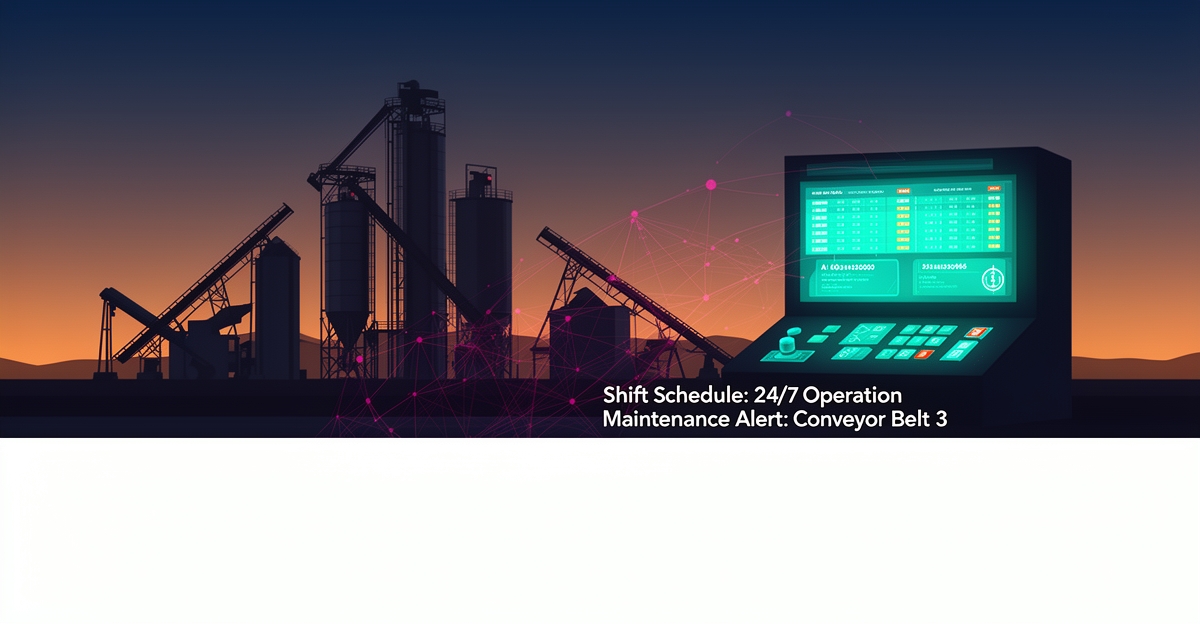
7 Signs Your Asphalt Plant Needs an AI Operator to Manage Shifts and Scheduling
Key Facts
- The U.S. paving contractors industry is a large, highly fragmented market — typically tens of thousands of operators with no single company holding meaningful share according to industry sizing data
- Inconsistent shift handoffs cause crews to spend the first hour reconstructing what happened, leading to rework and safety risks
- AI operators provide standardized handoff summaries from sensors, batch tickets, and logs in natural language to incoming crews
- Predictive maintenance powered by AI analyzes historical data to flag conflicts before maintenance windows close
- AI workflow builds transform scheduling from a daily fire drill into a data-driven process optimizing crew allocation
- Real-time visibility replaces tribal knowledge with auditable records, making scheduling a repeatable process rather than a daily negotiation
- AI employees work 24/7 without turnover, analyzing historical patterns to maximize throughput per labor hour
Hire a team member that works 24/7 — for less than a part-time wage.
AI receptionists, SDRs, dispatchers and 99+ roles. Trained on your business, fully managed.
Not sure where to start? Ask our AI planner
Inconsistent Shift Handoffs and Missed Maintenance Windows
Fragmented handoffs and missed service windows quietly erode margin in a large, highly fragmented U.S. paving contractors market according to industry sizing data. When one shift leaves notes on paper or in a text thread, the next crew spends the first hour reconstructing what happened, and maintenance gets pushed until a breakdown forces it.
Inconsistent shift handoffs create a repeatable error loop. Critical information about mix temperatures, plant throughput, and equipment anomalies is lost between crews, leading to rework, safety risk, and delayed starts. AI can help by providing a standardized and automated process for shift handoffs, ensuring that all relevant information is communicated accurately and efficiently.
Missed maintenance windows compound the problem. Unplanned downtime from deferred service reduces productivity and forces costly overtime to recover lost tons. AI can help by analyzing historical data and predicting maintenance needs, allowing for proactive scheduling and minimizing downtime.
An AI operator standardizes the transition without adding headcount. Shift coordinators or production supervisors built as managed AI employees can manage workflows 24/7, improving efficiency and reducing human error in high-pressure environments.
Standardization looks like this in practice:
- Automated handoff summaries generated from sensors, batch tickets, and operator logs, delivered in natural language to the incoming crew
- Natural-language queries on scheduling data, such as “Show me all jobs scheduled for next week at the Main Street plant” via direct connection of scheduling data to AI assistants
- Predictive maintenance prompts that surface patterns in historical data and flag conflicts before a window closes
AI can help with asphalt plant scheduling by answering natural-language questions, summarizing demand, flagging conflicts, and surfacing patterns in historical data as described in plant scheduling research. The PlantDemand MCP tool connects your scheduling data directly to AI assistants, enabling queries like “Show me all jobs scheduled for next week at the Main Street plant” according to the tool overview.
Safe adoption starts with structure. Asphalt and aggregate producers can adopt AI agents safely, starting with the Model Context Protocol (MCP) standard per a white paper on AI agents in asphalt plant operations. That protocol enables consistent data access for handoff notes, maintenance logs, and production targets without rebuilding core systems.
With standardized handoffs and predictive maintenance windows, plants reduce the variability that drives overtime and spoilage. Real-time visibility into operations replaces tribal knowledge with auditable records, and scheduling becomes a repeatable process rather than a daily negotiation. AIQ Labs approaches this through AI Workflow Builds, rebuilding the one workflow that costs you the most — shift coordination and maintenance scheduling — at a fixed price, in phases.
The result is fewer surprises at shift change, fewer missed service windows, and a crew that starts producing instead of problem-solving.
Labor Shortages and Inefficient Scheduling
The U.S. paving contractors industry is a large, fragmented market where no single company holds meaningful share. This fragmentation means most asphalt plants lack the scale to maintain dedicated scheduling teams, forcing superintendents to juggle crew allocation alongside production targets. When experienced operators retire or call out, the ripple effect cascades through multiple shifts — trucks arrive with no one to load them, silos sit idle, and maintenance windows get pushed until equipment fails.
AIQ Labs addresses this exact pressure point by deploying AI employees trained as shift coordinators who work 24/7 without the turnover that plagues human scheduling roles. These AI operators don't just fill gaps; they analyze historical crew patterns, equipment availability, and incoming order volumes to build rosters that maximize throughput per labor hour. The Model Context Protocol (MCP) standard enables asphalt and aggregate producers to adopt AI agents safely, connecting scheduling data directly to AI assistants that can answer natural-language queries like "Show me all jobs scheduled for next week at the Main Street plant" while flagging conflicts and surfacing patterns in historical data.
- Crew shortages that leave critical positions unfilled during peak production windows
- Overtime costs spiraling because schedules react to crises instead of anticipating demand
- Knowledge loss when veteran schedulers leave, taking tribal knowledge with them
- Inability to rebalance shifts quickly when weather or supplier delays change the plan
- Superintendents spending hours on spreadsheets instead of managing plant operations
The AI Workflow Builds approach transforms scheduling from a daily fire drill into a data-driven process that continuously optimizes crew allocation against real-time demand signals.
Lack of Real-Time Visibility and Scalability Limits
Manual spreadsheets and phone calls leave plant managers flying blind between shifts, and growth stalls when scheduling can’t keep pace with demand. Without live visibility, small inefficiencies compound into missed jobs, overtime, and equipment downtime.
Asphalt plants often lack real-time data, making it difficult to make informed decisions. AI can help by providing real-time data and analytics, enabling plant managers to make data-driven decisions and optimize operations. The U.S. paving contractors industry is a large, fragmented market as of late 2026, with no company holding meaningful share, intensifying pressure to scale efficiently.
Limited visibility shows up as delayed handoffs, invisible bottlenecks, and reactive maintenance. Real-time visibility into operations is difficult to achieve with manual tracking, which limits the ability to identify areas for improvement and optimize operations. AI surfaces patterns in historical data and flags conflicts before they disrupt production.
Scalability limits emerge when scheduling remains tied to one person’s memory and a shared calendar. Manual scheduling carries low upfront costs but is inefficient, prone to errors, and lacks scalability. AI-powered scheduling delivers optimized scheduling, reduced errors, and improved scalability, though it requires data integration and training.
The PlantDemand MCP tool connects your scheduling data directly to AI assistants, enabling queries like “Show me all jobs scheduled for next week at the Main Street plant”. AI can help with asphalt plant scheduling by answering natural-language questions, summarizing demand, flagging conflicts, and surfacing patterns in historical data. Asphalt and aggregate producers can adopt AI agents safely, starting with the Model Context Protocol standard.
With an AI Workflow Build, an AI operator can continuously monitor shifts, surface exceptions, and coordinate coverage without manual chasing. AIQ Labs deploys AI employees such as shift coordinators or production supervisors to manage workflows 24/7, improving efficiency and reducing human error in high-pressure environments.
Real-time, scalable scheduling typically delivers:
- Instant natural-language queries on jobs, crews, and equipment across plants
- Automated conflict detection and demand summarization for next-week planning
- Pattern recognition from historical data to support proactive maintenance and staffing
- Scalable coordination that grows with fragmented operations without adding headcount
Visibility becomes a control layer rather than a report, and scheduling shifts from reactive firefighting to a repeatable, auditable process that supports growth.
Still paying for 10+ subscriptions that don’t talk to each other?
We build custom AI systems you own outright. No vendor lock-in. Full control.
Not sure where to start? Ask our AI planner
Frequently Asked Questions
What are the main problems caused by inconsistent shift handoffs in asphalt plants?
How does AI help prevent missed maintenance windows in asphalt plants?
Can AI really help with labor shortages in the asphalt industry?
What is the Model Context Protocol (MCP) and why is it important for AI adoption in asphalt plants?
How does AI improve real-time visibility in asphalt plant operations?
Is AI-powered scheduling scalable for fragmented asphalt operations without adding headcount?
Turn Shift Chaos into Scheduling Certainty
From fragmented handoffs and missed maintenance to labor shortages and blind-spot scheduling, the signs are clear: when your asphalt plant relies on spreadsheets, sticky notes, and tribal knowledge, inefficiency compounds with every shift change. AI operators don’t just fill gaps—they standardize transitions, predict maintenance needs, optimize crew allocation, and turn scheduling from a daily fire drill into a repeatable, auditable process. The result? Fewer surprises at shift change, more tons produced per labor hour, and real-time visibility that scales with your fragmented operation—without adding headcount. If you’re ready to replace reactive firefighting with proactive, data-driven coordination, start with the 2-minute Fit Check to see where AI delivers the highest ROI in your plant. Then book your free 30-minute strategy call and discover how an AI Workflow Build can become your competitive advantage.
Make AI your competitive advantage — not just another tool.
Strategy, implementation and ongoing optimization. One partner, end to end.
Not sure where to start? Ask our AI planner