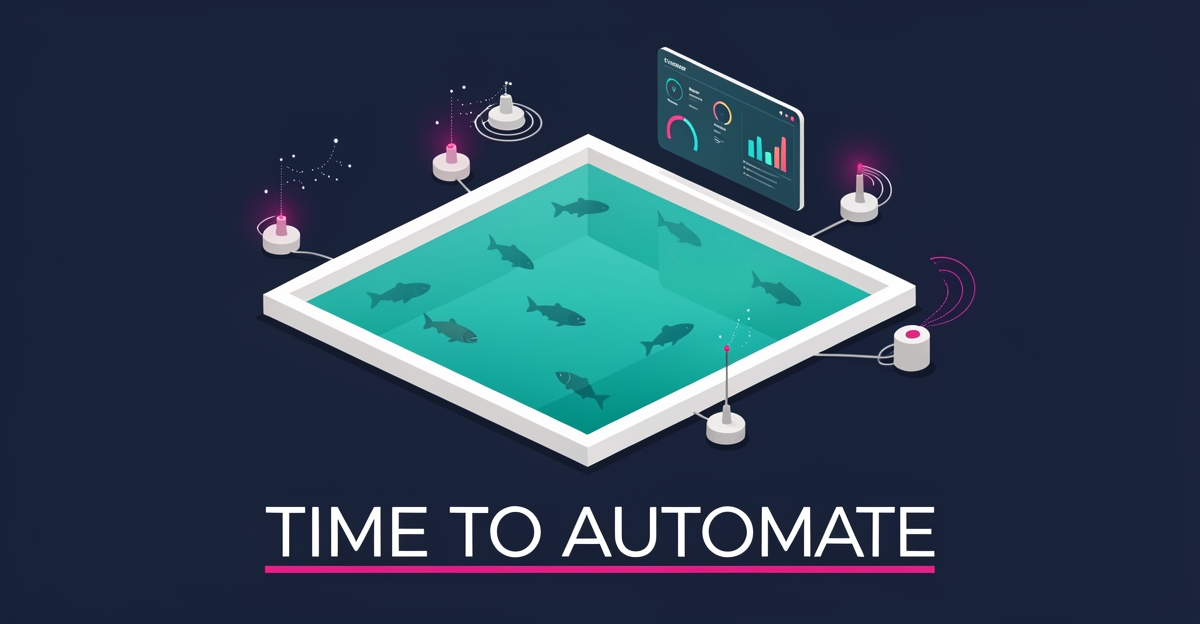
7 Signs Your Fish Farm Needs AI for Daily Operations
Key Facts
- A single pond operation requires roughly 3.3 hours of daily manual water testing, totaling about 1,205 labor hours per year according to an aquaculture ROI analysis.
- Feed typically represents 40–50% of aquaculture production costs, making it the single largest expense for fish farms per precision aquaculture research.
- AI-driven smart feeding can reduce the Feed Conversion Ratio by 5–15% by matching rations to real-time biomass and appetite as precision aquaculture research shows.
- Machine learning models such as Support Vector Machines have demonstrated up to 99% accuracy predicting water quality in intensive aquaculture systems according to AI aquaculture research.
- Computer vision enables contactless biomass estimation with a 3–5% margin of error, replacing stressful manual weigh-ins per stereo vision research.
- Automation reduces manual workload and improves monitoring accuracy, supporting better sustainability and productivity in fish farming per FlyPix AI industry analysis.
- A five-pond operation can consume the equivalent of more than one full-time employee's work year on water testing alone according to an aquaculture ROI analysis.
Hire a team member that works 24/7 — for less than a part-time wage.
AI receptionists, SDRs, dispatchers and 99+ roles. Trained on your business, fully managed.
Not sure where to start? Ask our AI planner
The Hidden Cost of Manual Farm Management
Manual logs and reactive checks quietly erode margins long before a mortality event shows up on the balance sheet. Traditional fish farming still relies on human eyes, clipboards, and scheduled test kits, which means problems are discovered after they cost you stock.
A single pond operation requires roughly 3.3 hours of labor per day for manual testing, which translates to about 1,205 hours per year according to an aquaculture ROI analysis. A five-pond operation would consume the equivalent of more than one full-time employee's work year on water testing alone. That labor is not just expensive; it is intermittent.
Manual water testing has built-in blind spots, as it only provides snapshot data at specific times while IoT monitoring offers continuous visibility. The fish don't care that your testing schedule says the next check is at 7 AM as the author notes. By the time a morning sample reveals a crash, dissolved oxygen can have been below critical thresholds for hours.
Record-keeping compounds the drag. Daily feeding, health observations, and stock movements are still tracked in spreadsheets and paper logs. Top farm management tools are praised for organizing farm records for stock movements, feeding activities, and health observations in one place because manual systems fragment accountability across ponds and cycles.
Reactive problem-solving also inflates the costliest input. Feed typically represents between 40% and 50% of production costs in aquaculture according to precision aquaculture research. Without real-time data, farmers overfeed to be safe or underfeed during stress, both of which raise the Feed Conversion Ratio. AI-driven smart feeding can reduce the Feed Conversion Ratio by 5% to 15% by matching input to actual biomass and appetite.
The core bottlenecks that drain profitability are:
- Manual data logging that creates delays and transcription errors
- Reactive problem-solving instead of predictive intervention
- Labor-intensive monitoring that limits scale without adding headcount
- Fragmented record-keeping that slows compliance and traceability
Aquaculture 4.0 shifts the relationship between farmers and data from manual observation to intelligent systems that predict outcomes as described in Aqua4 analysis. A dashboard that shows dissolved oxygen at 4.2 mg/L is useful. A system that knows your tilapia are at week 14 of grow-out, water temperature has been trending up for three days, algae density is increasing, and predicts that DO will drop below 3.0 mg/L by 2 AM tonight, then activates emergency aeration at midnight before the crash happens: that is the difference between monitoring and intelligence in the author's words.
Automation reduces manual workload and improves the accuracy of monitoring efforts, leading to better sustainability and productivity in fish farming per FlyPix AI. AI-powered monitoring tools can automate critical operations including water quality tracking, disease detection, and environmental change monitoring as industry monitoring guides highlight.
Identifying operational bottlenecks in fish farming such as monitoring, record-keeping, or disease detection is the first step toward scalable automation. AIQ Labs builds these systems in phases, so farms can start with the single workflow that costs the most and expand from there. Learn more at AI Workflow Builds.
Sign 1: You're Drowning in Data but Starving for Insights
You're recording dissolved oxygen at 7 AM and 7 PM, but the crash happens at 2 AM. That gap between snapshot data and continuous reality is where profits disappear.
Manual water testing consumes roughly 1,205 hours per year for a single pond operation — close to the equivalent of a full-time employee doing nothing but walking the banks with test kits. A five-pond operation swallows more than one FTE entirely. On top of the labor, consumables add up: pH kits need replacement every 50–100 tests, ammonia kits follow similar cycles, and DO meter membranes typically require swapping every three to six months. Calibration solutions drain budgets on a rolling basis.
- Spreadsheets capture what happened yesterday, not what's happening now
- Paper logs create blind spots between scheduled checks
- Historical trends stay buried in disconnected notebooks
- Reactive decisions replace predictive management
The industry calls this the jump from Aquaculture 3.0 to Aqua4 — the critical shift where AI models understand biological context and predict outcomes instead of merely displaying dashboards. As one analysis puts it, a system that knows your tilapia are at week 14, water temperature has trended up for three days, algae density is increasing, and predicts DO will drop below 3.0 mg/L by 2 AM — then activates emergency aeration at midnight — that is the difference between monitoring and intelligence.
AIQ Labs replaces manual record-keeping with continuous, automated data pipelines. Our AI Employees handle routine monitoring tasks end-to-end — integrating sensor feeds, logging observations, and flagging anomalies before they become catastrophes — at roughly 80% less cost than a human hire. The result: staff reclaim thousands of hours for growth and sustainability work while the system watches what humans can't — 24/7, without gaps, without fatigue.
Sign 2: You Find Out About Problems After They've Become Crises
The problem with manual monitoring isn't just the labor — it's the blind spots. A single pond operation demands roughly 3.3 hours of daily testing, totaling over 1,200 hours annually, yet still only captures snapshots at specific intervals. Industry veterans know the sinking feeling of discovering a dissolved oxygen crash at 6 AM when the math on floating stock becomes brutally clear.
- Nighttime oxygen crashes occur between scheduled checks
- Algae blooms shift water chemistry faster than daily readings catch
- Equipment failures go unnoticed until mortality spikes
- Weather-driven temperature swings alter metabolic rates overnight
This reactive cycle defines the gap between traditional operations and Aquaculture 4.0. As Agrinovo illustrates, a dashboard showing 4.2 mg/L is useful, but a system that knows your tilapia are at week 14, detects three days of rising temperature and increasing algae density, then predicts DO will drop below 3.0 mg/L by 2 AM and activates emergency aeration at midnight — that transforms crisis management into prevention. AI models trained on historical patterns, weather data, and biological growth cycles forecast water quality anomalies before they become lethal events.
The shift from snapshot testing to continuous intelligence changes everything. Algorithms like Support Vector Machines have demonstrated up to 99% accuracy predicting water quality in intensive systems, turning hours of manual labor into automated foresight. AIQ Labs builds these predictive workflows into custom systems that integrate with existing sensors and farm management tools, replacing reactive scrambling with automated preventative actions that protect inventory around the clock.
Sign 3: Your Feed Costs Are High and Growth Rates Are Inconsistent
Feed costs can silently drain profitability when growth rates lag despite consistent feeding schedules. Manual feeding often relies on fixed rations or visual estimates, leading to overfeeding during low-activity periods and underfeeding when fish are most hungry—both waste feed and disrupt growth cycles. This inconsistency directly impacts the Feed Conversion Ratio (FCR), a critical metric where even small improvements translate to significant savings since feed typically represents 40–50% of total production costs.
AI-driven smart feeding systems address this by using real-time data to adjust rations based on fish behavior, water conditions, and growth stages. Research shows these systems can reduce FCR by 5–15% through precision feeding algorithms that minimize waste while ensuring nutritional needs are met. For example, computer vision technology enables non-invasive biomass estimation by analyzing fish size and density via underwater cameras, allowing farms to calculate exact feed requirements without stressing the stock or relying on infrequent manual weigh-ins.
- Feed typically accounts for nearly half of aquaculture operating expenses, making optimization a top priority for cost control.
- Smart feeding powered by AI can lower FCR by 5–15%, directly reducing feed waste and improving growth uniformity.
- Computer vision enables contactless biomass tracking with a 3–5% margin of error, supporting data-driven feeding decisions.
By automating feed calculations and delivery timing, AI workflows eliminate guesswork and labor-intensive monitoring, freeing staff to focus on health management and strategic planning. AIQ Labs helps fish farms implement these intelligent feeding systems as part of broader operational automation, turning a major cost center into a streamlined, sustainable process. To explore how AI can optimize your feed management and growth consistency, start with the two-minute Fit Check.
Sign 4: Disease Detection Relies on Visual Checks and Guesswork
By the time a fish looks sick, the problem has usually been developing for days. Visual checks catch disease only after symptoms become obvious — lesions, discoloration, erratic swimming — which means treatment starts late and losses have already begun.
The core limitation is that human observation is intermittent and subjective. A worker walking the tanks a few times a day sees snapshots, not trends, and early behavioral changes like reduced feeding response or subtle shifts in swimming patterns are easy to miss. This mirrors the problem with manual water testing: as one aquaculture analysis puts it, "the fish don't care that your testing schedule says the next check is at 7 AM."
Research-backed AI approaches now offer a non-invasive alternative to visual guesswork. According to research on precision aquaculture, computer vision and acoustic monitoring enable continuous observation of fish behavior, biomass, and pathology without handling or stressing the stock. Key capabilities include:
- Computer vision for detecting physical abnormalities, tracking movement patterns, and estimating biomass without contact
- Acoustic monitoring that picks up behavioral changes in feeding and activity that precede visible illness
- Stereo vision systems that analyze 3D fish movement with an error margin of just 3–5%
- Contactless weight estimation that eliminates the stress of traditional netting and weighing
The shift matters because disease detection is really a pattern recognition problem — and patterns emerge from continuous data, not periodic walkthroughs. The same precision aquaculture research notes that AI algorithms like Support Vector Machines have achieved up to 99% accuracy in predicting water quality conditions in intensive systems, demonstrating how machine learning outperforms human observation for biological prediction tasks.
Modern Aquaculture 4.0 systems take this further by layering AI models that understand biological context — knowing, for example, that tilapia at week 14 combined with rising water temperature and algae density signals an impending oxygen crash, and acting before it happens. This is the difference between reacting to sick fish and preventing the conditions that make them sick.
If your disease protocol still depends on a worker spotting something unusual during rounds, you're operating with a built-in delay. AIQ Labs builds custom workflows that automate exactly this kind of continuous monitoring and anomaly detection, turning disease management from reactive guesswork into proactive intervention.
From Identification to Implementation: Your Path Forward
Recognizing the warning signs is the first step; acting on them is where competitive advantage begins. The gap between identifying a bottleneck and deploying a solution is where most operations lose margin, but it doesn't require a full-scale overhaul to start seeing returns.
The most effective path forward targets a single, high-impact workflow first. Feed typically represents between 40% and 50% of production costs in aquaculture, and AI-driven smart feeding can reduce the Feed Conversion Ratio by 5% to 15%. Simultaneously, manual water testing consumes roughly 1,205 labor hours per year for a single pond—time that AI monitoring reclaims instantly. Start with the workflow bleeding the most revenue, whether that is feeding optimization or continuous water quality surveillance.
- Audit current operations against the seven signs to pinpoint the highest-cost bottleneck
- Select one workflow—monitoring, feeding, or record-keeping—for initial automation
- Deploy a managed AI Employee tailored to that specific role
- Measure ROI in weeks, then scale to adjacent workflows
AIQ Labs offers three ways in. AI Employees are managed AI staff—receptionists, monitoring technicians, compliance loggers, and 99+ other roles—that plug into your existing tools and run 24/7 at roughly 80% less cost than a human hire. AI Workflow Builds rebuild the one workflow that costs you the most, at a fixed price and in phases, so you see returns before committing further. And when you're ready, an AI Operating System connects everything into one operating layer you own outright. Payment is flexible too: start monthly, build in milestones, or own it outright—no fake prices, no invented numbers. The engagement starts with a free 30-minute strategy call to map the bottleneck, not to sell a package.
Still paying for 10+ subscriptions that don’t talk to each other?
We build custom AI systems you own outright. No vendor lock-in. Full control.
Not sure where to start? Ask our AI planner
Frequently Asked Questions
How much time does manual water testing actually take per year for a single pond operation?
Can AI really reduce feed costs in fish farming, and by how much?
Is AI-powered disease detection better than visual checks by farm workers?
What's the difference between regular monitoring and Aquaculture 4.0 (Aqua4) systems?
Do I need to replace all my current systems to start using AI in my fish farm?
How does AI handle record-keeping and compliance in fish farming?
Stop Managing by Crisis: Your Next Move
The seven signs outlined above share a common thread: they all stem from the gap between snapshot data and continuous reality. Whether it is the roughly 1,205 hours lost annually to manual water testing, the 5% to 15% FCR improvement available through AI-driven feeding, or the disease outbreaks caught too late by visual checks, the cost of manual operations compounds daily. AIQ Labs helps fish farms close this gap with AI Employees, targeted workflow builds, and—when you're ready—a full AI Operating System that handles monitoring, feeding optimization, and anomaly detection around the clock. The path forward does not require a full operational overhaul. Start by auditing your farm against these seven signs to identify the single workflow bleeding the most margin. Then deploy one targeted automation—whether that is continuous water quality surveillance or precision feeding—and measure the return in weeks, not months. Ready to map your biggest bottleneck? Take the two-minute Fit Check at AIQ Labs, then book a free 30-minute strategy call to see exactly where AI can reclaim your margins.
Make AI your competitive advantage — not just another tool.
Strategy, implementation and ongoing optimization. One partner, end to end.
Not sure where to start? Ask our AI planner