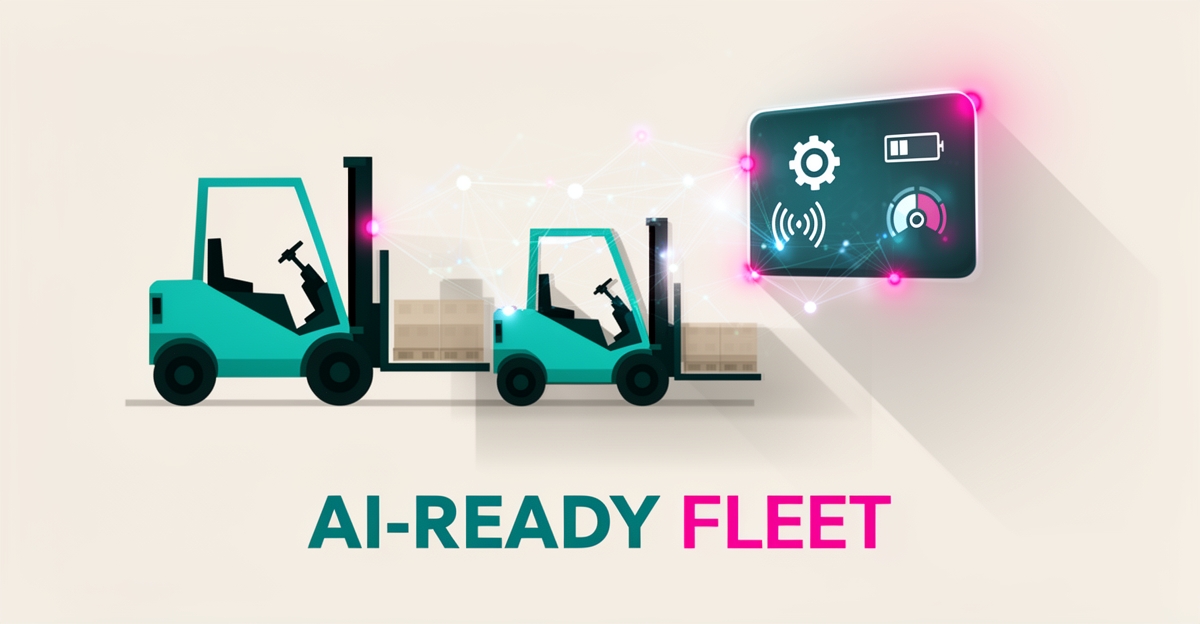
7 Signs Your Forklift Dealer Is Ready for AI-Driven Fleet Maintenance Scheduling
Key Facts
- Traditional 250-hour service intervals waste spend on low-use units and risk failure on high-use units.
- Fleet utilization can swing dramatically between low season and peak season—industry fleet analytics have documented utilization more than doubling from October to December in seasonal operations.
- Returning underutilized units too early before peak season has led to significant peak-season rental costs in documented fleet case studies.
- Edge computing can cut decision latency from hundreds of milliseconds to single-digit milliseconds for real-time anomaly detection, per robotics industry analysis.
- AI can typically forecast hydraulic pump and battery needs up to 90 days ahead, per industry analysis.
- Heavy dock forklifts can make on the order of 200 pallet moves per shift versus light picking work, according to industry analysis.
- Utilization-based right-sizing recommendations have cut double-digit unit counts across multi-site fleets in documented fleet analytics examples.
Hire a team member that works 24/7 — for less than a part-time wage.
AI receptionists, SDRs, dispatchers and 99+ roles. Trained on your business, fully managed.
Not sure where to start? Ask our AI planner
The Hidden Cost of Calendar-Based Maintenance
The traditional 250-hour service interval creates a false economy by treating all forklifts as if they operate under identical conditions. This rigid calendar-based approach either wastes resources on unnecessary maintenance for lightly used units or risks catastrophic failure on heavily utilized machines. When maintenance schedules ignore actual duty cycles, businesses pay for parts and labor that add no value while leaving critical wear undetected until it’s too late.
Fleet utilization data exposes the flaw in static scheduling: a fleet showing a few hours per day in October can more than double that by December as seasonal demand shifts according to fleet utilization analytics. Servicing units based on fixed hourly thresholds during low-use months means returning equipment prematurely—only to scramble for rentals when peak season hits. Fleet case studies have documented exactly this pattern: returning underutilized units in the fall, then facing inflated peak-season rental costs that ran into the tens of thousands of dollars as shown in seasonal utilization case studies.
- Wasted spend on filters, fluids, and labor for units operating well below capacity
- Increased risk of hydraulic or mast failure in high-duty-cycle units
- Misaligned fleet sizing that ignores real-time utilization trends
- Inability to predict spare parts needs based on actual wear patterns
- Reactive scheduling that disrupts operations during peak periods
AIQ Labs helps forklift dealers transition from arbitrary intervals to intelligent, usage-driven maintenance by integrating telematics data with operational calendars. Through AI Workflow Builds, dealers can rebuild the one maintenance workflow that costs the most—scheduling—based on real-time component health and forecasted demand, eliminating the guesswork that leads to both over-maintenance and dangerous oversights. This shift isn’t just about avoiding costs; it’s about building a maintenance strategy that adapts as dynamically as the fleet itself.
From Usage Data to Component Intelligence
The difference between a forklift that’s “running” and a forklift that’s actually healthy lies in the granularity of your data. Many dealers still rely on basic hour-meters to trigger service, but true AI readiness requires a shift from tracking time to monitoring component intelligence.
Instead of just counting hours, mature operations now track the health of specific subsystems like hydraulics, batteries, and mast chains. According to industry analysis, this allows dealers to move beyond arbitrary 250-hour service intervals and address wear based on actual component stress rather than the calendar.
Sign 1: You Monitor Component-Level Health
Your telematics system should distinguish between a battery losing charge and a hydraulic pump losing pressure. When you can isolate these variables, you stop performing unnecessary maintenance on healthy parts and start catching failures before they strand a customer’s operation.
Sign 2: You Track Duty-Cycle Intensity
Not all hours are created equal. A forklift making heavy pallet moves per shift at a dock—potentially on the order of 200 in intensive operations—endures significantly more stress than one performing light picking in a warehouse aisle. AI-ready dealers recognize that maintenance schedules must reflect this intensity, not just the odometer.
Key indicators of duty-cycle awareness include:
- Tracking load weights and lift heights alongside runtime
- Differentiating between high-intensity dock work and light order picking
- Adjusting service intervals based on actual wear patterns
- Correlating component health with specific operational tasks
Sign 3: You Leverage Edge Computing for Real-Time Decisions
Cloud processing introduces latency that can cost you equipment life. While sending data to the cloud and waiting for a response typically takes on the order of 250 milliseconds, edge computing can process information locally in roughly 10 milliseconds per robotics industry analysis. That difference enables immediate anomaly detection and automatic shutdowns before minor issues become catastrophic failures.
When your systems can detect a hydraulic anomaly and alert a technician in milliseconds rather than minutes, you’ve moved from reactive reporting to proactive protection. AIQ Labs helps dealers implement these edge-capable architectures, ensuring that maintenance alerts trigger instantly based on actual component distress rather than delayed cloud analytics.
Predictive Parts and Dynamic Scheduling
Forklift dealers who have moved beyond basic telematics are now using AI to forecast spare parts needs with meaningful foresight, projecting demand for critical components like hydraulic pumps and battery packs up to 90 days in advance. This predictive capability allows them to order parts during normal lead times, avoiding costly rush shipping fees and minimizing the risk of stockouts that could leave equipment idle. By analyzing usage patterns, wear indicators, and historical failure rates, AI models identify which components are likely to need replacement before they fail, turning inventory management from a reactive scramble into a strategic advantage. Industry research supports this forecast window as essential for aligning procurement with operational realities and reducing unnecessary expenses.
Beyond predicting what parts will be needed, advanced dealers are using AI to dynamically sequence maintenance tasks around operational calendars and bay availability, moving far beyond simple tracking of “wrench time.” Instead of scheduling service based solely on hour meters or fixed intervals, AI agents analyze shift patterns, peak rental demand, and technician workload to determine the optimal moment for each service event. This ensures maintenance happens during natural lulls—such as shift changes or low-demand periods—maximizing bay utilization without disrupting customer operations. The result is a smarter allocation of both time and space, where service bays are used efficiently and technicians are never waiting for work or overwhelmed by back-to-back jobs. Fleet utilization data suggests dealers implementing this approach see measurable gains in equipment availability and service throughput.
This shift represents a deeper integration of AI into daily operations, where scheduling isn’t just automated—it’s intelligently orchestrated. By syncing maintenance with real-time operational constraints, dealers avoid the inefficiencies of rigid calendars and the unpredictability of breakdown-driven repairs. AI continuously learns from bay occupancy, job duration, and parts delivery timelines to refine its sequencing, creating a feedback loop that improves over time. For businesses aiming to reduce downtime while controlling costs, this level of dynamic scheduling marks a clear sign of maturity in AI-driven fleet maintenance. Telematics analytics indicate that dealers using such systems report fewer service delays and higher first-time fix rates, directly impacting customer satisfaction and operational resilience. AIQ Labs supports this evolution by building custom AI workflows that integrate telematics data with scheduling systems, enabling dealers to own and optimize their maintenance intelligence without vendor lock-in.
Fleet Optimization and Autonomous Action
The most advanced forklift dealers are now using AI not just to predict maintenance needs, but to drive autonomous actions across their operations—transforming data into decisions without human intervention. This level of maturity enables right-sizing recommendations, such as trimming double-digit numbers of LPG units across multiple sites based on utilization analytics, directly optimizing fleet composition and reducing unnecessary costs according to fleet utilization insights. These systems analyze real-time usage patterns and duty cycles to identify underperforming assets, allowing dealers to reallocate or retire equipment strategically rather than reactively.
Beyond scheduling, AI is enabling video-verified safety compliance through integrated multi-camera DVR systems that trigger event-based recording and analysis as supported by Fleet Complete’s telematics solutions. When combined with AI, these systems don’t just capture footage—they interpret it, detecting unsafe behaviors like excessive speed or improper load handling and automatically initiating corrective workflows. This creates a closed-loop safety system where insights lead to immediate, documented action, reducing risk and improving audit readiness.
At the peak of operational autonomy, AI agents now schedule technicians independently, syncing with existing dispatch systems to assign the right person to the right job at the right time—without generating mere alerts as demonstrated in AI-driven logistics transformations. These agents consider technician skill sets, location, parts availability, and equipment criticality to optimize response sequences, especially in environments with limited maintenance bays. By embedding AI into the core of service logistics, dealers shift from reactive support to predictive, self-orchestrated maintenance ecosystems that maximize uptime and minimize manual coordination. AIQ Labs enables this level of automation through AI Employees—managed AI staff such as dispatchers and service schedulers that work within your existing operational fabric at a fraction of the cost of an equivalent hire.
Implementing AI-Driven Maintenance with AIQ Labs
Forklift dealers ready for AI-driven maintenance have moved beyond basic telematics to systems that actively optimize fleet health. This readiness means their operations can now predict component failures before they occur and align service schedules with real-time demand patterns. AIQ Labs partners with these businesses to transform maintenance from a reactive cost center into a proactive efficiency driver.
The implementation begins with a detailed assessment of existing telematics, dispatch software, and maintenance workflows to identify integration points and data gaps. From there, AIQ Labs designs a custom AI system that ingests real-time sensor data on hydraulics, batteries, and mast chains to generate condition-based service recommendations. This approach replaces arbitrary 250-hour intervals with precise scheduling that minimizes both unnecessary downtime and catastrophic failures.
Deployment follows one of three engagement models tailored to the dealer’s scale and control preferences. Start Monthly deploys an AI Employee functioning as an autonomous Service Scheduler within weeks, handling alert triage and technician assignments at roughly 80% less cost than a human hire. Build in Milestones allows phased delivery of a department-wide maintenance automation system, with payment tied to each completed phase. For dealers seeking full control, Own It Outright delivers a complete AI Operating System—one connected operating layer, built in phases, that integrates deeply with existing tools and scales with fleet growth, owned outright.
Once live, the AI Employee continuously monitors usage patterns—including the dramatic seasonal utilization swings seen in fleet analytics examples—to forecast maintenance needs and optimize spare parts inventory up to 90 days in advance. It also aligns service windows with operational calendars to avoid peak demand periods, directly addressing a key readiness indicator. By turning raw telematics into autonomous decisions, these systems enable dealers to act on intelligence rather than wait for data, reducing unplanned downtime while extending asset lifecycles. Dealers can begin with the 2-minute Fit Check, followed by a free 30-minute strategy call to map their specific maintenance bottlenecks and ROI potential.
Still paying for 10+ subscriptions that don’t talk to each other?
We build custom AI systems you own outright. No vendor lock-in. Full control.
Not sure where to start? Ask our AI planner
Frequently Asked Questions
What is the main problem with traditional 250-hour maintenance schedules for forklifts?
How does seasonal demand affect forklift maintenance planning?
What does it mean to monitor component-level health in forklift maintenance?
Why is edge computing important for real-time forklift maintenance decisions?
How far in advance can AI predict spare parts needs for forklift fleets?
Can AI help forklift dealers right-size their fleets based on usage data?
Stop Wrenching by the Calendar
Ready forklift dealers have moved beyond counting hours to interpreting what those hours actually mean. You monitor hydraulic pressure and battery health instead of guessing at 250-hour intervals, sequence service around seasonal demand shifts, and predict parts needs 90 days out. Whether it’s avoiding the cost of returning units before a peak season or deploying edge computing that detects anomalies in milliseconds, the goal remains the same: intelligence that acts before breakdowns strand your customers. AIQ Labs helps dealers build these capabilities through custom AI systems that integrate with your existing telematics and dispatch tools—whether you start with a monthly AI Employee to handle scheduling or build a full maintenance operating system you own outright. The technology is ready when you are. Start the Fit Check today to map your maintenance bottlenecks and see exactly where AI can cut your downtime.
Make AI your competitive advantage — not just another tool.
Strategy, implementation and ongoing optimization. One partner, end to end.
Not sure where to start? Ask our AI planner