7 Signs Your Repair Shop Needs AI to Automate Routine Service Workflows
Key Facts
- Industry research suggests AI tools can automate a majority of routine administrative tasks in repair shops, including invoicing, scheduling, and inventory tracking according to industry research
- AI-assisted diagnostics typically outperform unaided manual diagnosis, reducing misdiagnosis rates and rework per recent data
- AI assistants respond to routine customer inquiries in seconds rather than minutes, improving booking rates and customer experience according to industry analysis
- AI integration with shop management systems can reduce manual data entry substantially, often saving 10+ hours weekly per technician according to recent findings
- Automated reminders and rescheduling typically reduce service appointment no-shows per customer data
- As of late 2026, AI adoption in auto repair is accelerating, with a growing majority of shops expected to use some form of AI according to adoption forecasts
Hire a team member that works 24/7 — for less than a part-time wage.
AI receptionists, SDRs, dispatchers and 99+ roles. Trained on your business, fully managed.
Not sure where to start? Ask our AI planner
Your Shop Is Losing Revenue to Manual Administrative Work
Every minute a technician spends on paperwork is a minute not spent on revenue-generating work. In repair shops, repetitive administrative work quietly erodes capacity, inflates labor costs, and creates the inconsistent service logs customers notice.
Manual intake forms, handwritten work orders, and duplicate data entry between systems force technicians to toggle between the bay and the back office. Industry research suggests AI tools can automate a majority of administrative tasks in auto repair shops, including invoicing, scheduling, and inventory tracking, while cutting total shop operations time meaningfully.
The data entry burden is especially costly. Recent findings indicate AI integration with shop management systems can reduce manual data entry by as much as 70%, often saving 10+ hours weekly per technician. That time returns directly to diagnostics, repairs, and customer-facing work.
Inconsistent service logs compound the problem. When notes live on paper, in text messages, and in different software fields, history is lost between visits. Shops report longer response times, repeated questions, and missed upsells because no single source of truth exists for a vehicle’s service history.
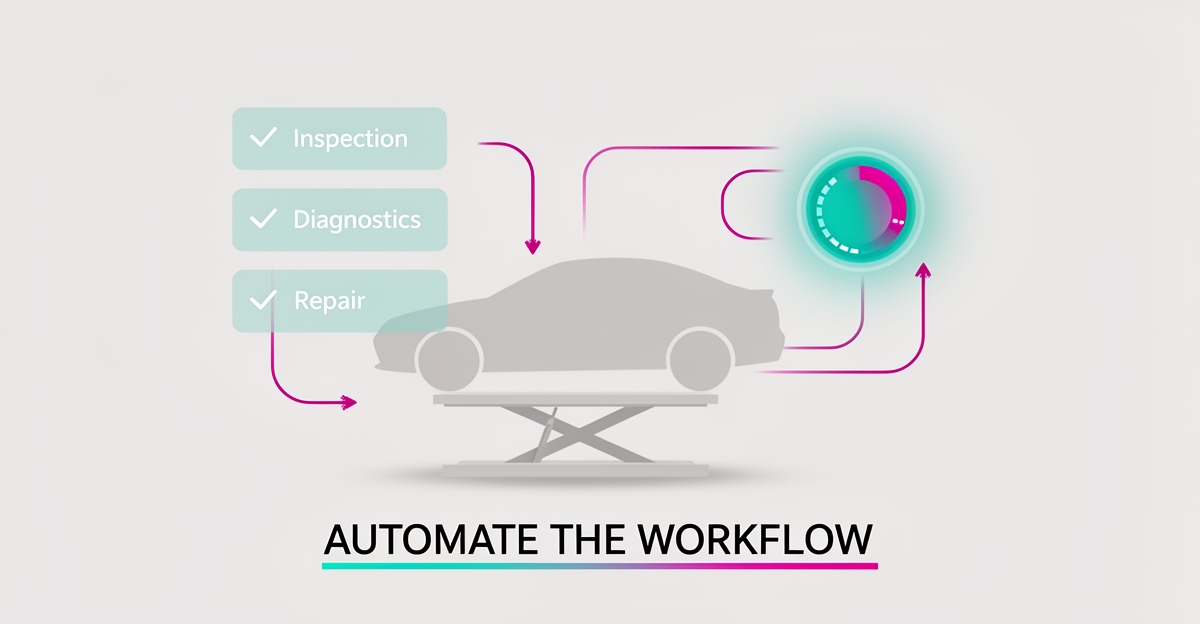
AI-driven workflow automation addresses this by handling routine service intake, appointment booking, and job tracking with minimal human oversight. This is exactly the kind of repetitive, rules-based work an AI Workflow Build is designed for: rebuild the one workflow that costs you the most, at a fixed price, in phases.
Common administrative drains that AI can remove include:
- Repetitive paperwork for intake, estimates, and approvals that sits in queues
- Manual copy-paste between shop management, accounting, and parts ordering systems
- Inconsistent service logs created by multiple technicians using different formats
- Follow-up calls and texts for status updates and appointment reminders
When these tasks are automated, service advisors stay focused on selling and customers receive faster updates. Most routine admin work can run without adding headcount, freeing the team to do the work only humans should do.
AIQ Labs helps repair shops deploy managed AI Employees—receptionists, schedulers, dispatchers, and 99+ other roles at roughly 80% less cost than a human hire—to handle service intake, appointment booking, and job tracking. The result is fewer errors, faster cycle times, and recovered technician hours that translate directly to revenue.
Shops that remove manual administrative drag report smoother operations and higher throughput without extending hours or hiring.
Customer Frustration Is Growing Due to Slow Response Times
A delayed reply is the first crack in customer trust, and in auto repair that crack turns into a lost appointment. When a driver calls about a check-engine light or a service inquiry, they expect an immediate answer, not a hold queue.
Shops still relying on manual phones and email are losing that moment. Industry research shows a majority of auto repair customers say AI assistants improve their experience through faster response times—answering in seconds or a couple of minutes versus the long waits typical of busy counters. That speed gap directly fuels frustration and no-shows.
Slow response times also erode confidence before the car even arrives. Customers who wait for callbacks often assume the shop is busy, disorganized, or uninterested. The result is hesitation to book, increased call-backs, and higher cancellation rates that waste bay time.
AI workflow automation closes the gap by handling routine service intake in real time. Recent data finds AI assistants handle most routine customer inquiries—checking repair status, scheduling, quoting turnaround—resolving the majority without human escalation. The system is available during peak hours and after hours when staff are unavailable.
The impact shows up in retention metrics. Analysis of shop communications indicates AI-powered reminders and rescheduling options typically reduce service appointment no-shows substantially. Faster answers create a perception of reliability that supports repeat business.
This is where a managed AI receptionist changes the service counter dynamic. Instead of adding headcount, shops automate the repetitive intake and booking loops that create bottlenecks.
Common friction points that AI can absorb include:
- After-hours calls about appointment availability going unanswered
- Repeated requests for status updates on repairs already in progress
- Manual rescheduling that requires advisor intervention
- Inconsistent follow-up on quotes and estimates
When routine workflows run without human oversight, advisors focus on consultative conversations and technicians stay in the bay. AIQ Labs helps repair shops deploy AI systems that handle service intake, appointment booking, and job tracking with minimal human oversight, aligning with the need for faster, consistent customer communication.
Shops that remove delay from the first touchpoint protect trust and convert inquiries into booked work.
Diagnostic Inaccuracies Are Costing You Money and Trust
Human-led diagnostics in repair shops carry hidden costs that extend far beyond the service bay. Misdiagnoses trigger unnecessary repairs, wasted parts, and frustrated customers who lose trust when problems persist or return. These errors don’t just waste time—they create liability, rework cycles, and reputational damage that erode profitability bay by bay.
AI-assisted diagnostic tools are helping reverse this trend. Research suggests AI-supported diagnostics typically achieve higher accuracy in identifying engine issues than unaided manual diagnosis, a gain that directly reduces misdiagnosis rates. That improvement translates to fewer comebacks, less wasted parts and labor, and lower liability exposure per bay. By catching issues humans miss—such as brake wear invisible to the naked eye detected by computer vision—AI helps prevent both over-servicing and dangerous oversights.
The financial and operational ripple effects are significant. Machine learning models have sharply reduced engine misdiagnosis rates in dealerships using AI-assisted tools, cutting unnecessary part replacements and labor hours. When technicians start with accurate AI-guided diagnostics, they avoid tearing down systems that don’t need repair, preserving both customer trust and shop efficiency. AI doesn’t replace expert judgment—it elevates it by providing a reliable foundation for decision-making, ensuring every bay operates with fewer costly errors and greater confidence in every repair order.
To explore how AI-assisted diagnostics can fit your shop’s workflow and reduce liability costs, start with a free strategy call to assess your specific needs and identify high-ROI automation opportunities. AIQ Labs helps repair shops build custom AI systems that integrate diagnostic assistance with service intake and job tracking—creating a unified workflow where accuracy drives efficiency from the first customer interaction to the final quality check.
Your Competitors Are Already Using AI to Gain an Edge
The competitive landscape is shifting fast. Early adopters of AI in auto repair are pulling ahead, capturing market share through measurable operational gains. Shops that implemented AI-driven workflows typically report faster job completion times, allowing them to serve more customers without adding staff. This speed advantage directly impacts revenue potential and customer throughput.
Beyond timing, AI is reducing costs at the operational level. Research suggests AI integration has meaningfully lowered average repair costs for consumers in recent analyses, driven by fewer misdiagnoses, optimized parts usage, and streamlined labor allocation. These savings compound across hundreds of monthly repair orders, creating meaningful margin improvement.
Customer satisfaction is also rising in tandem. Shops using AI-personalized service recommendations report higher satisfaction scores, while AI assistants cut response times from many minutes to seconds. Together, these factors create a stronger customer experience that drives loyalty and repeat business.
The momentum is clear: as of late 2026, a growing majority of auto repair shops are expected to use some form of AI technology, up sharply from just a quarter of shops in early 2025. This rapid adoption signals that AI is no longer optional for shops aiming to stay competitive—it’s becoming the new standard for efficient, customer-focused operations. Industry data confirms that early movers are already realizing these benefits across diagnostic accuracy, administrative efficiency, and customer engagement.
How to Start Automating Your Service Workflows with AIQ Labs
Start with a free strategy call to pinpoint where AI will deliver the highest return—whether it’s eliminating repetitive paperwork, fixing inconsistent service logs, or cutting long customer response times. AIQ Labs helps repair shops identify workflows that drain time and resources, then builds custom AI systems tailored to their specific tools and goals.
The process begins with a two-minute Fit Check and a no-obligation 30-minute strategy session where an AI engineer maps your biggest bottlenecks and quantifies potential gains. From there, you choose how to move: start monthly, build in milestones, or own the system outright. AIQ Labs develops production-ready AI solutions for service intake, appointment booking, and job tracking—designed to integrate with your existing shop management software and scale as your business grows. For shops ready to connect intake, scheduling, diagnostics, and follow-up into one layer, an AI Operating System built in phases may be the right fit.
- AI tools can automate a majority of routine administrative tasks in auto repair shops, cutting total operations time meaningfully
- AI-assisted diagnostic tools typically outperform unaided manual diagnosis, reducing misdiagnosis and rework
- Automated reminders and rescheduling typically reduce service appointment no-shows
These improvements free up skilled staff to focus on complex repairs and customer engagement while reducing errors and wait times. AIQ Labs’ approach ensures you own the systems built—no vendor lock-in, no subscription chaos—just a unified, intelligent workflow that evolves with your shop. To begin, Start the Fit Check and schedule your Free 30-Minute Strategy Call.
Key Takeaways
Turn Your Repair Shop’s Bottlenecks Into Breakthroughs
From draining administrative work to slow response times and diagnostic inaccuracies, the signs are clear: manual processes are quietly costing your shop time, trust, and revenue. AI isn’t about replacing your team—it’s about removing the routine work that keeps them from doing their best work. Shops that automate service intake, booking, and follow-up recover hours every week, convert more inquiries into booked jobs, and keep customers coming back.
AIQ Labs has deployed 200+ multi-agent systems and runs four live SaaS products daily, so the systems we build are proven in production. Start with the 2-minute Fit Check, then book your free 30-minute strategy call. Questions first? Reach us at [email protected].
Make AI your competitive advantage — not just another tool.
Strategy, implementation and ongoing optimization. One partner, end to end.
Not sure where to start? Ask our AI planner