7 Ways AI Can Improve Operations at a Christmas Tree Farm
Key Facts
- Drone and AI analysis can reportedly map around 100 hectares in about 30 minutes, according to industry coverage.
- Tree counting accuracy has been reported as high as roughly 98% with drone imagery on European farms.
- Drones can replace the work of 5–10 manual workers for counting, spraying and monitoring, per industry analysis.
- A single drone unit has been reported to cost around €25,600 plus software and training.
- Some farms feature slopes of 60–70° that block conventional machinery, per field research.
- Each tree can get a unique ID for 10-year harvest cycle tracking via AI systems.
Hire a team member that works 24/7 — for less than a part-time wage.
AI receptionists, SDRs, dispatchers and 99+ roles. Trained on your business, fully managed.
Not sure where to start? Ask our AI planner
The Seasonal Agriculture Bottleneck Christmas Tree Farms Face
The seasonal nature of Christmas tree farming creates a unique operational bottleneck that traditional methods struggle to overcome. Farms face the dual challenge of managing a roughly 10-year harvest cycle with no real-time visibility into tree growth or inventory, while relying on manual field counting and measurement that is both time-consuming and error-prone. This approach becomes increasingly unsustainable as farm sizes vary widely—from small family operations of 5–10 hectares to large enterprises exceeding 500 hectares—making consistent, accurate tracking nearly impossible without significant labor investment.
Manual field walks to count and measure trees are not only labor-intensive but also highly susceptible to human error, especially across vast or uneven terrain where visibility is limited and physical access is difficult. These inefficiencies directly impact critical functions like planting schedules, harvest planning, and inventory forecasting, leaving farms operating reactively rather than predictively. Traditional methods struggle to keep pace with the scale and complexity of modern tree farming, particularly when managing tens of thousands of individual trees over a decade-long lifecycle.
- Drone- and AI-driven analysis can reportedly map around 100 hectares in approximately 30 minutes, with tree-counting accuracy reported as high as the high-90s.
- Drones are replacing the equivalent of 5–10 manual workers for tasks like counting, spraying, and monitoring on Christmas tree farms.
- Some farms feature steep terrain with slopes reaching 60–70°, complicating traditional equipment use and increasing safety risks.
These challenges are further compounded by persistent labor shortages and the physical demands of working in rugged, often sloped landscapes—conditions that make manual oversight not just inefficient but potentially hazardous. For AIQ Labs, this operational reality underscores the need for intelligent automation that doesn't just digitize existing processes but fundamentally reimagines how tree farms monitor, manage, and plan across their entire lifecycle. By addressing these core pain points—manual labor dependency, lack of real-time data, and terrain limitations—AI-enabled workflows offer a path toward greater accuracy, reduced strain on workers, and improved long-term predictability in an industry where timing and precision are everything.
How AI and Drone Vision Are Changing Plantation Management
Drone and AI technologies are transforming how Christmas tree farms manage their plantations, moving beyond manual field counts to precision monitoring systems. These tools enable farms to track every tree individually, assess growth patterns, and plan interventions with a level of accuracy manual methods can't match. The shift is particularly valuable given the typical 10-year harvest cycle, where long-term tracking directly impacts yield and quality.
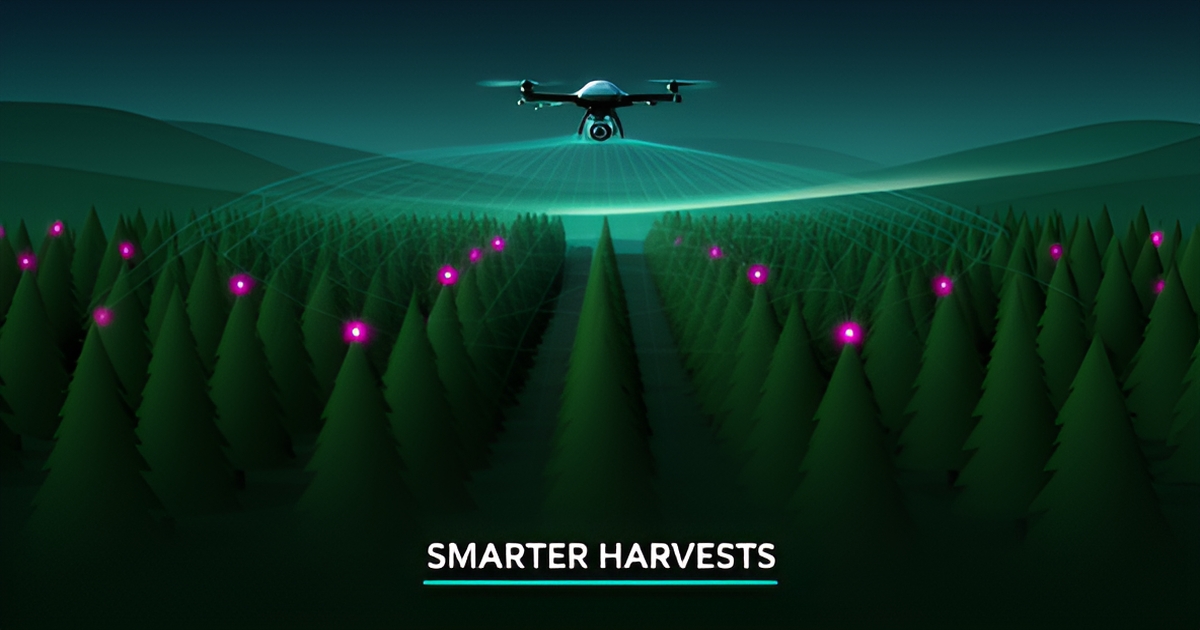
AI-powered systems using machine learning and computer vision can now identify and count Christmas trees from drone and satellite imagery with remarkable efficiency. Industry coverage reports that drone- and AI-driven analysis can map around 100 hectares in approximately 30 minutes and count trees with accuracy reported as high as roughly 98%. Each tree can receive a unique ID, enabling continuous growth tracking and inventory management throughout its lifecycle.
Beyond counting, drones equipped with LiDAR sensors generate detailed terrain and vegetation maps that improve precision in field management. This data supports targeted applications of fertilizers and herbicides, reducing waste and labor while promoting healthier tree development. Recent analysis notes these technologies are replacing the equivalent of 5–10 manual workers for tasks like spraying and monitoring, allowing former field staff to transition into drone operator roles.
- Tree identification and unique ID assignment per tree
- High-90s tree counting accuracy reported via drone imagery
- ~100-hectare mapping completed in roughly 30 minutes
- LiDAR terrain mapping for precision field management
- Targeted spraying for fertilizers and herbicides
AIQ Labs supports farms looking to automate these workflows through AI Workflow Builds that integrate drone data with inventory tracking and harvest planning systems. By turning aerial imagery into actionable insights, farms can shift from reactive maintenance to predictive plantation management—optimizing resources while improving long-term yield predictability. This approach helps seasonal agriculture operations scale efficiently without proportional increases in manual labor.
From Manual Labor to Managed AI Workflows on the Farm
Manual counting on a Christmas tree farm means walking tens of thousands of trees across uneven ground, year after year, across a 10-year harvest cycle. AI-driven drone workflows are turning that labor into managed data, with operational wins that show up in safety, speed, and planning.
Drones have moved from experimental tools to everyday equipment over the past several years, particularly for larger growers. Industry coverage reports drones replacing the equivalent of 5–10 manual workers for tasks like counting, spraying, and monitoring. Former manual laborers are transitioning to drone operator roles, improving safety and reducing physical strain.
The shift is most visible on steep terrain. Some farms have 60–70° slopes where conventional machinery is impractical. Field research from N.C. State University notes autonomous ground-based drones, or robotic mowers, are being developed to replace conventional machinery on those slopes. This reduces the need for workers to haul equipment and navigate hazardous inclines.
Inventory tracking becomes predictive rather than reactive. AI systems analyze drone imagery to identify individual trees, measure size, and track growth over time, with each tree assigned a unique ID for the typical 10-year harvest cycle. In Denmark, one of Europe's largest producers, growers have begun replacing manual counting with drone-driven analysis that can reportedly map around 100 hectares in about 30 minutes and count trees with accuracy reported as high as roughly 98%.
That accuracy enables harvest planning at scale. LiDAR scanning generates detailed terrain and vegetation maps, while targeted spraying of fertilizers and herbicides reduces waste and labor. The result is managed AI workflows that automate inventory tracking, planting schedules, and harvest planning instead of relying on seasonal crews.
Adoption is not frictionless. Drones have been reported to cost around €25,600 per unit, with additional expenses for software, training, and compliance with aviation regulations. Analysis of adoption barriers highlights high cost and regulation as challenges for smaller farms, with drones currently used mostly by larger companies for inventory assessments. Danish growers vary widely in size, from small family operations of 5–10 hectares to enterprises with more than 500 hectares.
Larger enterprises are leading adoption as capabilities improve and prices trend down. The pattern mirrors how AI business process automation is applied in seasonal agriculture: a practical path to automating inventory tracking, planting schedules, and harvest planning to operate more efficiently and predictively. At AIQ Labs, this is exactly the kind of work we design through AI Workflow Builds — fixed-price, phased systems that replace repetitive field work with owned, integrated agents.
- Labor reallocation: the equivalent of 5–10 manual workers replaced by drone operators
- Safety gain: autonomous ground drones reduce strain on 60–70° slopes
- Speed and accuracy: ~100 hectares mapped in about 30 minutes with tree-count accuracy reported in the high-90s
- Adoption barrier: roughly €25,600 per drone plus software, training, and regulatory compliance
As drone technology improves and growers become more tech-savvy, the operational model moves from manual labor to managed, data-driven workflows.
Building an AI-Powered Farm Operating System with AIQ Labs
Imagine running your entire Christmas tree farm from a single dashboard—where inventory counts update themselves, planting schedules adjust to weather patterns, and harvest plans optimize for maximum yield without you lifting a finger. This isn't science fiction; it's the operational reality that AI workflow automation can deliver to seasonal agriculture businesses today.
For Christmas tree farms managing decade-long growth cycles, the stakes are particularly high. Traditional manual counting methods are time-consuming and prone to error, especially on large farms with tens of thousands of trees. AI-powered systems can reportedly map around 100 hectares in approximately 30 minutes with tree-counting accuracy in the high-90s, transforming how growers approach inventory management.
The real breakthrough comes from integrating these capabilities into a unified farm operating system. Rather than juggling disconnected tools for drone imagery, soil sensors, and sales data, AIQ Labs builds AI Operating Systems that connect every operational layer. These systems can automatically:
- Track individual tree growth using computer vision and unique ID assignment
- Predict optimal harvest windows based on size, species, and market demand
- Automate replanting schedules to maintain consistent year-over-year inventory
- Sync field data with sales pipelines for real-time availability updates
This end-to-end automation matters because Christmas tree farming operates on a 10-year cycle where planning errors compound over time. Industry analysis reports drones and AI replacing the equivalent of 5–10 manual workers per farm for tasks like counting and spraying, while improving precision. When these tools feed into a central AI system, growers gain predictive insights that manual methods simply cannot match.
The barrier for many farms isn't the technology itself—it's the complexity of implementation. That's why AIQ Labs offers three clear ways to engage. You can start monthly with a single AI Employee managing your inventory tracking, build in milestones to automate one workflow at a time at a fixed price, or own the entire system outright with full control over your data and code. Drones have moved rapidly from experimental tools to everyday equipment—and the farms thriving today are those treating AI as core infrastructure, not an afterthought.
Whether you're managing 50 acres or 500, the question isn't if AI will transform tree farming—it's whether you'll lead that transformation or scramble to catch up.
Still paying for 10+ subscriptions that don’t talk to each other?
We build custom AI systems you own outright. No vendor lock-in. Full control.
Not sure where to start? Ask our AI planner
Frequently Asked Questions
How much faster is counting trees with drones and AI compared to walking the fields?
Can drones really handle steep or hard-to-reach Christmas tree farms?
Will AI replace my field workers?
How accurate is tree counting with drone imagery?
What does it cost to get started with drones on a tree farm?
What can AI do beyond just counting trees?
From Field Walks to Farm Intelligence: The New Standard for Tree Farm Operations
The shift from manual field walks to AI-driven workflows represents more than a technology upgrade—it's a fundamental rethinking of how Christmas tree farms manage decade-long growth cycles. Drone mapping that covers roughly 100 hectares in about 30 minutes, unique tree IDs enabling lifecycle tracking, and autonomous systems navigating 60–70° slopes aren't incremental improvements; they eliminate the guesswork that has defined seasonal agriculture for generations. Farms adopting these systems are reallocating labor from hazardous counting to skilled drone operation, turning inventory from a reactive scramble into a predictive asset, and building operating systems that compound value across every planting and harvest cycle. The barrier isn't capability—it's implementation. AIQ Labs helps farms bridge that gap with custom AI workflows that integrate drone data, inventory tracking, and harvest planning into a single system you own outright, starting with one automated workflow or scaling to a complete farm operating system. The farms leading this transition aren't waiting for the technology to mature—they're using it to secure their next ten harvests today. Ready to see which workflow on your farm could deliver the fastest return? Start the 2-minute Fit Check at aiqlabs.ai/apply, then book a free 30-minute strategy call at aiqlabs.ai/book.
Make AI your competitive advantage — not just another tool.
Strategy, implementation and ongoing optimization. One partner, end to end.
Not sure where to start? Ask our AI planner