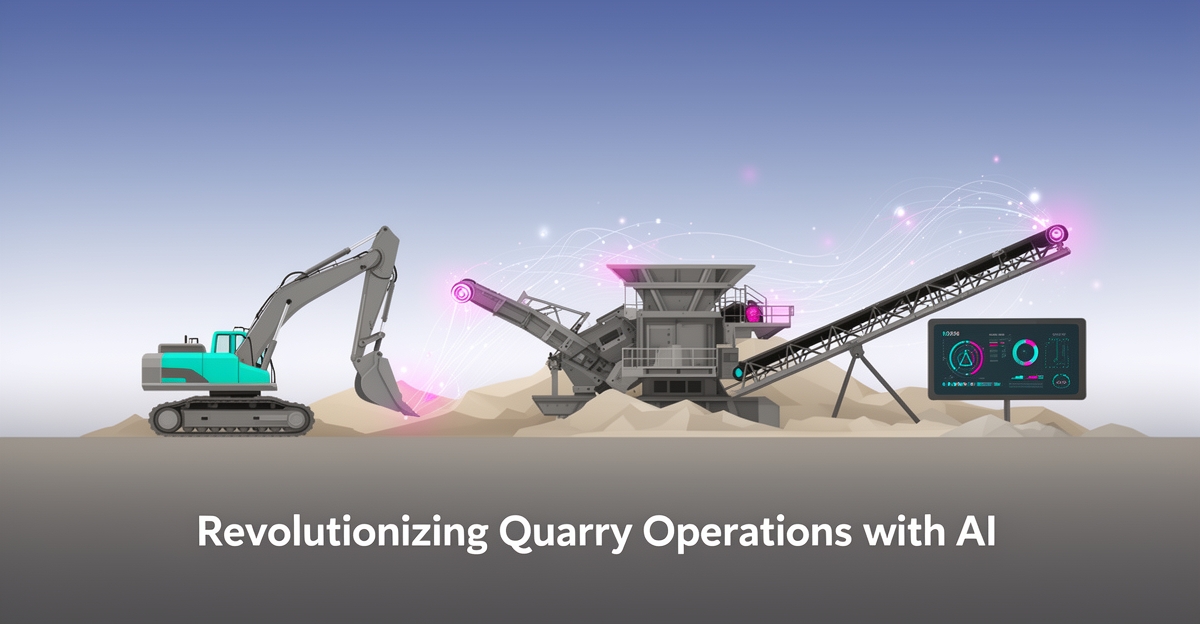
7 Ways AI Can Reduce Downtime in Quarry Operations
Key Facts
- AI adoption among small and mid-sized industrial firms still lags well behind large enterprises, typically due to infrastructure and expertise constraints
- Lack of relevant expertise remains one of the most commonly cited barriers to enterprise AI adoption
- Predictive maintenance relies on continuous vibration, temperature, and pressure data from critical machinery
- AI failure forecasting can surface anomalies days or weeks before mechanical breakdown
- Edge-friendly, cloud-light monitoring suits quarry sites with limited connectivity and power
Hire a team member that works 24/7 — for less than a part-time wage.
AI receptionists, SDRs, dispatchers and 99+ roles. Trained on your business, fully managed.
Not sure where to start? Ask our AI planner
The Cost of Downtime: Why Quarries Need Proactive Solutions
Unplanned equipment downtime in quarry operations carries a steep financial and operational toll, turning routine maintenance into a crisis when machinery fails unexpectedly. Reactive approaches not only halt production but also inflate repair costs and introduce safety hazards that can ripple across the entire site. This pattern of addressing problems only after they occur creates a costly cycle of lost productivity and rushed fixes that undermine long-term efficiency.
Adoption data consistently shows that small and mid-sized enterprises lag behind large firms in AI use, highlighting a significant gap among the very operations that dominate the quarry sector—where limited resources often delay investment in proactive solutions. This low adoption rate leaves many quarries dependent on manual inspections and scheduled maintenance that fails to catch emerging issues in time, resulting in preventable breakdowns during peak production periods.
The consequences extend beyond immediate repair bills. Unplanned downtime disrupts workflow synchronization, delays material processing, and strains labor resources as teams scramble to respond to emergencies. These inefficiencies compound over time, eroding profitability and increasing wear on equipment that operates under stress after a failure. Without real-time visibility into machine health, quarries remain vulnerable to cascading failures that could have been avoided with earlier intervention.
AIQ Labs addresses this challenge by building automation systems that monitor equipment health and optimize maintenance schedules—shifting operations from reactive to proactive models. By integrating sensor data with intelligent analytics, these systems enable quarries to anticipate failures before they occur, reducing the frequency and duration of unplanned stops. This approach not only protects output but also extends asset life and improves safety by minimizing emergency interventions in high-risk environments.
- Reduced production output during critical processing windows
- Emergency repair costs that typically far exceed planned maintenance
- Increased safety risks from rushed troubleshooting in hazardous zones
- Shortened equipment lifespan due to stress-induced wear after failures
- Delayed project timelines affecting client commitments and revenue flow
The shift from reactive to proactive maintenance isn’t just about avoiding downtime—it’s about redefining operational resilience. When quarries can predict and prevent failures, they gain control over scheduling, parts inventory, and labor allocation, transforming maintenance from a cost center into a strategic advantage. This foundation sets the stage for AI-driven solutions that don’t just fix problems but prevent them from arising in the first place.
How AI Transforms Maintenance: From Reactive to Predictive
AIQ Labs transforms maintenance from reactive to predictive by leveraging AI to analyze sensor data, monitor equipment in real time, and forecast failures before they occur—directly addressing the costly downtime that plagues quarry operations. As larger enterprises adopt AI at a much higher rate, the shift toward intelligent maintenance is no longer optional but essential for staying competitive in heavy industry. This approach enables quarry operators to move beyond fixed schedules and emergency repairs, instead using data-driven insights to service equipment only when needed, maximizing uptime and extending asset life.
Predictive maintenance systems rely on continuous streams of vibration, temperature, and pressure data collected from critical machinery such as crushers, conveyors, and loaders. By applying machine learning models to this data, AI can detect subtle anomalies that precede mechanical failure—often days or weeks in advance. These models improve over time as they learn from historical failure patterns, allowing quarries to anticipate issues like bearing wear, misalignment, or hydraulic degradation before they lead to unplanned breakdowns. The result is a maintenance strategy that is both proactive and precise, reducing unnecessary servicing while preventing catastrophic failures.
Real-time monitoring enhances this capability by providing instant visibility into equipment health across the quarry site. AI-powered platforms aggregate data from IoT sensors and compare it against baseline performance thresholds, triggering automated alerts when deviations occur. Maintenance teams receive actionable notifications—such as rising motor temperatures or abnormal vibration frequencies—allowing them to intervene during planned downtime rather than responding to sudden stoppages. This shift not only reduces mean time to repair but also improves safety by minimizing the need for emergency interventions in hazardous environments.
Failure forecasting takes this a step further by predicting not just that a component will fail, but when and how—enabling smarter parts procurement and technician scheduling. For example, if AI forecasts a conveyor belt degradation in 72 hours, maintenance can be scheduled during a low-production window, with the correct replacement part staged and the right crew assigned. This level of foresight transforms maintenance from a cost center into a productivity driver. AIQ Labs builds these capabilities directly into quarry workflows through [AI Workflow Builds](/workflow-builds), ensuring that machine health data flows seamlessly into maintenance planning and execution.
- Analyzes sensor data to detect early signs of equipment wear
- Triggers automated alerts before failures occur
- Optimizes maintenance scheduling based on real-time conditions
- Reduces unplanned downtime through failure forecasting
- Extends equipment lifespan by preventing avoidable damage
By anchoring maintenance decisions in continuous data analysis rather than fixed intervals or guesswork, quarries achieve higher reliability, lower operational costs, and improved safety—all critical factors in sustaining productivity in demanding extractive environments. This predictive approach, powered by AI, represents a fundamental upgrade from traditional maintenance models, turning equipment uptime from a variable outcome into a measurable, controllable asset.
Implementing AI in Quarry Operations: Practical Steps for SMBs
Quarry SMBs can’t afford downtime, yet most are still reacting to failures instead of preventing them. A practical AI rollout starts with readiness, not hype, and scales only after proving value on the most critical assets.
Start with an honest assessment of current equipment, maintenance practices, and data availability. Adoption surveys consistently show small enterprises using AI at a fraction of the rate of medium and large firms. That gap reflects infrastructure and expertise constraints that SMBs must address early.
Infrastructure readiness matters before any model is built. Power and connectivity limits are real constraints for high-demand AI scenarios. For a quarry, this means prioritizing edge-friendly monitoring and cloud-light analytics that run reliably on existing site power and connectivity.
Sensor deployment should be targeted, not blanket. Install IoT devices on high-impact machines to capture vibration, temperature, pressure and operational parameters. This creates the real-time data stream needed for predictive maintenance and workflow automation, while keeping initial costs manageable.
Data integration is the bridge between sensors and decisions. Connect equipment monitoring with maintenance management, production scheduling and inventory systems so alerts become work orders automatically. True ownership of custom-built systems avoids vendor lock-in and lets SMBs control future development—a core principle in every [AI Operating System](/ai-operating-systems) AIQ Labs delivers.
Model development begins small and learns continuously. Build predictive models from historical and real-time data to forecast failures and performance degradation, then validate predictions against actual outcomes. Gradual scaling reduces risk and builds operator trust, which is essential when lack of relevant expertise remains one of the most commonly cited barriers to AI adoption.
Workflow automation closes the loop. Use AI to optimize maintenance scheduling around production windows, parts availability and technician capacity, and to automate alerts that notify crews before issues become critical. AIQ Labs builds custom automation systems that monitor machine health and optimize maintenance schedules for this exact use case.
A practical SMB rollout follows a contained sequence:
- Assess current state and pick one critical workflow for a pilot
- Deploy sensors and establish secure data collection and storage
- Integrate AI predictions with existing maintenance and operations tools
- Train personnel to interpret alerts and refine models over time
- Scale to additional equipment after proving uptime and ROI
This step-by-step path aligns with [AI Workflow Builds](/workflow-builds), [AI Employees](/ai-employees) and [AI Operating Systems](/ai-operating-systems), letting quarry teams move from reactive repairs to proactive uptime with systems they own and can expand over time.
Still paying for 10+ subscriptions that don’t talk to each other?
We build custom AI systems you own outright. No vendor lock-in. Full control.
Not sure where to start? Ask our AI planner
Frequently Asked Questions
How can AI reduce unplanned downtime in quarry operations?
Is AI adoption common in small quarry businesses?
What are the main barriers to implementing AI in quarry operations?
Can AI help with maintenance scheduling in quarries?
What kind of data do AI systems use to predict equipment failures in quarries?
Does AI extend the lifespan of quarry equipment?
From Reactive Repairs to Resilient Operations
Unplanned downtime in quarry operations is a compounding problem — lost output, emergency repair costs, safety exposure, and shorter asset life. The article shows how AI shifts that pattern from reactive firefighting to predictive control through real-time sensor monitoring, failure forecasting, and maintenance scheduling that aligns with production windows. For SMBs, the path is practical: assess critical assets, deploy targeted IoT monitoring, integrate alerts with maintenance and inventory systems, and scale after proving uptime and ROI. The adoption gap between small and large firms reflects infrastructure and expertise constraints that can be closed with edge-friendly, owned systems. AIQ Labs builds custom automation that monitors machine health and optimizes maintenance schedules, helping quarries turn uptime into a measurable asset. Start with a focused pilot on your highest-impact workflow and map the ROI. Take the 2-minute Fit Check at [aiqlabs.ai/apply](/apply) for a free 30-minute strategy call to identify your first high-ROI automation opportunity.
Make AI your competitive advantage — not just another tool.
Strategy, implementation and ongoing optimization. One partner, end to end.
Not sure where to start? Ask our AI planner