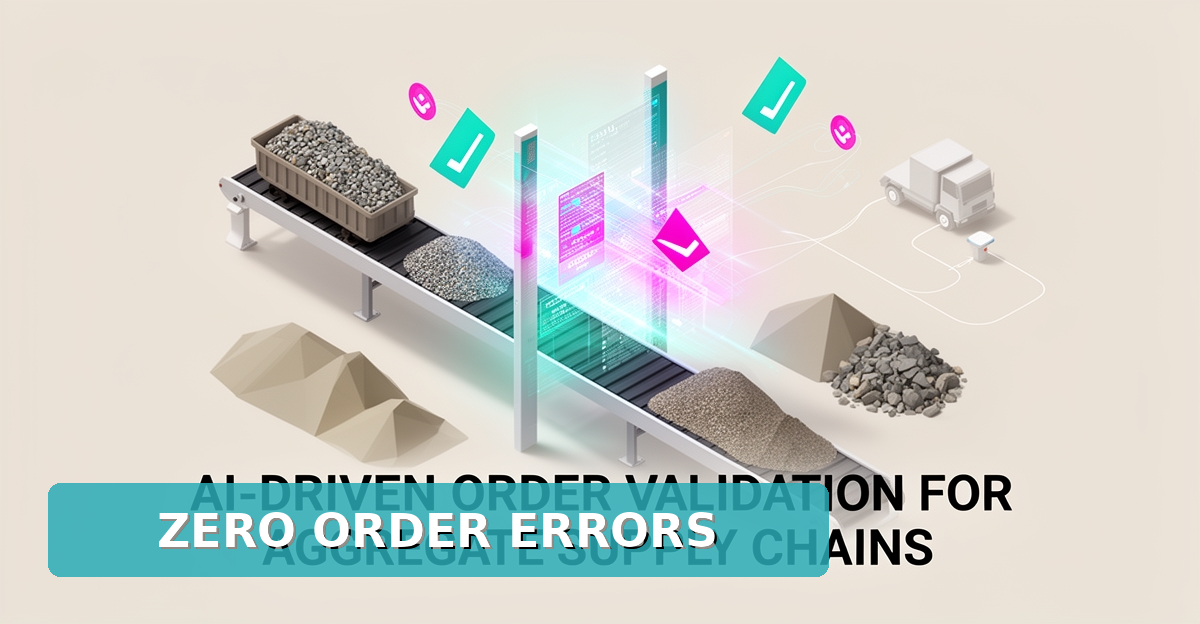
7 Ways AI Can Reduce Order Processing Errors in Aggregate Supply Chains
Key Facts
- Industry analyses of AI order management commonly report cost reductions in the 35-45% range and accuracy above 95% according to Artsyl Tech
- A large majority of procurement teams using AI report fewer compliance errors — LinkedIn's procurement research cites 91% per LinkedIn research
- LinkedIn's research also reports that most teams using AI in procurement see faster supplier onboarding — cited at 67%
- Most companies now use automation to standardize daily workflows — cited at 76% per DocuClipper
- 62% of companies report three or more major process inefficiencies solvable by automation per DocuClipper
- Artsyl Tech reports AI order management can improve customer satisfaction scores by 30-40% in the first year according to Artsyl Tech
- AI demand forecasting accuracy is commonly reported in the 92-97% range per industry analysis
Hire a team member that works 24/7 — for less than a part-time wage.
AI receptionists, SDRs, dispatchers and 99+ roles. Trained on your business, fully managed.
Not sure where to start? Ask our AI planner
The Hidden Cost of Order Errors in Gravel and Aggregate Supply
A single wrong digit in a gravel order can send 20 tons of aggregate to the wrong site, triggering a cascade of costs that erode already thin margins. For dispatch and procurement teams in aggregate supply chains, manual order processing remains one of the most persistent sources of operational risk.
The scale of the problem is significant. According to workflow automation research from DocuClipper, 62% of companies report three or more major process inefficiencies that could be solved through automation. In aggregate supply, those inefficiencies show up as miskeyed quantities, incorrect delivery addresses, and mismatched product specifications.
Manual data entry sits at the heart of most order errors. When dispatch teams re-key information from emails, phone calls, and paper tickets into multiple systems, every touchpoint introduces a new opportunity for mistakes. As Andrew Zhyvolovych, CEO of Precoro, has put it: "AI doesn't replace procurement professionals. It replaces the 15-20 hours per week your team wastes on manual data entry, chasing approvals, reconciling invoices, updating spreadsheets, and generating reports."
The downstream consequences of these errors extend well beyond a single bad delivery:
- Misdelivers and redelivery costs — sending the wrong material or wrong quantity means return trips, wasted fuel, and idle crews
- Compliance failures — incorrect documentation can trigger regulatory issues, especially on government or infrastructure projects
- Damaged client relationships — contractors relying on just-in-time aggregate deliveries lose trust when orders arrive wrong or late
- Invoice disputes — mismatched order and delivery records create billing friction that delays payment
The compliance dimension deserves particular attention. Research compiled by LinkedIn on AI in procurement found that 91% of teams using AI report fewer compliance errors — a figure that underscores just how error-prone manual validation processes are by comparison.
Consider what happens when order validation depends entirely on human review. Dispatchers must cross-reference contract terms, pricing tiers, credit availability, and delivery windows for every order. Under time pressure, corners get cut. A report from Artsyl Tech reports that AI-powered order management achieves cost reductions of 35-45% and pushes order accuracy above 95% — numbers that highlight the gap between manual and automated workflows.
The financial bleed is often invisible until it compounds. Each misdelivered load might cost a few hundred dollars in fuel and labor. Multiply that across dozens of weekly orders, add the administrative hours spent reconciling discrepancies, and the annual impact becomes substantial. Yet many aggregate suppliers accept this as a cost of doing business.
It doesn't have to be. AIQ Labs builds AI Workflow Builds that integrate directly with existing dispatch and procurement systems, automatically validating orders against contract terms and flagging inconsistencies before a truck ever leaves the yard. The technology exists today to catch these errors at the source.
How AI Detects, Validates and Auto-Corrects Gravel Orders
A single misplaced decimal on a gravel order can cascade into a misdelivered load, a stalled construction schedule, and a costly reconciliation process. In aggregate supply chains, where orders move quickly and margins are tight, the margin for error is effectively zero — and that is precisely where AI earns its place.
At the core of AI-driven order processing is its ability to detect inconsistencies that human reviewers routinely miss. AI systems scan incoming gravel orders against contract terms, historical patterns, and supplier data simultaneously, flagging mismatches in pricing tiers, quantities, or delivery specifications before a truck ever leaves the yard. According to procurement research, 91% of teams using AI report fewer compliance errors — a figure that speaks directly to the validation power these systems bring to high-volume order environments.
Validation goes beyond simple error-checking. AI cross-references each delivery request against contract terms, applies the correct pricing tier, and confirms credit availability automatically. This removes the manual bottleneck that slows down order confirmation and introduces the kind of fatigue-driven mistakes that accumulate over a busy season. The result is a workflow that is both faster and measurably more accurate than manual processing alone.
The auto-correction capability is where AI moves from passive flagging to active resolution. When the system identifies a data error — a wrong unit of measure, an outdated price, a duplicated line item — it can correct the entry in real time, route the corrected order forward, and log the change for audit purposes. According to Artsyl Tech, AI order management achieves order accuracy improvements exceeding 95% alongside reported cost reductions of 35-45%.
The practical applications across a gravel supply operation are broader than most operators initially expect:
- Automating routine tasks like data entry, invoice checks, and supplier onboarding to free staff for higher-value work
- Analyzing contracts and supplier data to surface hidden risks before they affect the budget
- Generating demand forecasts with accuracy rates commonly reported in the 92-97% range, according to industry analysis
- Providing real-time order status updates that enable proactive customer communication
That last point carries more weight than it might appear. Customer satisfaction in aggregate supply depends heavily on reliability and communication. AI systems that flag a potential delay or discrepancy early enough to notify the customer before the delivery window closes are doing something no manual process can sustain at scale. According to Artsyl Tech, AI order management can improve customer satisfaction scores by 30-40% within the first year of deployment.
AIQ Labs builds these kinds of tailored workflows to operate within existing procurement and dispatch systems — not as a replacement for the tools a business already runs, but as an intelligent layer that connects and validates across them. The goal is a system where errors are caught at intake, corrected automatically, and logged for review, without adding headcount or slowing throughput.
The aggregate industry has long accepted a baseline level of order error as a cost of doing business. AI makes that assumption worth revisiting.
Proven Impact: Accuracy, Cost and Compliance Gains
When AI is applied to order management, the gains are not marginal. Industry analyses report that AI-powered order processing can achieve order accuracy improvements exceeding 95% and cost reductions of 35-45%, while also reducing compliance errors and accelerating supplier onboarding.
These improvements come from replacing manual, error-prone processes with intelligent systems that validate, correct, and optimize every order. In aggregate supply chains, where a single misdelivery can cost thousands, this level of precision is a competitive advantage.
According to industry analysis, AI order management delivers measurable impact across multiple dimensions:
- Order accuracy improvements exceeding 95% — AI validates orders against contract terms, pricing tiers, and credit availability in real time.
- Cost reductions of 35-45% — Automation eliminates manual data entry, reduces errors, and speeds up processing cycles.
- 91% of teams report fewer compliance errors — AI cross-checks orders against regulatory and contractual requirements automatically.
- 67% of teams report faster supplier onboarding — AI streamlines documentation, validation, and approval workflows.
- Customer satisfaction scores improve by 30-40% — Real-time order tracking and proactive communication reduce disputes and delays.
These are not theoretical projections. They reflect real-world deployments where AI handles the repetitive, rules-based work that humans find tedious and error-prone.
The difference between traditional and AI-driven order processing is stark. Manual processing relies on human oversight, which is slow and prone to mistakes—especially when dealing with high volumes of gravel orders, delivery schedules, and supplier terms.
Automated systems improve speed and consistency, but they follow rigid rules and cannot adapt to exceptions or learn from patterns. AI-powered processing, by contrast, is intelligent, predictive, and proactive. It detects anomalies, flags risks, and auto-corrects errors before they become costly problems.
For example, AI can analyze thousands of supplier contracts to identify terms that historically led to disputes, according to procurement experts. This capability alone can prevent compliance issues and renegotiation headaches down the line.
In aggregate supply chains, where orders involve bulk materials, tight delivery windows, and complex logistics, AI's ability to validate and optimize every transaction is invaluable. A single misdelivery of gravel or sand can disrupt construction timelines and damage client relationships.
AIQ Labs has seen firsthand how custom AI workflows can transform order processing — the company has deployed 200+ multi-agent systems and runs four live SaaS products daily. By integrating AI into existing procurement and dispatch systems, businesses reduce errors, cut costs, and improve supplier and customer satisfaction—all without replacing their current infrastructure.
The result is a supply chain that operates with greater precision, agility, and confidence. AI does not just reduce errors; it creates a foundation for scalable, sustainable growth.
Implementation Roadmap for Aggregate Operations
Aggregate supply chains live or die on clean orders, yet manual handoffs between procurement and dispatch create costly misdelivers. A practical roadmap turns AI from concept into daily error prevention without ripping out existing systems.
Start with data quality foundations before any model goes live. Aggregate operations run on spreadsheets, legacy ERPs, and phone notes, so validation rules and master data cleansing are essential. Workflow automation statistics show 76% of companies use automation to standardize daily workflows, and 62% report three or more major process inefficiencies that could be solved through workflow automation. Clean source data lets AI detect inconsistencies and auto-correct gravel orders reliably.
Next, map the procurement to dispatch journey and identify high-error touchpoints. Order entry, contract pricing tiers, credit checks, and delivery instructions are typical failure points. AI can automate routine tasks such as data entry and invoice checks, freeing staff for strategic work. According to industry research, 58% of organizations automate reporting and planning processes to improve decision-making with real-time data.
Workflow integration should be incremental and API-first. AI layers on top of existing procurement and dispatch systems to validate delivery requests in real time, flag mismatches against contract terms, and suggest corrections before dispatch. AI order management can achieve average cost reductions of 35-45% and order accuracy improvements exceeding 95%, according to AI in order management analysis. This is where tailored AI workflows matter.
Change management determines adoption. Teams need clear ownership, simple interfaces, and transparent guardrails so AI acts as augmentation, not replacement.
A phased rollout for aggregate operations typically includes:
- Data audit and cleansing: standardize product codes, customer sites, and contract pricing
- Pilot on one lane or product: deploy validation AI for gravel orders with human-in-the-loop review
- Integrate with procurement and dispatch tools via API for automated validation and auto-correct
- Train dispatchers and buyers on exceptions handling and feedback loops
- Scale across sites with monitoring, KPI dashboards, and continuous retraining
AIQ Labs structures deployment around three entry points: AI Employees (managed AI staff — including dispatchers and order-validation roles — at roughly 80% less cost than a human hire, Start Monthly), AI Workflow Builds (rebuild the one workflow that costs you the most, fixed price, built in milestones), and AI Operating Systems (one connected operating layer, built in phases, owned outright). For most aggregate operations, the order-to-dispatch workflow is the natural first build.
Procurement teams already see compliance gains from AI. LinkedIn procurement insights report 91% of teams using AI in procurement report fewer compliance errors. Embedding those controls early reduces misdelivers, protects margins, and builds trust with customers.
Still paying for 10+ subscriptions that don’t talk to each other?
We build custom AI systems you own outright. No vendor lock-in. Full control.
Not sure where to start? Ask our AI planner
Frequently Asked Questions
How much can AI actually reduce order processing errors in our aggregate supply chain?
Will implementing AI require replacing our current dispatch and procurement systems?
What specific compliance benefits does AI provide for government and infrastructure projects?
How long does it take to see results from an AI order processing implementation?
What's the real cost of an AI Employee for order processing compared to hiring a human dispatcher?
How does AI handle the messy, unstructured order data we get from emails, phone calls, and paper tickets?
From Error-Prone Orders to Predictable Margins
Aggregate supply chains have long accepted misdelivers, invoice disputes and compliance slips as a cost of doing business, but the data shows manual order processing is no longer sustainable. AI can detect inconsistencies at intake, validate orders against contract terms, pricing tiers and credit in real time, and auto-correct errors before a truck leaves the yard — industry analyses commonly report accuracy above 95% and cost reductions of 35-45%. The shift is from reactive cleanup to proactive prevention, freeing dispatch and procurement teams from 15-20 hours per week of manual re-keying and reconciliation. For operations ready to move forward, start with clean master data, map high-error touchpoints like pricing and delivery instructions, and pilot validation AI on one lane with human-in-the-loop review. AIQ Labs builds tailored workflows — from a single AI dispatcher to a full AI Operating System — that layer onto existing procurement and dispatch systems to catch errors at source without replacing your infrastructure. Start the 2-minute Fit Check to book a free 30-minute strategy call and map your biggest bottleneck.
Make AI your competitive advantage — not just another tool.
Strategy, implementation and ongoing optimization. One partner, end to end.
Not sure where to start? Ask our AI planner