7 Ways AI Can Reduce Staff Burnout in High-Traffic Laser Tag Arenas
Key Facts
- Surveys in recent years have found that a large majority of employees—often cited around 77%—report experiencing burnout at their current job according to widely referenced Deloitte survey data
- Research suggests frequent AI users can experience notably higher burnout rates than infrequent or non-users when adoption is poorly managed according to Forbes
- Burnout has been estimated to cost the global economy hundreds of billions of dollars annually in lost productivity and turnover per Gallup estimates
- Survey data indicates roughly half of burned-out employees are actively planning to quit their jobs per Deloitte survey data
- Highly burned-out workers are significantly more likely—some research suggests more than twice as likely—to search for new employment per Forbes research
- In one cited trial, AI-driven burnout prediction increased daily breaks from 1.8 to 2.5 as shown in a TechClass study
- A substantial share of employees say AI has improved their access to workplace support per Spring Health's workplace mental health reporting
Hire a team member that works 24/7 — for less than a part-time wage.
AI receptionists, SDRs, dispatchers and 99+ roles. Trained on your business, fully managed.
Not sure where to start? Ask our AI planner
The Burnout Crisis Behind the Arena Counter
The hum of excited players, the clatter of vests, and the rapid-fire check-ins at the counter paint a familiar picture for any high-traffic laser tag arena. Behind this energetic facade, however, lies a structural challenge: young, part-time staff are often expected to juggle guest registration, real-time score tracking, equipment safety checks, and party hosting—all simultaneously. This constant context-switching and cognitive load is a primary driver of burnout, a crisis reflected in stark industry data. Surveys have found that a large majority of employees—often cited around 77%—report experiencing burnout at their current job, a state so debilitating that Gallup estimates it costs the global economy hundreds of billions of dollars annually in lost productivity and turnover. For laser tag arenas, this isn't a seasonal staffing hiccup; it's a systemic issue, with roughly half of burned-out employees actively planning to quit their jobs.
This turnover cycle erodes operational consistency and inflates training costs, directly impacting the guest experience and safety standards. The problem isn't just the volume of tasks, but their nature—many are repetitive, administrative duties that drain energy without leveraging staff strengths in customer engagement or gameplay facilitation. When employees spend their shifts manually entering waiver data or reconciling scores instead of monitoring play zones or ensuring equipment integrity, their sense of efficacy diminishes. Research shows that feeling ineffective—a core component of burnout—is a powerful predictor of turnover, with highly burned-out workers being significantly more likely to search for new employment. Addressing this requires shifting staff focus from transactional busywork to higher-value, safety-critical interactions.
AIQ Labs approaches this challenge by targeting the root cause: the manual workflows that fragment staff attention and accelerate fatigue. Through fixed-price AI Workflow Builds, arenas can rebuild the one workflow that costs the most—whether that's digital guest check-in, automated score aggregation, or equipment usage logging—and reclaim significant portions of their team's cognitive bandwidth. This isn't about replacing staff with machines; it's about strategically deploying AI as a capacity tool to handle the predictable, rule-based processes that contribute most to mental exhaustion. When implemented with clear norms and employee involvement—framing AI as a learning aid rather than a performance mandate—this automation directly attacks the exhaustion and inefficacy dimensions of burnout. The goal is to return staff to what they do best: creating a safe, fun, and well-managed environment where players can focus on the game, not the logistics.
The AI Paradox: Why Automation Can Help or Hurt
Artificial intelligence in the workplace presents a critical paradox: it can both alleviate and intensify staff burnout, depending entirely on how it is deployed. For high-traffic laser tag arenas, this nuance is essential—AI might automate tedious score tracking, yet simultaneously create new cognitive demands if not implemented with care. Research suggests frequent AI users can experience substantially higher burnout rates than infrequent or non-users, highlighting the risks of unthoughtful adoption according to Forbes. Yet, in a contrasting trial, organizations using AI specifically for burnout prediction reduced emotional exhaustion and increased daily breaks from 1.8 to 2.5 as shown in a TechClass study.
This divergence underscores that outcomes hinge on implementation strategy. When AI functions as a "capacity tool"—automating draining tasks like guest registration or equipment monitoring—it frees staff to focus on meaningful work such as gameplay supervision and safety checks. Conversely, if AI operates as a mere "productivity engine," it can introduce scope creep, constant output monitoring, and a sense of inefficacy where employees question their value as noted in Psychology Today. The shift from "doing" to "monitoring" creates cognitive strain, often termed "AI brain fry," as staff vigilantly validate outputs instead of engaging directly per HRD Connect.
Successful integration requires treating AI as a learning challenge, not a performance mandate. Leaders must establish clear norms for use, provide ongoing training, and foster psychological safety so teams feel empowered to adapt. In laser tag arenas, where staff often span Gen Z and millennial generations, addressing underlying anxieties about job stability while emphasizing purpose becomes vital per Great Place To Work. Ultimately, AI's impact on well-being is not inherent to the technology itself but shaped by whether it restores employee agency or erodes it through relentless optimization. For AIQ Labs, this means designing workflows that prioritize human experience—ensuring automation serves as a support, not a substitute, for judgment and care.
7 AI Workflows That Give Your Staff Their Energy Back
In high-traffic laser tag arenas, staff burnout often stems from repetitive administrative tasks that drain energy before a single game even begins. By automating these workflows with AI, arenas can shift staff focus back to gameplay, safety, and guest experience—where human judgment and connection matter most. When implemented thoughtfully, AI becomes a capacity tool that restores employee energy rather than just a productivity engine.
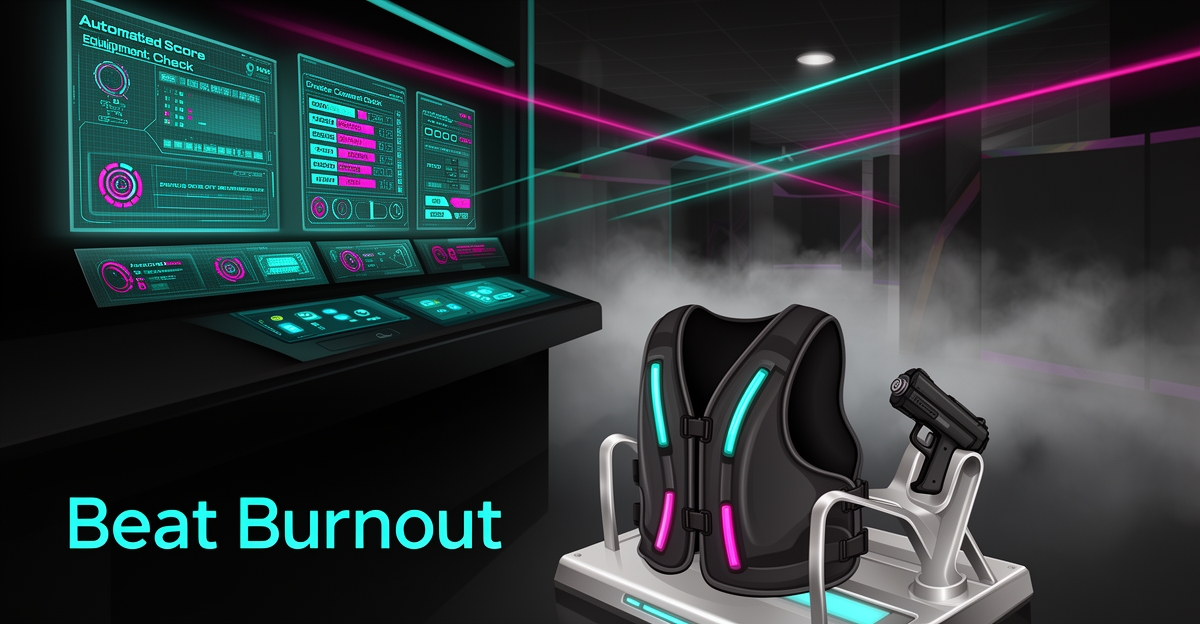
AI-powered guest registration and waiver intake eliminate manual data entry during peak hours, reducing front-desk congestion and letting staff greet players personally. Automated score tracking and leaderboards remove the need for constant manual updates, freeing referees to monitor gameplay safety instead of chasing scores. Equipment monitoring systems with predictive maintenance alerts prevent gear failures mid-session, cutting down on reactive troubleshooting that interrupts flow and frustrates both staff and guests.
An AI receptionist—available as part of AIQ Labs' AI Employees service—handles booking calls 24/7, capturing party inquiries and waiver signatures without tying up phone lines, typically at a fraction of the cost of a human hire. AI-driven party coordination automates scheduling, reminders, and special requests—reducing the mental load of managing multiple moving parts. Staff scheduling optimization uses historical traffic data to align shifts with demand, preventing overstaffing lulls and understaffing rushes that lead to exhaustion. Finally, automated post-game follow-ups—like satisfaction surveys and loyalty prompts—run in the background, giving staff back time to reset between sessions instead of chasing feedback.
These workflows don't just save time; they address core burnout drivers. Research suggests employees who frequently use AI show higher burnout rates when the technology increases cognitive load or monitoring duties, but when AI removes repetitive work, it directly combats exhaustion—a key dimension of burnout affecting a large share of employees. By focusing AI on tasks that don't require human judgment—like data entry, scorekeeping, and routine follow-ups—arenas create space for staff to engage in meaningful work that uses their creativity and care, which is linked to lower burnout and higher retention.
When AI is introduced as a learning tool rather than a performance mandate, and when staff are involved in shaping how it's used, it builds agency and self-efficacy—critical factors in preventing the "Why bother?" mentality that erodes purpose. In a laser tag arena, where split-second safety calls and genuine guest interactions define the experience, freeing staff from administrative busy work isn't just efficient—it's essential for sustaining a team that's present, energized, and ready to play.
Implementing AI Without Creating New Stress
The most dangerous moment in an AI rollout isn't when the technology fails—it's when your team starts believing the technology matters more than they do. A 2024 study published in Nature supports this: AI adoption doesn't directly cause burnout, but it fuels job stress, which does. The difference between relief and exhaustion lies entirely in your implementation approach.
Start by framing the rollout as experimentation, not a performance mandate. When arena staff view AI as a skill they're developing rather than a test they're failing, you build the self-efficacy in AI learning that the Nature research identifies as a critical buffer against stress. This means training sessions where it's safe to say "I don't know how this works yet," and leadership that models fallibility by sharing their own missteps with the new systems.
Next, draw a hard line around human judgment. In a high-traffic laser tag environment, AI should handle score tracking, equipment diagnostics, and waiver processing—but safety calls, conflict resolution between players, and gameplay rulings must remain non-negotiable human territory. Research from Spring Health emphasizes that defining these boundaries prevents the "monitoring shift," where staff burn out from constantly supervising AI outputs instead of engaging with guests.
Address the elephant in the room directly: job security. According to Great Place To work data, most employees feel hopeful about AI's opportunities, but that optimism crumbles without transparency. For Gen Z staff—who often fill arena roles—acknowledge their anxiety about being replaced while emphasizing that AI handles the repetitive tasks that drain energy, freeing them for the high-value guest interactions that actually require emotional intelligence.
Avoid these implementation pitfalls:
- Treating AI as a surveillance tool rather than a support system
- Allowing the "infinite workday" where faster turnarounds simply mean more tasks
- Mandating adoption without providing learning time or psychological safety
- Measuring success only by output volume instead of employee efficacy
The goal is preventing what Psychology Today describes as "inefficacy"—the sense that your work doesn't matter because a machine does it faster. When AIQ Labs designs workflow automation for entertainment venues—whether a single Workflow Build or a full AI Operating System—we build in these human checkpoints from day one, ensuring that technology absorbs the administrative friction while your team retains the judgment calls that make the work meaningful.
Your First Step: Map the Draining Work
Before implementing any solution, you need to see exactly where your team's energy is leaking. In high-traffic laser tag arenas, staff burnout often stems not from the excitement of gameplay but from repetitive, high-friction workflows that pile up during peak hours. Survey data suggests a large majority of employees report experiencing burnout at their current job, with roughly half of those intending to leave—a costly cycle for venues reliant on consistent, engaged teams. Start by auditing which tasks drain staff most: Is it the registration queue backing up on Saturday afternoons? Constant phone calls for last-minute bookings? Or the meticulous, time-consuming equipment checks between rounds? Pinpointing these pain points reveals where automation can restore capacity, not just speed up output.
Choose one high-friction workflow to automate first—perhaps guest registration, which involves manual data entry, waiver signing, and payment processing during rush periods. Automating this single touchpoint frees staff to focus on safety briefings, gear fitting, and real-time gameplay support, directly addressing the exhaustion dimension of burnout. Measure the impact not just in throughput gains, but in well-being: track reductions in overtime, increases in break-taking (as seen in trials where AI-driven burnout prediction raised breaks from 1.8 to 2.5 per day), and qualitative feedback on job satisfaction. This targeted approach ensures AI serves as a capacity tool, not just a productivity engine.
To identify your highest-ROI starting point with zero obligation, AIQ Labs offers a free 2-minute Fit Check followed by a free 30-minute strategy call. This working session maps your biggest bottlenecks and pinpoints where AI automation will most effectively reduce staff strain—no pitch, just clarity on your opportunity to build a sustainable, engaged team. Begin here: Start the Fit Check, then schedule your free strategy call.
Where AI Meets Human Energy: Building Teams That Stay and Thrive
The path to reducing burnout in laser tag arenas isn't about replacing staff with technology—it's about using AI to remove the repetitive, draining tasks that pull them away from what they do best: creating safe, engaging experiences for players. By automating workflows like guest registration, score tracking, and equipment monitoring, arenas can reclaim cognitive bandwidth for their teams, directly addressing the exhaustion and inefficacy that drive turnover. The key lies in thoughtful implementation: framing AI as a learning tool, preserving human judgment for safety-critical moments, and involving staff in the process to build agency and trust. When done right, this approach doesn't just improve well-being—it strengthens operational consistency, enhances guest satisfaction, and protects your investment in a motivated, present workforce. If you're ready to see where your team's energy is being drained and how AI can help restore it, start with a free, no-obligation Fit Check to map your biggest bottlenecks and identify high-impact automation opportunities—then schedule your 30-minute strategy call to turn insights into action.
Make AI your competitive advantage — not just another tool.
Strategy, implementation and ongoing optimization. One partner, end to end.
Not sure where to start? Ask our AI planner