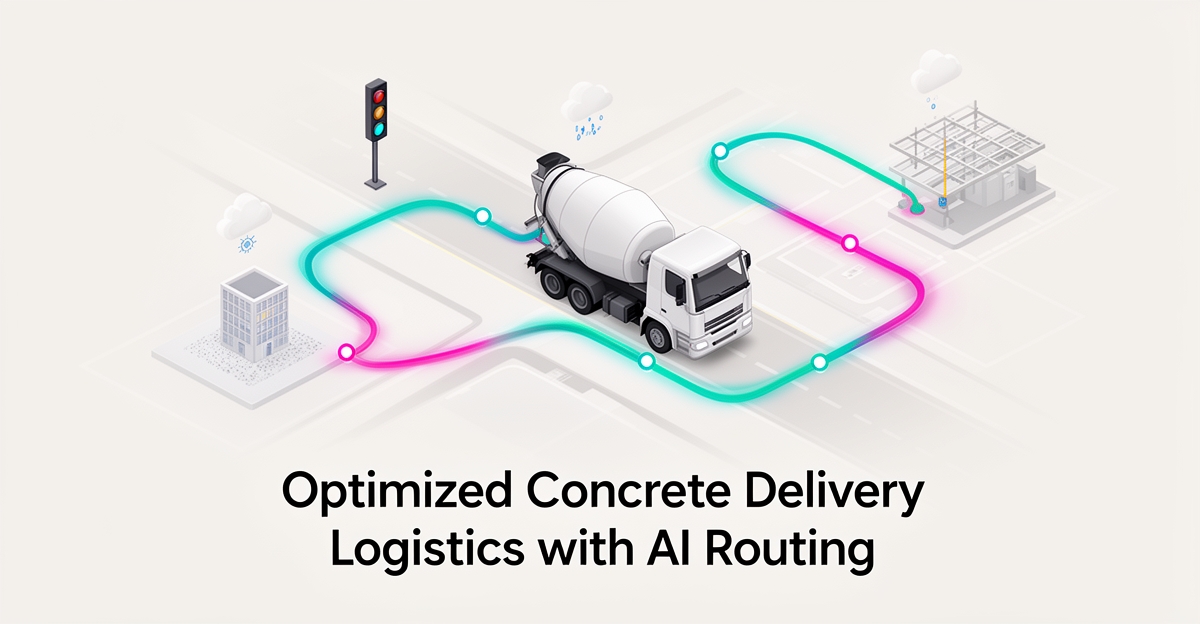
7 Ways AI Can Streamline Delivery Scheduling for Ready-Mix Concrete Operations
Key Facts
- AI can reduce empty miles through continuous route re-optimization as traffic and pour times change
- AI enables real-time schedule updates that propagate to drivers and plants when weather or site conditions shift
- Fuel typically represents 20-30% of total delivery costs in ready-mix operations, making route efficiency a direct margin lever
- Concrete is time-sensitive: every minute beyond the optimal workability window risks rejected loads and rework
- Human oversight remains central—AI handles recalculations while dispatchers retain final authority on critical calls
Hire a team member that works 24/7 — for less than a part-time wage.
AI receptionists, SDRs, dispatchers and 99+ roles. Trained on your business, fully managed.
Not sure where to start? Ask our AI planner
The Hidden Cost of Manual Concrete Dispatching
The hidden cost of manual concrete dispatching begins long before a truck leaves the plant—it’s baked into every delay, detour, and decision made without real-time visibility. Traditional scheduling methods rely on static routes and reactive adjustments, leaving suppliers vulnerable to cascading inefficiencies that erode both margins and concrete quality. When unexpected traffic snarls or sudden weather shifts occur, dispatchers scramble to reroute trucks on the fly, often resorting to suboptimal paths that waste fuel and extend delivery windows. These aren’t just operational hiccups—they’re systemic flaws in a process designed for predictability in an inherently unpredictable industry.
The financial toll compounds quickly. Idling trucks burn through diesel while waiting for clearance at congested job sites, and longer routes directly inflate fuel consumption—a significant expense given that fuel typically represents 20-30% of total delivery costs in ready-mix operations. Beyond the pump, inefficient routing increases wear and tear on vehicles, accelerates maintenance cycles, and raises the risk of missed delivery windows that trigger penalties or damage client relationships. Perhaps most critically, every minute a truck spends in transit beyond the optimal workability window risks compromising concrete integrity, leading to rejected loads, rework, and reputational harm that far outweighs the immediate cost of a delayed pour.
These challenges are amplified by the industry’s narrow margin for error. Unlike goods that can withstand delays, concrete is a time-sensitive material where scheduling precision isn’t just about efficiency—it’s about structural integrity. Manual systems simply can’t process the volume of real-time variables—live traffic patterns, hyperlocal weather forecasts, plant load times, and job site readiness—at the speed required to make adaptive decisions. As a result, suppliers operate in a constant state of damage control, absorbing avoidable costs while struggling to maintain service reliability. This reactive posture not only strains resources but also limits scalability, trapping businesses in a cycle where growth demands more manual effort without proportional gains in throughput or quality.
Route Optimization & Resource Allocation
Ready-mix concrete lives and dies by the clock. A late load sets, a truck sits idle, and margins erode fast. AI changes that equation by turning traffic, weather, and pour data into optimal routes and smarter truck use in real time.
AI algorithms ingest live traffic patterns, job site locations, and current fleet availability to sequence deliveries dynamically. The system continuously re-ranks stops as conditions shift, balancing travel time against concrete workability windows. This adaptive routing reduces empty miles and matches truck capacity to pour requirements without manual dispatcher intervention.
Across logistics-heavy industries, automation is steadily moving from static planning tools toward systems that respond to live conditions. In concrete operations, that shift shows up as real-time responsiveness, optimized delivery routes, and predictive maintenance signals that keep trucks available when pours are scheduled.
Resource allocation becomes predictive rather than reactive. AI models forecast demand by job location, batch size, and historical pour curves, then pre-position trucks and drivers to minimize deadhead. When a site delays or weather changes, the workflow updates instantly across dispatch, drivers, and plant.
For ready-mix suppliers, the value of this approach typically appears as fewer late deliveries, lower fuel burn, and higher asset utilization—gains that compound every operating day rather than arriving as a one-time win.
AIQ Labs builds custom AI workflows for concrete suppliers that integrate with existing dispatch systems, reducing delays and fuel costs without requiring new hardware. This is the core of our [AI Workflow Builds](/workflow-builds) approach: identify the one workflow that costs you the most—in dispatch, that’s usually routing and rescheduling—then rebuild it in phases at a fixed price.
Typical gains from AI-driven routing and allocation include:
- Reduced empty miles through continuous route re-optimization as traffic and pour times change
- Better truck-to-pour matching that aligns drum capacity with job requirements and set times
- Real-time schedule updates that propagate to drivers and plants when weather or site conditions shift
- Improved fleet utilization by predicting availability and preventing bottlenecks at busy sites
The result is a dispatch system that responds to change faster than manual reprogramming allows—turning live data into decisions while the load is still in the drum, not after it’s been rejected at the site.
Dynamic Rescheduling & Predictive Weather Integration
A sudden downpour, a jackknifed truck on the interstate, or a site crew that is running two hours behind—any of these can turn a carefully planned concrete delivery schedule into chaos before the first mixer leaves the plant. The operations pulling ahead today are the ones whose systems react to these disruptions faster than a dispatcher can pick up the phone.
This is where adaptive automation separates itself from traditional scheduling. Rule-based dispatch software follows fixed logic and breaks the moment conditions change, while AI-driven systems continuously monitor weather forecasts, traffic incidents, and job site readiness signals, then recalculate routes and pour sequences on the fly. For ready-mix operations, that speed is not a luxury—concrete has a hard specification window, and every minute of delay risks a rejected load.
In practical terms for concrete suppliers, a dynamically rescheduling system can:
- Re-route trucks around traffic incidents in real time, protecting slump and temperature specs
- Delay or advance batching when weather forecasts shift, avoiding wasted loads
- Sequence deliveries around confirmed site readiness instead of static time slots
- Alert dispatchers only when a decision exceeds predefined thresholds, keeping humans in control
That last point matters more than most vendors admit. Across AI-assisted work, the pattern that holds up is human-in-the-loop: the AI handles the recalculations and humans retain final authority over critical calls. Dispatch is exactly that kind of environment—the system re-optimizes continuously, but a dispatcher signs off on anything that touches a customer commitment or a safety threshold.
The stakes of getting weather response wrong are enormous. For a concrete supplier, predictive weather integration means the system does not just react to rain—it anticipates it, adjusting pour schedules hours before conditions deteriorate and protecting loads that would otherwise be wasted.
AIQ Labs builds these capabilities as custom workflows that plug directly into existing dispatch systems, so suppliers gain real-time adaptive scheduling without replacing hardware or retraining their entire team. The result is fewer rejected loads, lower fuel spend, and deliveries that consistently arrive inside specification windows—even on the days when everything goes wrong.
Integrating AI with Existing Dispatch Infrastructure
Integrating AI with existing dispatch infrastructure doesn’t require a complete overhaul of current systems. Instead, custom AI workflows can layer onto legacy platforms through API connections and middleware, enabling adaptive automation without new hardware investments. This approach allows concrete suppliers to enhance scheduling intelligence while preserving familiar interfaces for dispatch teams—building intelligent systems on foundations that already work.
The transition from rule-based to AI-driven automation introduces responsiveness to real-time variables like traffic congestion, weather delays, and last-minute job changes. Unlike static scheduling tools, AI workflows continuously learn from operational data, adjusting routes and resource allocation dynamically. This adaptive capability supports smarter decision-making while reducing manual intervention, with human judgment remaining critical for exceptions and client communication.
Maintaining human oversight is essential during scaling, ensuring AI augments rather than replaces dispatcher expertise. Strategies include setting confidence thresholds for AI recommendations, enabling manual overrides, and using AI as a decision-support tool during peak hours or complex scenarios. This balance allows teams to focus on high-value interactions while routine scheduling is handled efficiently. AIQ Labs designs these integrations to align with existing workflows, supporting a smooth transition toward greater operational resilience. By connecting AI to current dispatch tools through secure APIs and custom adapters, suppliers gain predictive scheduling benefits without disrupting daily operations or requiring staff retraining on entirely new platforms. The result is a scalable, human-centered system that improves on-time deliveries and reduces fuel waste through intelligent, adaptive coordination.
Still paying for 10+ subscriptions that don’t talk to each other?
We build custom AI systems you own outright. No vendor lock-in. Full control.
Not sure where to start? Ask our AI planner
Frequently Asked Questions
Will AI replace my dispatchers or just make them faster?
Can AI scheduling work with the dispatch system we already use?
How much fuel and cost can we actually save with AI routing?
Does AI help with weather and last-minute site delays?
Is this a trend or are companies really automating dispatch now?
What kind of results do ready-mix suppliers see first?
Pour Precision Into Profit
Manual dispatching in ready-mix concrete is expensive because it can’t keep up with traffic, weather, site readiness and workability windows in real time. AI changes that by turning live data into continuously optimized routes, predictive resource allocation and dynamic rescheduling that protects concrete quality and margins. Suppliers who integrate adaptive automation with existing dispatch infrastructure gain fewer late deliveries, lower fuel burn and higher fleet utilization without replacing hardware or retraining teams. If you want to see where the biggest gains are in your network, start with a focused workflow assessment and map the bottlenecks that cost you loads and fuel. Start the 2-minute Fit Check at [aiqlabs.ai/apply](/apply) for a free 30-minute strategy call to identify high-ROI automation opportunities specific to your dispatch system.
Make AI your competitive advantage — not just another tool.
Strategy, implementation and ongoing optimization. One partner, end to end.
Not sure where to start? Ask our AI planner