AI Dispatcher for Field Service: A Complete Guide for Owner-Operators
Key Facts
- Industry reports suggest AI dispatchers can substantially reduce manual coordination time and eliminate human errors in route assignments according to Worldmetrics
- Workflow automation studies commonly report first-year productivity gains in the 30–40% range for full deployments per workflow automation research
- McKinsey has estimated AI-powered automation could add trillions in annual economic value across global industries per McKinsey
- A large majority of companies now use AI in at least one business function, per recent McKinsey State of AI surveys per McKinsey
- A growing share of organizations are experimenting with or scaling AI agents per McKinsey State of AI
- Forrester's TEI studies have documented strong multi-year ROIs for enterprises deploying workflow automation platforms per Forrester
- Workflow automation studies report average annual savings per organization in the tens of thousands of dollars per Formstack via Custom Workflows AI
Hire a team member that works 24/7 — for less than a part-time wage.
AI receptionists, SDRs, dispatchers and 99+ roles. Trained on your business, fully managed.
Not sure where to start? Ask our AI planner
The Hidden Cost of Manual Dispatching in Field Service
Owner-operators in field service often underestimate how much time and revenue manual dispatching silently drains from their operations. What feels like a necessary administrative task quickly becomes a bottleneck that limits growth and frustrates both technicians and customers.
According to industry research, a large share of coordination time in field service is consumed by manual scheduling, routing adjustments, and phone tag between dispatchers and techs. This inefficiency directly translates to delayed response times, missed service windows, and technicians spending more time waiting or driving than actually working. For owner-operators managing tight schedules and thin margins, every minute lost to dispatching errors is revenue left on the table.
Manual systems also lead to frequent routing errors and poor job matching, which increase fuel consumption and overtime costs while reducing first-time fix rates. Technicians end up backtracking, arriving late, or lacking the right parts because jobs weren't assigned based on real-time location, skill set, or inventory availability. These avoidable mistakes erode customer trust and increase the likelihood of negative reviews or canceled contracts.
The cumulative effect is significant underutilization of your most valuable assets—your technicians and vehicles. When dispatching relies on spreadsheets, whiteboards, or gut feeling, you're not optimizing for efficiency; you're reacting to chaos. Over time, this creates a ceiling on how many jobs you can realistically handle each day, no matter how hard your team works.
Operational studies show that poor scheduling alone can cost field service businesses thousands annually in lost productivity and avoidable expenses. For owner-operators wearing multiple hats, the hidden cost isn't just in wasted hours—it's in the growth opportunities you're forced to pass up because your dispatching system can't scale with demand.
By recognizing these inefficiencies as systemic rather than incidental, owner-operators can begin to see dispatching not as a chore to endure, but as a process ripe for transformation. The shift from manual to intelligent dispatching isn't just about saving time—it's about reclaiming control over your schedule, your resources, and your bottom line.
How AI Dispatchers Transform Field Service Operations
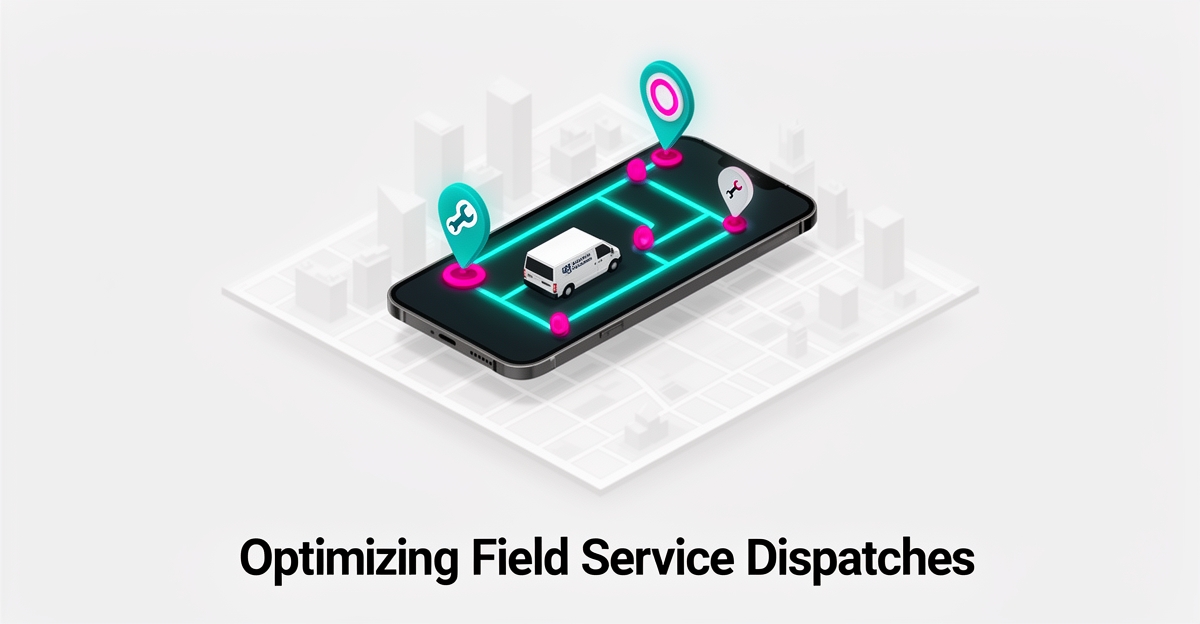
Owner-operators in field service know the daily juggling act of matching jobs to technicians, managing routes, and keeping customers informed—all while trying to grow the business. This constant manual coordination not only consumes valuable time but also introduces errors that impact service quality and profitability. An AI dispatcher transforms this reality by introducing a four-layer intelligent system that automates and optimizes every aspect of job assignment and execution.
At its core, the AI dispatcher architecture combines vehicle routing solvers, constraint programming, machine learning prediction, and real-time optimization to create a dynamic scheduling engine. Vehicle routing solvers determine the most efficient paths for technicians while respecting operational constraints like service windows and skill requirements. Constraint programming ensures schedules remain compliant, aligned with business priorities, and free from conflicts such as double-booking or overtime violations. Machine learning continuously improves the system by predicting job durations, technician availability, and traffic patterns based on historical data, making the inputs to routing and constraint solvers more accurate over time. Finally, real-time optimization re-evaluates and adjusts schedules as new jobs arrive, technicians finish early, or unexpected delays occur—ensuring the schedule stays optimal throughout the day.
This layered approach delivers measurable operational improvements. AI dispatchers can dramatically cut manual coordination time and eliminate human errors in route assignments, freeing owner-operators and dispatchers to focus on strategic growth rather than administrative firefighting. By optimizing routes and technician utilization, these systems also lower fuel consumption, minimize overtime costs, and maximize the number of jobs completed per day. Perhaps most importantly for customer-facing businesses, AI dispatchers provide accurate ETAs and proactive notifications, significantly enhancing the customer experience and building trust through reliability.
For owner-operators in plumbing, HVAC, or maintenance, this means fewer missed appointments, higher first-time fix rates due to better-matched technicians, and real-time visibility into field operations. The system learns from each job, continuously refining its predictions and assignments to improve performance over time. As field service demands grow more complex with increasing customer expectations for speed and transparency, an AI dispatcher isn't just an efficiency tool—it becomes a foundational capability for sustainable operations and competitive advantage. AIQ Labs builds AI dispatchers as part of its AI Employees lineup—managed AI staff that cost roughly 80% less than a human hire—and can also rebuild your entire dispatch workflow as a fixed-price Workflow Build. Either way, you keep full ownership of the system, tailored to your specific trade and service area.
Implementing an AI Dispatcher: From Selection to Scale
Moving from understanding AI dispatchers to actually implementing one can feel daunting—but a structured approach turns complexity into clarity. Here's how owner-operators can deploy an AI dispatcher without disrupting daily operations.
Step 1: Assess Your Dispatch Bottlenecks
Start by mapping where your current process breaks down. Are technicians idle between jobs? Do emergency calls derail your schedule? Is manual coordination eating up hours? Research suggests AI dispatchers can substantially reduce manual coordination time and eliminate human errors in route assignments—so identifying your pain points helps you measure impact later.
Step 2: Choose a Platform Built for Scale
Not all AI dispatchers are created equal. Evaluate platforms based on whether they can handle your current job volume and support 3x growth without performance degradation. According to industry analysis, scalability, integration capability, and real-time responsiveness are the top criteria for selection. Look for systems that connect seamlessly with your existing CRM, calendar tools, and payment platforms—disjointed systems create more problems than they solve.
Step 3: Deploy in Phases, Not All at Once
Roll out your AI dispatcher incrementally. Start with a single crew or service area, validate performance, then expand. This mirrors the Build in Milestones model AIQ Labs uses—you approve and pay for each phase as it ships, so you're never committed to the whole build before you've seen it work. You can review the payment models on the pricing page.
Step 4: Train Your Team on New Workflows
Your technicians and office staff need to understand how the AI dispatcher assigns jobs, updates statuses, and communicates changes. Focus training on:
- How job assignments appear and what triggers reassignments
- Updating job status in real time so the system can re-optimize
- Handling exceptions that require human override
- Reading performance dashboards to spot trends
Step 5: Monitor, Measure, Optimize
Implementation doesn't end at go-live. Track metrics like response time, first-time fix rate, and technician utilization. Data from workflow automation studies suggests first-year productivity gains of 30–40% for full deployments—but typically only when businesses actively refine their systems. Regular performance reviews let you adjust routing logic, update constraints, and improve predictions as your operation evolves.
AIQ Labs structures every deployment around this continuous optimization model, ensuring your AI dispatcher adapts as your business grows rather than becoming obsolete. The goal isn't just automation—it's building a scalable operational backbone that compounds efficiency gains over time.
Still paying for 10+ subscriptions that don’t talk to each other?
We build custom AI systems you own outright. No vendor lock-in. Full control.
Not sure where to start? Ask our AI planner
Frequently Asked Questions
How much time am I actually losing with manual dispatching?
What does an AI dispatcher actually do differently than my spreadsheet?
Will an AI dispatcher scale as my business grows?
How big is the productivity lift after implementation?
Do I have to shut down operations to switch to AI dispatching?
Can AI dispatching really cut errors and improve customer experience?
From Reactive Dispatching to Proactive Growth
Manual dispatching silently drains time, fuel, and revenue from field service operations—turning technicians into waiters and owner-operators into firefighters. As this guide has shown, AI dispatchers transform that reality by intelligently matching jobs to skills, optimizing routes in real time, and eliminating costly errors in scheduling and assignment. The result isn't just efficiency—it's reclaiming control over your schedule, reducing waste, and unlocking the capacity to take on more jobs without adding headcount. For owner-operators in plumbing, HVAC, or maintenance, this means fewer missed appointments, higher first-time fix rates, and a scalable foundation for sustainable growth. The next step is simple: take AIQ Labs' 2-minute Fit Check to see whether an AI dispatcher fits your operation, then book your free 30-minute strategy call. Find out how a custom AI dispatcher can become your operational backbone—not another tool to manage, but a system that works for you.
Make AI your competitive advantage — not just another tool.
Strategy, implementation and ongoing optimization. One partner, end to end.
Not sure where to start? Ask our AI planner
Related Resources
halifax's aiq labs bets that small businesses would rather
Halifax-based AIQ Labs offers SMBs custom AI development, 99 managed AI Employee roles, and transformation consulting—with full IP ownership and no vendor lock-
smes lead ai automation boom why small businesses are
Small and medium businesses are driving the fastest growth in AI automation adoption, outpacing enterprises. AIQ Labs helps SMEs build owned, scalable AI system
workforce management market set to hit 172 billion as ai
New research projects the workforce management market will grow 10.1% annually to $17.2 billion by 2031. Here's how AI, analytics, and AI employees are transfor
three ways to pay
AI receptionist service
The AIQ Letter
What we learn building AI systems that do real work.
Twice a month. Case notes, build lessons, and the numbers behind them.
The work you’re missing isn’t coming back.The next job still can be.
Thirty minutes. No pressure, no hard sell, no obligation. Just a clear look at what AI could quietly take off your plate — and what it would cost to find out.