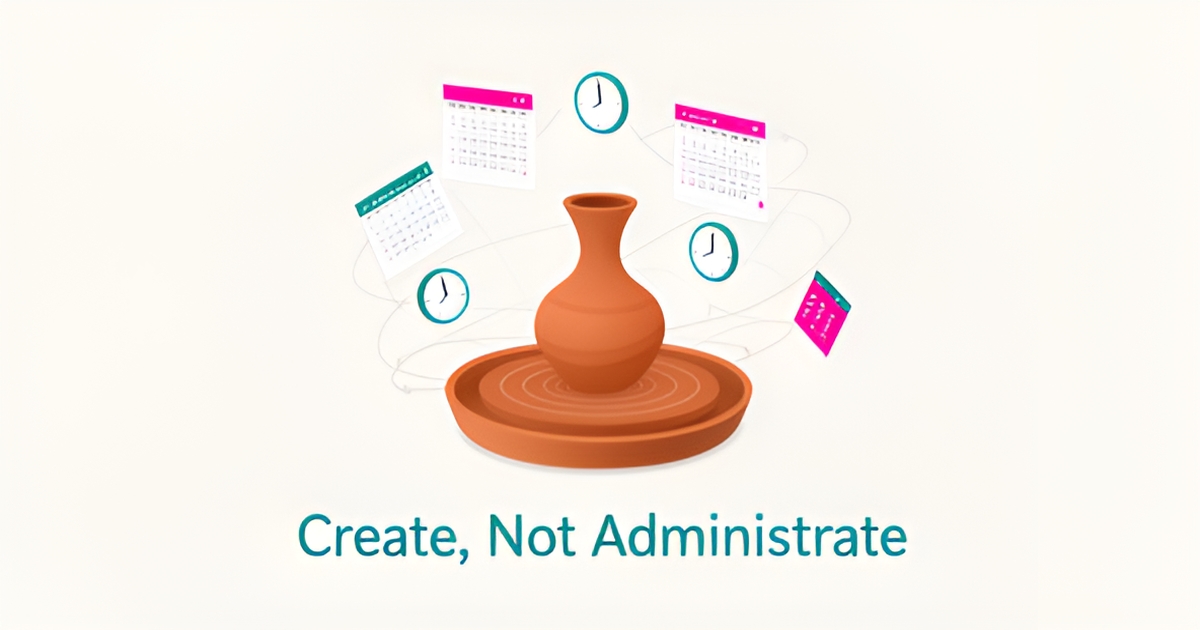
AI for Artistic Workflows: How Pottery Studios Can Automate Creative Scheduling
Key Facts
- Workplace productivity research has tracked a steady decline in focus efficiency, with average focused sessions shrinking in recent years according to workplace productivity studies
- Large-scale AI scheduling systems have cut scheduling time from hours to minutes by parallelizing thousands of shifts into smaller subproblems per workforce management research
- Reclaim.ai earns strong ratings for protecting focus time with Proactive Mode, typically around $10/user/month per AI scheduling assistant benchmarks
- Clockwise scores well for team-wide calendar sync with round-robin assignment, typically around $6.75/user/month per AI scheduling assistant benchmarks
- AIQ Labs has deployed 200+ multi-agent systems and runs 4 live SaaS products daily, including marketing automation and voice AI per their demonstrated capability portfolio
- ClayTrack suits US PYOP studios with piece-level firing tracking and Mailchimp integration but lacks collection-slot booking per custom AI workflow analysis
Hire a team member that works 24/7 — for less than a part-time wage.
AI receptionists, SDRs, dispatchers and 99+ roles. Trained on your business, fully managed.
Not sure where to start? Ask our AI planner
Why Pottery Studios Drown in Scheduling Chaos
Pottery studios operate at the intersection of art and logistics, where creative flow constantly collides with rigid operational demands. Behind the wheel-thrown pieces and glazed finishes lies a web of scheduling variables that most studios manage manually—often with costly consequences.
Kiln firing cycles alone create a complex matrix of timing dependencies: bisque loads must cool before glazing, glaze fires require precise cone settings, and studio space gets tied up for hours or days. Layer on multi-instructor availability for wheel sessions, hand-building classes, and kids camps, plus open-studio slots for member access, and the scheduling web becomes nearly impossible to untangle by hand. As noted in industry observations, many studios juggle glazing, kiln schedules, and bookings manually—a practice that directly leads to double bookings, material waste, and missed sales opportunities according to operational assessments.
This manual juggling doesn’t just create errors—it erodes the very focus time artists need to create. Workplace productivity research has tracked declining focus efficiency in recent years, with average focused sessions shrinking as administrative load grows as noted in workplace productivity studies. Every minute spent resolving scheduling conflicts or manually updating firing boards is time stolen from creative work, compounding the strain on studio owners who are already wearing multiple hats.
- Kiln scheduling requires tracking load type, cone, ware-in/out dates across multiple units
- Class bookings must align with instructor availability and studio capacity
- Open-studio slots need real-time visibility to prevent overbooking
- Material waste increases when firing schedules shift without automated alerts
- Missed follow-ups on inquiries convert fewer students due to delayed response times
When studios rely on spreadsheets, whiteboards, or generic calendar tools, they treat scheduling as a design challenge rather than a structured-data problem. This approach means every change—like moving a Thursday glaze fire to Friday—forces a manual rebuild of visual boards, introducing alignment errors and version confusion as design experts observe. The result is a reactive cycle where studios constantly patch schedules instead of preventing conflicts, leaving artists frustrated and businesses leaking revenue through avoidable inefficiencies. AIQ Labs addresses this gap by transforming scheduling from a manual burden into an automated, intelligent workflow that protects creative time while ensuring operational precision.
How AI Scheduling Assistants Solve the Structured-Data Problem
The most effective AI scheduling tools don't treat a pottery studio's calendar as a blank canvas—they treat it as a structured-data problem with rows, columns, and constraints. This distinction matters because it separates tools that merely display information from those that actively solve conflicts before they happen.
When a kiln firing shifts or an instructor calls in sick, traditional calendars require manual reshuffling of every dependent class and studio session. AI scheduling assistants approach this differently. According to industry analysis of machine learning scheduling, these systems "analyze workloads, time zones, priorities, and even personal productivity patterns" to automatically reorganize around disruptions. Instead of dragging text boxes across a grid, studio managers adjust a single data point and watch the entire schedule rebalance itself.
The core capabilities driving this shift include:
- Automated conflict detection that flags double-bookings before they reach students
- Focus-time protection that reserves uninterrupted blocks for deep creative work
- Smart task matching that pairs instructors with classes based on expertise and availability
- Complex shift optimization that handles thousands of scheduling permutations
Two platforms illustrate how this structured approach performs in practice. Reclaim.ai earns strong ratings by automatically syncing calendars and protecting focus time through Proactive Mode, which fills calendars in advance based on priorities. At roughly $10 per user monthly as of late 2026, it tracks weekly focus goals and reveals productivity patterns that help studio owners understand where their time actually goes.
Clockwise takes a team-wide approach, scoring well by transforming multiple calendars into a unified system. Its round-robin assignment distributes meetings based on workload, and automated no-meeting days safeguard collective focus periods. For pottery studios juggling multiple instructors, this means roughly $6.75 per user monthly buys coordinated visibility across wheel sessions, hand-building classes, and kiln loading schedules.
The efficiency gains are measurable. Large-scale AI scheduling deployments have cut scheduling time from hours to minutes by breaking tens of thousands of weekly shifts into parallel subproblems. While pottery studios operate at smaller scales, the principle holds: when AI handles the mathematical complexity of constraint satisfaction, humans reclaim time for creative direction.
This is where AIQ Labs sees studios gain the most traction—not by replacing artistic judgment, but by eliminating the administrative friction that prevents artists from reaching the wheel. The structured-data approach means a Thursday glaze fire moved to Friday updates every dependent class reminder, instructor notification, and studio calendar in seconds rather than hours.
Choosing the Right AI Workflow Solution for Your Studio Type
Picking an AI scheduling stack for a pottery studio starts with studio model, not features. Kiln firing schedules, class rotations, and artist availability create a structured-data problem that generic calendar tools miss. The right fit depends on whether you need full system ownership, piece-level tracking, or collection-slot flexibility.
For studios that want full system ownership and multi-department automation, a custom build is the path. AIQ Labs is positioned as best for studios seeking comprehensive AI transformation, custom solutions, and full system ownership. This approach builds production-ready systems that adapt to seasonal and artist-specific constraints, integrate with existing CRM, accounting, and scheduling tools, and remain owned by the studio rather than rented. It suits teaching studios, community studios, and growing operations that need kiln cycle tracking alongside class booking, waitlist handling, and staff scheduling in one owned ecosystem.
Specialized PYOP platforms serve a narrower but critical use case. ClayTrack is best for PYOP studios, especially those in the US, with a user-friendly interface for tracking pieces through firing stages, automatic notifications, a label system for easy identification, and Mailchimp integration for marketing. The trade-off is limited collection-slot booking, making it ideal for US-based paint-your-own-pottery studios focused on firing-stage visibility rather than broad class management.
UK studios with a strong pickup and retail flow often need flexible collection management. CollectIt is best for UK-based studios seeking flexible collection management and offers bookable collection slots, automated reminders, and a built-in marketing list that significantly increases collection rates. Its flexibility caters to a broader range of studio types beyond PYOP.
A practical decision framework helps match model to solution:
- Studio model: PYOP with firing-stage tracking → ClayTrack; teaching/community with multi-department workflows → custom build; UK retail with collection slots → CollectIt
- Geography and pricing: US-focused tools like ClayTrack use USD pricing; UK-focused tools like CollectIt use GBP pricing and local workflows
- Integration needs: Need deep two-way API integrations with legacy systems and full ownership → custom AI development; need quick setup with Mailchimp or marketing lists → specialized platforms
Scheduling complexity is real. Large-scale workforce scheduling systems handle enormous numbers of scheduling combinations, and the same principle applies to studios juggling kilns, instructors, and open studio time. Documented deployments have reduced scheduling time from hours to minutes by parallelizing shifts into subproblems, illustrating how AI can compress manual coordination.
Focus protection also matters. Workplace productivity research shows focus efficiency declining in recent years, underscoring why studios need systems that block deep-work time for artists and automate routine booking. When the calendar reflects priorities, creative work gets protected and administrative load drops.
Implementation Roadmap: From Assessment to Scaled Automation
Rolling out AI scheduling in a pottery studio works best as a phased build rather than a big-bang switch. An advisory session starts by mapping daily work — booking, inventory, class signups — so a specialist can recommend the smallest automations that reduce repetitive tasks and lower costs.
- Audit every workflow: kiln firing boards, class rosters, artist availability, open-studio slots, and follow-up sequences
- Select a solution matched to studio type and geography — AIQ Labs for comprehensive transformation, ClayTrack for US PYOP studios, CollectIt for UK collection management
- Lock in a brand kit (logo, colors, legible typeface) so every board, flyer, and price list inherits a consistent look
- Build reusable blocks for firing boards and class schedules — shifting a glaze fire from Thursday to Friday becomes a data edit, not a layout rebuild
- Configure automated booking, waitlist handling, and reminder/follow-up sequences that turn inquiries into students
- Set focus-time calendar rules (e.g., Reclaim.ai’s Proactive or Reactive modes) to protect deep-work blocks for creative production
- Run a controlled pilot on one kiln cycle or class series, tracking fill-rate and follow-up conversion
- Train staff with clear handoff documentation before expanding
- Scale only the workflows that prove ROI — start small, track results, and scale what improves bookings and sales
Reclaim.ai starts around $10/user/month as of late 2026, while Clockwise begins around $6.75/user/month for team-wide calendar sync. Large-scale AI scheduling systems have cut scheduling time from hours to minutes by parallelizing subproblems — proof that structured-data automation beats manual grids every time.
For studios that want help, AIQ Labs offers three entry points: an AI receptionist or dispatcher to handle bookings and inquiries at a fraction of a human hire, a fixed-price Workflow Build to rebuild the one scheduling workflow that costs the most, or a full AI Operating System owned outright. Payment models are Start Monthly, Build in Milestones, or Own It Outright — no lock-in, no fake pricing.
Beyond Scheduling: AI as a Creative Partner in the Studio
The kiln calendar used to be the only schedule that mattered—until the studio realized every flyer, pricing menu, and social post was its own scheduling problem. Generative AI tools such as DALL·E, Midjourney, and Runway now let potters test glaze palettes, spin up concept variations, and reinterpret classical forms in seconds rather than hours. A Berlin-based multimedia artist describes the workflow bluntly: "I use AI to generate the starting point, and then my job is to destroy it, rework it, humanize it." The artist remains the curator; the model merely accelerates the blank-page phase.
- Rapid palette testing across dozens of glaze combinations before mixing a single batch
- Instant concept variations for guest-artist workshops or seasonal collections
- Classical reinterpretation that references historical forms without copying them
- Storyboard generation for video tutorials that demonstrate throwing sequences
- Mood-board creation for grant proposals and gallery submissions
The same infrastructure that protects focus time on the calendar can also produce the studio's outward-facing assets. MiriCanvas draws from a large library of professional designer templates and ranks highly in the Design category by SimilarWeb, giving studios print-ready flyers, pricing menus, and event posters without switching platforms. Because the scheduling engine already knows class dates, kiln cycles, and instructor availability, those data points flow directly into the design layer—eliminating the copy-paste errors that make a studio look disorganized. AIQ Labs builds this unified creative-operational stack so the system that books a wheel-throwing session also generates its promotional assets, all while the artist retains full ownership of the output and the underlying IP.
Still paying for 10+ subscriptions that don’t talk to each other?
We build custom AI systems you own outright. No vendor lock-in. Full control.
Not sure where to start? Ask our AI planner
Frequently Asked Questions
How much time can AI scheduling assistants actually save pottery studios each week?
What specific scheduling problems do pottery studios face that AI can solve?
Is AI scheduling only for large pottery studios with multiple instructors?
Which AI scheduling tool is best for protecting creative focus time in pottery studios?
How do AI tools like MiriCanvas help pottery studios beyond scheduling?
What’s the first step to implementing AI scheduling in my pottery studio?
Protect the Wheel Time That Pays
Pottery studios thrive when kiln cycles, class rosters, and open-studio slots run without constant manual patching. Treating scheduling as structured data—rows of kiln loads, instructor constraints, and collection windows—lets AI flag conflicts before they reach students, protect focus blocks for making, and update every dependent reminder in seconds instead of hours. The studios that gain the most don’t replace artistic judgment; they remove the administrative friction that steals it. If your boards are still being rebuilt by hand each week, start with an audit of kiln firing, class, and follow-up workflows, then pilot one automated piece—waitlist handling, focus-time protection, or smart firing boards—and measure fill rate and response time. AIQ Labs builds production-ready AI systems that adapt to seasonal and artist-specific constraints and can be owned outright by the studio, with 200+ multi-agent systems deployed and 4 live SaaS products run daily. Ready to map your biggest bottleneck? Start the 2-minute Fit Check at https://aiqlabs.ai/apply, then book your free 30-minute strategy call at https://aiqlabs.ai/book, or reach the team at [email protected].
Make AI your competitive advantage — not just another tool.
Strategy, implementation and ongoing optimization. One partner, end to end.
Not sure where to start? Ask our AI planner