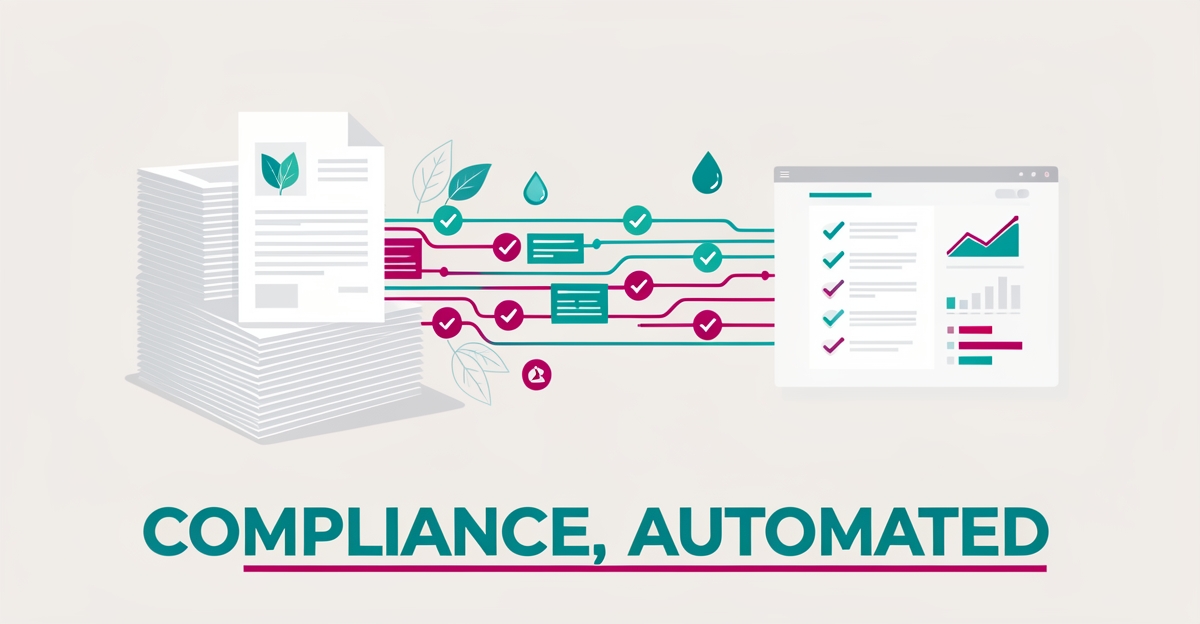
AI for Environmental Compliance: How Engineering Firms Can Automate EIA and Permit Tracking
Key Facts
- Industry surveys of AEC firms suggest senior engineers can spend a majority of their time assembling reports instead of engineering.
- AI-assisted reporting can compress multi-week manual cycles—such as TRI submissions—to a fraction of the time, with human review retained.
- Automated field-to-assessment workflows have delivered significant time reductions for engineering consultancies in documented industry examples.
- AI systems can typically map a regulatory change against active projects and produce a compliance impact brief within about 24 hours.
- Analysts including Gartner have warned that a large share of agentic AI projects risk cancellation due to governance gaps rather than technology failure.
- Regulators are increasingly treating AI-assisted decisions as auditable assets, with explainability expectations tightening as of late 2026.
- A short proof of concept using existing TRI data can typically produce first-draft reports within days.
Hire a team member that works 24/7 — for less than a part-time wage.
AI receptionists, SDRs, dispatchers and 99+ roles. Trained on your business, fully managed.
Not sure where to start? Ask our AI planner
The Hidden Cost of Manual Environmental Compliance
Manual compliance turns engineering expertise into clerical work, and the bill comes due in missed deadlines and lost talent.
Industry surveys of AEC firms suggest senior engineers can spend a majority of their time assembling reports rather than engineering. That time is consumed by repetitive cross-referencing of production records, site plans, Material Safety Data Sheets, waste manifests and emissions data for submissions like TRI and EIAs. Every report starts from scratch, and every project reinvents the process.
The cost shows up in timelines. A typical TRI report can take two to three weeks to cross-reference and assemble manually. AI-assisted workflows can compress that cycle to a matter of hours, with documented industry examples showing significant reductions in field-to-assessment time for engineering consultancies.
Firms lose more than hours. High-value experts become data clerks, project timelines slip, and institutional knowledge erodes because compliance work is fragmented and undocumented.
The hidden inefficiencies include:
- Senior staff pulled off design and analysis to hunt for data and validate formats
- Manual assembly of EIAs and TRI submissions that introduces inconsistency and error risk
- Reactive regulatory tracking that forces mid-stream scope changes after rules shift
- Audit exposure from reports built without full source attribution or decision trails
Civil engineering projects involve complex environmental regulations, and the pressure to deliver audit-ready documentation only increases as jurisdictions diverge. AIQ Labs builds systems that manage compliance workflows specific to engineering standards—whether through a focused rebuild of your most expensive reporting workflow or a broader connected operating layer—embedding automation in the tools teams already use.
Without automation, firms rent intelligence instead of building it. When the tool is turned off, no organizational knowledge remains. The result is a compliance function that is slow, expensive, and dependent on the availability of senior engineers for tasks that do not require their expertise.
Shifting reporting, compliance monitoring and inspection analysis to AI lets engineers engineer again.
How AI Automates Environmental Reporting and Regulatory Tracking
The manual grind of environmental reporting is a significant drain on engineering talent. As noted above, senior engineers can spend a large share of their time assembling reports instead of applying their core expertise. This administrative burden not only slows down projects but also introduces the risk of human error into critical compliance documentation.
Specialized AI systems directly address this inefficiency by automating the entire reporting lifecycle. They ingest and cross-reference diverse, multi-source data—including PDFs of site plans, emissions data from spreadsheets, and drone imagery—to validate findings against regulatory requirements. This allows the system to generate submission-ready documents like EPA Form R, transforming the workflow.
The impact on timelines can be dramatic. Industry analyses of AEC firms describe AI compressing a typical Toxic Release Inventory (TRI) reporting cycle from a manual process of two to three weeks down to a matter of hours. This level of automation is built on several key capabilities:
- Automated Data Ingestion: The system reads and interprets unstructured data from various formats, eliminating manual data entry.
- Cross-Referencing and Validation: It cross-references production records, waste manifests, and Material Safety Data Sheets (MSDS) against emissions data to ensure accuracy.
- Submission-Ready Formatting: The AI generates reports in the specific format required by regulatory bodies, such as the EPA.
Beyond report generation, AI enables proactive regulatory tracking. These systems continuously monitor updates from federal, state, and local agencies across all jurisdictions relevant to a firm's projects. When a new regulation is published, the AI can map it against active projects and generate a compliance impact brief—typically within about 24 hours—helping firms avoid costly mid-project scope changes.
Crucially, this level of automation is designed to augment, not replace, human experts. The goal is to produce a submission-ready draft, but the final technical review and sign-off always remain with a senior engineer. This "human-in-the-loop" approach is essential, as governance of AI in regulated industries requires clear human accountability. At AIQ Labs, we build these custom compliance workflow systems with that principle at their core, ensuring technology empowers engineers while maintaining rigorous oversight.
Building Governance-First AI Systems for Audit-Ready Compliance
Engineering firms can no longer treat AI as a productivity shortcut for compliance. As of late 2026, regulators are increasingly treating AI-assisted EIA and permit decisions as auditable assets that must carry a full decision history.
Manual compliance is unsustainable. Senior engineers spend a large share of their time assembling reports, not engineering. AI compresses workflows, but speed without traceability creates regulatory exposure. Audit workflows designed for human pacing break when AI resolves ambiguity silently.
Governance-first systems embed traceability at the data layer. Every input, model version, transformation, confidence score and human intervention is logged and retrievable. That record is what regulators will scrutinize, so explainability cannot be an afterthought.
Human-in-the-loop controls are non-negotiable in regulated AEC work. AI can generate submission-ready drafts, but accountability stays with humans who deploy it. Accountability does not transfer to the algorithm; it stays with the organization that decided it was ready. This means senior engineers retain final technical review and sign-off.
Agentic adoption is outpacing governance capacity. Analysts including Gartner have warned that a large share of agentic AI projects risk cancellation, often due to organizational and governance gaps, not technology. Firms that skip governance build rented intelligence that disappears when the tool is turned off.
A governance-first architecture for environmental compliance includes:
- Provenance and audit trails for every AI output, with source attribution and confidence levels
- Human review gates before final EIA or permit submission, with explicit escalation paths
- Continuous regulatory monitoring that maps changes to active projects within roughly 24 hours
- Domain stewardship with clear ownership for model performance and compliance alignment
AIQ Labs builds compliance workflows specific to engineering standards with this posture in mind. Systems are designed to run on firm infrastructure with embedded audit trails, not black-box vendor models—and with an operating system you own outright, the regulatory intelligence and its decision history stay yours. Regulatory intelligence can flag impacts fast, typically generating a compliance impact assessment within about 24 hours of a regulatory change.
Traceability is the product. When AI is embedded in the tools teams already use, decisions become auditable by default. That is how engineering firms move from reactive reporting to proactive, audit-ready compliance.
Phased Implementation: From Proof of Concept to Scaled Compliance Automation
Engineering firms can't afford to lose senior talent to paperwork. With senior engineers spending a large share of their time assembling reports rather than engineering, a phased rollout protects delivery while proving value fast.
A practical path follows proven AEC implementation patterns: start small with your own data, prove it on one real workflow, then scale with governance built in.
Phase one is a short proof of concept using existing TRI data. Upload the firm's most recent dataset and the system identifies inconsistencies and generates a first-draft report within days. This rapid validation demonstrates field-to-assessment acceleration without disrupting live projects. Documented industry examples show consultancies achieving major time reductions in field-to-assessment work with this approach.
Phase two is a 90-day lighthouse project for one report type, one jurisdiction, or one portfolio. Over 90 days the system goes into production on a real workflow with real submissions. Industry analyses describe TRI reporting cycles compressed from two to three weeks of manual cross-referencing to a matter of hours, while keeping human sign-off in place.
Phase three scales across jurisdictions and workflows. Learning from TRI reporting informs state-level compliance, EIAs, and inspection intelligence. AI systems ingest PDFs, spreadsheets, drone imagery and MSDS sheets, cross-reference against emissions data and regulatory requirements, and produce submission-ready outputs embedded in tools teams already use.
The three-phase rollout typically includes:
- Proof of Concept: Upload existing TRI or inspection records, generate a first-draft report and data-quality insights within days
- 90-Day Lighthouse Project: Deploy a production system for one report type with fixed scope, real submissions, and measurable accuracy gains
- Scaled Compliance Automation: Expand to additional report types, jurisdictions, and project portfolios with audit trails and human-in-the-loop controls
This progression aligns with how AIQ Labs builds compliance workflows specific to engineering standards—rebuilt in milestones at a fixed price, then scaled toward owned, production-ready automation. Governance is layered in from the start so traceability, explainability and accountability are not retrofitted later.
Firms that skip the narrow start risk the governance gap where agentic AI adoption outpaces governance in regulated industries. A phased approach lets domain experts set acceptance criteria, preserves institutional knowledge, and ensures AI decisions remain auditable assets.
Still paying for 10+ subscriptions that don’t talk to each other?
We build custom AI systems you own outright. No vendor lock-in. Full control.
Not sure where to start? Ask our AI planner
Frequently Asked Questions
How much time do senior engineers actually spend on compliance reporting instead of engineering work?
Can AI really reduce the time needed to prepare a Toxic Release Inventory (TRI) report from weeks to hours?
What does a phased implementation of AI for environmental compliance look like in practice?
How does AI ensure accountability and auditability in regulated industries like engineering?
Is human oversight still required when using AI for environmental compliance reporting?
What risks do engineering firms face if they adopt AI for compliance without proper governance?
From Compliance Burden to Engineering Advantage
Manual environmental compliance is draining engineering talent, with senior staff spending a large share of their time assembling reports instead of solving technical problems—a cost measured in missed deadlines, project delays, and eroded institutional knowledge. AI automation compresses workflows like TRI reporting from weeks to hours while embedding traceability and human oversight to meet evolving regulatory demands. By starting with a focused proof of concept and scaling with governance built in, firms reclaim engineering capacity, reduce legal risk, and turn compliance from a reactive chore into a proactive, audit-ready strength. To see how this applies to your workflows and identify your highest-impact automation opportunity, complete the two-minute Fit Check and book a free 30-minute strategy call.
Make AI your competitive advantage — not just another tool.
Strategy, implementation and ongoing optimization. One partner, end to end.
Not sure where to start? Ask our AI planner