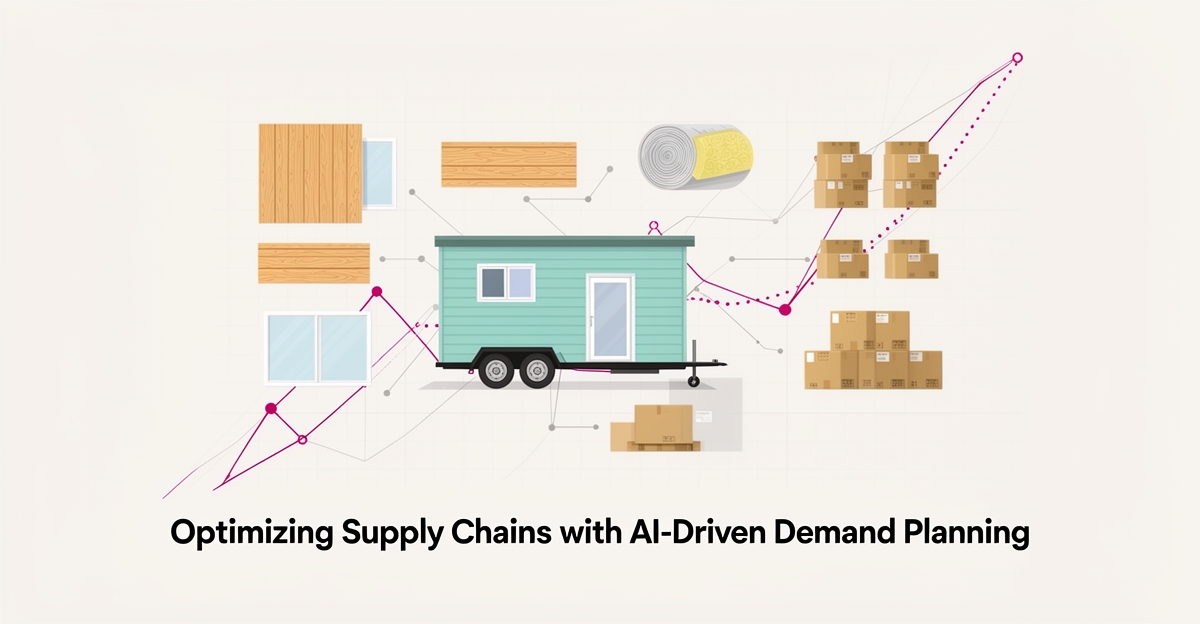
AI for Inventory & Material Forecasting in Tiny Home Construction
Key Facts
- Material costs devour 40-60% of tiny home budgets, making accurate forecasting critical for survival.
- AI-driven demand planning improves forecast accuracy by 20-30% over traditional methods, according to industry analysis.
- Businesses using AI-driven planning report 20-30% lower inventory holding costs while improving order fill rates, recent tool analysis shows.
- The AI warehousing market will explode from $11.22 billion in 2024 to $45.12 billion by 2030, benchmark research projects.
- Poor forecast accuracy triggers inventory carrying costs consuming 20-30% of total inventory value annually, industry benchmarks reveal.
- AI inventory management implementations can reduce excess stock by up to 40% while preventing stockouts.
- The AI inventory management market is expanding at a 29.8% compound annual growth rate through 2029, industry research indicates.
Hire a team member that works 24/7 — for less than a part-time wage.
AI receptionists, SDRs, dispatchers and 99+ roles. Trained on your business, fully managed.
Not sure where to start? Ask our AI planner
Why Tiny Home Material Demand Is Unpredictable
Material costs represent 40-60% of a tiny home’s total build cost, yet most builders still order lumber and appliances based on gut instinct rather than data. When demand shifts unexpectedly—as it frequently does in this niche market—that guesswork translates directly into stalled builds, emergency supplier runs, and capital trapped in excess inventory.
Unlike traditional homebuilders with decades of standardized sales data, tiny home manufacturers operate with sparse historical records. Many builders have only existed for a few years, and their sales histories contain gaps where custom builds or market experiments create irregular patterns. This scarcity of clean data makes traditional forecasting nearly impossible, forcing owners to choose between over-ordering expensive materials like cedar siding and composting toilets, or risking stockouts that delay delivery by weeks.
Regional demand volatility compounds the problem. A builder in the Pacific Northwest might see a surge in orders for off-grid capable units following zoning law changes, while a Southeast builder faces sudden demand for hurricane-rated models after storm season. These geographic shifts happen faster than quarterly purchasing cycles, leaving warehouses stocked with the wrong materials for current projects.
Seasonality adds another layer of complexity. The industry experiences distinct building seasons—spring and summer rushes followed by winter slowdowns—but weather patterns and economic factors increasingly disrupt these cycles. A mild winter can extend the building season unexpectedly, while high interest rates might stall orders during traditional peak months.
The financial impact is measurable and severe. According to industry benchmark data, businesses struggling with forecast inaccuracy face significantly higher carrying costs, with inventory holding expenses typically consuming 20-30% of total inventory value annually. For tiny home builders operating on thin margins, excess inventory ties up cash that could otherwise fund new projects or marketing efforts.
The consequences manifest in four critical areas:
- Stockouts that halt construction mid-build, damaging client relationships and triggering penalty clauses
- Overstock of specialized materials like tiny-home-specific trailer frames or compact appliances that cannot be easily returned
- Material waste from lumber, insulation, and finishes that degrade or become obsolete before use
- Cash flow compression when working capital sits in unused inventory instead of fueling growth
Traditional spreadsheet methods cannot process these variables simultaneously. However, recent analysis shows that AI-driven demand planning improves forecast accuracy by 20-30% over traditional methods by identifying patterns in sparse data that human planners miss. Companies implementing these systems report 20-30% lower inventory holding costs while maintaining better material availability, according to industry research.
This precision matters because tiny home construction lacks the bulk purchasing power of large developers. Every sheet of plywood and every mini-split HVAC unit represents a significant capital commitment that must align precisely with actual build schedules.
How AI Forecasting Improves Material Planning
Tiny home builders live with demand that shifts with weather, seasonality and regional sales spikes. Material shortages stall builds while excess lumber and fixtures tie up cash. Machine learning models turn that volatility into a predictable ordering rhythm.
AI forecasting blends historical sales, lead times, promotions, weather and macro signals to see demand patterns traditional spreadsheets miss. Models learn cross-SKU relationships and adapt to sparse data, giving builders a clearer view of what, when and where materials will be needed. According to industry research, AI-driven demand planning can improve forecast accuracy by 20-30% over traditional methods.
That accuracy translates directly into material planning. Better forecasts reduce stockouts on high-impact items like framing lumber and roofing, and they curb over-ordering of finishes that sit in storage. A recent analysis of inventory tools notes businesses using AI-driven demand planning have reported 20-30% lower inventory holding costs and improved order fill rates.
The market momentum is clear. The global AI in warehousing market is expected to reach USD 45.12 billion by 2030, from 11.22 billion in 2024 according to a forecasting benchmark study, reflecting how widely predictive inventory is being adopted.
For tiny home construction, the practical gains show up in daily operations:
- Reduced stockouts and fewer build delays from missing components
- Up to 40% less excess inventory tied up on site and in storage
- 20-30% lower holding costs through optimized reorder points
- Automated ordering that aligns material arrivals with build schedules
AI models also handle the signals unique to tiny homes: regional demand shifts, seasonal build cycles, and promotion-driven spikes. Feature engineering with lagged sales, rolling means, calendar flags and supplier lead-time averages lets forecasts stay responsive without manual intervention.
AIQ Labs builds predictive models that automate inventory ordering for builders, reducing waste and ensuring materials are always available. In the AI Inventory & Supply Chain Management category, these systems replace reactive purchasing with data-driven planning.
The result is a leaner supply chain where cash is freed, crews stay productive, and customers move in on time.
From Forecast to Automated Ordering in Tiny Home Operations
Tiny home builders often struggle to align material orders with fluctuating project timelines, leading to costly delays or excess inventory that ties up capital. AI-driven demand planning transforms this uncertainty into precision by analyzing sales history, regional trends, and seasonal patterns to forecast material needs at the SKU level. According to Gartner research cited in industry analysis, AI improves forecast accuracy by 20-30% over traditional methods, directly reducing the risk of stockouts during critical build phases.
With reliable forecasts in place, the next step is optimizing inventory actions—setting dynamic safety stock levels and reorder points that respond to real-time demand signals. AI models continuously recalibrate these thresholds using lead time variability and consumption rates, ensuring materials arrive just-in-time without overstocking. This approach has helped businesses lower inventory holding costs by 20-30% while improving order fill rates, as noted in a review of AI forecasting tools. For tiny home operations, this means fewer last-minute material rushes and more predictable cash flow.
Automation closes the loop by connecting AI-generated forecasts directly to ERP systems, triggering purchase orders when stock hits optimized reorder points. AIQ Labs’ AI-Enhanced Inventory Forecasting service builds custom models that handle multi-channel demand and external variables like weather or local housing trends, then integrates seamlessly with platforms such as QuickBooks or job management software. The result is a self-regulating inventory workflow where ordering happens automatically, waste is minimized, and builders never face delays due to missing materials—turning forecasting into a tangible operational advantage.
Implementation Roadmap for Builders
Implementing AI for inventory forecasting doesn't require a massive upfront investment—just a structured approach and commitment to data quality. The path from spreadsheet chaos to predictive intelligence follows a proven sequence that minimizes risk while building internal capability.
Start by auditing your data landscape. Collect SKU-level sales history, purchase order receipts, supplier lead times, and return patterns. According to industry analysis, AI inventory management requires clean, structured data as its foundation—messy spreadsheets and inconsistent naming conventions will sabotage even the most sophisticated models. This preparation phase often reveals gaps in how materials get tracked across projects, forcing valuable operational clarity before any algorithms enter the picture.
Once your data foundation solidifies, establish baseline forecasting models using simple exponential smoothing or moving averages. These traditional methods provide a performance benchmark against which you'll measure AI improvements. Research from Forthcast's comparative analysis shows that AI-driven demand planning improves forecast accuracy by 20-30% over these traditional approaches—but you need that baseline to prove the value.
Feature engineering separates adequate forecasts from exceptional ones. Build lag features that capture how last month's window sales predict this month's framing lumber needs. Create rolling averages that smooth weekly volatility. Flag seasonal patterns—tiny home construction typically surges in spring and summer when building conditions optimize. Incorporate supplier lead-time averages so the system learns that specialty windows require eight-week advance ordering while standard lumber needs only two. These engineered features teach models the operational realities of construction supply chains.
Validation and backtesting come next. Use time-series cross-validation with rolling windows to simulate how your model would have performed historically. Track Mean Absolute Percentage Error (MAPE) alongside business-specific KPIs like stockout frequency and carrying costs. MindInventory's research emphasizes that models require ongoing maintenance and retraining as market conditions shift—this isn't a set-it-and-forget-it technology.
The final step pushes forecasts into daily operations:
- Export predictions directly to your ERP or inventory management system
- Configure automated reorder points based on forecast confidence intervals
- Set safety stock levels that adjust dynamically to predicted demand volatility
- Create alerts for forecast anomalies that warrant human review
- Schedule monthly model performance reviews against actual outcomes
The market trajectory supports this investment. The AI in warehousing market is projected to grow from $11.22 billion in 2024 to $45.12 billion by 2030, signaling broad industry adoption. For tiny home builders operating on thin margins, that growth reflects proven ROI—businesses implementing AI-driven demand planning report 20-30% lower inventory holding costs according to Sumtracker's industry research.
AIQ Labs structures implementations through phased milestones, allowing builders to validate each stage before expanding scope. This approach aligns technical deployment with operational readiness, ensuring teams adopt new workflows rather than circumvent them. Success hinges less on algorithmic sophistication than on consistent data hygiene and committed model maintenance—the unglamorous work that separates functional systems from expensive experiments.
Still paying for 10+ subscriptions that don’t talk to each other?
We build custom AI systems you own outright. No vendor lock-in. Full control.
Not sure where to start? Ask our AI planner
Frequently Asked Questions
Why is material forecasting so hard for tiny home builders specifically?
Can AI really improve forecasts when we only have a few years of data?
What cost savings do builders actually see with AI inventory forecasting?
Do we need clean data before starting AI forecasting?
How does AI forecasting connect to automated ordering?
Is AI inventory forecasting just a trend or is adoption growing?
From Guesswork to Growth: How AI Forecasting Powers Tiny Home Success
Tiny home builders no longer need to choose between stockouts and excess inventory when AI forecasting turns volatile demand into predictable material flow. By analyzing sales history, regional trends, seasonality, and external signals, AI-driven planning improves forecast accuracy by 20-30%, reduces excess inventory by up to 40%, and cuts holding costs—freeing cash for growth instead of warehousing. The implementation roadmap is straightforward: audit your data, establish baseline models, engineer features like lagged sales and supplier lead times, validate with backtesting, then automate ordering through ERP integration. For builders ready to replace reactive purchasing with data-driven precision, the path forward starts with understanding your unique forecasting gap. Take the first step with a free, no-obligation strategy session to map your biggest bottleneck and see where AI can deliver real operational impact—no sales pitch, just clarity on your opportunity to build smarter.
Make AI your competitive advantage — not just another tool.
Strategy, implementation and ongoing optimization. One partner, end to end.
Not sure where to start? Ask our AI planner