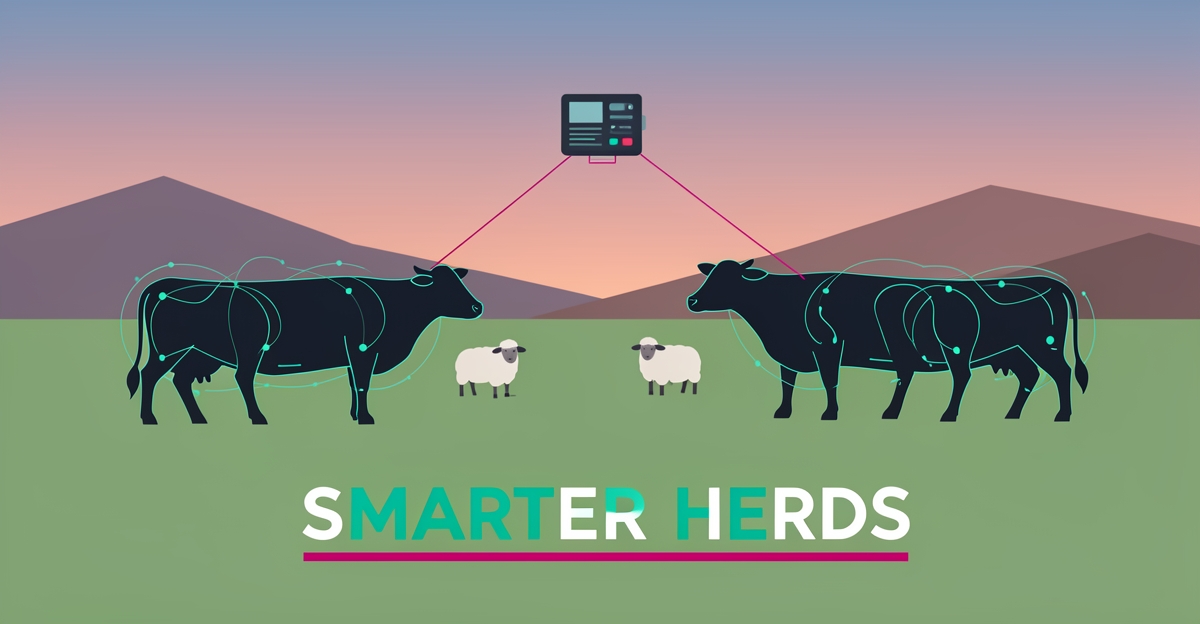
AI for Livestock Management: How AI Tracks Animal Behavior and Health
Key Facts
- AI systems can detect abnormal behavior, stress, isolation and lameness earlier than manual observation, reducing mortality risk
- Computer vision with pose estimation and multi-object tracking can identify individual cows in real time with high accuracy
- Automated gate control and accurate animal identification have reduced animal stress and injury on modern dairy farms
- Wearable IoT devices track animal health and activity continuously as part of farm automation
- Custom AI systems learn each herd's unique behavioral baselines instead of applying generic thresholds
- AIQ Labs has deployed 200+ multi-agent systems and runs 4 live SaaS products daily
Hire a team member that works 24/7 — for less than a part-time wage.
AI receptionists, SDRs, dispatchers and 99+ roles. Trained on your business, fully managed.
Not sure where to start? Ask our AI planner
Why Manual Herd Monitoring Falls Short
A single sick cow can go unnoticed for days in a herd of hundreds — and by the time symptoms become visible, treatment costs climb and recovery odds drop. Manual herd monitoring, no matter how skilled the farmer, simply cannot keep pace with the scale and speed of modern livestock operations.
Traditional record-keeping and visual observation create operational blind spots that leave critical health events undetected. When farmers rely on periodic check-ins and handwritten logs, early signs of illness, stress, and abnormal behavior slip through the cracks. Industry analysis of precision livestock farming consistently finds that AI systems detect abnormal behavior, stress, isolation, and lameness earlier than manual methods — directly reducing mortality risk and treatment costs.
The core limitations of manual monitoring include:
- Delayed illness detection — visual checks catch symptoms only after they become obvious, missing the early intervention window
- Inconsistent record-keeping — manual logs are prone to gaps, errors, and subjective interpretation across different workers
- Lameness and stress overlooked — subtle changes in gait or behavior go unnoticed without continuous observation
- Scattered data — paper records and disconnected spreadsheets make it nearly impossible to spot herd-level trends
These blind spots carry real financial consequences. Every missed case of lameness or late-detected infection drives up veterinary costs and increases the likelihood of mortality. For large-scale operations managing hundreds or thousands of animals, even a small percentage of undetected health issues compounds into significant losses.
The problem is not farmer competence — it is human limitation. No team can watch every animal around the clock. Agricultural technology coverage emphasizes that wearable devices and connected sensors now make continuous monitoring possible, tracking animal health and activity in real time and replacing guesswork with objective data.
Real-world deployments show what this shift looks like in practice. AI-powered tracking systems using computer vision and pose estimation have improved herd management on modern dairy farms, with operators reporting that automated identification and gate control significantly reduced animal stress and injury across the operation.
This is precisely why AIQ Labs builds custom AI systems that learn from each farm's unique behavioral patterns. Rather than applying generic thresholds, these systems adapt to the specific rhythms of a herd — flagging deviations that human observers would miss and giving farmers the early warning they need to act before small problems become costly emergencies.
How AI Tracks Health and Behavior in Real Time
Real-time visibility changes how livestock is managed. Instead of scheduled checks, farms can observe movement, feeding and social behavior continuously and respond before problems escalate.
Wearable IoT sensors form the first layer of precision livestock management. These devices track animal health and activity continuously, with IoT often described as "the senses of agriculture" for smart monitoring. Farm automation today relies on software integrating AI, sensors, and connected devices to monitor livestock and transform traditional agriculture into a data-driven system.
Computer vision adds individual-level identification without handling animals. AI-driven systems can accurately identify and track individual cows, enabling real-time monitoring and automated gate operations. Deployments using animal pose estimation and multiple object tracking have monitored cows in real time with high accuracy and minimal false positives and false negatives.
Together, the sensor and vision stack creates continuous behavioral baselines. AI livestock management software can improve tracking, health monitoring, feed efficiency, traceability, records, and real-time decision-making for smarter herd management — detecting abnormal behavior, stress, isolation, and lameness earlier, which reduces mortality risk and treatment costs.
Early detection is the operational value. When an animal deviates from its normal movement or feeding pattern, the system flags it for review. This shifts care from reactive treatment to preventive intervention, improving welfare and reducing losses.
The technology stack typically includes:
- Wearable IoT sensors that monitor movement and feeding patterns for health indicators
- Computer vision with pose estimation and multi-object tracking to identify individual animals
- Real-time analytics that detect abnormal behavior, stress, and isolation earlier than human observation
- Automated gate control that optimizes herd flow and reduces animal stress and injury
Precision tracking also supports production flow. AI in agriculture can deliver concrete outcomes, including optimized animal movement and production efficiency across large herds, and reduced risk of injury by preventing collisions and guiding cows through appropriate paths. Dairy deployments report that automated gate control and accurate cow identification have optimized production flow and significantly reduced animal stress and injury.
In practice, these systems learn farm-specific patterns. AIQ Labs deploys custom AI systems that learn from each farm's unique animal behavior patterns for smarter herd management, aligning with the broader industry shift toward real-time monitoring through sensors and software tools for instant feedback. If you're mapping how monitoring fits into your broader operation, our Workflow Builds rebuild the one workflow that costs you the most, at a fixed price and in phases.
Custom solutions are built around herd size, species, workflows, and connectivity limits — not one-size-fits-all templates. AIQ Labs has deployed 200+ multi-agent systems and runs 4 live SaaS products daily, so the engineering behind these deployments is proven in production, not just in theory.
By combining wearable sensing with vision-based identification, farms gain continuous, individual-level health and behavior data that supports breeding decisions and reduces mortality risk.
From Data to Decisions: Breeding, Feeding, and Herd Optimization
Raw behavioral data from wearable sensors becomes a strategic asset when transformed into actionable insights for herd management. AI systems analyze movement patterns, feeding times, and social interactions to reveal hidden trends in animal health and productivity. This continuous stream of data eliminates guesswork, allowing farmers to make evidence-based decisions that improve efficiency and animal welfare.
Centralized data platforms consolidate reproductive history, feed intake, and health events into a single view, removing operational blind spots that hinder timely interventions. Farmers gain real-time visibility into preg-checks, calving intervals, and genetic performance, enabling smarter breeding selections that align with herd goals. AI-powered livestock management software improves tracking and traceability while reducing mortality risk through early detection of abnormal behavior.
Feed optimization becomes precise when AI monitors individual intake levels and correlates them with weight gain and milk production. This allows for dynamic ration adjustments that minimize waste and maximize nutrient efficiency, directly improving cost-per-head metrics. Producers can identify underperforming animals quickly and adjust feeding strategies before inefficiencies impact profitability.
- AI can detect lameness and isolation behaviors well before visual observation — often days earlier
- Centralized records reduce time spent on manual data entry by eliminating duplicate tracking systems
- Feed intake monitoring improves ration accuracy, lowering cost-per-head by optimizing nutrient utilization
- Reproductive tracking can improve conception outcomes by identifying optimal breeding windows through behavioral cues
- Real-time health alerts decrease treatment costs by enabling preventive care before conditions worsen
By converting raw sensor data into clear management directives, AI transforms livestock operations from reactive to predictive. Farmers no longer rely on seasonal checks or incomplete logs; instead, they access a living dashboard of herd performance that supports continuous improvement. This shift not only boosts productivity but also strengthens traceability — critical for meeting evolving regulatory and consumer demands. With AIQ Labs' custom systems learning from each farm's unique patterns, every decision becomes more precise, profitable, and sustainable.
Implementing Custom AI for Your Farm
Implementing custom AI for livestock management begins with understanding your farm's unique operational context — herd size, species, daily workflows, and connectivity limitations. Generic software often fails because it doesn't account for how animals actually behave in your specific environment or how your team interacts with existing tools. Effective systems must be built around these realities from the start, ensuring the technology adapts to your farm rather than forcing your farm to adapt to the technology.
AIQ Labs approaches this by designing owned, custom AI solutions that learn directly from your herd's behavioral patterns over time. Unlike off-the-shelf platforms that apply generic models, our systems ingest data from wearable sensors, feeding logs, and movement trackers to create a dynamic understanding of what normal looks like for your animals. This enables early detection of anomalies — such as changes in feeding time, reduced movement, or social isolation — that may indicate health issues before they become critical. Industry research consistently finds that AI-powered livestock management software can detect abnormal behavior, stress, and lameness earlier, reducing mortality risk and treatment costs by enabling proactive intervention.
The implementation process starts with a thorough assessment of your current infrastructure — what sensors you already use, how data is collected, and where gaps exist in monitoring. From there, we architect a system that integrates with your existing workflows, whether that means connecting to your herd management software, automating alerts to your team's mobile devices, or enabling automated gate operations based on real-time positioning. Deployments using computer vision and pose estimation have shown that AI-driven systems can accurately identify and track individual cows, enabling real-time monitoring and automated responses that optimize production flow and reduce animal stress.
Key considerations for deployment include:
- Herd size and density, which influence sensor placement and data processing needs
- Species-specific behaviors, such as grazing patterns in cattle versus social dynamics in swine
- Existing digital tools and their compatibility with AI integration points
- Connectivity constraints in rural areas, requiring edge computing or low-bandwidth data transmission
- Compliance and data ownership requirements, ensuring you retain full control of your farm's behavioral data
How you engage depends on where monitoring sits in your operation. A single high-cost workflow — like health alerting or feed tracking — can be rebuilt on its own through AI Workflow Builds at a fixed price, in phases. If you want monitoring, records, and alerts working as one connected layer across the whole operation, an AI Operating System is built the same way — in phases, and owned outright. And day-to-day follow-up tasks — scheduling vet visits, updating records, chasing alerts — can be handled by AI Employees at roughly 80% less cost than a human hire.
By building AI that evolves with your herd, you move beyond reactive health management toward predictive, precision livestock care. This improves animal welfare and breeding outcomes while reducing the operational blind spots created by manual record-keeping. The result is a self-improving system that becomes more accurate and valuable over time — turning your farm's unique behavioral data into a competitive advantage in herd management. For farms ready to move beyond generic tools, start the Fit Check — a free two-minute assessment — followed by a no-obligation 30-minute strategy call to map your highest-impact opportunities. You can also reach the team directly at [email protected].
Still paying for 10+ subscriptions that don’t talk to each other?
We build custom AI systems you own outright. No vendor lock-in. Full control.
Not sure where to start? Ask our AI planner
Frequently Asked Questions
How can AI spot a sick animal before I can see it myself?
What technology is actually used to track cows individually?
Does automated monitoring really reduce stress and injuries?
Is AI livestock management only for large operations?
Can AI help with feeding and breeding decisions, not just health?
What if my farm has poor internet or I'm worried about data ownership?
Turning Herd Insights into Herd Health
From spotting lameness days earlier to optimizing feed rations and breeding windows, AI transforms livestock management from reactive guesswork to proactive precision. By combining wearable sensors, computer vision, and custom learning models, farms gain continuous, individual-level visibility that reduces mortality risk, cuts treatment costs, and strengthens operational decisions — all while adapting to each herd's unique behavior. The result isn't just healthier animals; it's a more resilient, profitable operation built on data that works as hard as you do. Ready to see what AI can uncover in your herd? Start the Fit Check for a free two-minute assessment, followed by a no-obligation 30-minute strategy call to map your highest-impact opportunities. Prefer email? Reach the team at [email protected].
Make AI your competitive advantage — not just another tool.
Strategy, implementation and ongoing optimization. One partner, end to end.
Not sure where to start? Ask our AI planner