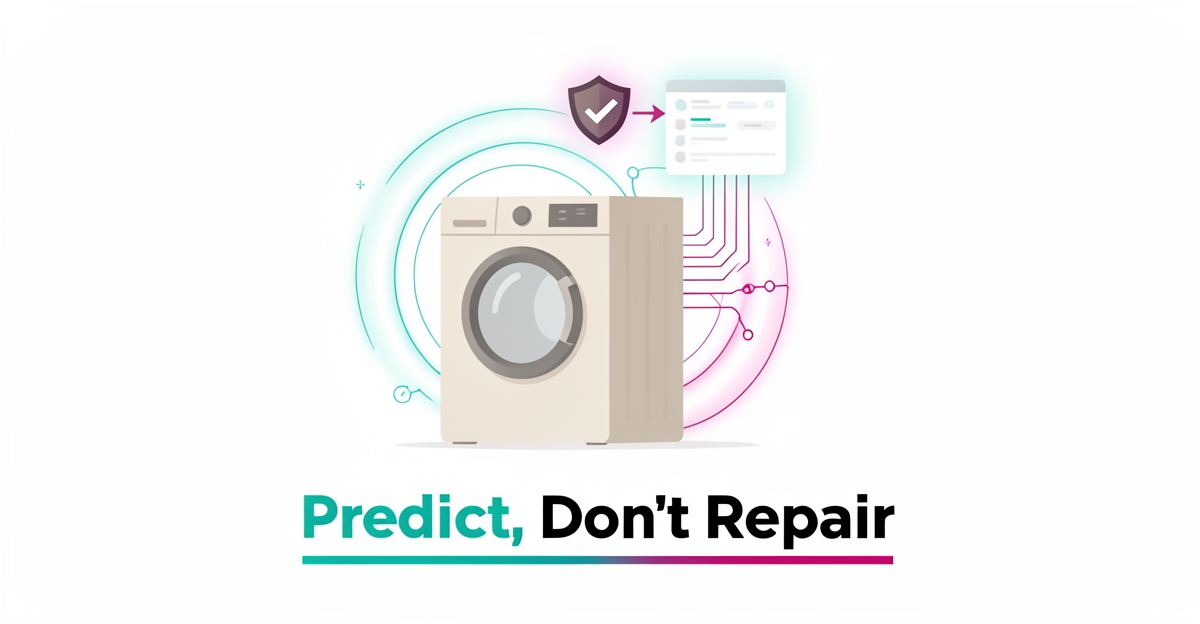
AI Maintenance Alerts: Prevent Appliance Failures Early
Key Facts
- Emergency repairs cost up to 4x more than planned maintenance according to industry analysis.
- AI-driven maintenance programs show organizations see 30% longer asset lifespans and 50% fewer unplanned failures.
- Predictive maintenance can reduce downtime by up to 50% and cut maintenance costs by as much as 40%.
- AI-powered predictive maintenance reduces unplanned failures by up to 50% and extends asset lifespans by 40%.
- 94% of organizations report an increased desire to deploy AI compared to just 12 months ago.
- AI-driven predictive maintenance can reduce unplanned outages by 20% and cut maintenance costs by 25%.
- AI-powered predictive maintenance reduces infrastructure failures by 73%, extends asset lifespans by 40%, and cuts workplace safety incidents by up to 75%.
Hire a team member that works 24/7 — for less than a part-time wage.
AI receptionists, SDRs, dispatchers and 99+ roles. Trained on your business, fully managed.
Not sure where to start? Ask our AI planner
The Cost of Reactive Maintenance in Appliance Repair
When a refrigerator compressor dies on a Saturday afternoon, the repair call that follows is rarely a routine transaction, it's a scramble. That scramble defines reactive maintenance, and according to industry analysis, emergency repairs cost up to 4x more than planned maintenance. For appliance repair businesses, that multiplier doesn't just hit the customer's invoice; it ripples through scheduling, parts inventory, and technician availability.
The reactive cycle is brutally simple: an asset fails, the team scrambles, and the business absorbs premium costs for parts, overtime labor, and rushed logistics. One industry observer put it bluntly, that's not a maintenance strategy, it's damage control after the damage has already happened. Every emergency call is a symptom of a failure that, in most cases, gave off warning signs weeks earlier.
The financial burden extends well beyond the repair itself. Reactive maintenance carries a cluster of hidden operational costs that quietly erode margins:
- Shortened asset lifespans, forcing earlier replacement purchases
- Unplanned downtime that disrupts customers' homes and businesses
- Premium pricing on expedited parts and after-hours labor
- Technician burnout driven by constant firefighting
- Lost repeat business when customers associate your brand with breakdowns
The asset lifespan penalty deserves particular attention. Research shows that organizations deploying predictive approaches see 30% longer asset lifespans and 50% fewer unplanned failures. Inverting that finding reveals the true cost of waiting: appliances maintained reactively wear out faster, fail more often, and generate frustrated customers who start shopping for replacements, or for a different service provider.
For service businesses, the customer experience dimension may be the most expensive consequence of all. A homeowner whose dishwasher floods the kitchen doesn't remember the years of quiet, reliable operation; they remember the emergency. McKinsey research found predictive maintenance can reduce downtime by up to 50% and cut maintenance costs by as much as 40%, numbers that translate directly into fewer crisis calls and more customers who view their service provider as a trusted partner rather than a last resort.
As Raj Goodman Anand of AI-First Mindset® observes, "React made sense when data was expensive. Data is cheap now and therefore waiting is the cost." For appliance repair companies sitting on years of service history, that insight reframes the entire business model, the data needed to predict failures already exists in their customer databases. Companies like AIQ Labs build predictive AI models that integrate directly into those existing customer records, turning dormant service histories into early-warning systems that alert customers before a breakdown ever enters the picture.
How AI Predictive Maintenance Turns Alerts into Action
Predictive maintenance only delivers value when alerts translate into real-world action. As one expert notes, prediction alone isn’t enough, adoption is the product, and AI only matters if it fits into existing workflows and turns insight into action without friction. For appliance repair companies, this means connecting sensor data and AI insights directly into service scheduling and customer communication systems so technicians know exactly when and how to intervene.
The workflow begins with collecting real-time data from appliances, vibration, temperature, and acoustic sensors stream signals to cloud or edge platforms where the data is cleaned and aligned. Historical repair logs are then labeled to train machine learning models that detect early failure patterns. Once validated, these models feed into a Computerized Maintenance Management System (CMMS) or service platform, automating alerts, work orders, and recommendations that fit seamlessly into current operations.
When properly integrated, AI-powered predictive maintenance reduces unplanned failures by up to 50% and extends asset lifespans by 40%. It also cuts maintenance costs by up to 40% and decreases downtime by up to 50%, shifting the model from costly emergency repairs to planned, efficient interventions. AIQ Labs helps appliance repair businesses build this end-to-end system, from data pipeline to actionable alerts, ensuring AI becomes a practical part of daily workflows rather than another disconnected tool.
- Install sensors to capture real-time appliance signals like vibration and temperature
- Clean, store, and label data to train machine learning models on failure patterns
- Deploy models into CMMS to automate work orders and customer alerts
- Monitor predictions in real time and refine based on technician feedback
- Integrate alerts into existing service schedules to avoid extra downtime
Implementing AI Maintenance Alerts: From Pilot to Profit
Moving from a pilot project to a profitable AI maintenance alert system requires more than just a working model, it demands a structured approach that turns insight into action. AIQ Labs’ three-pillar methodology provides the framework for this transition, starting with a clear assessment of your data infrastructure and business goals. The first step is defining specific objectives, such as reducing unplanned failures or optimizing service schedules, and aligning them with measurable KPIs like mean time between failures or customer satisfaction scores. This ensures the AI solution addresses real pain points rather than becoming a technology exercise.
Next, focus on collecting the right data from the right sources. For appliance repair companies, this means connecting sensors or leveraging existing service history data to capture signals like temperature fluctuations, vibration patterns, or usage frequency that precede failures. As noted in industry guidance, successful implementations begin with streaming, storing, and cleaning this data at scale, removing noise and aligning time-series inputs so models can learn meaningful patterns. Without this foundation, even the most advanced algorithms will fail to deliver accurate predictions.
Once data is prepared, label historical failure events to train machine learning models capable of detecting early warning signs. Models like LSTM networks or Random Forests excel at identifying subtle degradation trends in time-series data. Validation is critical: test models with unseen data to measure precision, recall, and F1-score, ensuring they generalize well beyond the training set. Only then should you deploy the AI into your operational workflow by integrating it with your Computerized Maintenance Management System (CMMS). This integration automates alert generation, creates maintenance tickets, and recommends optimal service windows, turning predictions into seamless actions for technicians.
The final and often most challenging phase is adoption and change management. As one industry expert emphasized, "Prediction alone isn’t enough. Adoption is the product. AI only matters if it fits into existing workflows, respects how shops actually run, and turns insight into action without friction." Success hinges on making alerts simple and actionable, for example, bundling a predicted repair into an already scheduled maintenance visit to avoid extra downtime. Technicians should not need to learn new tools or disrupt their routines; instead, the AI should enhance their existing processes. AIQ Labs supports this through tailored training programs, clear communication strategies, and ongoing performance tracking to drive organization-wide buy-in.
By following this structured path, from data preparation and model validation to CMMS integration and change management, appliance repair companies can move beyond pilot purgatory and unlock tangible ROI. The payoff includes fewer emergency repairs, extended appliance lifespans, and higher customer satisfaction through proactive, reliable service. With the right partner, AI maintenance alerts evolve from a technical experiment into a core driver of operational efficiency and long-term profit.
From Breakdowns to Breakthroughs
Shifting from reactive repairs to proactive alerts changes the economics of appliance service. Emergency calls cost up to 4x more than planned maintenance, while predictive approaches extend asset lifespans and cut unplanned failures by enabling interventions before customers notice a problem. The real win is workflow integration: alerts that flow into scheduling and customer communication, work orders that technicians can act on without new tools, and service history that becomes an early-warning system.
For appliance repair businesses, the data to start is already in your customer records. The next step is defining a clear pilot goal, such as reducing unplanned failures or optimizing service windows, mapping the signals that precede failure, and connecting predictions to your existing CMMS and outreach processes. Start with a focused use case, validate with real technician feedback, and scale only what proves actionable.
AIQ Labs builds predictive AI models that integrate directly into existing customer databases, turning service history into proactive maintenance alerts that improve satisfaction and drive repeat business. Start the Fit Check at https://aiqlabs.ai/apply for a free 30-minute strategy call to map your biggest bottleneck, or contact us at [email protected] for instant answers.
Make AI your competitive advantage — not just another tool.
Strategy, implementation and ongoing optimization. One partner, end to end.
Not sure where to start? Ask our AI planner