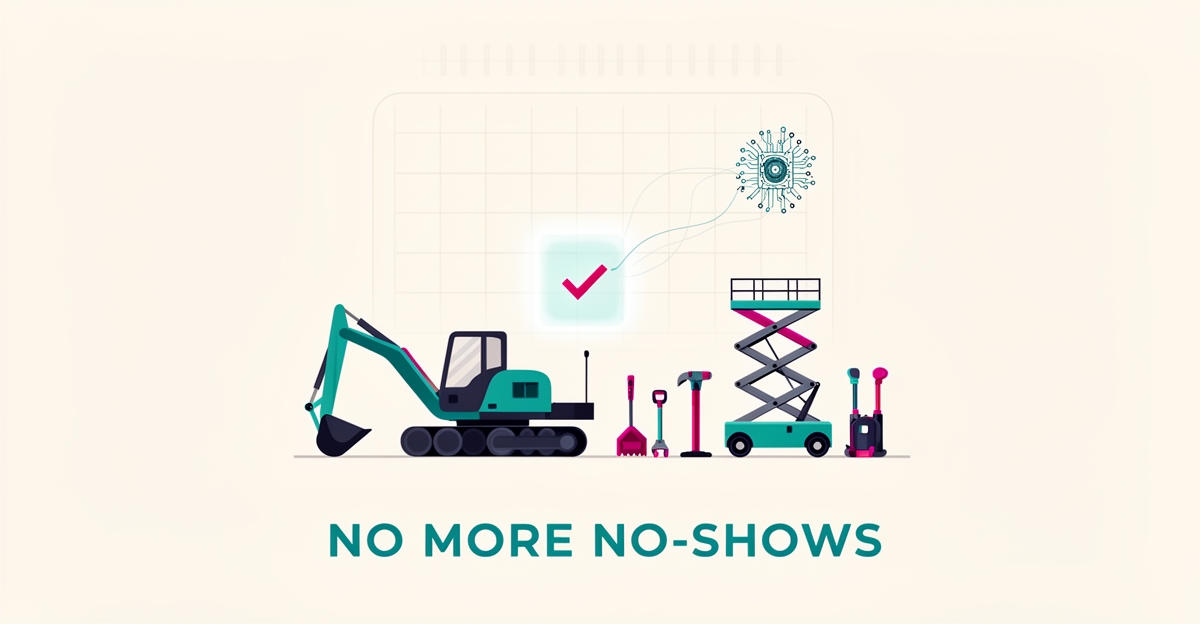
AI-Powered Booking Systems: How Equipment Rental Companies Can Reduce No-Shows
Key Facts
- AI booking systems analyze historical customer behavior to flag high-risk reservations days in advance, so staff can intervene before a cancellation happens rather than after.
- When a cancellation occurs, automated waitlist matching can instantly offer the vacated slot to waitlisted customers, preventing idle equipment and lost revenue.
- Personalized reminders sent through each customer's preferred channel (SMS, WhatsApp, email) consistently outperform generic, fixed-time blasts across service industries.
- Healthcare deployments of predictive booking AI — the closest analogue to rental scheduling — have reported no-show reductions in the range of 40% in documented case studies, though results vary by operation.
- Structuring inventory data as machine-readable (price, duration, availability) enables AI agents to book equipment from natural language queries like "I need a drill for Tuesday."
- The strongest deployments are hybrid: AI handles routine scheduling and follow-ups while staff focus on high-value customer interactions and relationship building.
Hire a team member that works 24/7 — for less than a part-time wage.
AI receptionists, SDRs, dispatchers and 99+ roles. Trained on your business, fully managed.
Not sure where to start? Ask our AI planner
Why Traditional Booking Systems Fail Equipment Rentals
Every empty rental slot tells the same story: a customer who booked with good intentions, then simply never showed up. For equipment rental companies, those missed pickups and forgotten reservations translate directly into idle inventory, wasted staff time, and revenue that quietly disappears.
The root of the problem lies in how traditional booking systems operate. Most rely on static, rule-based reminders — a generic SMS or email sent at a fixed time before the reservation. These systems depend entirely on customer memory and goodwill, with no ability to detect who is actually at risk of not showing. When a cancellation does occur, staff must manually chase replacements, and the slot often sits empty.
The cost of this reactive approach adds up in ways most operators never fully measure. Service businesses that have audited their scheduling data routinely find significant quarterly losses tied to missed appointments and manual follow-up — a pattern that mirrors what happens when rental bookings live in disconnected spreadsheets and calendars. Staff hours vanish into follow-up calls and "chasing," leaving less time for the customer interactions that actually build loyalty.
Traditional systems fail on three specific fronts:
- Static reminders treat every customer identically, ignoring behavior patterns like last-minute cancellations or forgotten reservations that signal elevated risk.
- Manual follow-ups consume staff capacity, turning scheduling coordinators into full-time reminder senders instead of revenue contributors.
- Cancellations leave permanent gaps, because there is no mechanism to instantly match waitlisted customers to vacated slots.
The contrast with modern approaches is striking. Documented deployments in adjacent scheduling-heavy industries — healthcare being the most studied — have reported no-show reductions around 40% after moving from manual reminders to agentic AI that learns individual behavior and preferred communication channels. The consistent theme across these cases is prediction and proactive intervention rather than generic notification blasts.
The lesson for equipment rental is clear: the booking system should not be a passive calendar. It should analyze who forgets pickups, predict which reservations are likely to fall through days in advance, and reach customers through the channels they actually use. AIQ Labs builds these systems as part of its AI Workflow Builds, integrating directly with your existing CRM and calendar tools so scheduling stops being an administrative burden and starts acting as an active operational manager. The technology exists today — the question is whether rental operators keep absorbing preventable losses or close the gap.
How Agentic AI Reduces No-Shows Through Prediction and Personalization
Agentic AI transforms booking systems from passive schedulers into proactive tools that anticipate and prevent no-shows. By analyzing historical customer behavior — past cancellations, preferred communication times, response patterns — these systems identify high-risk bookings days in advance. This predictive capability allows rental companies to intervene early with tailored nudges, significantly improving pickup rates. Deployments in scheduling-heavy industries like healthcare have reported no-show reductions in the 40% range after shifting from manual reminders to behavior-learning AI, though exact results depend on the operation.
The power of this approach lies in its personalization and timing. Instead of generic reminders sent at fixed intervals, agentic AI delivers messages via each customer's preferred channel — SMS, WhatsApp, or email — at the optimal moment based on their unique habits. When a cancellation does occur, the system instantly fills the slot by notifying waitlisted customers, keeping rental equipment utilized and revenue stable. This dynamic rescheduling ensures that last-minute changes don't result in idle inventory, turning potential losses into booked opportunities.
- Analyzes user behavior patterns to predict no-show risks days ahead
- Sends personalized reminders via preferred channels (SMS, WhatsApp)
- Automatically fills cancelled slots by notifying waitlisted customers
- Integrates with CRM and calendar tools for real-time synchronization
- Reduces staff workload by handling routine follow-ups and nudges
AIQ Labs builds these intelligent booking systems as fixed-price workflow builds — you keep full ownership of the technology, and payment is structured in milestones so you're never committed beyond the phase you've approved. The system continuously learns from new data, refining its predictions over time to become more accurate at preventing no-shows. This creates a self-improving loop where each interaction makes the system smarter, leading to steadily higher pickup adherence and better equipment utilization. By combining predictive analytics with personalized engagement, agentic AI doesn't just reduce no-shows — it turns booking reliability into a competitive advantage.
Implementing AI Booking: Integration, Workflow, and Human Oversight
The biggest mistake rental companies make with AI booking is treating it as a rip-and-replace project. In reality, the most successful deployments layer AI on top of the systems you already run — your CRM, your calendar, your communication channels — so nothing about your daily workflow has to change overnight.
Integration starts with connection. AI agents need to pull customer history from your CRM to personalize follow-ups and push confirmations directly into your calendar to prevent double-booking. In documented workplace deployments, AI systems have handled routine coordination end to end — recognizing visitor context, sending calendar invites and instructions, and flagging exceptions for humans without any manual steps. For a rental operation, that same logic means confirmations, reminders, and rescheduling flow through tools like Google Calendar, Outlook, SMS, and WhatsApp automatically.
Before any of that works, your inventory data has to be structured for machine readability. Rather than listing equipment as vague line items, break each offering into clear data points — price, duration, availability days — so an AI agent can understand and book a specific machine from a conversational query like "I need a drill for Tuesday." This matters because the booking journey is shifting: the start of the customer journey is increasingly a single prompt rather than a website visit, and companies whose inventory isn't machine-readable simply won't be bookable by AI agents.
A practical rollout typically looks like this:
- Define governance rules first — who owns the booking process, what triggers changes, and how modifications are logged.
- Structure equipment and availability data so AI agents can read and act on it.
- Connect the AI to your existing CRM, calendars, and communication channels via API.
- Enable predictive features: no-show risk scoring, preferred-channel reminders, and automatic waitlist matching when cancellations occur.
- Monitor no-show rates and adherence, then refine the models as new behavioral data accumulates.
Results from adjacent industries are instructive. Healthcare deployments of predictive booking AI have reported no-show reductions around 40%, with some clinics documenting large drops in missed follow-ups within the first two months of automating reminder workflows. The pattern translates directly: predictive intervention beats generic, fixed-time SMS blasts every time.
One caution deserves emphasis: AI should not replace human judgment. AI excels at automating routine scheduling and identifying open time blocks, but it lacks the judgment needed to prioritize based on urgency and strategic goals. The winning model is hybrid — AI handles the busy work of confirmations, reminders, and slot-filling, while your staff focus on high-value customers and relationship building. AIQ Labs designs systems with exactly this division of labor in mind, whether that's an AI receptionist or dispatcher absorbing routine admin, or a full AI operating system connecting scheduling to the rest of your operation — so your team spends its time where it actually generates revenue.
Still paying for 10+ subscriptions that don’t talk to each other?
We build custom AI systems you own outright. No vendor lock-in. Full control.
Not sure where to start? Ask our AI planner
Frequently Asked Questions
Why do generic SMS reminders keep failing for equipment rentals?
How much can an AI booking system actually reduce no-shows?
Will AI replace my scheduling team?
How does AI personalize reminders instead of blasting everyone?
Can AI automatically fill a slot when someone cancels last minute?
Do I have to rip out my CRM and calendar to use AI booking?
Turn Your Booking System Into a Revenue Protector
Every empty slot in your rental calendar represents more than a missed transaction — it is equipment sitting idle, staff time wasted on chasing confirmations, and revenue that simply evaporates. The pattern from adjacent industries is clear: replacing static reminders with predictive, personalized AI booking systems can meaningfully cut no-shows, while automatically backfilling cancellations from waitlists and syncing with your existing CRM and calendar tools. The path forward does not require ripping out your current infrastructure. Start by auditing your last quarter's no-show rate to establish a baseline, then layer intelligent automation on top of the systems you already use. If you are ready to close the gap between bookings and actual pickups, AIQ Labs can help — whether that's rebuilding your booking workflow as a fixed-price Workflow Build or staffing the front line with an AI dispatcher or receptionist. Begin with the two-minute Fit Check at https://aiqlabs.ai/apply to see if a custom AI booking solution makes sense for your operation, or book a free 30-minute strategy call to map out your highest-ROI automation opportunities.
Make AI your competitive advantage — not just another tool.
Strategy, implementation and ongoing optimization. One partner, end to end.
Not sure where to start? Ask our AI planner