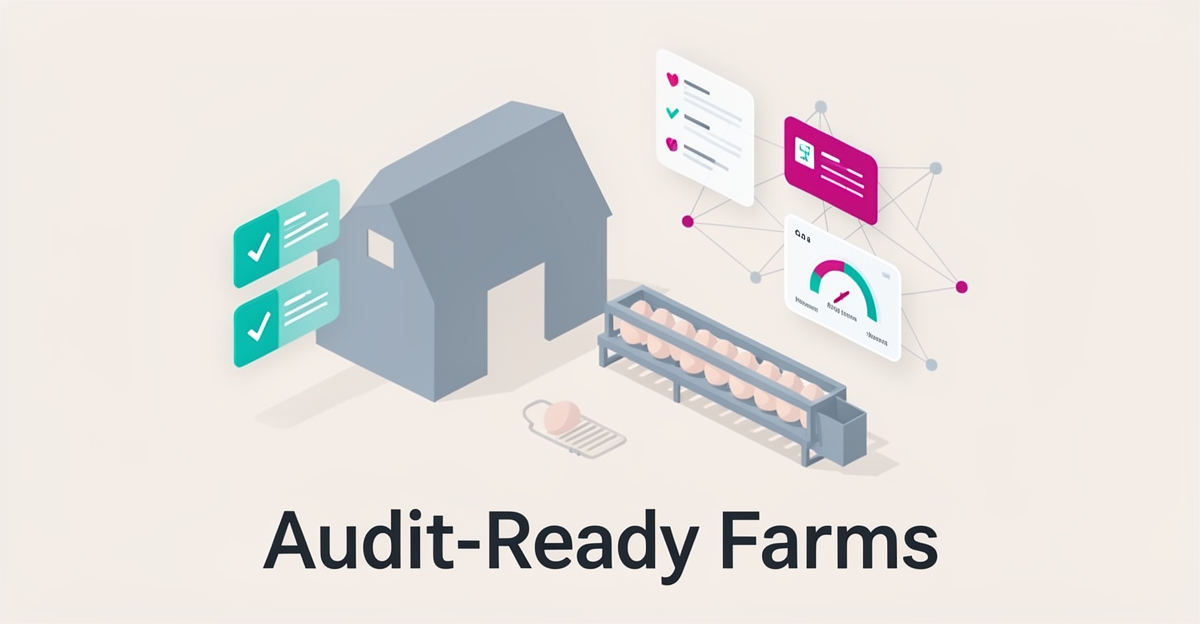
AI-Powered Compliance & Record Keeping for Poultry Farms in Regulated Markets
Key Facts
- Compliance research suggests manual processes are significantly less accurate than AI-assisted reporting, with AI systems commonly cited at up to 95% accuracy according to compliance research
- Regulatory change volume has grown to the point where human-only tracking is impractical for most operations per compliance monitoring analysis
- The cost of non-compliance is widely reported in the millions per year, with data breaches adding millions more per incident based on compliance cost research
- AI-assisted audits are reported to shrink audit cycles from roughly two weeks to a few days while expanding coverage without added headcount per generative AI compliance implementation guide
- Field trials of integrated poultry intelligence platforms have demonstrated near-perfect egg-count accuracy on edge devices confirmed by PoultryFI research
- AI-powered poultry platforms have reported meaningful feed waste reductions through automated anomaly detection per commercial deployment case study
- Manual filing errors are cited as a leading driver of compliance violations according to compliance monitoring research
Hire a team member that works 24/7 — for less than a part-time wage.
AI receptionists, SDRs, dispatchers and 99+ roles. Trained on your business, fully managed.
Not sure where to start? Ask our AI planner
The Compliance Crisis: Manual Records vs. Regulatory Reality
Poultry farmers operate on thin margins, yet manual record keeping makes it hard to catch FCR spikes, mortality risk, water-intake drops, or feed waste early. Stricter welfare and environmental mandates now collide with paper-based systems that are time-consuming, prone to human error, and inherently lacking indicators of emerging problems. This double-bind leaves producers reactive when regulators demand proactive, auditable proof.
Compliance research suggests manual processes fall well short of AI-assisted reporting accuracy, with AI systems commonly cited at up to 95%. Meanwhile, the sheer volume of regulatory change across regulated industries has made human-only tracking impractical. And the cost of getting it wrong is steep: non-compliance is widely reported to cost organizations millions per year, before counting the reputational damage of a failed audit.
- Paper logs miss early welfare signals that sensors catch in real time
- Human auditors cannot process the volume of modern regulatory change
- Manual filing errors are cited as a leading driver of compliance violations
- Audit cycles stretch to weeks when they could take days
Field trials of integrated poultry intelligence platforms have demonstrated near-perfect egg-count accuracy on edge devices and forecasting windows of roughly 10 days ahead, turning record keeping from a compliance burden into an operational advantage. PoultryFI research confirms that multi-sensor AI replaces isolated inspections with continuous monitoring, while commercial deployments report meaningful feed waste reduction through automated anomaly detection. AIQ Labs applies this same architecture — combining computer vision, predictive forecasting, and compliance-first audit trails — to help farms shift from reactive filing to continuous, verifiable compliance without adding headcount.
How AI Transforms Compliance from Reactive Filing to Continuous Intelligence
The traditional model of compliance in poultry farming relies on sporadic inspections and manual documentation, creating dangerous blind spots where violations can fester undetected. This reactive approach struggles to keep pace with evolving food safety and animal welfare regulations, leaving farms vulnerable to costly penalties and reputational damage. Modern AI platforms transform this paradigm by enabling continuous, automated monitoring that generates auditable records in real time.
The PoultryFI platform exemplifies this shift through its six-module architecture designed for edge deployment. It integrates camera placement optimization, audio-visual monitoring, analytics and alerting, real-time egg counting, production forecasting, and prescriptive recommendations into a unified system. Field trials validated near-perfect egg-count accuracy on Raspberry Pi 5 hardware and demonstrated the ability to forecast egg yield and feed consumption roughly 10 days in advance, providing actionable intelligence before issues escalate. These capabilities eliminate the guesswork and latency inherent in paper-based logging or periodic checks.
By automating critical tracking functions, the system creates a continuous stream of compliant, traceable data without manual intervention. Every egg count, environmental reading, and anomaly detection is timestamped and stored, forming an immutable audit trail that satisfies regulatory requirements for record retention and traceability. This shifts compliance from a burdensome, error-prone task to a source of operational intelligence, where data not only proves adherence but also drives proactive improvements in flock health and productivity. The result is a self-documenting farm where readiness for inspection is constant, not episodic.
Automating the Audit Lifecycle: From Prep to Retention
AI compresses the audit lifecycle from a stressful, weeks-long scramble into a streamlined, continuous process. According to recent compliance research, organizations using AI have reported shrinking audit cycles from roughly two weeks to a few days while expanding audit coverage without adding headcount.
This acceleration stems from automating the documentation pipeline that traditionally bogs down poultry operations. Rather than scrambling to compile feed logs, health records, and biosecurity checklists when inspectors arrive, AI systems generate audit-ready reports continuously. Industry analysis suggests AI can cut manual effort in evidence collection and documentation dramatically — often by as much as 90% — eliminating the days typically spent gathering paperwork.
Real-time anomaly detection transforms food safety monitoring from reactive to proactive. Research on integrated poultry farm intelligence demonstrates that AI platforms can identify FCR spikes, mortality risks, and water-intake drops immediately, rather than discovering issues during scheduled inspections. These systems provide continuous oversight that satisfies stringent biosecurity and welfare standards while creating automatic audit trails.
Effective automation addresses the full audit lifecycle through several integrated capabilities:
- Automated documentation generation that compiles compliance reports from live operational data
- Real-time anomaly detection for immediate identification of food safety and biosecurity risks
- Structured evidence collection that sharply reduces manual gathering effort
- Continuous record updates that demonstrate active compliance management rather than stagnant paperwork
Structured record retention directly addresses what inspectors prioritize during facility reviews. As noted in poultry audit preparation guidelines, first impressions matter significantly, and quality management systems must show consistent updates to prove procedures are evolving rather than static. AI maintains these living records automatically, ensuring every entry is timestamped, traceable, and immediately retrievable.
AIQ Labs builds compliant, auditable AI systems for regulated agricultural environments through AI Workflow Builds — rebuilding the one workflow that costs you the most, at a fixed price and in phases. By treating compliance as an automated byproduct of daily operations rather than a periodic emergency, poultry farms maintain inspection readiness year-round while freeing staff to focus on flock welfare and production quality.
Implementation Roadmap: From Pilot to Owned AI Operating System
Moving from pilot to production requires a deployment path that respects both regulatory rigor and operational reality. Organizations that skip data governance end up with AI models that produce unreliable compliance recommendations — worse than having no AI at all. The alternative is a phased approach that validates accuracy at each stage before expanding scope.
- Start Monthly: Deploy a single AI Employee for compliance intake and monitoring — a managed AI staff member at roughly 80% less cost than a human hire, integrated into your existing farm management tools
- Build in Milestones: Automate department-level workflows for records and inspection prep with an AI Workflow Build — fixed price, paid per phase, and everything built is yours
- Own It Outright: Transition to a full AI Operating System — one connected operating layer built in phases and owned outright, with complete code ownership, audit trails, and human-in-the-loop controls
Targeted solutions deploy quickly and can shrink audit cycles from weeks to days while expanding coverage. AIQ Labs structures each phase around validation layers, guardrails, and complete audit logging. With 200+ multi-agent systems deployed, we know the pattern that works: validate a single workflow, prove the accuracy, then scale. The goal isn't just automation; it's an owned system that evolves with your regulatory landscape.
Still paying for 10+ subscriptions that don’t talk to each other?
We build custom AI systems you own outright. No vendor lock-in. Full control.
Not sure where to start? Ask our AI planner
Frequently Asked Questions
How much time can AI save on audit preparation for poultry farms?
Can AI really improve egg counting accuracy on poultry farms?
What feed waste reduction results have been seen with AI in poultry operations?
Is manual record keeping still viable given today's regulatory demands?
How soon can a poultry farm see results from implementing an AI compliance system?
Does AI create auditable records that regulators will accept?
From Compliance Burden to Competitive Advantage
The shift from paper-based compliance to AI-powered continuous intelligence represents more than operational efficiency — it fundamentally changes how poultry farms navigate regulated markets. Manual record keeping is slow, error-prone, and consumes weeks of audit preparation time; AI systems generate timestamped, immutable records continuously and have been shown to compress audit cycles dramatically while expanding coverage. Field trials confirm near-perfect egg-count accuracy on edge devices and roughly 10-day forecasting windows that turn reactive filing into proactive operational control. And the feed waste reductions reported in commercial deployments prove compliance infrastructure can simultaneously drive profitability. AIQ Labs applies this same architecture — combining computer vision, predictive forecasting, and compliance-first audit trails — to help farms maintain inspection readiness year-round without adding headcount. The implementation roadmap starts with a single AI Employee for compliance intake and monitoring, then scales through phased milestones to a fully owned AI Operating System with complete code ownership and human-in-the-loop controls. Ready to see where automation delivers the fastest return? Start the two-minute Fit Check at aiqlabs.ai/apply for a free 30-minute strategy call — no obligation, just clarity on your highest-impact opportunity.
Make AI your competitive advantage — not just another tool.
Strategy, implementation and ongoing optimization. One partner, end to end.
Not sure where to start? Ask our AI planner