AI-Powered Compliance Tracking: How Contractors Stay Ahead of Safety and Permitting Rules
Key Facts
- AI-powered compliance tools typically handle workloads in minutes to hours versus days or weeks manually, according to compliance automation research.
- Industry reporting suggests AI can reach roughly 95% accuracy in compliance reporting versus around 60–70% for manual processes per industry analysis.
- Companies using AI-driven compliance tools have reported productivity gains of around 35% according to industry research.
- Data breaches remain expensive — recent industry analyses put the average cost in the millions of dollars, a hit few mid-sized contractors could absorb per data privacy research.
- Construction is widely cited as responsible for nearly 40% of global emissions according to industry analysis.
- US construction productivity has improved only modestly over the past two decades per industry analysis.
- Project delays continue to cost the construction sector billions of dollars annually according to industry analysis.
Hire a team member that works 24/7 — for less than a part-time wage.
AI receptionists, SDRs, dispatchers and 99+ roles. Trained on your business, fully managed.
Not sure where to start? Ask our AI planner
The Compliance Bottleneck: Why Manual Tracking Fails Construction Firms
A single missed permit deadline can stall a project for weeks, trigger fines, and damage a contractor's standing with inspectors and clients alike. Yet most construction firms still rely on spreadsheets, email reminders, and paper files to manage exactly these high-stakes obligations.
The cost of that approach is significant. Industry analysis suggests US construction productivity has improved only modestly over the past two decades, and project delays continue to cost the sector billions of dollars annually. Manual compliance tracking is a quiet contributor to both.
Consider what contractors are juggling by hand:
- Permit deadlines that vary by municipality and shift with each project site
- Safety inspection schedules and documentation across multiple crews
- Certificate of insurance (COI) renewals for every subcontractor on the books
- Building code adherence records that auditors and owners may request at any time
When any one of these slips, the consequences compound quickly. Research on compliance reporting suggests manual processes achieve roughly 60–70% accuracy, while AI-powered systems can reach around 95%. That gap translates directly into fines, rework, and failed audits for firms tracking compliance by hand.
The stakes extend beyond individual projects. Construction is widely cited as responsible for nearly 40% of global emissions, which means regulators are tightening environmental and permitting requirements rather than loosening them. Firms relying on reactive, manual tracking find themselves scrambling to keep pace with an evolving rulebook.
Meanwhile, labor shortages make the problem worse. Skilled compliance-focused staff are scarce, and asking project managers to spend hours reconciling insurance certificates or chasing permit status pulls them away from the work that actually moves projects forward. Compliance industry observers note that staying competitive now requires adopting tools that incorporate AI and predictive analytics — the same workload that takes days or weeks manually can often be handled in minutes to hours.
The pattern is clear: manual compliance is a structural bottleneck, not just an administrative annoyance. It caps productivity, invites risk, and consumes the very labor the industry cannot spare. That's why firms are turning to AI-driven compliance workflows that monitor permit deadlines, safety documentation, and COI renewals in real time — an approach AIQ Labs builds for regulated construction firms through its AI Workflow Builds, replacing scattered spreadsheets with automated, auditable tracking. Companies adopting AI-driven compliance tools have reported productivity gains of around 35%, a head start their manually operated competitors cannot easily match.
How AI Transforms Compliance: Speed, Accuracy, and Proactive Risk Management
Manual compliance in construction means chasing paper trails across sites, spreadsheets, and email threads while deadlines slip. AI flips that model by turning scattered records into a real-time compliance layer that works continuously in the background.
Speed changes first. Compliance automation research shows AI-powered tools can typically handle the same workload in minutes to hours compared to days or weeks for manual processes. That compression matters when permit windows are narrow and inspections are scheduled with little notice.
Accuracy follows speed. Industry reporting on AI versus manual compliance suggests AI can achieve up to roughly 95% accuracy in compliance reporting, compared to around 60–70% for manual processes. Fewer transcription errors and missed renewals mean fewer fines and audit findings.
Productivity gains are measurable. The same analysis notes companies using AI-driven compliance tools have reported productivity increases of around 35%. Teams spend less time reconciling documents and more time executing work.
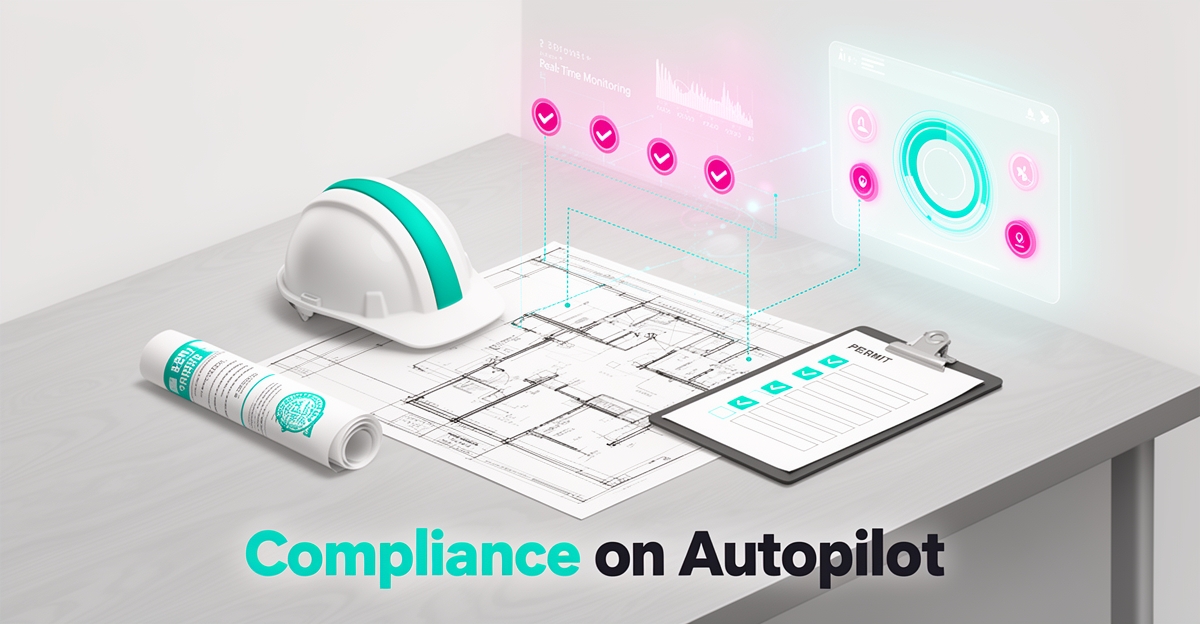
The shift from reactive to proactive is the core advantage. Instead of discovering a lapsed certificate or missed inspection after the fact, AI monitors permit deadlines, safety inspections, and compliance documents continuously.
- Real-time monitoring of permit expirations and renewal triggers
- Automated tracking of safety inspections and corrective actions
- Centralized compliance document management with alerts before deadlines
- Proactive risk flagging based on historical data patterns
This proactive stance reduces exposure. Construction firms face project delays costing billions annually and rising regulatory complexity, making early risk detection essential.
Manual processes are inherently reactive. Teams review logs after incidents, chase missing paperwork during audits, and rely on memory for upcoming deadlines. AI systems invert that by scanning data streams, comparing them to code requirements, and surfacing gaps before they become violations.
Risk management moves from reactive to proactive when monitoring is continuous rather than periodic. Real-time dashboards give project managers immediate visibility into compliance status across multiple sites.
Integration is key for regulated construction firms. AIQ Labs connects these capabilities into AI-driven compliance workflows that monitor permit deadlines, safety inspections, and compliance documents in real time — whether as a single rebuilt workflow or as part of a broader AI Operating System connecting your project, accounting and field data.
The result is a compliance posture built on speed, accuracy, and foresight rather than scramble and remediation.
Critical Implementation Challenges: Data Security, Integration, and the Trust Factor
Adopting AI for compliance tracking introduces real hurdles that contractors must navigate carefully. Data security stands out as a top concern — recent industry analyses put the average cost of a data breach in the millions of dollars, a figure that can devastate mid-sized construction firms. Protecting sensitive permit data, safety inspection records, and worker information requires robust encryption, access controls, and continuous monitoring — capabilities that should be built into any AI compliance system from the ground up, and are standard in AIQ Labs builds.
Integration with existing construction management systems presents another practical challenge. Many firms rely on legacy project management, accounting, or scheduling tools that weren't designed to connect with modern AI platforms. Successful implementation demands deep technical expertise to create seamless data flows without disrupting daily operations. AIQ Labs builds AI agents that work within your current workflows rather than replacing them entirely, so crews keep the tools they know while the compliance layer runs behind them.
Perhaps the most subtle yet critical challenge is avoiding the "surveillance trap." As noted by industry leaders, micromanagement creates compliance. Trust creates ownership. When AI tools focus excessively on tracking individual activity rather than outcomes like permit adherence or safety incident reduction, they erode morale and productivity. The most effective compliance AI systems prioritize proactive risk identification and audit readiness, using data to support teams—not scrutinize them—thereby reinforcing a culture where safety and compliance become shared goals, not enforced obligations.
Deploying AI Compliance: A Phased Approach for Regulated Contractors
Regulated contractors implement compliance tracking best through a structured, phased approach that minimizes risk and builds internal capability. The process begins with identifying specific pain points—such as permit deadline tracking, safety inspection scheduling, and certificate of insurance renewals—where manual processes create bottlenecks and exposure to fines. Industry research indicates AI-powered compliance tools can typically handle the same workload in minutes to hours compared to days or weeks for manual processes, with reporting accuracy often approaching 95% versus roughly 60–70% for manual methods — efficiency gains that matter for construction firms facing tightening regulations and labor shortages.
Next, contractors assess integration requirements with existing tools like project management software, accounting systems, and document repositories. AIQ Labs evaluates your current technology stack to design seamless connections, ensuring AI agents can pull permit data from municipal portals, push safety inspection results to compliance dashboards, and flag COI expirations before they trigger work stoppages. This phase includes validating data security measures — breaches remain costly enough to sink a mid-sized firm — so robust protection for sensitive compliance information is essential. Data privacy research underscores that trust-preserving implementation is as vital as technical accuracy.
Finally, organizations establish governance frameworks with human-in-the-loop controls for high-stakes decisions like permit approvals or safety violation escalations. AIQ Labs embeds audit trails, role-based access controls, and configurable escalation paths so AI handles routine monitoring while qualified staff review exceptions—balancing automation with oversight to maintain employee trust and regulatory defensibility. Contractors can engage through flexible payment models: Start Monthly with an AI Employee handling compliance monitoring, Build in Milestones to automate permit workflows first, or Own It Outright for a full owned system. This approach ensures regulated contractors gain real-time compliance visibility without upfront risk, turning regulatory adherence from a cost center into a competitive advantage. Productivity studies show firms using AI-driven compliance tools have reported productivity gains of around 35%, directly reducing fines and audit exposure.
Real-World ROI: From Fines and Delays to Automated Efficiency
Construction firms using AI-powered compliance tools have reported productivity gains of around 35% by automating permit tracking, safety inspections, and documentation workflows, freeing teams to focus on high-value field work rather than administrative bottlenecks. According to industry research, these gains translate directly to faster project timelines and reduced labor overhead. AI systems can also compress administrative processing dramatically, turning what once took days into minutes or hours through real-time monitoring and automated alerts. SmartCompliance notes that this speed enables proactive risk management—identifying compliance gaps before they trigger fines or work stoppages.
- Preventing costly delays by flagging expiring permits or missed inspections days in advance
- Eliminating manual data entry errors that trigger rework or regulatory penalties
- Creating immutable audit trails that satisfy OSHA, local building authorities, and insurance auditors
- Cutting document processing and approval routing time through intelligent capture
- Scaling compliance oversight across multiple job sites without adding headcount
AIQ Labs has delivered this level of automation across 200+ multi-agent systems deployed for construction and regulated-sector clients, building custom compliance engines that integrate with project management tools, accounting systems, and field reporting apps. These systems ensure regulatory alignment while giving clients full ownership of their audit trails—no vendor lock-in, no black-box reporting. By embedding AI into core workflows, firms transform compliance from a cost center into a competitive advantage that protects margins and accelerates delivery.
Still paying for 10+ subscriptions that don’t talk to each other?
We build custom AI systems you own outright. No vendor lock-in. Full control.
Not sure where to start? Ask our AI planner
Frequently Asked Questions
How much more accurate is AI compliance tracking compared to spreadsheets and manual checks?
Will AI actually save my team time on permits and safety inspections?
Is construction compliance data safe with AI systems?
Does using AI for compliance feel like surveillance to crews?
Can AI help with productivity when we're short on skilled compliance staff?
Is AI compliance reactive like our current manual process?
From Scramble to System: Making Compliance a Competitive Edge
Manual compliance is a structural bottleneck for contractors, not just an administrative annoyance. Spreadsheets and email reminders create the missed permits, lapsed COIs and inspection gaps that drive fines, delays and audit risk, while pulling project managers away from work that moves projects forward. AI flips the model from reactive chasing to real-time monitoring, compressing days of paperwork into minutes, lifting reporting accuracy toward 95% versus roughly 60–70% manually, and enabling proactive risk flagging before violations occur. The shift also demands care around data security, legacy system integration and trust, with the best outcomes coming from outcome-focused monitoring that supports teams rather than surveilling them. For regulated construction firms, the next step is to map your highest-exposure workflows, validate integration points with existing project and document systems, and pilot continuous monitoring where delays cost the most. AIQ Labs builds AI-driven compliance workflows that monitor permit deadlines, safety inspections and compliance documents in real time for regulated contractors. Start the two-minute Fit Check at aiqlabs.ai/apply, then book a free 30-minute strategy call to map your biggest bottleneck and identify high-ROI automation opportunities.
Make AI your competitive advantage — not just another tool.
Strategy, implementation and ongoing optimization. One partner, end to end.
Not sure where to start? Ask our AI planner